
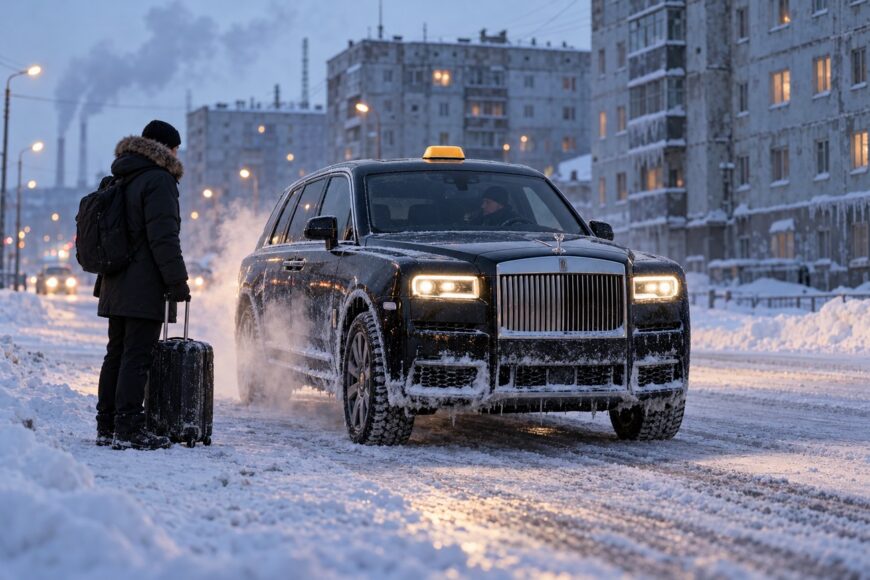
A hand-built luxury SUV and Vorkuta’s −40°F operating environment represent two very different engineering priorities. The Cullinan offers exceptional cabin comfort, quietness, and all-wheel drive, yet Arctic taxi service measures success by dispatch reliability, braking consistency, and recovery options.
The Cullinan’s V12, power, and passenger experience do not prove suitability for continuous taxi work in this climate. The central trade-off is clear: premium comfort may attract a limited clientele, while winter resilience, preparation time, tire damage, fuel use, and downtime determine whether the service remains operational.
- Can a Rolls-Royce Cullinan Work as a Vorkuta Taxi?
- What −40°F Does to a Luxury SUV and Taxi Schedule
- Winter Wheels: The Cullinan’s Biggest Practical Compromise
- AWD, Winter Tires, and the Myth of Effortless Arctic Traction
- The Hidden Taxi Costs: Damage, Cleaning, Downtime, and Backup Capacity
- A Minimum Operating Protocol for a Cullinan in Vorkuta
- Verdict: Arctic Luxury or an Expensive Showcase Taxi?
- Frequently asked questions
- What does 255/50R21 109H mean on a Cullinan winter tire?
- Why must Cullinan tire pressures be checked when the tires are cold?
- What should a Vorkuta operator do if the Cullinan will not start after an overnight −40°F stop?
- What documents should be checked before using a Cullinan commercially in Vorkuta?
Can a Rolls-Royce Cullinan Work as a Vorkuta Taxi?
The Cullinan has all-wheel drive, a 6.75-liter V12, and an 8-speed automatic transmission. In the early specification, output is approximately 563 hp and 627 lb-ft. That combination supports confident acceleration and effortless highway performance, while the high-grade cabin can make a long trip more comfortable for passengers.
Those specifications describe capability, not commercial suitability. A taxi spends hours exposed to repeated starts, short trips, idling, snow clearance, curb impacts, passenger loading, and contaminated roads. The practical test is whether the vehicle can repeat that cycle reliably, with predictable costs and a workable recovery plan.
Insufficient verified public data exists on regular Cullinan taxi operation in Vorkuta or its reliability there at −40°F. The absence of failure statistics does not prove that the vehicle will fail, but it prevents a responsible claim of proven Arctic durability.
A high purchase price also does not establish factory readiness for continuous commercial operation at −40°F. The Cullinan may serve as a carefully controlled premium vehicle, yet that is a narrower proposition than replacing a specialized winter taxi fleet.
What −40°F Does to a Luxury SUV and Taxi Schedule
−40°F is approximately −40°C. At that temperature, the battery, engine oil and other fluids, rubber components, electronics, sensors, seals, and door mechanisms face sharply higher demands. A vehicle that starts reliably in ordinary winter weather may require a different operating routine after an overnight stop at this temperature.
Starting reliability depends heavily on battery condition, parking protection, fluid suitability, and the time available for preparation. A failed start can remove the car from dispatch for much longer than the attempted start itself, especially if the vehicle must be warmed in a protected bay or recovered without damaging low-mounted components.
Snow, road chemicals, and ice can cover cameras and sensors, contaminate expensive trim, and interfere with doors and access points. Cleaning is therefore part of dispatch preparation. Sending the vehicle out with blocked cameras or frozen mechanisms creates a safety and service problem, regardless of the badge on the hood.
Passenger waiting adds another burden. Keeping the engine running for long periods increases fuel use and thermal load, although exact local Cullinan measurements are unavailable. Repeated idling also lengthens the time between inspections and increases the importance of a warm parking strategy.
A realistic schedule must include time for defrosting, clearing sensors, checking doors, inspecting tires, and confirming that the vehicle is ready to move. Treating the Cullinan like an ordinary short-haul taxi can turn one delayed start or frozen component into a dispatch failure.
Winter Wheels: The Cullinan’s Biggest Practical Compromise
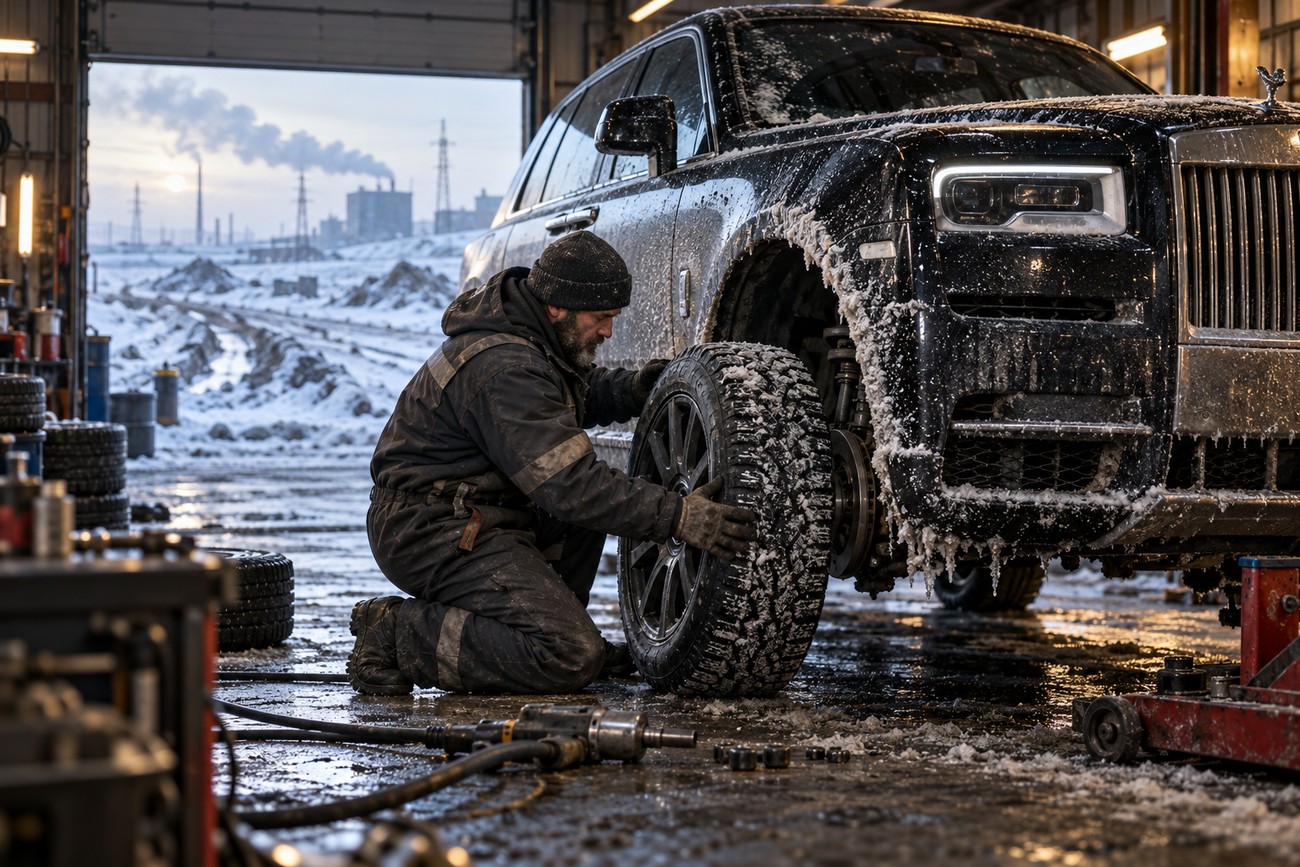
Cullinan wheel options span 21–23 inches. One 22-inch example uses 255/45R22 tires at the front and 285/40R22 at the rear, depending on configuration. These low-profile sizes support the vehicle’s road-focused character, but they leave less sidewall between an expensive wheel and Vorkuta’s frozen potholes, ruts, and broken edges.
Rolls-Royce offers narrower, higher-profile official winter wheels and states that they improve grip below 7°C. One official 21-inch winter example is 255/50R21 109H. The added sidewall can provide more impact protection and a more practical winter footprint, although it does not automatically fit every Cullinan configuration.
Every replacement setup requires a vehicle-specific check of tire size, load index, speed rating, pressure, wheel offset, and brake clearance. The fact that a tire is 21 inches does not establish compatibility. A 21-inch winter wheel may still be unsuitable for a particular brake system or configuration without confirmation.
For 255/50R21, one Michelin specification gives an example of 34 psi at the front and 42 psi at the rear. Those figures must not be transferred to another size or vehicle configuration. The vehicle placard and owner’s manual take priority, and pressures should be checked when the tires are cold.
Wheel damage is a commercial risk, not merely a cosmetic concern. An impact that might be routine for a conventional taxi can become an expensive wheel or tire repair when original components are costly and regional replacement logistics are limited.
AWD, Winter Tires, and the Myth of Effortless Arctic Traction
All-wheel drive helps the Cullinan pull away on snow and slippery surfaces. It distributes engine torque to improve traction during acceleration, which can make a departure feel controlled. It does not replace winter tires or guarantee shorter braking distances on ice.
Ice braking depends primarily on the tires, surface condition, speed, and ABS behavior. Engine power and AWD cannot create grip where the tire compound and tread cannot find it. Cornering stability is subject to the same physical limits, especially when the vehicle is carrying passengers and luggage.
Leaving a summer or performance tire fitted to avoid the cost of a separate winter set is an unsafe commercial compromise. Performance tires such as ContiSportContact 5, where specified, are not suitable for safe winter taxi operation, even if the vehicle has AWD and sophisticated electronic systems.
Pressure checks also require discipline. Measure the tires cold, before driving or after sufficient time for them to return to ambient temperature. A warmed-up tire gives a different reading, and adjusting from that reading can leave the vehicle incorrectly set after it cools.
The Hidden Taxi Costs: Damage, Cleaning, Downtime, and Backup Capacity
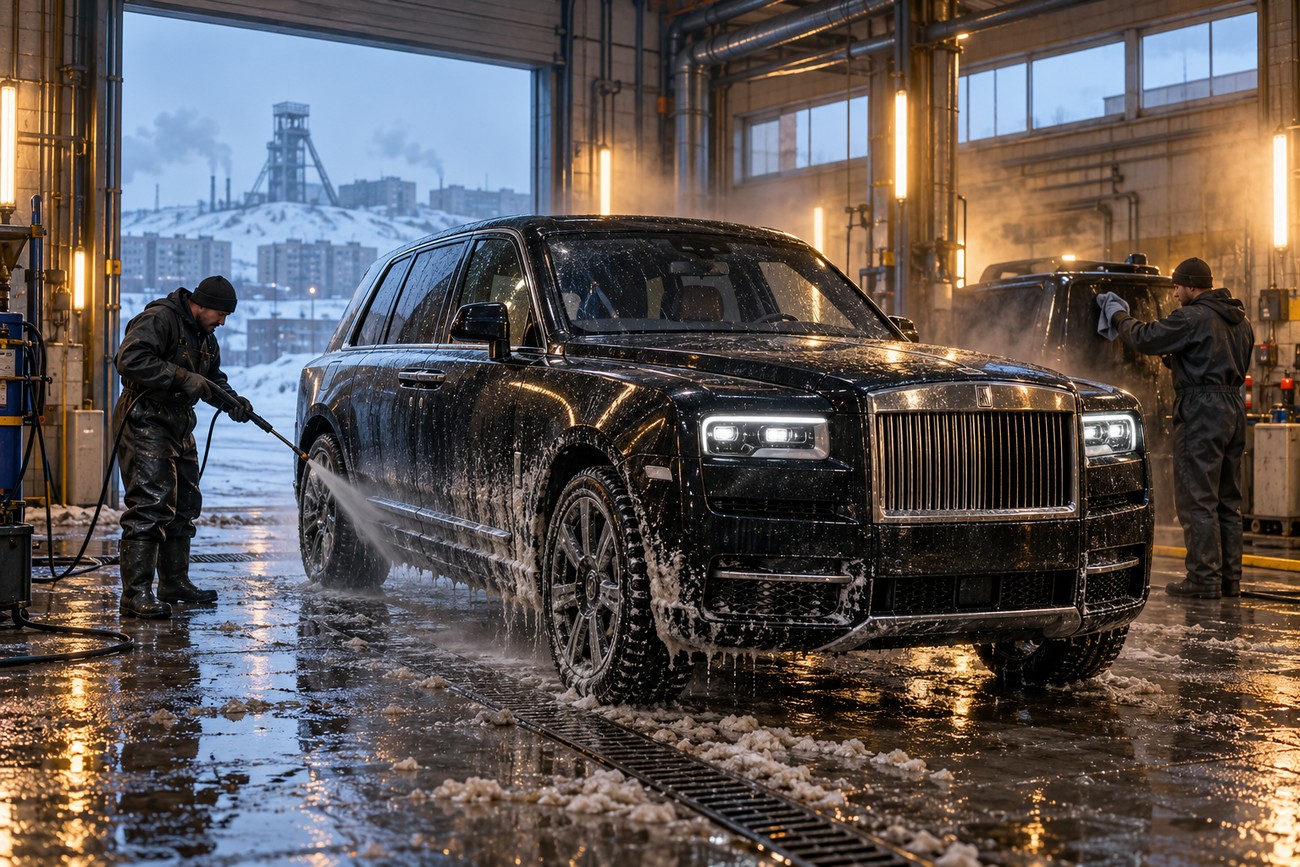
The purchase price is only one part of the operating equation. Original wheels and tires, specialist service, fuel, repeated washing, interior cleaning, battery support, and lost dispatch time can make Cullinan taxi work substantially more expensive than operating a purpose-built winter taxi.
Snow and road chemicals create recurring work beneath the vehicle and around its sensors, cameras, doors, and trim. Underbody washing helps control contamination, while careful cleaning protects equipment and finishes. Both activities consume labor and reduce availability compared with a simpler fleet vehicle.
A warm garage and controlled battery charging or monitoring may matter more in extreme cold than premium fuel or additives. The useful investment is the one that reduces failed starts and uncontrolled downtime. No public Vorkuta-specific failure statistics confirm how often Cullinan suspension, electronics, cameras, or battery systems fail in this climate.
Fleet planning must also account for capacity. A vehicle immobilized by a damaged wheel, frozen mechanism, or failed start needs a substitute or a recovery route. Without that fallback, the Cullinan’s premium positioning can become a liability because one unavailable car immediately affects a high-value booking.
A Minimum Operating Protocol for a Cullinan in Vorkuta
Every shift should begin with cold-tire pressure checks against the vehicle placard, followed by a visual inspection of the tread, sidewalls, wheels, lights, doors, and visible suspension components. Pressures vary by tire size and axle; the 34 psi front and 42 psi rear example applies to one 255/50R21 specification only.
Before dispatch, cameras and sensors should be cleared of snow, ice, and road film. Door operation, windshield visibility, and passenger access deserve the same attention. The vehicle also needs scheduled underbody cleaning, rather than waiting until contamination has accumulated around vulnerable components.
Parking should be protected whenever possible, with a warm-bay option and controlled battery charging or monitoring. The schedule must allow time for warming, defrosting, inspection, and cleaning. Repeated attempts to start a cold vehicle without a decision point can drain the battery and complicate recovery.
A documented failure plan should identify the recovery provider, safe warming method, replacement vehicle, and escalation process. Commercial operators must also verify local taxi authorization, insurance requirements, and vehicle-admission rules directly, because the available evidence does not confirm specific regional requirements.
Verdict: Arctic Luxury or an Expensive Showcase Taxi?
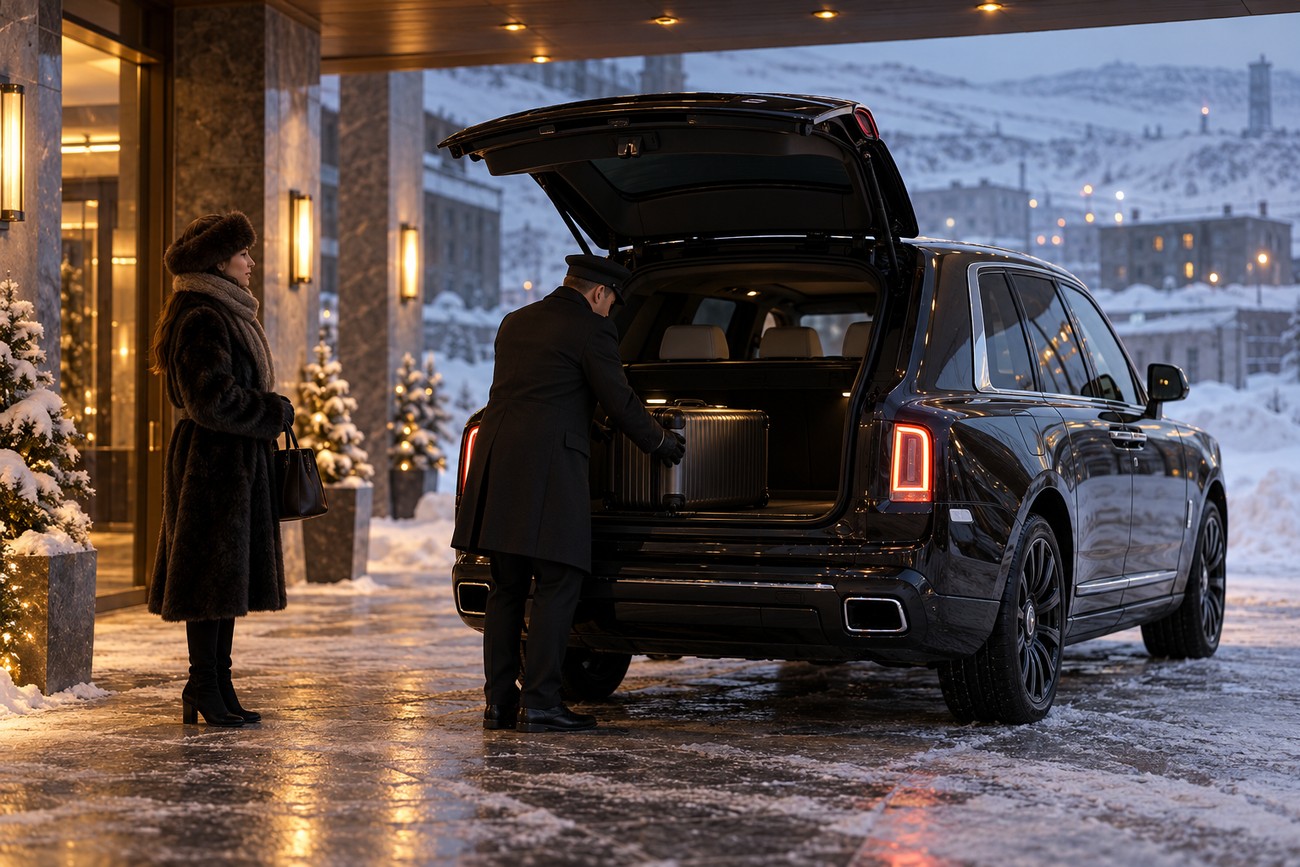
The Cullinan could make sense as a limited, premium, carefully controlled service. Its quiet cabin, luxury appointments, and all-wheel drive can create a distinctive passenger experience when bookings are scheduled, parking is protected, and a replacement plan exists.
High-frequency, unattended, cost-sensitive taxi work is a different use case. There, predictable braking, higher tire sidewalls, repairability, battery support, and recovery capacity matter more than maximum V12 output. Repeated exposure to potholes, snow, chemicals, idling, and long waits magnifies every operating weakness.
Official winter wheels are available on request, but regional availability, price, and delivery timing are unconfirmed. No publicly confirmed factory Arctic package for continuous Cullinan taxi operation at −40°F is established by the available evidence.
Winter tires and disciplined preparation improve the odds of dependable service, but they do not create Arctic certification or proven Vorkuta reliability. The Cullinan is better framed as a controlled premium service proposition than as a conventional high-utilization winter taxi.
Frequently asked questions
What does 255/50R21 109H mean on a Cullinan winter tire?
“255” is the tire width in millimeters, “50” is the sidewall height expressed as a percentage of that width, and “R21” identifies radial construction for a 21-inch wheel. “109” is the load index, while “H” is the speed rating. These markings describe more than wheel diameter, so a matching 21-inch size alone is insufficient.
The 255/50R21 109H example belongs to one winter setup. Before fitting it, the operator must confirm load capacity, speed rating, wheel compatibility, brake clearance, pressure requirements, and approval for the specific Cullinan configuration.
Why must Cullinan tire pressures be checked when the tires are cold?
Driving warms the tire and raises its internal pressure. A reading taken after a trip therefore does not represent the pressure available at the start of the shift, and correcting that warm reading can produce an incorrect cold setting.
Check all four tires before dispatch, using the vehicle’s placard and manual as the controlling references. Axle pressures can differ, and the 34 psi front and 42 psi rear example applies only to one Michelin specification for 255/50R21.
What should a Vorkuta operator do if the Cullinan will not start after an overnight −40°F stop?
Stop repeated starting attempts before the battery is depleted. Move the vehicle to protected warming if that can be done safely, use an approved battery-support procedure, and follow the manufacturer’s recovery guidance rather than adding improvised fluids or additives.
If the vehicle does not recover promptly, activate the documented recovery and replacement-vehicle plan. The car should return to service only after the cause of the failed start and the condition of the battery and fluids have been checked.
What documents should be checked before using a Cullinan commercially in Vorkuta?
Confirm the local authorization required for taxi operation, the insurance policy’s commercial-use terms, and the vehicle-admission or registration requirements that apply to the intended service. The exact regional rules should be obtained directly from the relevant authorities, insurer, and operating partners.
Keep those confirmations with the vehicle’s operating records, along with tire fitment information and maintenance documentation. Luxury equipment does not substitute for legal authorization or appropriate commercial insurance.







