
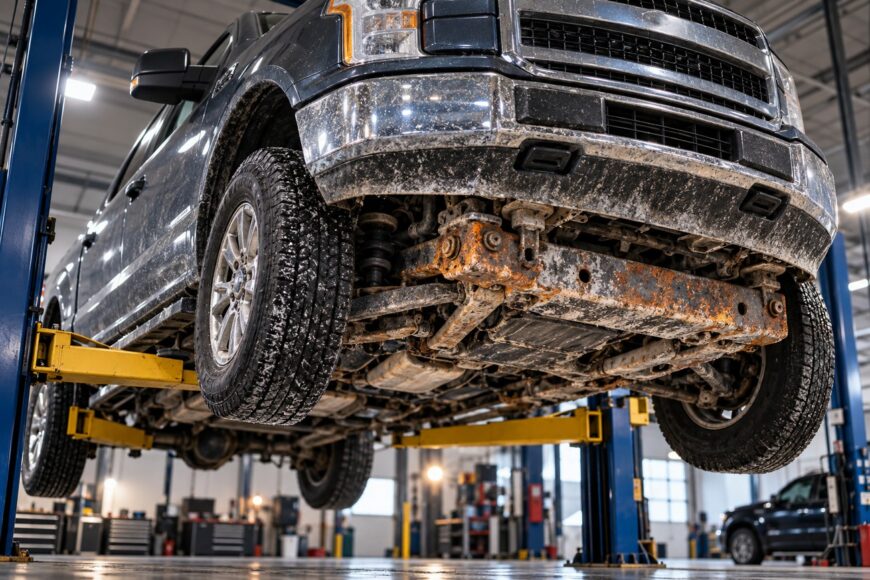
A Ford F-150 can look presentable even when road salt has damaged the frame, suspension mounts, brake lines, or fasteners underneath. That gap between body condition and underbody condition matters when you are deciding whether to keep driving, pay for repairs, or buy a used truck. A clean exterior and an uneventful test drive cannot establish that its load-bearing steel is sound.
The useful distinction is between light surface rust and metal that is deeply pitted, delaminated, cracked, or perforated. Color alone cannot tell you how much steel remains. A lift inspection should establish where the damage is, whether adjacent parts are affected, and whether a repair can be trusted before you commit to towing, structural work, or a purchase.
- Why Road Salt Rusts a Ford F-150 Frame
- Surface Rust or a Structurally Unsafe Frame?
- Where to Inspect an F-150 Frame for Hidden Rust
- What to Do Before You Buy or Keep Driving
- Repair, Coating, or Frame Replacement?
- VIN Recalls, Prevention, and the Final Decision
- Frequently asked questions
- What truck frame rusts the most?
- How can I inspect inside a boxed F-150 frame without opening it?
Why Road Salt Rusts a Ford F-150 Frame
Chlorides in road salt accelerate electrochemical corrosion of steel. A salty film can keep moisture against the metal after fresh water would have drained away, so damage can continue after a winter road looks dry. Road spray reaches the underside of the truck, including joints, mounting points, and areas that receive little attention during an ordinary wash.
Mud and abrasive debris make exposure harder to manage. They collect around ledges, drains, and brackets, holding salty moisture against the steel and wearing at protective coatings. Salt can also enter boxed or closed frame sections through openings, where cleaning and inspection are more difficult than on an exposed surface.
That does not mean every F-150 has internal frame corrosion. It means an outer wall that looks acceptable cannot, by itself, establish the condition of the section behind it. The concern is greater when a truck has spent years on salted winter roads, especially if dirt has been allowed to remain in drainage areas.
Exposure history can tell you more than mileage alone. A higher-mileage truck used in a salt-free climate may have a cleaner underbody than a lower-mileage truck that has seen repeated winters with de-icing salt. Use location and maintenance records to guide the inspection, then judge the actual metal on the vehicle.
Surface Rust or a Structurally Unsafe Frame?
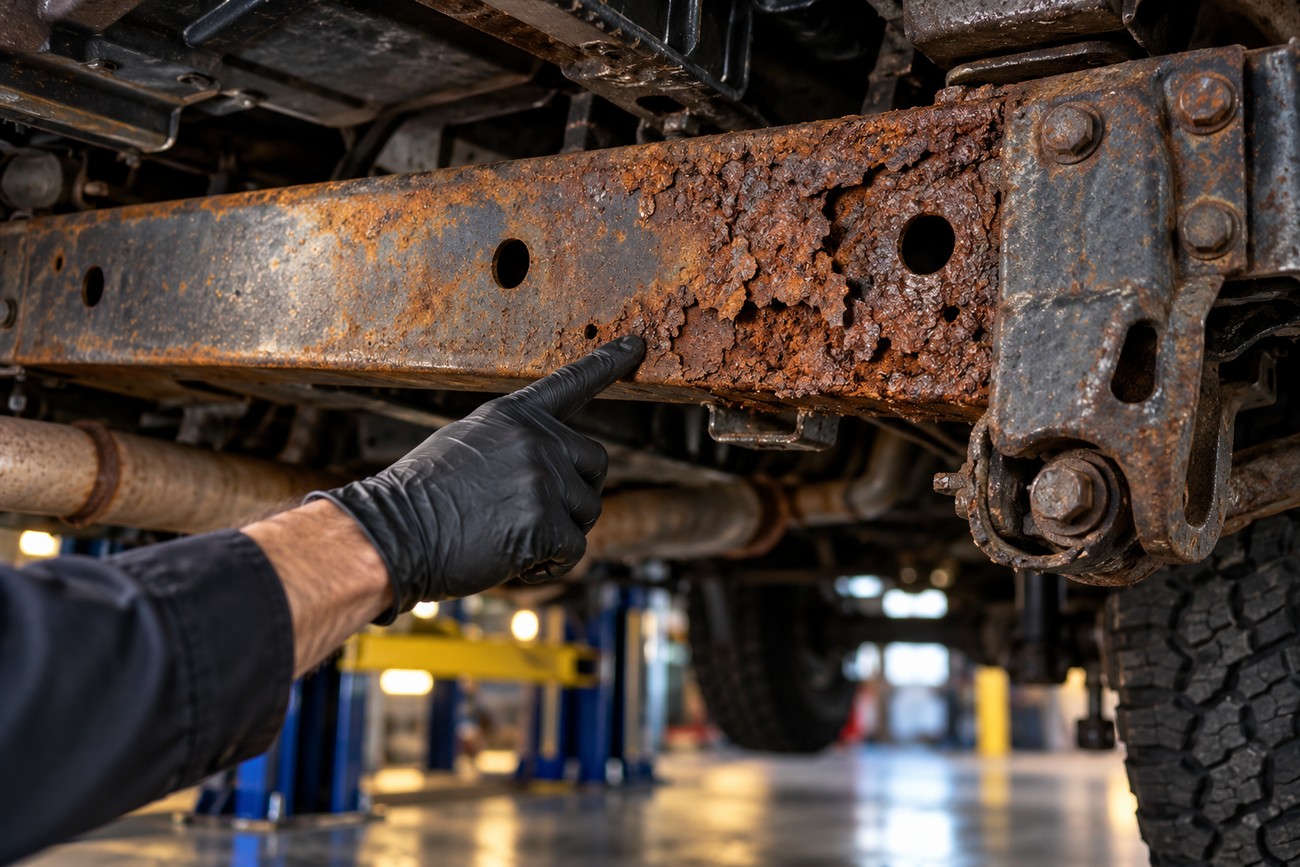
Light surface rust is staining or shallow oxidation on otherwise solid steel. It deserves cleaning and protection, yet its orange color does not automatically mean the frame has lost meaningful strength. The inspector still needs to see the edges, welds, and nearby attachments; a small visible patch can sit beside a more serious dirt trap.
Deep pits are a different finding because they represent metal lost from the section. Thick, loose, layered flakes—the “potato-chip” appearance sometimes described by buyers—raise concern about delamination or section loss. Scraping off those layers may reveal much less sound steel than the original outline suggests.
Cracks, holes, or metal separating around a weld or mounting point require prompt professional assessment. Deep pitting, layered flaking, cracks, and perforation can reduce the frame’s load-bearing capacity, particularly where suspension loads enter it. If a mount is weakened or a section has perforated, avoid relying on a normal-feeling drive as evidence that it is safe.
Fresh black paint or undercoating does not settle the question. It can conceal loose scale, a crack, or a previous patch, while a rusty-looking but solid area may need only corrosion control. Ask what was underneath the coating and have suspicious areas physically examined rather than accepting a color-based verdict.
There is no universal Ford allowance that says a given amount of frame rust is safe. The decision depends on remaining thickness, the construction and location of the damaged area, how far it extends, and applicable local inspection rules. A qualified assessment is more useful than a blanket claim that rust is either harmless or beyond repair.
Where to Inspect an F-150 Frame for Hidden Rust
Start on a lift at the spring and suspension mounts, where damaged steel affects how loads reach the frame. Look around brackets, welds, bolt heads, and the steel immediately beside each attachment. Corrosion around fasteners can complicate even a limited repair by making parts difficult to remove or leaving too little sound material for reassembly.
Follow both frame rails and the crossmembers, including sections near the transmission. Continue to the front supports and any areas where dirt sits against steel or drain openings appear blocked. Inspect more than the outward-facing wall: upper surfaces, inside corners, and the far side of a bracket can be difficult to see from below.
A bright light and mirror help reveal those angles; an endoscope can provide a partial view through an existing opening in a boxed section. A qualified inspector may carefully probe or tap suspicious areas and assess thickness where access permits. Aggressive poking by an owner can damage a thin section or nearby lines without producing a reliable structural verdict.
One owner has reported corrosion near the passenger floor and transmission crossmember. That report is a reason to inspect the area when accessible, not evidence of a standard failure location across F-150 model years. More useful than chasing a single reported spot is checking every mounting and debris-catching area on the particular truck in front of you.
What to Do Before You Buy or Keep Driving
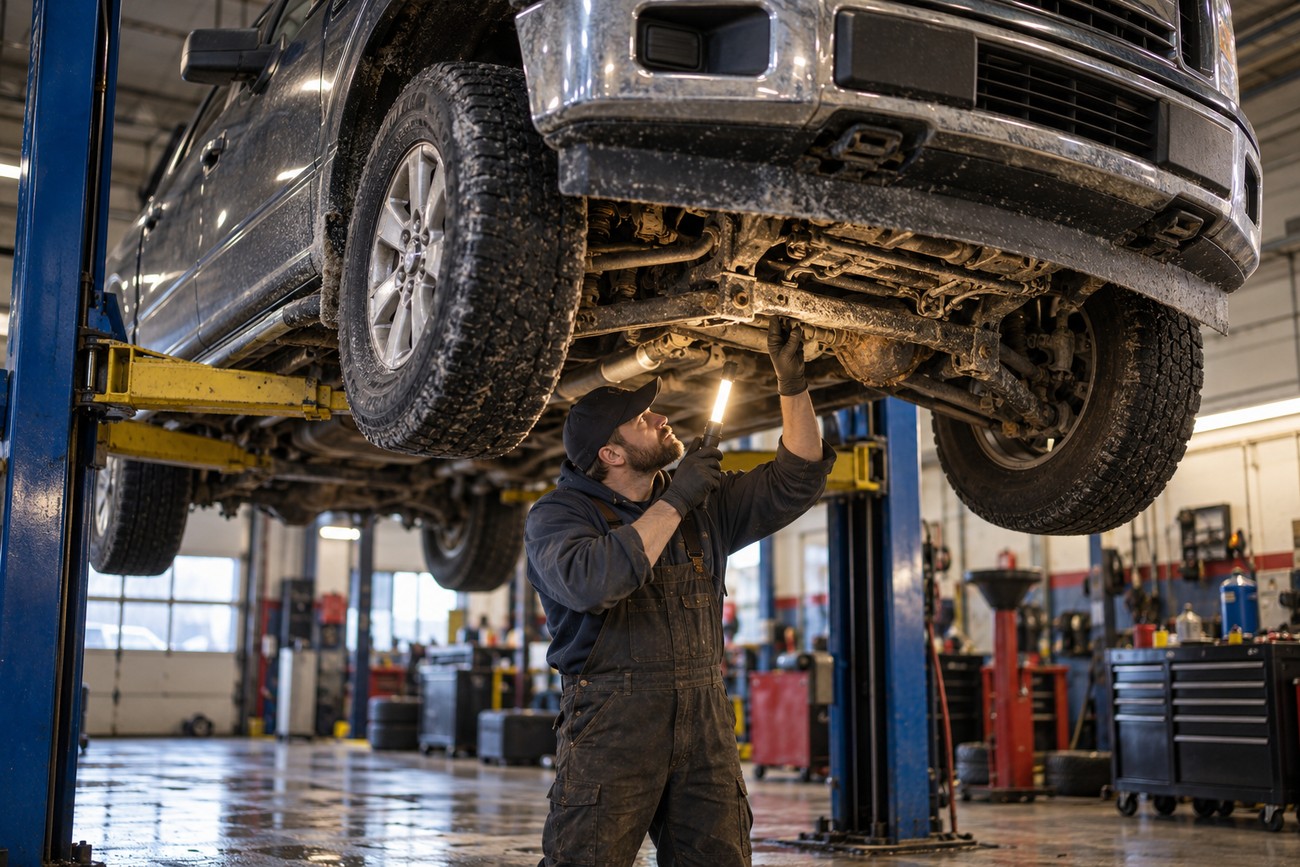
If you are buying, arrange an independent lift inspection before negotiating on a truck with a salted-road history. A quick drive can reveal how it handles, but it will not show hidden thinning inside a frame section. A clean bed, tidy paint, and fresh undercoating are no substitute for seeing the underside in good light.
Have the inspector record both structural findings and related repair needs. Brake lines, cables, fasteners, and suspension hardware may be badly corroded even when the main rails remain serviceable. That distinction matters: an acceptable frame can still come with substantial safety work and difficult, costly disassembly.
If you already own the truck, seek an assessment before towing or committing to cosmetic rust treatment when you find layered scale, a crack, a hole, or a weakened mount. Ask for photographs and a written account of which sections were checked and which could not be accessed. That gives you a sounder basis for deciding whether to drive, repair, or seek another opinion.
Do not treat an empty recall search as a corrosion clearance. Recalls address specific campaigns and VINs, while ordinary salt damage is a condition of the individual vehicle. Where several adjacent sections are weakened, the cost and uncertainty of restoring the truck may make walking away more sensible than approving one repair after another.
Repair, Coating, or Frame Replacement?
Cleaning and protective coating are reasonable measures for sound steel with light surface rust. Loose scale must be removed, and the metal underneath checked before it is covered. Paint or undercoating applied over delamination can hide a thin section, an old patch, or a crack; it cannot give lost thickness back to the frame.
Cracks, holes, and severe pitting call for evaluation by a qualified welder or engineer familiar with structural frame repairs. A credible repair plan identifies unsound metal to remove and establishes that the surrounding structure can support the proposed work. Simply welding a plate over the visible damage leaves its cause and extent unresolved.
Some shops decline heavily corroded frame work because they cannot stand behind the remaining structure. Ask whether a previous repair involved cutting out damaged metal, how the patch was joined, and whether nearby areas were inspected before they were coated. A neat-looking repair at one spot does not certify the rest of the frame.
Replacement may be worth evaluating when damage is extensive, though the condition of attached hardware and other underbody parts still affects the decision. With multiple weakened areas, repeated welding can leave you paying for successive failures rather than a dependable truck. If sound repair cannot be established, retiring the vehicle may be the safer choice.
VIN Recalls, Prevention, and the Final Decision
Ford recommends checking open campaigns using the truck’s VIN. As of October 18, 2026, Ford’s database listed safety campaign 26S28 for 2015–2017 F-150s. That listing alone does not establish a corrosion-related frame issue or coverage for a particular truck; confirm the campaign details against its VIN.
Eligible official recall repairs are performed free through a dealer. Recall status answers whether a particular campaign applies, not whether the frame, mounts, or brake lines are in good condition. Keep the VIN check and the physical inspection as separate parts of the decision.
For a sound frame, remove road salt from accessible underbody areas after winter exposure, paying attention to drains and dirt pockets. Allow cleaned areas to dry, and inspect the condition of coatings before applying new protection. Avoid forcing water into a cavity if it cannot drain; trapped moisture can work against the purpose of cleaning.
Prevention can limit further exposure, but it cannot reverse deep pitting or restore perforated steel. Base the final decision on the inspected condition of the frame and its attachments, the feasibility of a dependable repair, and the truck’s other corrosion-related needs. Treat a coating as maintenance, never as a substitute for that assessment.
Frequently asked questions
These comparisons and inspection methods can help you decide what evidence to request. Neither gives a pass-or-fail answer without assessing the individual truck.
What truck frame rusts the most?
There is no reliable universal ranking of truck frames that applies across climates and individual vehicles. Years of winter salt exposure, drainage, cleaning history, and the condition of boxed sections are more useful comparison points than a model name alone.
For a used F-150, compare the actual underbody findings from a lift inspection with its service and location history. A truck with less mileage is not automatically the safer purchase if it has spent more winters on salted roads.
How can I inspect inside a boxed F-150 frame without opening it?
Use existing drain or access openings where appropriate, with an endoscope and reflected light to examine reachable interior surfaces. A qualified inspector can also assess suspect steel thickness where the frame design and access allow. Do not drill new holes solely for an informal look without professional guidance.
These methods have limits: debris can block a view, and a camera cannot show every internal wall or prove its remaining strength. If exterior evidence suggests serious section loss but the interior remains inaccessible, record that uncertainty and get a structural assessment before relying on the frame.







