
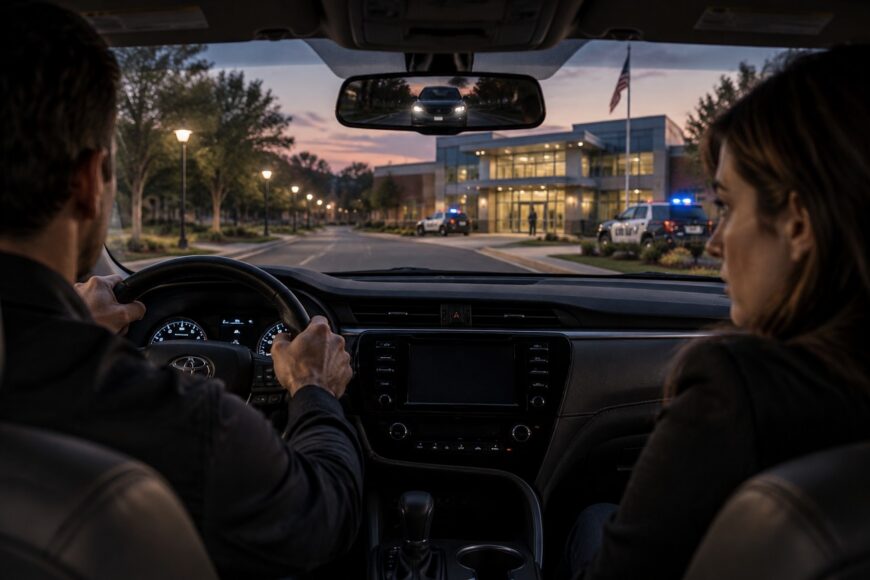
A driver who follows your Toyota Camry after a confrontation may be trying to identify your home address rather than simply continuing along the same route. Driving into your driveway can reveal your entrance, garage, apartment, or regular parking location.
Do not drive home or escalate the encounter. Keep control of the Camry, avoid contact, and head toward a staffed public-safety location or an illuminated, busy public place. Call 911 when the situation appears threatening, using hands-free operation or asking a passenger to call.
Toyota safety features may help with traffic hazards, but they do not protect you from a person who is following you. Your immediate safety depends on your destination, driving decisions, communication with the dispatcher, and keeping the vehicle secured.
- If a Road-Rage Driver Is Following Your Camry, Do This First
- Do Not Turn the Situation Into a Chase
- What Your Toyota Camry Can—and Cannot—Do
- Preserve Evidence Without Creating More Risk
- When You Reach a Safe Place, Do Not Go Home Yet
- Frequently asked questions
- What state is #1 for road rage?
- What is the #1 cause of road rage?
- What should you do if a road-rage driver follows you home?
If a Road-Rage Driver Is Following Your Camry, Do This First
- Keep driving toward the nearest police station, fire station, or illuminated, busy public place. Illinois State Police advise drivers who believe they are being followed to avoid going home and to call 911. Utah authorities give similar guidance, directing drivers toward police or fire stations or another busy public location.
- Secure the Camry while it is moving. Keep the doors locked and the windows closed. Avoid eye contact, gestures, signals, conversation, or any response that could encourage the other driver to stop beside you or follow more aggressively.
- Contact 911 as soon as practical. Use hands-free operation while driving, or have a passenger make the call. Tell the dispatcher your current location and direction of travel, then describe the pursuing vehicle’s plate, color, model, and distinguishing features.
- Continue toward help without creating a second emergency. Maintain a controlled speed, obey traffic signals where possible, and leave enough space to maneuver safely. If the other vehicle makes contact, blocks your path, or presents an immediate threat, give the dispatcher that information promptly.
Details may be difficult to remember under stress, so say the most useful facts first: where you are, where you are going, and what the other vehicle looks like. A passenger can note additional details while you keep both hands available for driving. Do not stop to write information down unless you have reached a safe location.
Do Not Turn the Situation Into a Chase
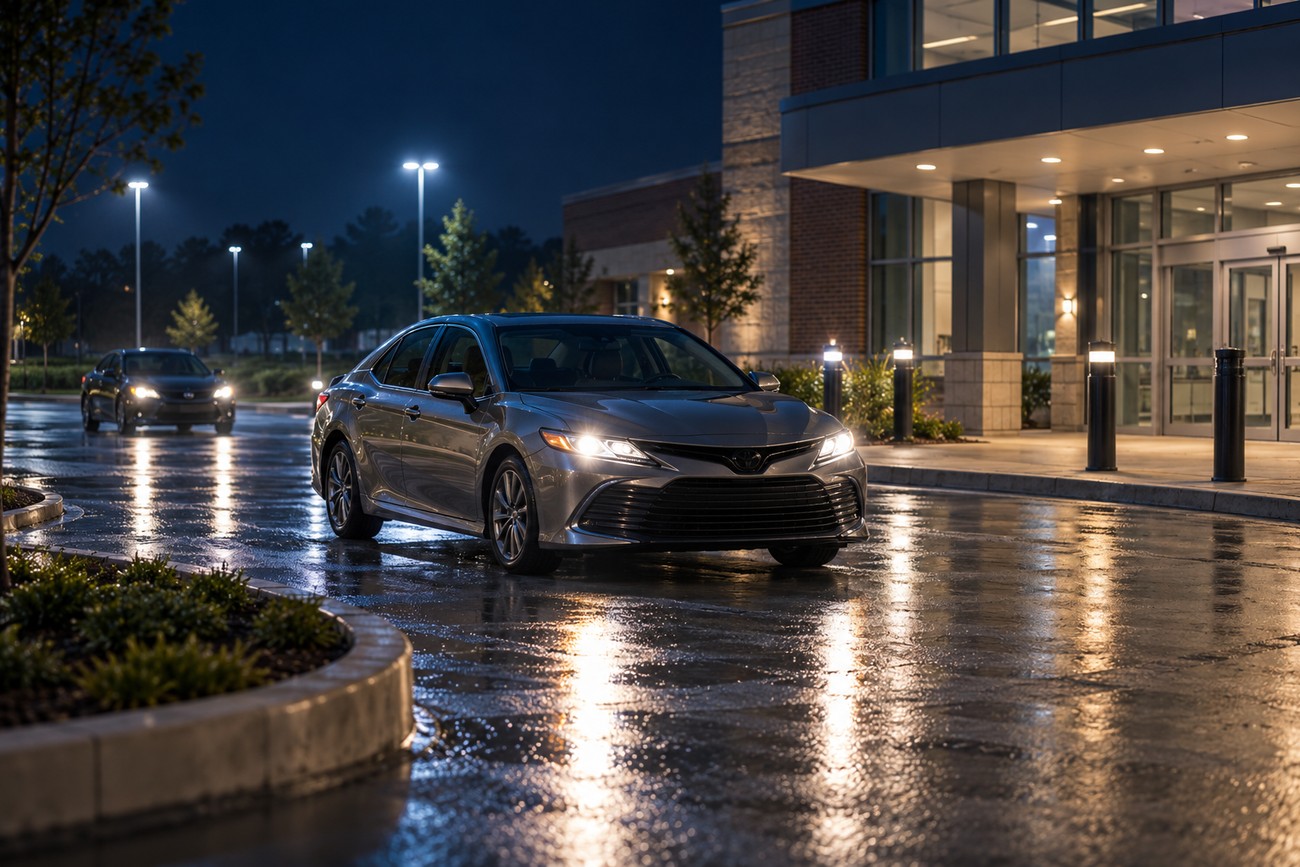
You do not need to prove the pursuit by making repeated turns. A driver may be following you, or the vehicles may share part of the same route, but uncertainty does not require a risky test. If the situation feels threatening, choose a police station, fire station, or busy, illuminated location and request help.
Driving directly home creates a clear exposure. The other driver may see your address, apartment entrance, garage, driveway, or usual parking space. Even if the vehicle disappears from your mirrors, arriving home can leave you outside the protection of a staffed public place.
A shoulder, empty gas station, or isolated parking lot provides fewer witnesses and fewer immediate sources of assistance. Exiting the Camry, opening a window, arguing, or using gestures can turn a driving dispute into a face-to-face confrontation. Keep the vehicle secured and continue toward help unless stopping is required by an immediate road hazard.
Speeding, abrupt lane changes, or trying to provoke a race can cause a separate crash. The safer objective is to increase distance through normal, controlled driving while contacting authorities. A pursuing driver’s behavior is outside your control; your task is to reduce opportunities for contact and reach people who can intervene.
What Your Toyota Camry Can—and Cannot—Do
Blind Spot Monitoring, Rear Cross-Traffic Alert, and the Pre-Collision System are driver-assistance features. They can support awareness of certain traffic risks under specified conditions, but they are not anti-pursuit systems and do not provide personal protection from another driver.
Parking assistance has similar limits. These functions work only under specified conditions and require you to maintain visual control of the surrounding area. Toyota warns against relying on parking assistance excessively, so an alert, camera view, or automated maneuver should never determine whether you remain near an aggressive person.
The Toyota Integrated Dashcam’s parking-recording behavior is also narrower than many drivers assume. A G-sensor-detected impact may activate parking recording, and the system may preserve up to 60 seconds after the impact, depending on the vehicle’s configuration and system conditions.
An approaching person or vehicle is not guaranteed to trigger that recording. Useful footage may be unavailable if there was no impact, the camera was disabled, storage was full, or the relevant event fell outside the camera’s viewing area. A front-facing camera may also miss a plate approaching from behind or traveling beside the Camry.
Use Toyota technology as supporting information after you reach safety, rather than as a reason to remain in danger. A warning light cannot assess the pursuing driver’s intentions, summon police, block a door, or prevent a confrontation.
Preserve Evidence Without Creating More Risk
After reaching a safe location, preserve the information you already have. A passenger may record video or note the pursuing vehicle’s plate while the Camry is moving, provided doing so is lawful and does not interfere with the driver. The driver should not handle a phone, photograph the other vehicle, or review footage while operating the car.
Write down or record a short spoken description as soon as you are safe: the plate, color, model, distinguishing features, direction of travel, route, and approximate location. Preserve original video files rather than relying only on edited clips or screenshots. If the Camry’s camera has stored an event, avoid deleting or overwriting the original file.
Drivers often remember the confrontation more clearly than the pursuing vehicle’s plate, direction, or exact location. A brief spoken description and the original files are usually more useful than risky phone handling during the drive.
Camera placement determines what evidence exists. A front-facing camera may capture the vehicle ahead while missing a plate behind or alongside the Camry. Recording may also be unavailable when there was no impact, the camera was off, storage was full, or the event was outside the viewing area.
Recording rules, reporting procedures, and the applicable offense vary by country, state, or region. Give the original material to local police and ask what information or reporting steps apply where the incident occurred. Avoid publicly posting identifiable footage before checking local legal and privacy considerations.
When You Reach a Safe Place, Do Not Go Home Yet
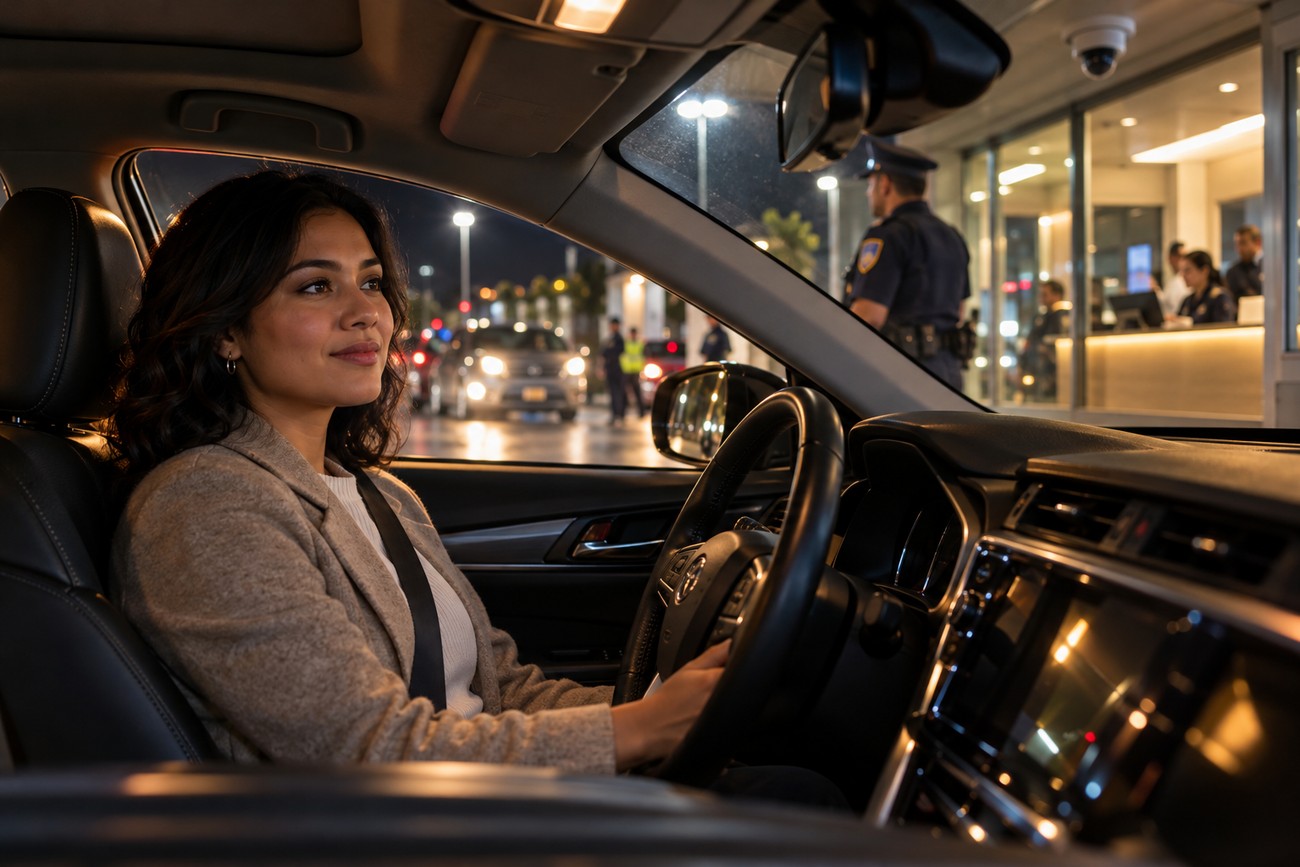
Remain inside the locked Camry after arriving at a safe location. Keep the windows closed, avoid contact with the other driver, and tell the dispatcher your exact position. A staffed location with lighting, cameras, and people who can summon help quickly is preferable to a quiet entrance or an empty lot.
Do not assume the danger has ended simply because the other vehicle is no longer visible. The driver may have stopped nearby, taken another entrance, or continued out of sight. Stay in the vehicle until authorities provide direction or the situation has clearly been assessed.
If a police station is closed or inaccessible, choose another staffed public-safety facility or a populated public location rather than waiting at an empty entrance. Update 911 with the new destination and remain in a position where help can reach you quickly.
Going home should be a later decision made after the immediate concern has been addressed. If the other driver is still present, follow dispatcher instructions and avoid leaving the Camry to inspect damage, confront the person, or open the door.
Frequently asked questions
What state is #1 for road rage?
There is no reliable universal number-one state for road rage. Results depend on the dataset, timeframe, and definition used: one study may measure reported incidents, another crashes or citations, and another survey responses.
Those measures describe different things and can produce different rankings. A state ranking also does not change the immediate response to being followed: avoid going home, seek a police station, fire station, or illuminated, busy public place, and contact 911 when necessary.
What is the #1 cause of road rage?
There is no single universally established number-one cause. Immediate triggers can include a perceived insult, blocked lane, close following, maneuvering dispute, or confrontation, while broader conditions may affect how a driver responds.
Because sources measure different events and use different definitions, an unsupported single-cause statistic should not guide safety decisions. Once a driver follows you, the priority is to avoid engagement and reach help, regardless of what started the disagreement.
What should you do if a road-rage driver follows you home?
Stay inside the locked Camry, keep the windows closed, and avoid opening the door or confronting the driver. Call 911 and give your exact location, the pursuing vehicle’s description, and any immediate threat. If you have not yet reached home, drive to a police station, fire station, or illuminated, busy public place instead.
If the vehicle is no longer visible, do not treat that alone as proof that the danger has ended. Remain in a staffed, monitored location until you receive guidance, and preserve any lawful video or vehicle details without handling a phone while driving. The suggestion to make four right turns is an informal user-discussion tip, not an official requirement or necessary test of pursuit.







