
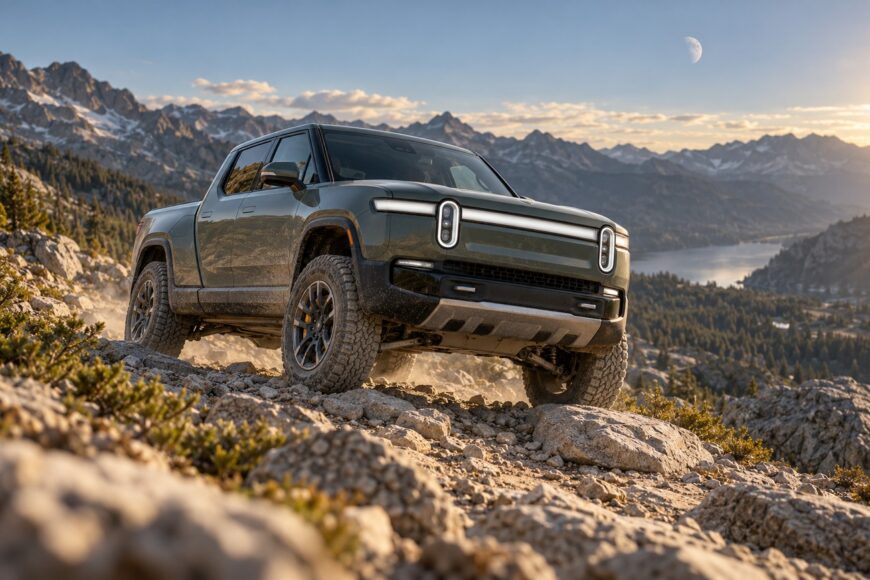
An electric truck starts a climb with a clear advantage: its motors can deliver strong torque immediately, with no gear changes to interrupt traction. That makes a Rivian R1T impressive on technical ground. The harder question is whether its tires, battery, seals, electronics, and cooling systems could function on the Moon at all.
This is a thought experiment, not an announced Rivian mission. Earth off-road reports can show how the R1T behaves on dirt and rock, but they cannot establish lunar capability. The Moon replaces familiar trail conditions with vacuum, abrasive regolith, severe temperatures, and a completely different wheel–soil problem.
- What the R1T can climb on Earth
- Does one-sixth gravity make lunar hills easier?
- Regolith, tires, and the limits of off-road modes
- Vacuum and temperature: the survival problem
- Battery power, cooling, and the range trap
- What a lunar-capable electric truck would actually need
- Frequently asked questions
- How would an electric truck recharge on the Moon?
- Why are people selling their Rivian trucks?
What the R1T can climb on Earth
Some R1T configurations offer up to approximately 835 hp and 1,230 Nm, although specifications vary by version. Immediate motor response and all-wheel-drive control help the truck begin a climb smoothly, especially where a conventional drivetrain might shift or deliver torque abruptly. Adjustable air suspension provides approximately 205–380 mm of ground clearance, depending on its setting.
That clearance helps protect the underside and improve breakover performance, while approach and departure geometry can reduce contact with a bank. It does not define the truck’s climbing angle. Reports of 20–30° dirt climbs are owner observations under particular conditions, not a certified maximum grade for every R1T configuration.
Mass remains a practical constraint. The R1T weighs approximately 3.1–3.3 metric tons, so soft ground can absorb energy, reduce tire penetration into a usable surface, and increase the risk of digging in. Owners also report that traction control can restrict wheel torque on difficult terrain, depending on the selected mode and conditions.
Does one-sixth gravity make lunar hills easier?
Lunar surface gravity is approximately one-sixth of Earth’s. That reduces the force pulling a vehicle downhill, but it also reduces the normal force pressing each tire against the ground. On an ideal uniform slope, the two effects largely scale together, so lower gravity alone does not guarantee a greater traction-limited climbing angle.
The simplified calculation becomes unreliable on a real lunar route. Wheel slip, loose soil, buried rocks, edge obstacles, and the vehicle’s changing attitude can determine whether a wheel climbs or spins. A 20–30° Earth dirt-climb report therefore cannot be converted directly into a lunar grade rating.
Lunar regolith is dry, fine, and highly abrasive, with wheel–soil behavior that cannot be assumed equivalent to an Earth trail. Lower weight may reduce some structural loads, yet reduced tire loading can make it harder to generate useful grip. The result depends on the wheel design, contact pressure, soil strength, and how much material the wheel displaces.
Regolith, tires, and the limits of off-road modes
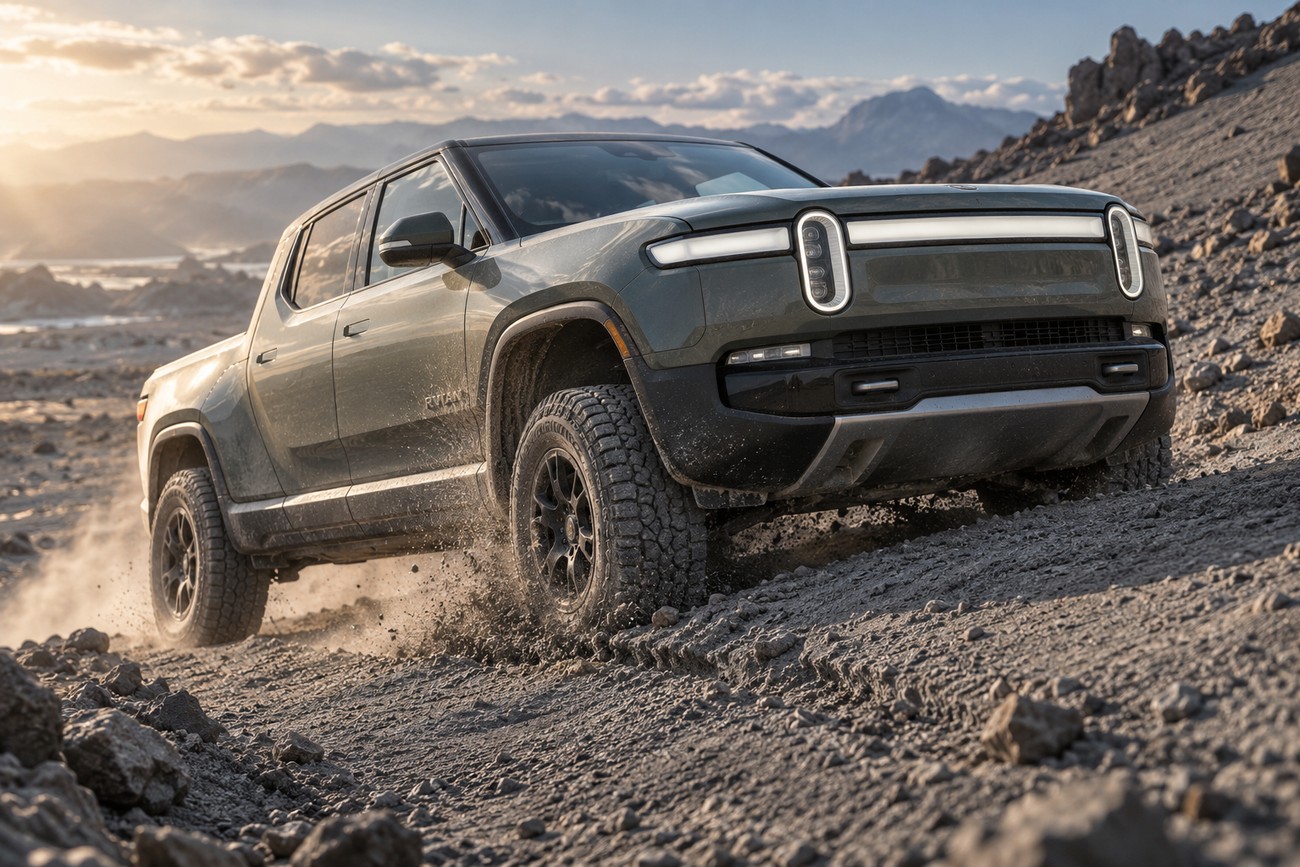
On loose ground, contact quality often matters more than peak motor output. The R1T’s approximately 3.1–3.3 metric tons can help a suitable tire find resistance on firm terrain while increasing sinkage on soft material. Tire construction, tread, pressure, and sidewall behavior can decide whether the motors move the truck forward or simply excavate a trench.
That principle is familiar on Earth. Owners describe a limited choice between road-oriented tires with lower loose-surface grip and more aggressive off-road tires that increase rolling resistance and energy use. Some also report traction-control intervention that restricts wheel torque on loose or difficult terrain. Those observations describe vehicle behavior, not lunar performance.
Lunar regolith adds a harsher materials problem. Conventional automotive tires and lubricants are not designed for lunar vacuum and temperature extremes, while fine dust can enter or abrade exposed moving parts. A lunar vehicle would need wheels, bearings, seals, dust barriers, and lubricants selected and qualified for that environment; an off-road software mode cannot provide those physical changes.
Vacuum and temperature: the survival problem
The Moon has essentially no atmosphere, so there is no air for ordinary convective cooling. Heat can still move through solid structures and be radiated away, but both paths require deliberate thermal design. A system designed around airflow, Earth ambient temperatures, and normal pressure would need a different heat-rejection strategy.
Approximate lunar surface temperature extremes range from −170 to +120 °C, depending on location and illumination. Such swings can affect seals, cable insulation, electronics, lubricants, and structural interfaces in different ways. Materials may contract, expand, harden, outgas, or lose performance; failure would not necessarily occur immediately or uniformly across the vehicle.
These conditions create a qualification problem rather than a simple horsepower problem. A production R1T is not certified for lunar operation, regardless of how confidently it climbs an Earth trail. Its automotive components would require vacuum testing, thermal-cycle testing, dust assessment, and mission-level reliability evidence before a responsible engineer could assign lunar operating limits.
Battery power, cooling, and the range trap
The Large Pack is approximately 135 kWh, and the research brief cites roughly 500–550 km of Earth-rated range, depending on configuration. That figure describes controlled Earth driving conditions. It does not predict lunar range, where route resistance, wheel slip, thermal limits, and the absence of charging infrastructure would dominate mission planning.
Reports from demanding Earth trails describe approximately 1.5–2 times highway energy consumption, with results varying by surface, speed, temperature, payload, and driving style. Sustained climbs can also raise battery and motor temperatures. If the pack begins cold or already heat-soaked, available power and efficiency may change before the driver reaches the top.
An automotive lithium-ion pack is not certified for lunar vacuum and temperature conditions. The Moon’s lack of atmosphere also removes the simple option of dumping heat into moving air, so radiators, conductive paths, insulation, and operating schedules would need careful design. Lower gravity reduces some gravitational work, yet it does not eliminate rolling losses, slip, thermal management, or the energy needed to escape soft regolith.
What a lunar-capable electric truck would actually need
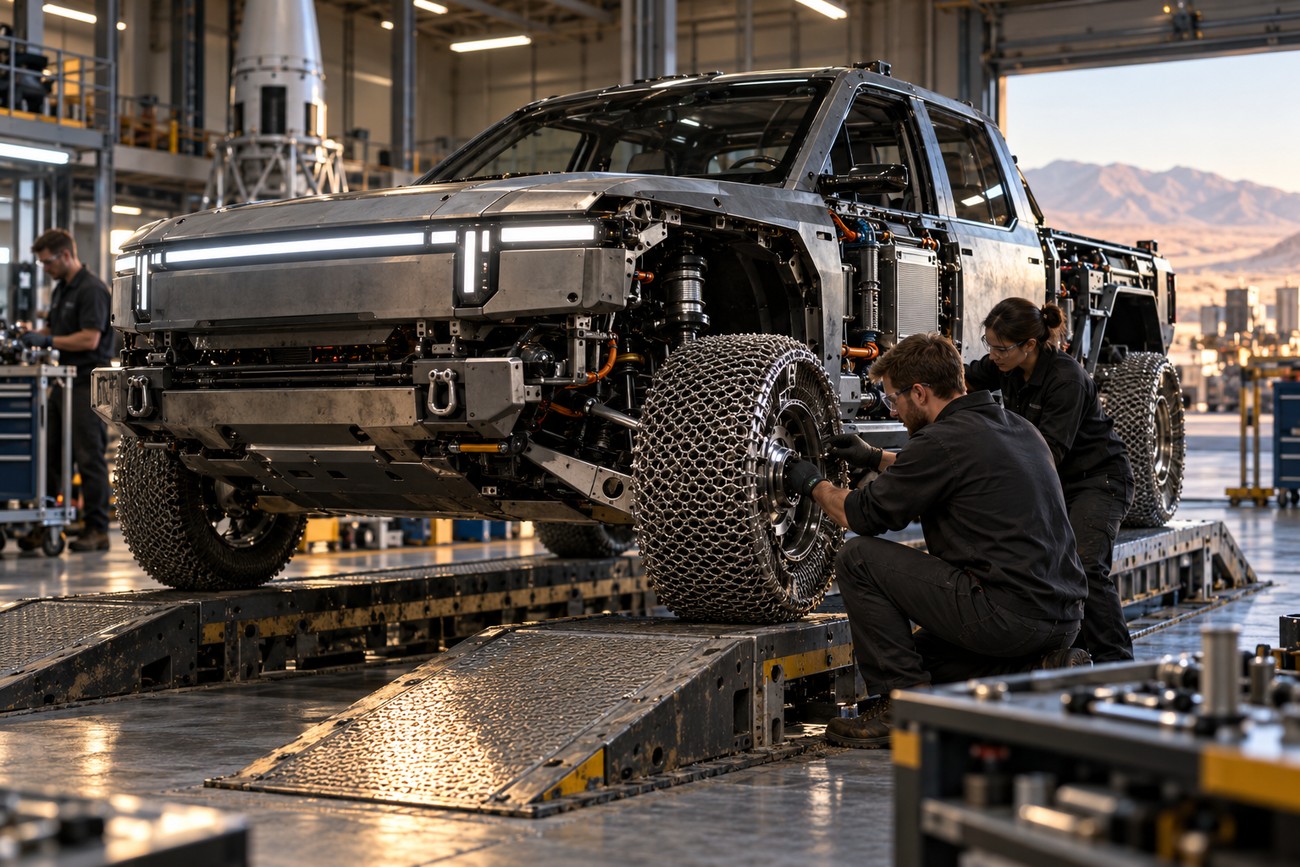
The stock R1T could not simply be delivered to the Moon and driven up a hill. Its electric drivetrain concept might remain useful, especially because precise motor control can support low-speed traction. The road vehicle around that drivetrain would need substantial redesign and qualification before it became a lunar machine.
Key changes would include purpose-built wheels, dust protection, vacuum-compatible materials and lubricants, radiation-tolerant electronics, and controls validated for delayed or limited intervention. The battery would need a thermal-control system suited to vacuum, severe temperature cycles, and long periods without a convenient external heat sink. Reliable heat rejection would be a mission requirement, not an accessory.
Some R1T configurations offer up to approximately 835 hp and 1,230 Nm, but those figures say little about lunar mobility. A purpose-built electric vehicle’s climbing ability would depend on its tested wheel–soil system, structural loads, thermal margins, and recovery strategy. Marketing language about adventure capability cannot substitute for space qualification, and a production R1T is not certified for lunar operation.
Frequently asked questions
How would an electric truck recharge on the Moon?
It would need a dedicated power source and protected charging hardware because there are no ordinary charging stations on the lunar surface. A mission could use solar generation, surface power equipment, or another planned energy system, with storage sized for periods when sunlight is unavailable. The charging interface would also need protection from vacuum, abrasive dust, temperature extremes, and thermal expansion.
That infrastructure would be part of the mission architecture, not an optional accessory carried by a road vehicle. Power generation, cable routing, battery heating or cooling, and safe shutdown procedures would have to be tested together. An R1T Earth range figure provides no answer to those requirements.
Why are people selling their Rivian trucks?
There is no single verified reason that applies to every seller. Individual decisions can reflect ownership cost, charging access, vehicle size, service experience, changing payload needs, or expectations about off-road use. A resale listing alone does not show that the truck is unreliable or unsuitable for Earth driving.
It also does not support a claim about lunar readiness. The supplied evidence establishes no announced Rivian R1T lunar mission, and a production R1T is not certified for lunar operation. Earth ownership decisions and space qualification are separate questions.







