
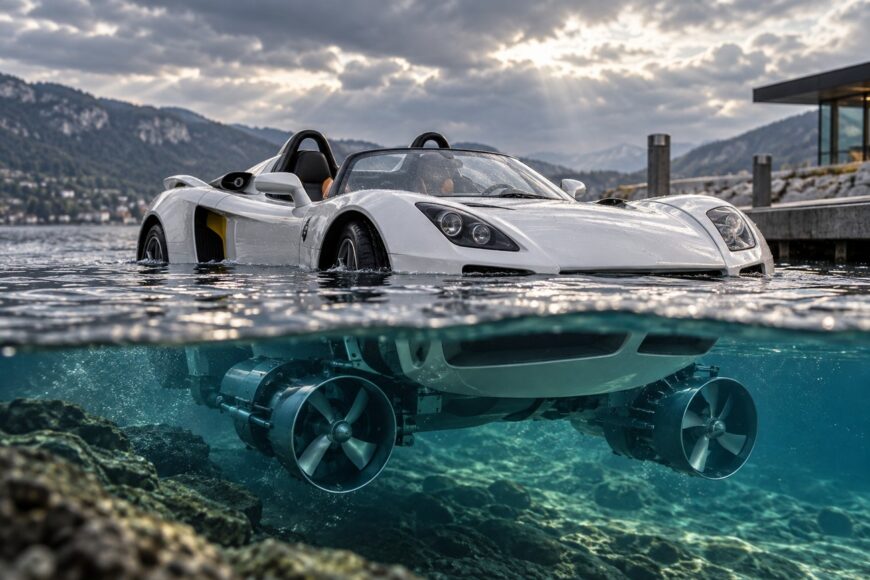
The Rinspeed sQuba looks like a sports car, yet its defining trick begins where the road ends: it can leave the surface and move underwater. That combination makes it one of the most memorable automotive concepts of the 2000s while also raising a practical question. Is it a genuine transport breakthrough or an elaborate publicity exercise?
Debuting in 2008, the sQuba was a two-seat electric roadster and show car, not a normal production vehicle. Its engineering combines road propulsion with separate water systems, creating a machine that demonstrates a difficult technical idea without offering the usability, service support, or everyday convenience expected from a production car.
- What Is the Rinspeed sQuba?
- How the sQuba Moves on Land and Underwater
- Rinspeed sQuba Specifications and Performance
- What Underwater Driving Is Really Like
- Safety, Preparation, and the Practical Drawbacks
- Concept Car, Engineering Demonstration, or Usable Transport?
- Common Myths and Conflicting Specifications
- Frequently Asked Questions
- What is the price of the Rinspeed sQuba?
- What do you call a vehicle that can travel underwater?
- How much does an amphibious car cost?
What Is the Rinspeed sQuba?
The Rinspeed sQuba is a two-seat electric roadster concept designed to travel on land and underwater. Rinspeed presented it as a highly specialized vehicle built around electric propulsion, water thrusters, and an open cockpit. Its appearance suggests a lightweight sports car, but its operating environment extends into a very different engineering problem.
The 2008 debut matters because the sQuba was created as a show car and engineering demonstration. It was not developed into a mass-production model with ordinary dealer support, a documented retail price, or a conventional ownership cycle. Treating it as a model that could be bought and maintained like a regular road car creates expectations the project was never designed to meet.
Calling it simply an amphibious car also misses the central feature. Conventional amphibious vehicles are generally intended to float and travel across water, while the sQuba is designed to submerge and move underwater. That requires separate propulsion, control of the vehicle’s balance, and an operating environment that differs sharply from both road driving and ordinary boating.
How the sQuba Moves on Land and Underwater
The sQuba does not rely on one conventional automotive drivetrain for every situation. Its main electric drive is intended for land travel, while separate water-propulsion assemblies provide movement in water and underwater. This division explains why some descriptions call it a multi-motor or three-motor vehicle, even though those systems perform different functions.
The official Rinspeed specification lists the main electric drive at 54 kW. The water system includes two 800 W units and two 3.6 kW Rotinor units. These figures describe separate water-propulsion equipment rather than extra versions of the main road motor.
Underwater movement is provided by two water-jet or hydrojet propulsion assemblies. Their task is to push and maneuver the vehicle through water, where tire grip and ordinary road gearing have no useful role. The result is better understood as a multi-mode propulsion platform than as a car with one motor that does everything.
This architecture also explains why road performance cannot predict underwater performance. A road vehicle can use tires, suspension, and surface traction to accelerate and turn. Underwater, the design depends on thrust direction, body balance, buoyancy management, and the resistance of the surrounding water.
Rinspeed sQuba Specifications and Performance
The following figures come from official Rinspeed material where available. Secondary descriptions sometimes use converted or rounded power figures, so those should not replace the primary specification.
| Specification | Reported figure | Qualification |
|---|---|---|
| Vehicle type | Two-seat electric roadster concept | Show car, not a mass-production vehicle |
| Dimensions | 3785 × 1940 × 1117 mm | Official Rinspeed figure |
| Wheelbase | 2300 mm | Official Rinspeed figure |
| Mass | Approximately 920 kg | Officially reported approximate figure |
| Main electric drive | 54 kW | Officially listed figure |
| Water propulsion | 2 × 800 W and 2 × 3.6 kW Rotinor units | Separate water-propulsion systems |
| Road top speed | More than 120 km/h | Officially stated |
| Acceleration | 0–60 km/h in 7.1 seconds | Officially reported |
| Maximum underwater depth | Up to 10 m | Officially reported maximum |
| Underwater speed | Approximately 3 km/h | Commonly repeated secondary report, not presented as the official road-speed equivalent |
On land, the stated figures give the sQuba credible sports-car-like performance for a lightweight concept. Its official maximum road speed is more than 120 km/h, and the claimed 0–60 km/h time is 7.1 seconds. Those numbers describe the surface-driving mode and say little about the vehicle’s aquatic usefulness.
The dimensions are compact in length but substantial in width, while the approximately 920 kg mass is low for a machine carrying multiple propulsion systems. The packaging challenge is significant: the designers had to accommodate road-drive hardware, water equipment, electrical systems, and a body capable of operating around water.
The official underwater capability is a depth of up to 10 m. Reports commonly place underwater speed at approximately 3 km/h, although this figure should be treated as a secondary description rather than a directly equivalent official performance rating. Differences in published power and speed figures are one reason the Rinspeed PDF is the preferred reference.
What Underwater Driving Is Really Like
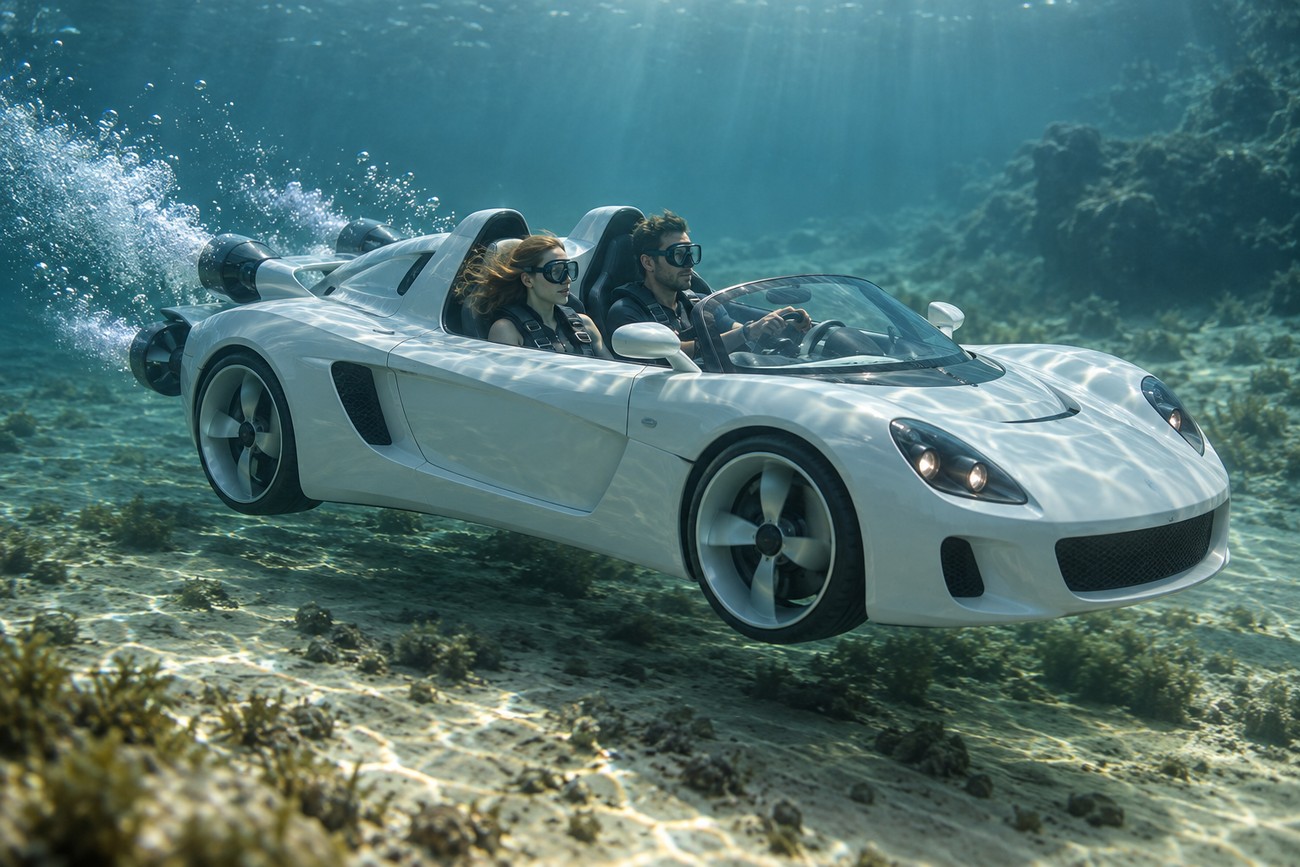
Underwater travel in the sQuba is slow, specialized, and condition-dependent. The commonly repeated underwater speed of approximately 3 km/h is far below the road capability, so the vehicle should not be imagined as a sports car continuing its normal behavior below the surface.
At that speed, control and stability matter more than headline motor output. The water thrusters must provide usable directional force, while the body must remain balanced enough for the occupants and controls to function. Maneuvering becomes a problem of managing thrust and the vehicle’s position in the water.
The open cockpit changes the experience further. The occupants are exposed to the surrounding water, and underwater operation requires a level of preparation and tolerance that ordinary driving does not. An open cabin may help the concept avoid the complexity of a sealed passenger compartment, but it also limits comfort and broad usability.
The stated maximum depth of up to 10 m defines the concept’s demonstrated envelope; it does not turn the sQuba into a general-purpose submersible. Conditions, visibility, recovery arrangements, and the occupants’ preparation all influence whether the underwater mode is usable in a particular setting.
Safety, Preparation, and the Practical Drawbacks
The open cabin is the most obvious practical compromise. It creates safety and comfort concerns during submersion and makes the vehicle’s operation fundamentally different from driving a sealed car. The concept therefore depends on suitable conditions and careful preparation, even though it was not presented with the normal operating framework of a production vehicle.
Water exposure also changes the maintenance problem. Sealing, corrosion control, inspection routines, and recovery planning become central concerns whenever a vehicle transitions between road use and underwater use. The headline power figures provide little guidance about the long-term burden of keeping those systems reliable.
The sQuba has no established mass-production lifecycle that would define routine service intervals, parts support, certification responsibilities, or ownership costs. A concept can demonstrate that a system works during a controlled presentation while leaving many questions unanswered for long-term operation.
Its infrastructure requirements also narrow the use case. A suitable launch area, appropriate water conditions, preparation for the occupants, and a plan for recovering the vehicle all matter more than the ability to reach a road speed above 120 km/h. These demands make the sQuba poorly suited to ordinary daily transportation.
There is no clear evidence of a normal mass-market certification and service structure for the sQuba. That distinction matters for anyone interpreting online images or claims as evidence that the vehicle could be used like a commercially supported car.
Concept Car, Engineering Demonstration, or Usable Transport?
The sQuba is best evaluated as an engineering demonstration with strong visual impact. It shows that a lightweight electric roadster can be combined with dedicated underwater propulsion, which is a difficult and memorable design exercise. Its achievement lies in integrating those functions into one recognizable vehicle.
The practical use case remains narrow. A person seeking daily transportation gains little from a vehicle that requires unusual operating conditions, exposes its occupants during submersion, and lacks an ordinary retail and service structure. The open cockpit and slow underwater movement reinforce its specialist character.
Critics who describe the sQuba as a wealthy person’s toy or a public-relations display are responding to that gap between engineering spectacle and utility. The criticism is reasonable if the vehicle is judged as transport. It becomes less fair if the project is judged by its original purpose: demonstrating an unusual combination of road and underwater mobility.
Road speed should therefore remain secondary in the overall assessment. A vehicle that performs well on land can still be poorly suited to underwater travel, where the useful measures are control, stability, depth, preparation, and recovery. The sQuba succeeds as a concept precisely because it exposes that engineering difference.
Common Myths and Conflicting Specifications
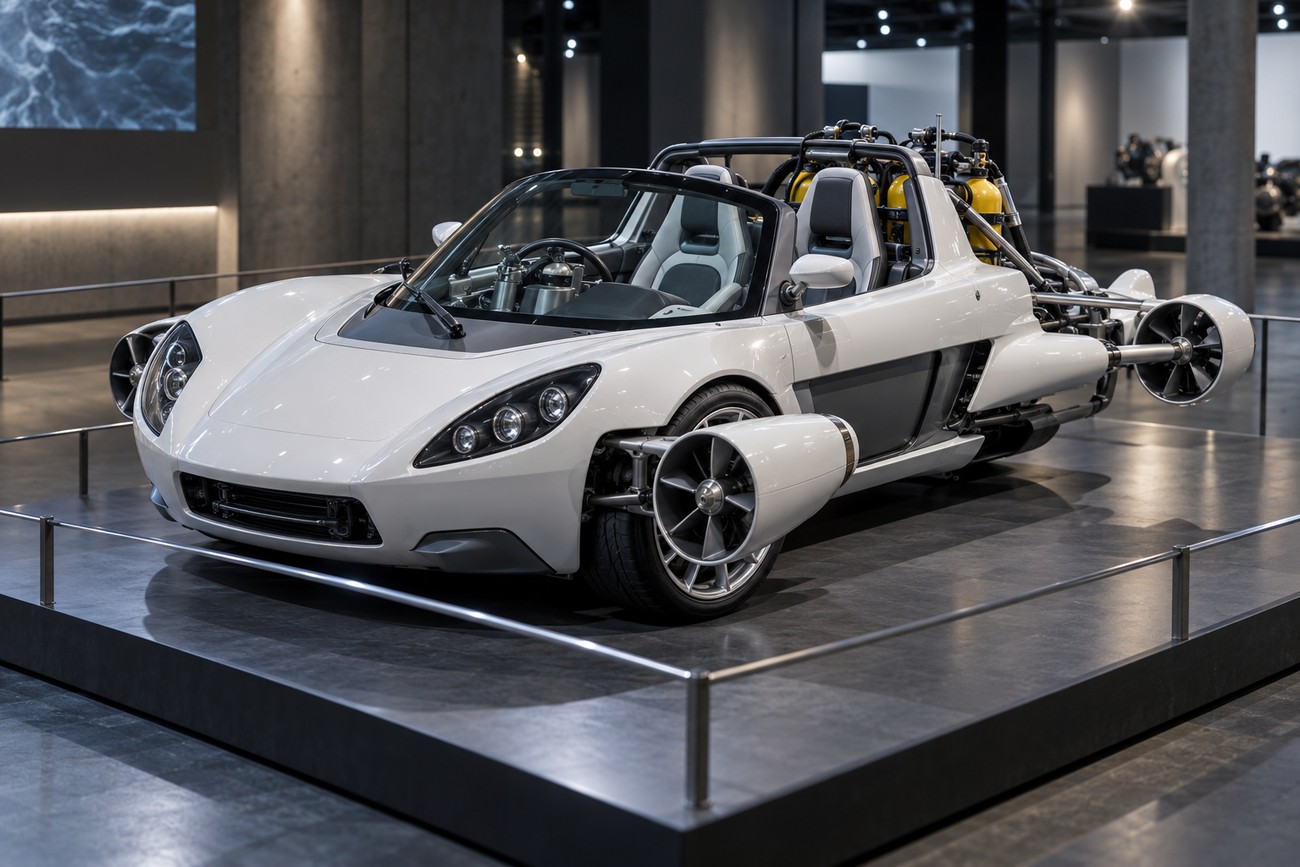
The most important correction is that the sQuba is a 2008 concept, not a standard production vehicle. It should not be presented as a car available through ordinary dealers, and speculative online prices should not be treated as official purchase figures.
The vehicle is also more than a conventional amphibious car. An amphibious vehicle usually emphasizes travel between land and water, while the sQuba is intended to move underwater. That distinction affects propulsion, balance, occupant protection, and the conditions required for operation.
The official main-drive figure is 54 kW. Some secondary descriptions use approximately 73 hp, which is a rounded or converted reference that should be kept separate from the official specification. Other published figures may differ because sources summarize the concept’s systems inconsistently.
References to a three-motor system describe different propulsion functions rather than three identical automotive motors. The land electric drive and the separate water systems serve different modes. When figures conflict, the official Rinspeed PDF provides the most reliable baseline, while secondary claims should be labeled as such.
Frequently Asked Questions
What is the price of the Rinspeed sQuba?
The Rinspeed sQuba has no established normal retail price because it is a concept and show car, not a mass-production vehicle. Rinspeed did not offer it as an ordinary dealer-supported model with a standard market price.
Online figures that assign a specific purchase cost are therefore speculative unless they refer to a separate custom project or another amphibious vehicle. The squab’s real commercial limitation is its production status, service support, and lack of a documented ownership lifecycle.
What do you call a vehicle that can travel underwater?
Common terms include underwater car, submersible car, and underwater-capable vehicle. “Amphibious vehicle” is broader and usually describes a vehicle designed to operate on both land and water, without necessarily traveling below the surface.
For the sQuba, “underwater-capable concept” or “submersible car concept” is more precise than simply “amphibious car.” The wording signals that its defining function is underwater movement while also making clear that it is an experimental show vehicle.
How much does an amphibious car cost?
There is no single meaningful market price for amphibious cars. Costs vary according to whether the vehicle is a production model, a one-off concept, a custom build, or a machine designed only to float and travel across water.
A commercially supported amphibious vehicle has different costs and obligations from a hand-built or experimental design. The Rinspeed sQuba should be kept out of ordinary price comparisons because it has no established retail offering and adds underwater propulsion to the usual land-and-water requirements.







