

A hypercar on a road and a person in freefall seem to invite a simple speed comparison. Yet the answer changes depending on the target: reaching 200 km/h first is a race against the clock, while comparing the car’s top speed with a diver’s eventual falling speed is a different test. Both also need a defined starting point.
With a simultaneous start and a 200 km/h target, the standard Rimac Nevera wins. It reaches that speed in a few seconds; a belly-to-earth skydiver typically takes tens of seconds to approach the ordinary terminal-speed range of around 190–200 km/h. A specialist speed skydiver can eventually reach around 480 km/h, exceeding the standard Nevera’s stated 412 km/h top speed, but that does not make the diver first to 200 km/h.
- Who reaches 200 km/h first?
- Nevera and skydiver speeds by configuration
- Why terminal velocity changes when a skydiver moves
- Why the Nevera’s headline specs cannot decide the clock
- How to make the car-versus-skydiver race fair
- Frequently asked questions
- Can a race video prove who reached the target speed first?
- Which is faster, Koenigsegg or Rimac Nevera?
- What is the fastest production car to drive 1/4 mile?
- Rimac Nevera vs. a skydiver who hits terminal velocity first: YouTube?
Who reaches 200 km/h first?
In a simultaneous-start race to 200 km/h, the standard Nevera gets there first. The car accelerates to that target in a few seconds, while a belly-to-earth skydiver typically needs tens of seconds to approach their usual terminal-speed range. Those are approximate comparisons, not results from a matched car-and-skydiver test.
The target sits near the upper end of the ordinary belly-to-earth range of around 190–200 km/h. A particular diver might settle below 200 km/h, depending on body position, clothing, mass, and air conditions. In that case, the diver would approach their terminal speed without ever reaching the chosen target.
“First” requires a clock that starts for both participants at the same time: the car begins its run as the diver begins freefall. It also requires speed readings with stated references. Without those rules, a car’s eventual maximum and a diver’s settled falling speed say little about who reached a target sooner.
Nevera and skydiver speeds by configuration
These figures describe a car’s stated top speed and approximate falling speeds under different skydiving configurations. They show how much posture changes the comparison. None is a time-to-speed result.
| Configuration | Speed | What the figure describes |
|---|---|---|
| Standard Rimac Nevera | 412 km/h | Manufacturer-stated top speed, not the time needed to reach it |
| Belly-to-earth freefall | Around 190–200 km/h | Approximate posture-dependent terminal speed |
| Stable head-down freefall | Approximately 240–290 km/h | Approximate posture-dependent terminal speed |
| Specialist speed skydiving | Can reach around 480 km/h | Speed attainable in a specialized streamlined posture, not an ordinary jump |
Why terminal velocity changes when a skydiver moves

Terminal velocity is the approximate steady falling speed at which a skydiver’s weight and aerodynamic drag balance. It applies to a particular mass, body position, clothing, and set of atmospheric conditions. Air density also changes with altitude, so there is no single terminal speed for every human fall.
A belly-to-earth position presents a relatively broad area to the airflow and typically settles around 190–200 km/h; approximately 193 km/h is a useful practical reference, not a universal limit. In a stable head-down position, the smaller effective area reduces drag, allowing approximately 240–290 km/h. Gravity has not become stronger—the aerodynamic configuration has changed.
In head-down flight, small losses of symmetry can add drag or disturb stability, making a quoted speed difficult to sustain even when the diver holds the nominally faster posture.
Specialist speed skydiving takes streamlining further and can reach around 480 km/h. That figure describes a specialized dive, not a typical recreational jump. Control matters as much as adopting the posture: if the diver changes position or exposes more area to the airflow, drag rises and the falling speed changes.
Why the Nevera’s headline specs cannot decide the clock
The standard Nevera’s stated top speed is 412 km/h, but top speed does not tell you how long the car takes to reach a lower target. Its claimed 0–100 km/h time is 1.81 seconds, with Rimac’s one-foot-rollout qualification. That figure establishes rapid early acceleration without supplying a measured 0–200 km/h result for this comparison.
Rollout changes where an acceleration timer begins. Timing equipment, road surface, and run conditions can also affect a reported result, so figures obtained by different methods should not be treated as interchangeable. The Nevera’s stated 412 km/h maximum is likewise a top-speed specification, not a routine road speed.
The Nevera R is a different model with distinct claims: 430 km/h top speed in a manufacturer-controlled run, 0–100 km/h in 1.72 seconds, and 0–300 km/h in 7.89 seconds. None of those figures replaces the standard Nevera’s specifications. Some third-party databases list around 415 km/h for the standard car, but that is not a new manufacturer specification in place of 412 km/h.
How to make the car-versus-skydiver race fair
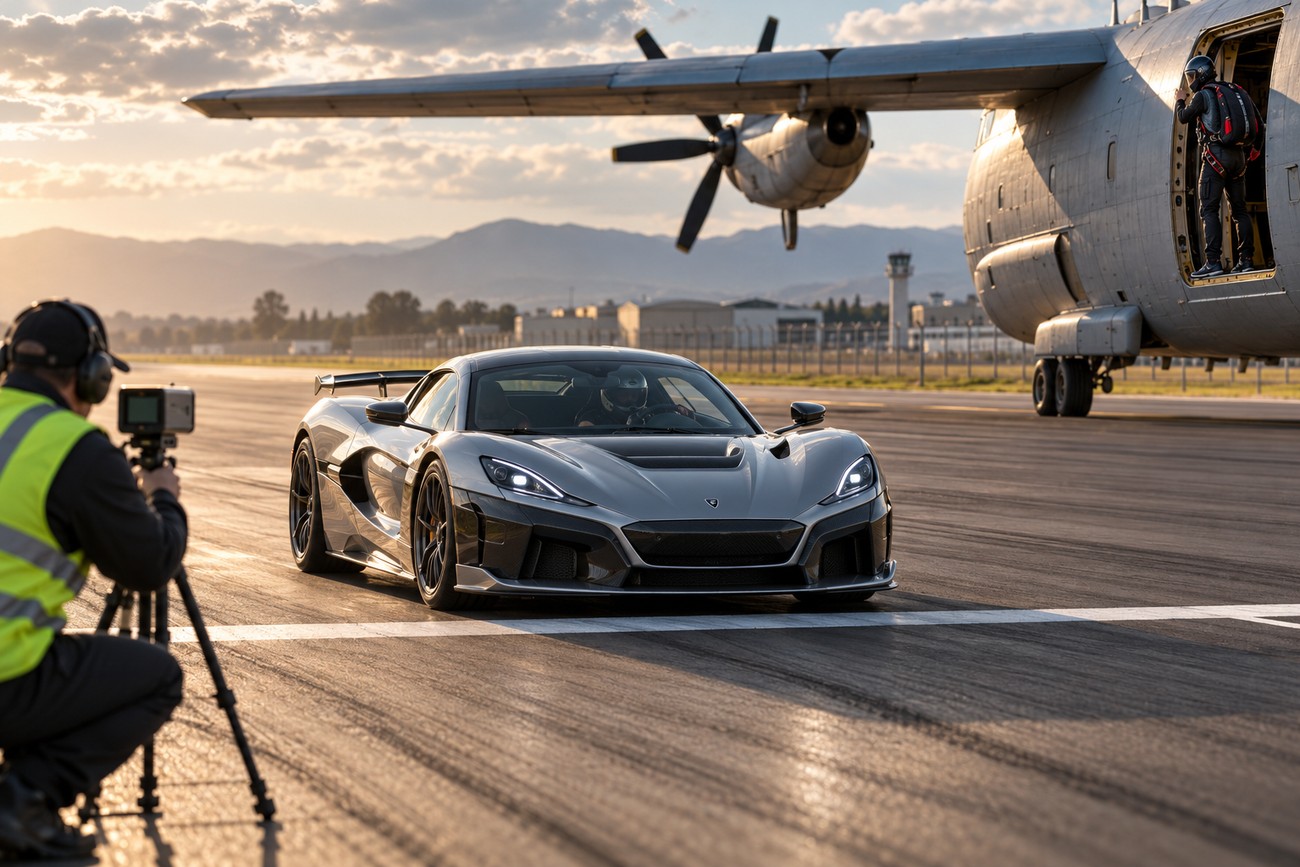
Define the event before starting either clock. Specify a simultaneous start, a target speed, the diver’s posture and starting altitude, and the measurement used for each participant. A 200 km/h target gives the clearest version of the race: the standard Nevera reaches it in a few seconds, while ordinary belly-to-earth freefall approaches its roughly 190–200 km/h terminal range over tens of seconds.
For the diver, speed through the surrounding air and motion relative to the ground are different measurements. Wind can shift the ground track even as the diver’s airspeed reflects the drag acting on their body. The car’s speed is measured along the road, so a credible comparison must identify each reading rather than present two unlabeled numbers.
Change the question to who can eventually go faster, and the possible winner changes. A specialist speed skydiver can reach around 480 km/h, above the standard Nevera’s stated 412 km/h top speed. That outcome does not reverse the race to 200 km/h: maximum attainable speed and elapsed time to a target are separate results.
Frequently asked questions
The details of a speed claim matter most when you are judging footage or comparing records from different vehicles. These checks keep unlike measurements from becoming a single misleading result.
Can a race video prove who reached the target speed first?
Yes, if it establishes synchronized starts, a defined target speed, and speed measurements whose sources and reference frames are identified. Footage that only shows a speed overlay or an edited sequence cannot, by itself, establish which participant crossed the target first. Check whether the car reading is road speed and whether the diver reading is airspeed or ground-relative speed.
Which is faster, Koenigsegg or Rimac Nevera?
There is no single answer without naming a specific Koenigsegg model and choosing a test, such as top speed or time over a set distance. “Koenigsegg” refers to a maker, while the standard Nevera is a particular car with a stated 412 km/h top speed. A fair comparison needs figures for the named vehicles measured under comparable conditions.
What is the fastest production car to drive 1/4 mile?
The answer depends on the record date and the rules used to define a production car. The quickest verified quarter-mile run should be compared using a documented elapsed time, consistent timing equipment, and a clear production specification; the speed figures discussed here do not establish that record.
Rimac Nevera vs. a skydiver who hits terminal velocity first: YouTube?
In a simultaneous race to 200 km/h, the standard Rimac Nevera reaches the target first, usually in a few seconds. A typical belly-to-earth skydiver needs tens of seconds to approach terminal speed, while a specialized speed skydiver can eventually exceed the Nevera’s top speed.







