
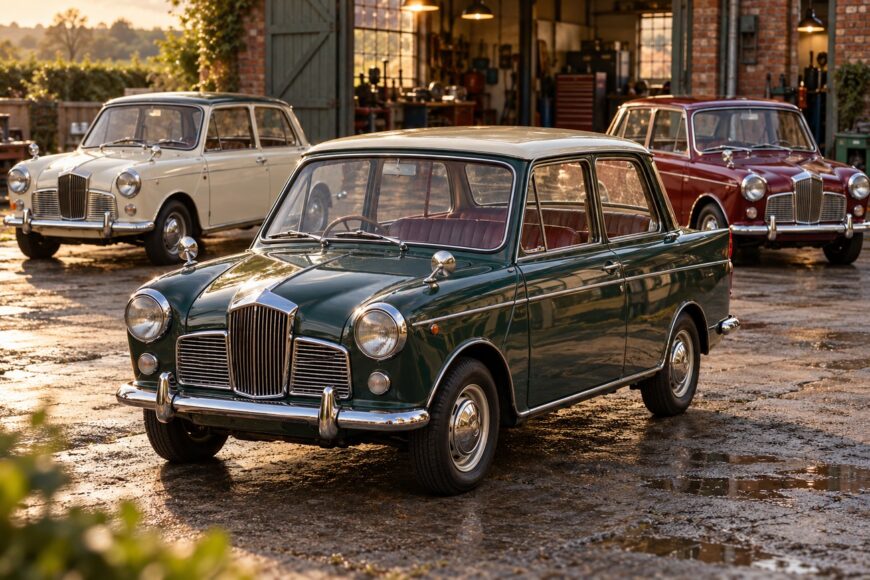
The Riley Elf is a Mini with tailfins, a separate trunk, and an unmistakable claim to luxury. Its upright grille and longer rear body make it look like a small formal sedan, although it retains the compact dimensions and closely packed mechanical layout of the Mini beneath. That combination gives the Elf much of its appeal and sets limits on what it can carry and how easily it can be maintained.
Appearance alone tells you little about how a particular Elf will drive. An early 848 cc car has different reserves of power from a later 998 cc version; brakes, suspension, doors, and gearboxes also changed over the production run. For a buyer, the useful question is which specification the car has now, how faithfully it represents its generation, and whether the work done to it makes ownership easier or merely hides the next repair.
- Why the Riley Elf Was More Than a Mini With a Badge
- Riley Elf Mk I, Mk II and Mk III: The Changes That Matter
- What an Elf Feels Like on the Road
- The Trunk, Cabin and Everyday Compromises
- Inspecting an Elf: Brakes, Suspension and Hidden Costs
- Originality Versus Usability: Choosing the Right Elf
- Frequently asked questions
- How much does a Riley Elf cost?
- What is the difference between a Riley Elf and a Wolseley Hornet?
- Which documents help verify a Riley Elf’s identity?
Why the Riley Elf Was More Than a Mini With a Badge
Built by BMC from 1961 to 1969, the Riley Elf was a more expensive derivative of the ADO15 Mini. The Wolseley Hornet was its closely related counterpart. Both took the Mini’s small-car architecture in a more formal direction, aimed at buyers who wanted its easy-to-place size without its plainest presentation.
The extended rear body gave the Elf a distinct trunk, while modest tailfins carried the new shape through to the back of the car. At the front, the upright Riley grille changed its expression just as decisively. The exterior details and more elaborate cabin trim worked together: this was a different interpretation of the Mini, rather than a badge attached to an otherwise identical body.
Its proportions still demand perspective. Approximate published dimensions put the wheelbase at 2,038 mm, length at 3,302–3,308 mm, width at 1,410 mm, and height at 1,334–1,346 mm. The longer tail matters when you have a bag to stow, but the wheelbase and cabin remain those of a tiny car. The Elf should not be mistaken for a roomy family sedan simply because its silhouette resembles one.
BMW Group Classic records 30,912 Riley Elfs across Mk I, Mk II, and Mk III production. That figure establishes the scale of the model, not the rarity or value of an individual survivor. Condition, evidence of identity, and the correctness of hard-to-find Elf-specific details matter more when comparing cars for sale.
Riley Elf Mk I, Mk II and Mk III: The Changes That Matter
The badge stayed the same, but each generation brought changes you can feel or see. Use this outline to identify what to investigate, then verify the fitted components on the car itself.
| Generation | Engine and front brakes | Doors, windows, and suspension | What it means for a buyer |
|---|---|---|---|
| Mk I, early production from 1961 | Early A-series 848 cc engine; buyer’s guides describe early 7-inch Lockheed drum brakes. | Earlier door and window arrangement; establish the suspension fitted to the individual car. | Expect modest acceleration, and judge the brakes by their condition rather than their specification alone. |
| Mk II, before October 1966 | A-series 998 cc engine and front drums with twin leading shoes. | Earlier-style doors and windows; check the actual suspension and any later changes. | The larger engine offers more usable pull. Confirm that brake work matches the installed system. |
| Mk III, October 1966 to August 1969 | 998 cc engine; inspect the fitted brakes rather than assuming they remain standard. | Wind-up door windows, concealed exterior hinges, push-button handles, and Hydrolastic suspension. | Check the distinctive doors and Hydrolastic system. A fully synchronized gearbox appeared around 1968, so it cannot be assumed on every Mk III. |
BMW Group Classic gives Mk III production as 9,574 cars and describes it as the first Mini variant with wind-up door windows. The gearbox change came later than the Mk III’s introduction. A registration date, therefore, is a starting point for identification, not proof that a car has every late feature.
What an Elf Feels Like on the Road
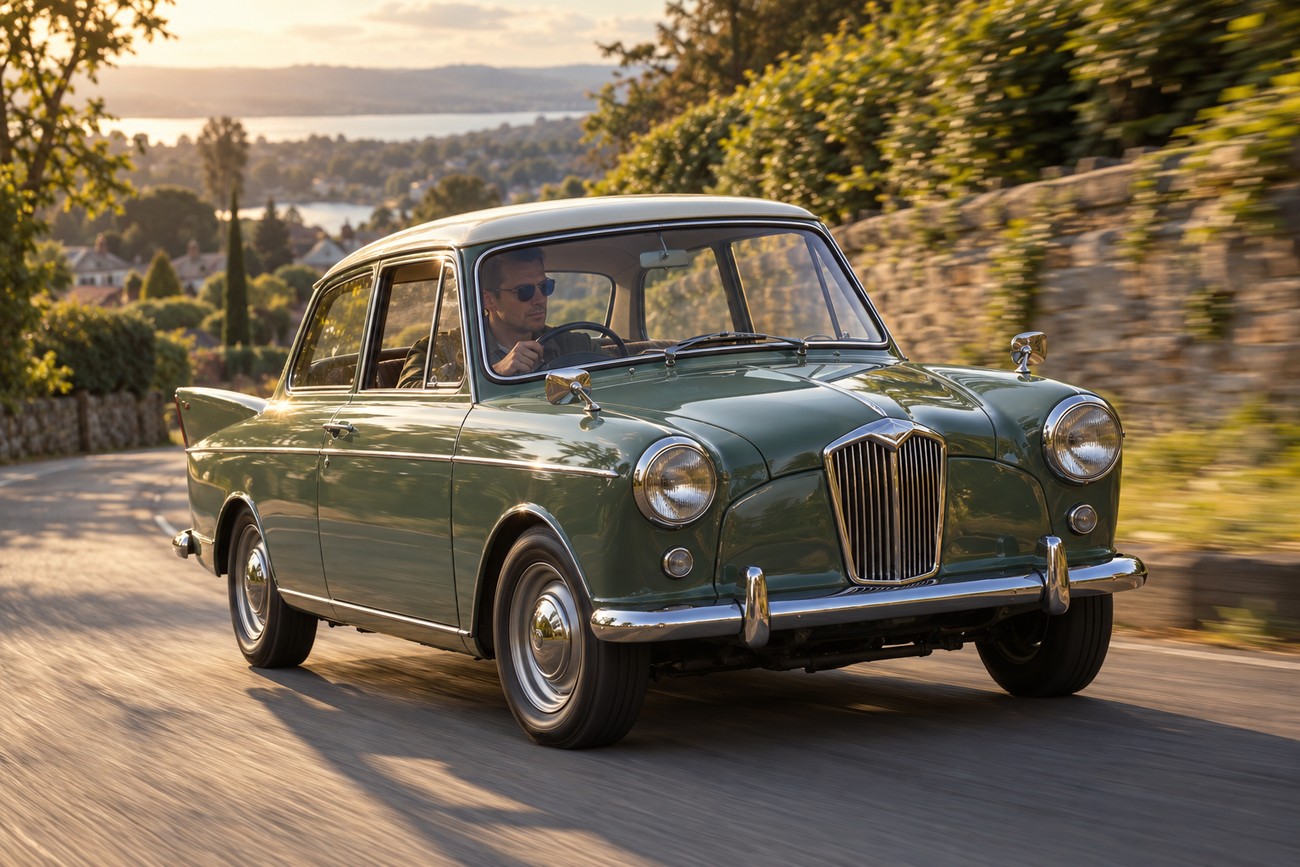
An Elf still has the Mini’s direct, compact-car character: you sit in a small cabin, judge gaps easily, and feel road speed without needing much of it. The engine makes a meaningful difference to the effort involved. The early 848 cc A-series asks for more gear changes when traffic speeds rise or a road climbs; the later 998 cc is noticeably more flexible, especially when pulling away or recovering pace without an immediate downshift.
Published figures for these engines suggest a rise from about 34 to 38 hp and from 44 to 52 lb ft of torque. Those numbers are modest, yet the added torque is useful in such a light car. Neither version promises effortless modern cruising, and an engine that hesitates, runs roughly, or feels unusually weak deserves diagnosis rather than an explanation based solely on its age.
Early buyer’s guides describe 7-inch Lockheed drum brakes, while the Mk II gained twin-leading-shoe front drums. Well-maintained drums can suit an Elf’s intended use, but poor adjustment or worn components can make stopping feel uncertain. The suspension deserves the same attention: a lively response to steering belongs to the car’s character; wandering, repeated bouncing, or an uneven stance points toward a condition problem.
Wheel size can alter the impression before any engine work is considered. Compared with 10-inch wheels, 12-inch wheels are associated with greater ground clearance and taller effective gearing, which can ease engine speed at a given road speed while taking some urgency out of acceleration. Tire dimensions and other fitted parts also affect the result. Check what is actually on the car and whether it suits its brakes and bodywork before treating a wheel change as an improvement.
The Trunk, Cabin and Everyday Compromises
The Elf’s separate, extended trunk gives luggage a place of its own, a practical distinction from the ordinary Mini’s rear arrangement. It can make a short trip easier to pack and keeps smaller belongings out of the passenger space. Its shape remains constrained by a compact two-door body, though, so the word “trunk” should not lead you to expect the load-carrying ability of a later, larger sedan.
Inside, the more formal trim changes the atmosphere more than the available room. Front occupants still live close to the doors and controls, and getting into the rear calls for the usual compromises of a small two-door car. Noise and road movement are part of the experience, especially on a longer drive; a tidy-looking cabin does not necessarily make an Elf restful at modern traffic speeds.
Mk III wind-up windows are a meaningful everyday change. They bring a more familiar way to open and close the glass, but the mechanism required different inner door trim and reduced the door pockets. That trade-off matters if you rely on those pockets for loose items, and it matters more to a restorer trying to return a late car to the right interior specification.
Packaging affects work on the car as well as travel in it. Access to components in the tightly arranged engine bay and compact body can turn a simple inspection into a slower job. Allow for that when assessing a car with deferred maintenance: a neglected hose, brake component, or suspension fault may be straightforward in principle while still being awkward to reach and put right.
Inspecting an Elf: Brakes, Suspension and Hidden Costs
Start with the structure and the evidence of previous work. Look along the body for uneven repairs, inspect accessible seams and lower areas carefully, and compare what you see with restoration photographs or invoices if they exist. Many surviving Elfs have been repaired or restored; fresh paint is neither proof of sound metal nor a reason by itself to reject a car. The aim is to establish what was done and whether the finish is supported by sound work beneath it.
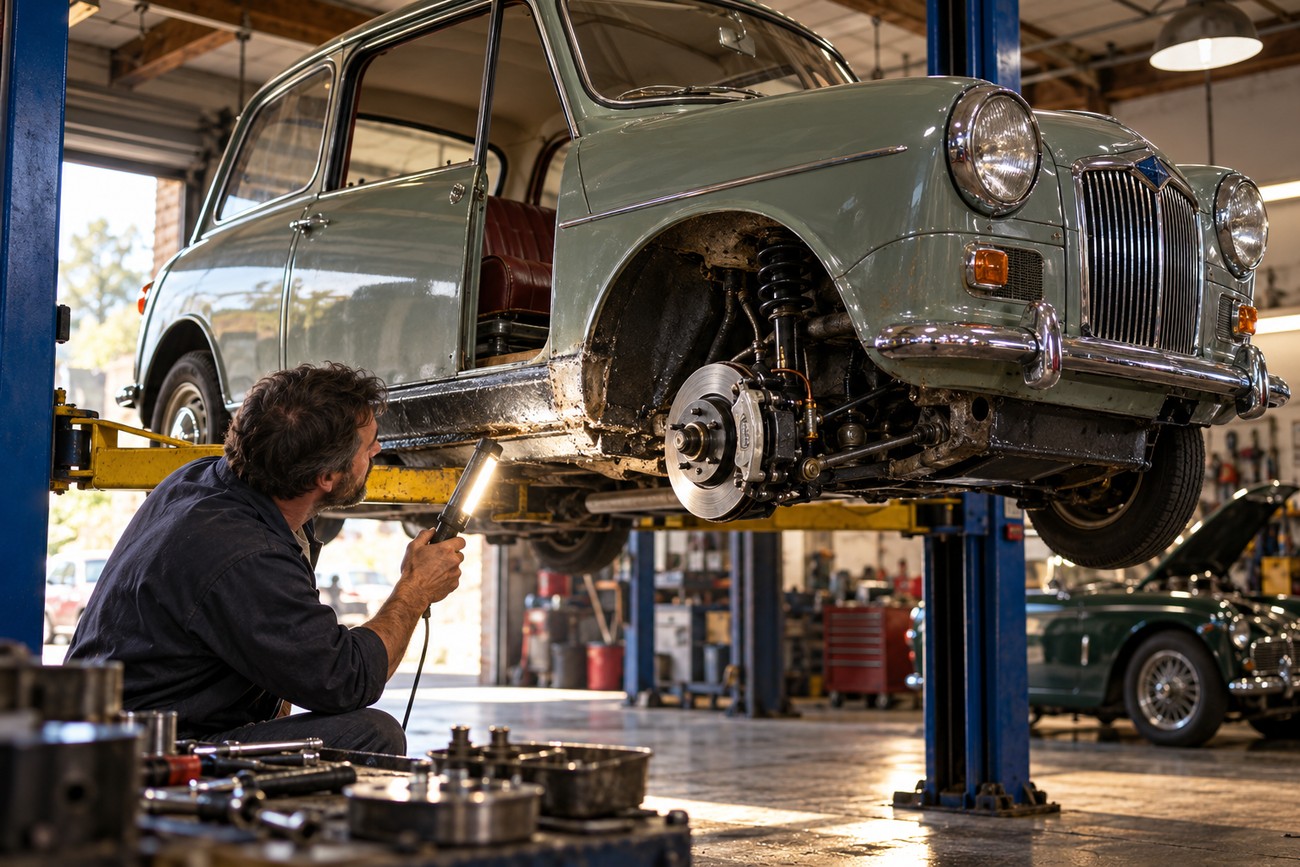
Next, assess braking as a system. Check that the car stops consistently and that the pedal feel, adjustment, and visible components agree with the seller’s description. Early 7-inch Lockheed drums depend heavily on good maintenance, and Mk II twin-leading-shoe fronts have their own correct parts and adjustment needs. Discs may be a desirable improvement for someone who will drive regularly, but they should be identified as a modification where fitted, with the quality and compatibility of the installation checked.
Move on to stance and suspension behavior. Look for uneven ride height, damaged or deteriorated components, and movement that feels loose rather than controlled on a careful test drive. BMW Group Classic states that every Elf Mk III received Hydrolastic suspension, making signs of leakage or a sagging corner especially important on those cars. Confirm what remains installed before planning repairs; identifying a fault is more useful than assuming every low-riding Elf needs the same parts.
Finally, record the wheel and tire sizes, inspect clearance, and establish whether the brakes fit safely beneath the wheels. A switch between 10- and 12-inch wheels can affect ground clearance and effective gearing, so it changes more than the car’s appearance. Compare engine, doors, interior, and other visible details with the claimed generation, then factor any unresolved discrepancies into your decision. The expensive surprise is often work you could see evidence of but had not yet identified clearly enough to assess.
Originality Versus Usability: Choosing the Right Elf
A collector’s strongest candidate may be the car whose color, interior, wheels, and door hardware can be matched to convincing records, even if it needs careful mechanical recommissioning. Someone who intends to drive frequently may prefer a sound, well-documented car with reversible changes that improve braking or day-to-day reliability. Neither approach excuses weak structural repairs. Decide which departures from original specification you can accept before a polished example makes the choice for you.
The Mk II and Mk III distinctions are useful checks on a seller’s account. Mk III cars have wind-up windows, concealed exterior hinges, and push-button handles; Mk II cars belong to the earlier door arrangement. A mixture of features warrants investigation, though it is not automatic evidence of dishonesty. Panels and fittings can be replaced during repairs, and the registration date alone may not describe the car’s build specification.
Mechanical specification matters just as much as trim when selecting an Elf to use. An early 848 cc car requires more patience than a later 998 cc example, while the fully synchronized gearbox that appeared around 1968 can make repeated town shifts easier than in earlier cars. Do not assume that every Mk III has that gearbox. Check the fitted unit and how it shifts, then weigh the advantage against the condition of the rest of the vehicle.
The notion that an Elf is merely a Mini with a richer grille misses its distinct rear body, cabin details, and changes across generations. Equally, the shared Mini foundation does not make every Elf drive alike or every Mini part a direct replacement. Repainted cars, nonstandard wheels, and changed mechanical units can still be excellent to own when the work is sound and documented. Buy the combination of identity, condition, and driving behavior you can verify, rather than an assumed future value.
Frequently asked questions
The answers below are useful when comparing advertised cars, particularly where a familiar Mini component or an attractive restoration makes the details of an Elf harder to judge.
How much does a Riley Elf cost?
There is no reliable single price for a Riley Elf without a current market and a specific car to assess. Look for recent completed sales in the country where you intend to buy, then compare the same generation and broadly similar condition. An asking price is useful context, but it does not show what a buyer paid.
Adjust that comparison for documented body repairs, mechanical needs, and how well original features can be verified. BMW Group Classic’s total of 30,912 Elfs describes production across all three generations; it does not determine the price of an individual car. Set aside room in your assessment for faults that an inspection has identified but the seller has not yet repaired.
What is the difference between a Riley Elf and a Wolseley Hornet?
The Riley Elf and Wolseley Hornet are closely related, more formally styled derivatives of the Mini ADO15 sold under different BMC marques. Their most immediate distinctions are the marque-specific grille, badges, and trim details. Compare cars of similar years and specifications before attributing a difference in performance or equipment to the Riley or Wolseley name alone.
For a buyer, the distinction also affects the search for correct visible parts. A component may fit the shared underlying design while the grille, emblem, or finishing detail is wrong for the car being restored. Establish the year and the individual car’s specification before buying marque-specific pieces.
Which documents help verify a Riley Elf’s identity?
Registration records, vehicle identification markings, engine numbers, available archival information, and restoration records help build a Riley Elf’s history. Compare the numbers recorded on paper with those present on the car, then use dated photographs and repair invoices to understand changes made since it was built.
No single document proves every item currently fitted. An original registration record cannot confirm that today’s engine, doors, wheels, or interior have remained unchanged; a restoration invoice may document a replacement without establishing the car’s original specification. The strongest account is one in which the paperwork, physical markings, and visible features support each other.







