

A rental company can charge you for a small scratch on a Nissan Versa several days after you return it, even if you believe the mark was already present or an employee said the car looked fine. The delay can make the situation feel unfair, especially when the vehicle passed through other customers or branches before the invoice arrived.
The central issue is not simply whether a scratch is visible. The company generally needs to connect the damage to your rental period under the applicable agreement, while you need evidence showing the vehicle’s earlier condition. A charge is not automatically valid because the company found a mark, but a successful challenge usually depends on the contract, the inspection timeline, and the records both sides can produce.
- Why a Rental Company Can Charge for an Old Scratch
- Check the Contract Before You Accept the Damage Claim
- Build the Evidence: Photos, Records, and the Car’s Timeline
- How to Dispute the Nissan Versa Scratch Charge
- CDW, Deductibles, and Charges Beyond the Repair
- Prevent the Next Scratch Dispute at Pickup and Return
- Frequently asked questions
- What happens if you return a rental car with scratches?
- How much will I get charged for a scratch on a rental car?
- What happens if I get a small scratch on my car rental?
- What happens if you scratch an Enterprise rental car?
Why a Rental Company Can Charge for an Old Scratch
A rental company may inspect a vehicle after it leaves the return area and send a damage charge several days later. Staff may have been busy, the return may have been contactless, or the car may have moved to another location before a more detailed inspection. A completed return process therefore does not always mean that no later claim can be made.
The practical dispute is usually about timing. A visible scratch proves that a mark exists, but it does not by itself prove that the mark arose during your rental period. The company’s internal damage report may identify the location and apparent size of the scratch without showing whether it was present at pickup.
That creates a common conflict between a renter’s memory and the company’s records. You may remember seeing the mark on the bumper or lower panel, while the original condition report may be incomplete or may simply say “no damage.” If neither side has clear photographs, the issue can become difficult to resolve.
A signed return form or an employee’s oral reassurance can help, but each has limits. An oral statement that the car looked fine is weaker evidence than a written inspection record or timestamped photographs, and a later invoice may still be challenged if the company cannot show when the scratch appeared or how its amount was calculated.
Check the Contract Before You Accept the Damage Claim
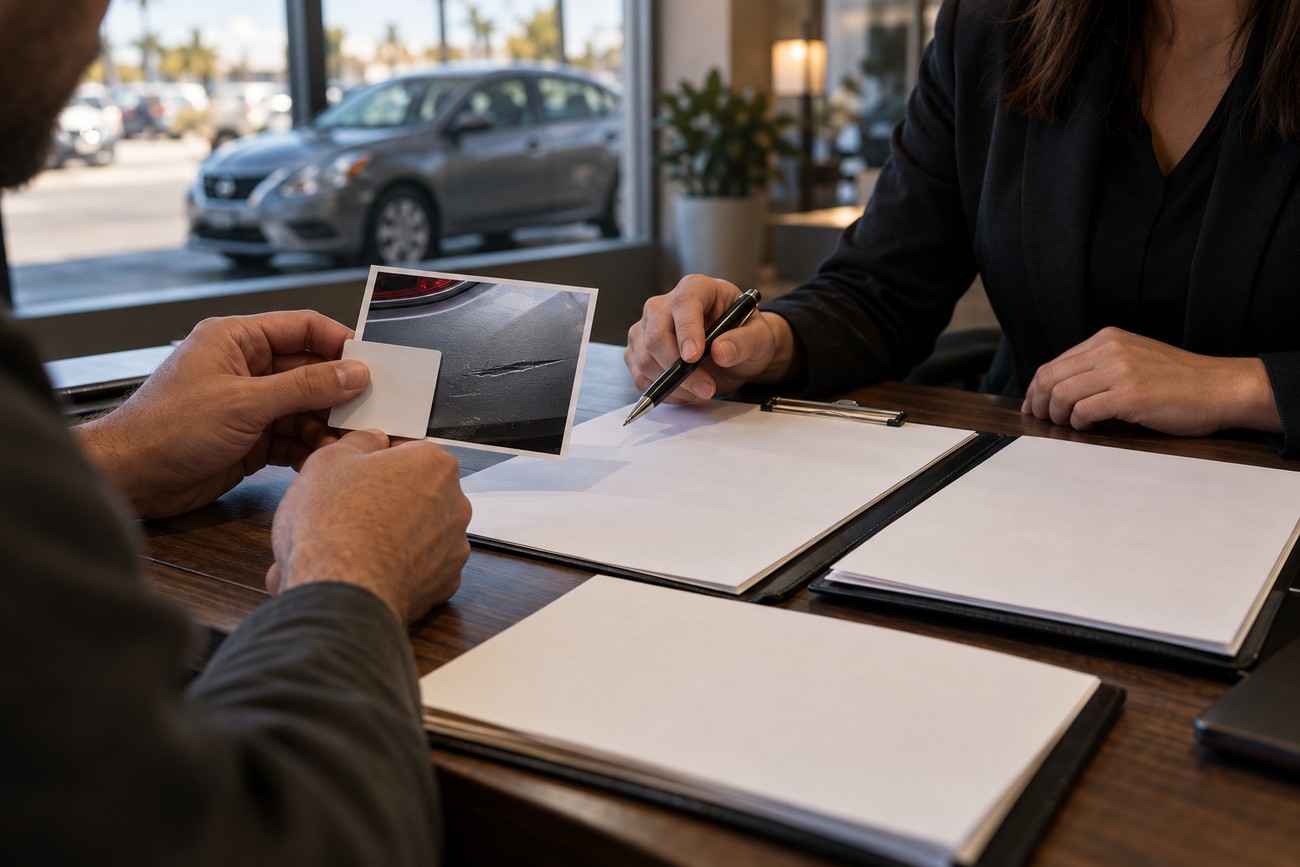
Start with the rental agreement, the vehicle condition report, the damage policy, the tariff for your rental rate, and any damage-assessment schedule. These documents may define ordinary wear, chargeable damage, inspection procedures, notice requirements, and the fees the company may seek after a return.
Scratch thresholds vary by company, country, contract, and rental rate. One cited Dollar policy says that one scratch larger than a 2 × 3.5-inch credit card, or several 1-inch scratches whose combined area exceeds that size, may be treated as damage. That is an illustration of one company’s policy, not a universal rule for every rental company or every Nissan Versa.
Do not assume that a small mark is automatically free or automatically billable. The agreement may distinguish between ordinary wear and damage requiring repair, and it may use separate criteria for paint transfer, dents, scuffs, or damage to a particular panel.
An invoice can contain more than a repair line. Assessment, administration, loss-of-use, or diminished-value charges depend on the rental agreement and applicable local law; none is automatically valid merely because it appears on an invoice. Ask the company to identify the contractual basis and calculation for every separate amount.
Build the Evidence: Photos, Records, and the Car’s Timeline
Compare what was recorded at pickup with what was recorded at return. The strongest photo set combines a wide view of the vehicle, a close-up of the scratch, visible identifying details such as the plate or a VIN fragment, and the surrounding pickup or return location. This helps link the image to the specific Nissan Versa rather than to an unidentified car.
Take photographs before driving away and immediately after return. Include the bumpers, sills, wheels, lower sections of panels, and other areas often missed in a quick walk-around. Use the original files where possible, and preserve the date and time shown by the device, the rental confirmation, and any location record.
One general photograph rarely shows enough detail to establish the size, position, and condition of a scratch. Cloud metadata can support a timeline, but metadata alone does not prove that a file has remained unchanged. A sequence of original images, taken in context and supported by the rental records, is more persuasive.
For a contactless return, record the time, location, mileage, fuel level, and key handover. Save the return confirmation, the app screen, the email acknowledging receipt, and any photograph showing where the vehicle was left. These details can matter if the company inspected the car much later.
- Keep the signed condition report and rental agreement.
- Preserve original pickup and return photographs, not only edited or compressed copies.
- Request the prior inspection images, post-return images, and damage report.
- Ask for the repair estimate or itemized calculation.
- Request relevant vehicle-movement history if the car went between customers or branches.
- Save every email, letter, app message, and payment record.
How to Dispute the Nissan Versa Scratch Charge

First preserve the invoice, payment record, rental agreement, condition report, and all photographs. Write down the dates and locations of pickup and return while they are still clear. If you already called the company, send a follow-up email summarizing the call and keep future communication in writing.
Send a formal written dispute promptly. State that the damage existed previously or has not been proven to have occurred during the rental. Explain where the scratch was, what you observed at pickup or return, and which documents support your position. Avoid making an unnecessary admission of responsibility while the timing remains unresolved.
The most useful request is often the vehicle’s full inspection and movement timeline, rather than another close-up of the alleged scratch. It can show whether the same condition was recorded before your rental and who had control of the car before the damage report.
Ask for the company’s evidence before pickup and after return, the damage report, the itemized repair calculation, and any relevant vehicle-movement history. Also ask when the vehicle was inspected, who recorded the damage, whether it was repaired, and whether the invoice includes administrative or downtime amounts.
Keep the dispute factual and specific. A concise request might say that you dispute liability because the scratch was pre-existing or because the company has not established that it occurred during your rental, and that you request suspension or review of the charge while the evidence is examined. Do not rely only on a telephone complaint.
If the company rejects the dispute, review the escalation route in the agreement and consider a consumer-protection agency or other local dispute process. A payment dispute may be possible in some cases, but its availability and outcome depend on the bank, payment network, rental contract, and jurisdiction. Keep pursuing the documentary record rather than presenting a chargeback as guaranteed.
CDW, Deductibles, and Charges Beyond the Repair
CDW is generally a contractual waiver or limitation, not blanket insurance. It may reduce your exposure subject to a deductible, exclusions, reporting duties, and conditions about how the vehicle was used. Read the version attached to your rental rate, since different products can apply different limits.
Glass, tires, and particular categories of body damage may be treated separately under the agreement. A policy can cover ordinary body damage while excluding certain parts, or it can impose a separate deductible. Administrative charges may also appear even when the repair itself is covered, if the contract permits them.
Coverage eligibility and responsibility are separate questions. CDW does not by itself prove that the scratch occurred during your rental, and a dispute about timing should still be made even if the company says the damage falls within a CDW process.
Ask the company to explain the deductible, the covered category, and every additional fee. Whether repair, assessment, administration, loss of use, or diminished value can be recovered depends on the agreement and applicable local law.
Prevent the Next Scratch Dispute at Pickup and Return
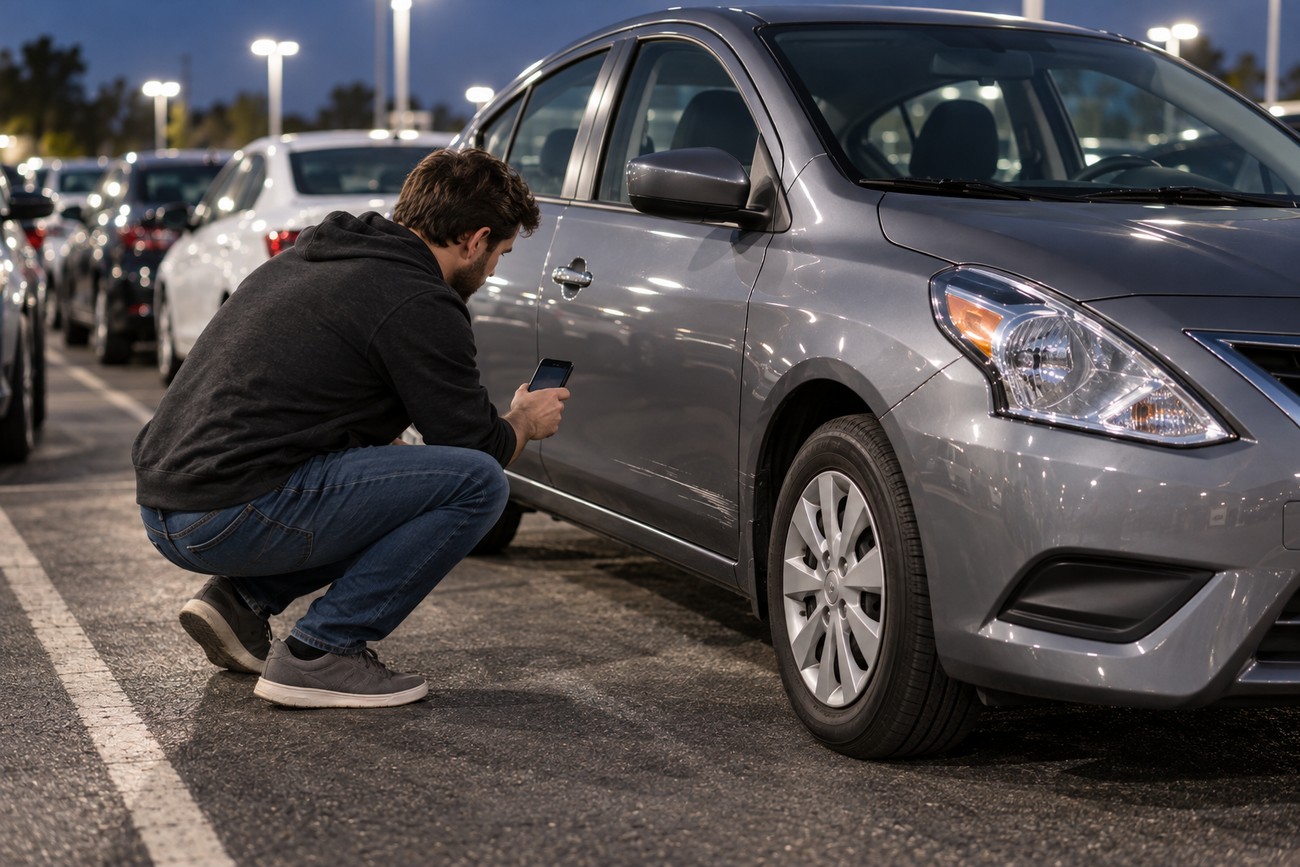
Allow time for a complete walk-around before leaving the lot. Check bumpers, sills, wheels, lower panels, door edges, mirrors, and less visible areas rather than looking only at eye level. Dirt, poor lighting, and a rushed handover can hide marks that later become disputed.
Report every existing defect before departure and have it added to the condition report or confirmed in the rental app. A verbal comment to an employee is weaker than a corrected document, signed report, or written app confirmation. If staff are unavailable, photograph the defect and send a time-stamped message before driving away.
Take a series of wide and close photographs at pickup and return. Show the vehicle, the defect or clean panel, identifying details, and the surrounding location. Keep the original files and confirmations with the contract, because an automatic rental closure or a signed “no damage” line may not prevent a later claim.
For a key-drop return, photograph the car after parking and record the mileage, fuel level, time, location, and moment the keys were handed over. Save proof that the company received the vehicle. This record cannot guarantee that a company will not invoice you, but it gives you a clearer timeline to use if the inspection happened later.
Frequently asked questions
Rental damage decisions depend on the agreement, the evidence, and the applicable local rules. The answers below describe the usual issues without treating one company’s policy as universal.
What happens if you return a rental car with scratches?
The company may inspect the vehicle at return or later and may issue a damage charge if it considers the scratch chargeable under the agreement. A later invoice does not automatically establish that you caused the mark, especially if the pickup condition was poorly documented.
Review the condition report and compare it with your own pickup and return photographs. If the scratch was already present or the timing is unproven, dispute the charge in writing and request the inspection records and itemized calculation.
How much will I get charged for a scratch on a rental car?
There is no universal price or scratch threshold. The amount can depend on the company’s damage policy, the rental rate, the location, the repair calculation, any deductible, and contract-based assessment or administration fees.
Ask for an itemized explanation rather than accepting a single total. Repair, assessment, administration, loss of use, or diminished-value charges depend on the rental agreement and applicable local law.
What happens if I get a small scratch on my car rental?
A small scratch may fall within ordinary wear under one contract and qualify as damage under another. The relevant test can include its size, depth, location, number of marks, and the company’s published or contractual criteria.
Report it promptly, document it clearly, and check CDW terms before paying. CDW may include a deductible or exclusions, and it does not resolve whether the scratch was present before your rental.
What happens if you scratch an Enterprise rental car?
Follow the Enterprise agreement and the instructions for reporting vehicle damage at the location where you rented the car. The applicable process, threshold, deductible, and fees should be confirmed from the contract and rate-specific documents rather than assumed from another company’s policy.
If the mark was pre-existing or the evidence does not show when it appeared, state that in a written dispute and request the before-and-after inspection records, damage report, and itemized calculation. The outcome can depend on the evidence, contract, and local rules.







