
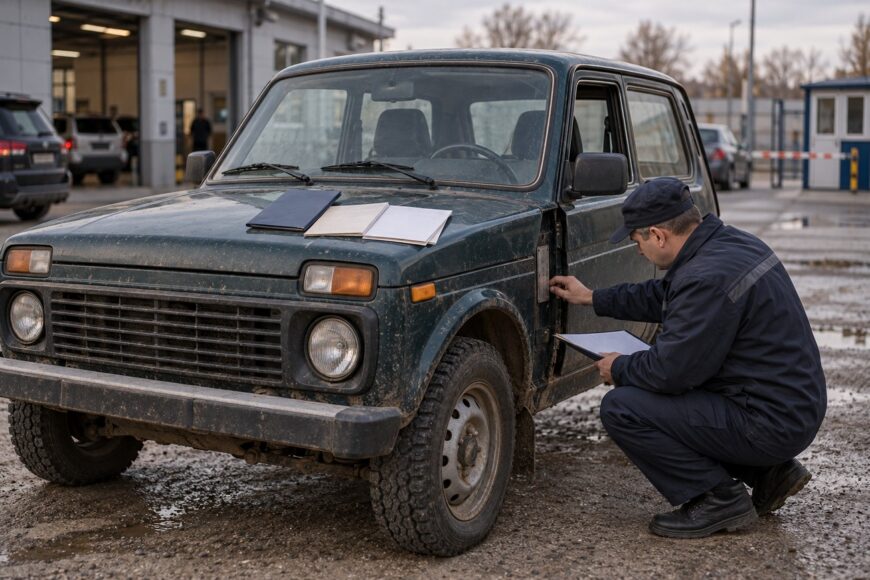
A rugged Lada Niva used for field work may look like agricultural machinery, and dealers sometimes present it as a “farm vehicle.” Its legal identity is different. A standard Niva is a Category M1 passenger vehicle, even when it spends most of its time on a farm, forest track, or field.
That distinction determines where it is registered and which tax or insurance rules apply. In most cases, the practical choice is ordinary GIBDD registration, written confirmation of any regional benefit, or the purchase of genuinely registrable agricultural machinery instead of relying on a sales promise.
- Why a Lada Niva Is Not a Tractor
- GIBDD or Gostekhnadzor: Which Register Applies?
- What Farm Use Does—and Does Not—Change
- Common Registration Failures and Safer Alternatives
- Frequently asked questions
- What should I verify before buying a Niva advertised as a farm vehicle?
- What are the IRS rules for farm vehicles?
- How far can you drive a farm-use vehicle in WV?
Why a Lada Niva Is Not a Tractor
A standard Lada Niva is a Category M1 passenger vehicle. Its registration documents are a PTS or electronic vehicle passport, and its normal registration authority is the GIBDD. The vehicle’s use on agricultural land does not change its approved category.
Gostekhnadzor deals with qualifying tractors and self-propelled agricultural, road, cleaning, and similar machines that are not subject to registration with the GIBDD. Such machinery normally has a PSM, or passport of a self-propelled machine. A PTS or electronic vehicle passport is not a substitute for a PSM.
This is why a Niva cannot normally be registered as a tractor simply because it carries tools, reaches fields, or belongs to a KFH or agricultural business. The decisive issue is the vehicle’s approved design and registration route, rather than the owner’s occupation or the surface on which the vehicle is driven.
GIBDD or Gostekhnadzor: Which Register Applies?
The comparison below shows why engine size alone cannot move an M1 car into the agricultural-machinery register.
| Vehicle | Category and authority | Document | Engine threshold | Registration logic |
|---|---|---|---|---|
| Lada Niva | Category M1; GIBDD | PTS or electronic vehicle passport | Engine size does not change the route | Registered as a passenger vehicle |
| Qualifying tractor or self-propelled agricultural machine | Gostekhnadzor | PSM | Internal-combustion engine over 50 cm³ | Must fall within the self-propelled-machine rules and not require GIBDD registration |
The more-than-50-cm³ threshold applies within the rules for qualifying self-propelled machinery. It does not convert a passenger car into such machinery. A Niva remains subject to GIBDD registration because its construction and approval place it in Category M1.
For a genuine self-propelled machine, registration is generally required within 5–10 days after acquisition, transfer of ownership, or receipt of a transit plate. That timetable does not create a separate deadline or route for a standard Niva at Gostekhnadzor.
What Farm Use Does—and Does Not—Change
Farm use does not automatically create a legal “farm vehicle” status. A KFH, agricultural business activity, field operation, or rural address does not by itself reclassify an M1 Niva as agricultural machinery.
The same principle applies to tax and insurance. There is no general federal mechanism that reduces transport tax or OSAGO premiums for a Niva solely because it is used in agriculture. Treatment is usually linked to the vehicle type and registration route, rather than the owner’s business activity.
Regional benefits may exist, but they are exceptions requiring confirmation from the relevant local tax or registration authority. The word “commercial” in a model description, including a commercial Niva version, may affect business or accounting treatment while leaving the vehicle an automobile registered through the GIBDD.
Obtain the position in writing before relying on a benefit. A verbal statement from a dealer, MFC employee, or local official may not protect you if the tax authority later applies the ordinary rules for a passenger vehicle.
Common Registration Failures and Safer Alternatives
The most predictable failure is an application to Gostekhnadzor based only on a PTS. Without a PSM and an eligible self-propelled-machine category, the application will generally be rejected. Repeated visits between the GIBDD, Gostekhnadzor, and an MFC rarely change that legal position.
Dealer descriptions create a second risk. Before paying for a Niva advertised as agricultural or farm machinery, check the vehicle category, the registration authority, and the document supplied for registration. Ask for written confirmation of any promised tax treatment rather than treating a marketing label as a legal status.
Before purchase, obtain the vehicle category and registration route in writing from the local authority named by the seller. This simple check can expose a farm-vehicle promise supported only by advertising.
Equipment can create a separate problem. An unapproved winch, snowplough, tow arrangement, or other design change may cause inspection, registration, or enforcement difficulties. Where applicable, also verify required safety equipment, including systems specified for particular vehicle batches.
The safer alternatives are straightforward: register the Niva normally with the GIBDD, register trailers and genuine agricultural machinery through the proper route, and confirm regional benefits separately. Conversion of a serial Niva into a self-propelled machine with a PSM is theoretically possible through specialized certification, but it is rare, costly, and difficult to complete.
The framework is also changing. Government Resolution No. 1507 is scheduled to lose force on 1 September 2026, while new rules and a unified register of self-propelled machinery are being prepared. Future controls should not be used as a reason to claim a current right to register an ordinary Niva as a tractor.
Frequently asked questions
Registration depends on the vehicle’s legal category, not simply on the owner’s farming activity.
What should I verify before buying a Niva advertised as a farm vehicle?
Check the PTS or electronic vehicle passport, confirm that the vehicle is Category M1, and identify the authority that will register it. Ask the local GIBDD, tax authority, or other competent body for a written position on any claimed regional benefit, including the exact tax condition.
Request approval details for proposed modifications such as a winch, plough, or tow equipment. If the seller promises Gostekhnadzor registration, require the relevant PSM and legal basis before signing the purchase documents.
What are the IRS rules for farm vehicles?
IRS rules are United States tax rules and do not govern registration of a Lada Niva in Russia. For a Russian vehicle, use the applicable regional transport-tax rules and obtain confirmation from the local tax authority; farming activity alone does not establish a nationwide Niva exemption.
How far can you drive a farm-use vehicle in WV?
West Virginia rules do not determine how a Russian-registered Niva may be used. In Russia, a farm-use Niva remains a passenger car, so its road use, insurance, and compliance duties follow the Russian vehicle category and applicable traffic rules.







