
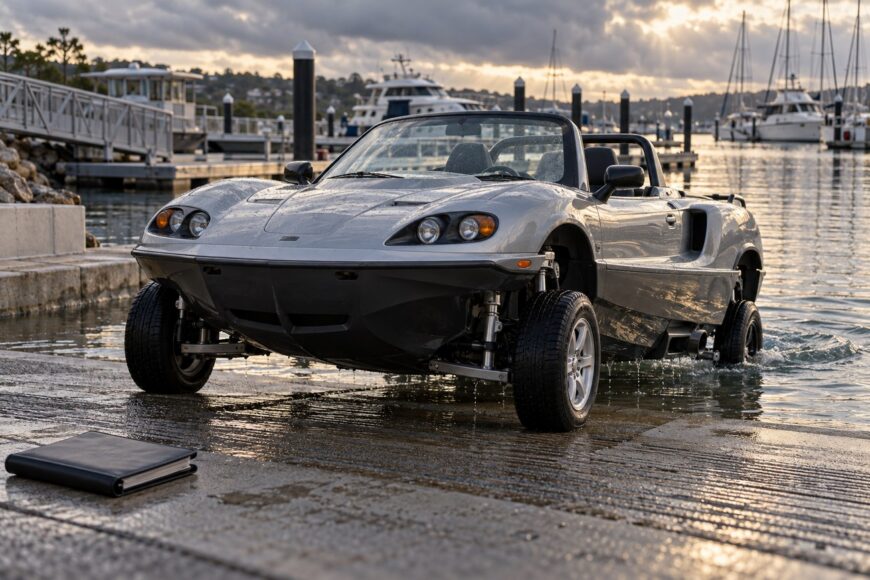
A Gibbs Aquada can operate on roads and on the water, but that capability does not create one universal registration. You must satisfy separate requirements for the vehicle, the vessel, and the particular waterway where you intend to use it. Car registration alone may leave the marine side unresolved, while vessel paperwork does not replace road approval, plates, tax, or motor insurance.
The main risk appears before the purchase. The Aquada is no longer produced, and Gibbs describes it as a proof-of-concept, so an older example may have incomplete ownership, import, conformity, or builder documentation. Before committing funds, obtain written guidance from the relevant road authority, vessel registrar, insurer, and local navigation authority for the exact vehicle and intended operating area.
- Why the Aquada Needs Two Compliance Tracks
- Road Registration: What the Car Side Requires
- Boat Registration, Licensing, and Waterway Limits
- A Pre-Purchase Path to Dual Registration
- Budgeting for Ownership Beyond the Purchase Price
- Common Registration Myths and Hidden Limitations
- Frequently asked questions
- What other vehicles can operate as both cars and boats?
- What is the current price of a Gibbs Aquada?
- What types of vehicles can travel both on land and underwater?
Why the Aquada Needs Two Compliance Tracks
Gibbs classifies the Aquada as a Private Light Vehicle for road purposes and identifies it as an RCD Category D vessel for design purposes. Those labels help describe the product, but they are not universal permissions. The road authority decides whether the specific example can be registered for road use, while maritime and navigation authorities apply separate rules on the water.
RCD Category D describes intended design conditions for a recreational vessel. It does not automatically authorize navigation on every lake, river, tidal water, or coastal area. Local limits may depend on the waterway, operating area, safety equipment, insurance, registration status, and the rules of the authority controlling access.
The model’s discontinued status adds a further qualification. Historical claims that a particular version met road and marine requirements may relate to a specific market and period of production. They do not guarantee current approval in another country, especially where the vehicle must pass individual certification or where original records are missing.
Road Registration: What the Car Side Requires
For road use, expect the ordinary vehicle-registration process, adapted to an unusual and discontinued design. Depending on the country, the authority may require type approval or individual certification, vehicle registration, number plates, applicable road tax, and motor insurance. The fact that the Aquada is amphibious does not remove any of those steps.
The ownership file should be checked before inspection or transport costs are incurred. Ask for the VIN or serial number, title or equivalent ownership document, bill of sale, import records, and any conformity or approval evidence. An incomplete chain of ownership can delay registration even where the vehicle starts, drives, and appears to have been maintained.
Imported examples deserve particular caution. A vehicle once accepted in its original market may still need an individual assessment in the destination country. The authority may examine lighting, emissions, braking, glazing, restraints, dimensions, labeling, and other requirements under current rules rather than relying on a seller’s description of historical compliance.
Request a written response from the road registrar before buying. Include the exact VIN or serial number, country of origin, intended country of registration, and copies of the documents already available. Verbal reassurance from a seller, broker, or previous owner is useful background, but it is not evidence that the authority will accept the vehicle.
Boat Registration, Licensing, and Waterway Limits
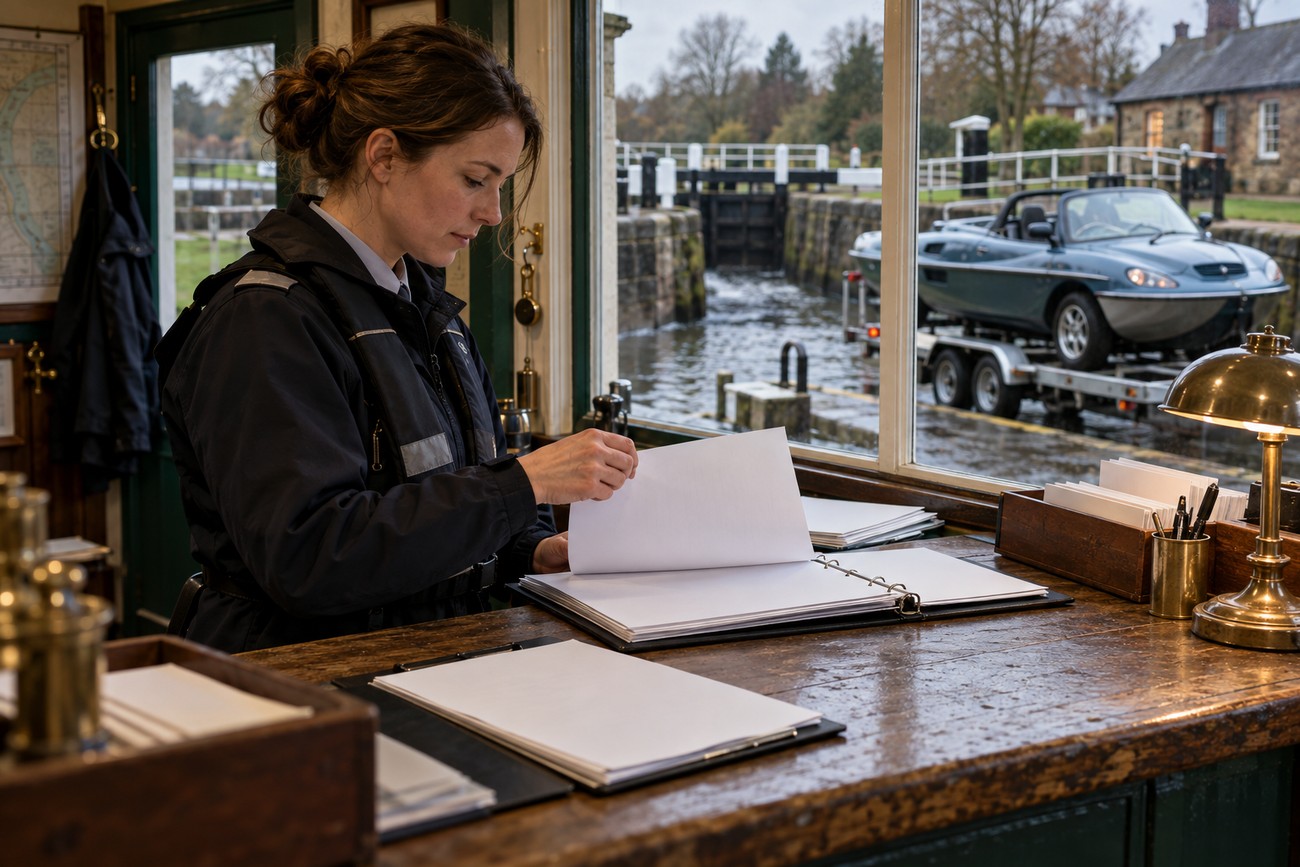
Vessel registration and permission to navigate are separate questions. The UK provides a useful example: the UK Ship Register may be relevant for sea-going registration, while inland waterways can require a separate license from the relevant navigation authority. Tidal waters, inland waters, and open-sea use may therefore involve different applications, fees, safety rules, and insurance conditions.
For a UK Ship Register application, the file may include a bill of sale, builder’s certificate, vessel particulars, measurement or tonnage evidence, and safety documentation. Radio information or other technical records may also be relevant, depending on the registration and intended operation. The exact list should be confirmed with the register before the transaction, because an Aquada’s automotive appearance does not simplify the vessel file.
Car registration cannot substitute for these documents. Nor does an RCD Category D classification prove that the Aquada can be used on a particular canal, river, harbor, or coastal zone. The local navigation authority may require its own licence, insurance evidence, equipment checks, or restrictions on where and when the craft may operate.
Confirm the status of the intended launch site as carefully as the registration route. A waterway may have rules about propulsion, speed, access points, pollution controls, navigation lights, or operating hours. A vessel that is legally registered for sea use may still need additional permission to enter or remain on an inland waterway.
A Pre-Purchase Path to Dual Registration
Start by sending the same core vehicle information to four parties: the road registrar, the vessel registrar, the insurer, and the navigation authority for the proposed waterway. Ask each one to identify the required documents, inspections, certificates, and acceptable substitutes. Written pre-clearance is especially valuable for a discontinued model because the process may depend on individual assessment.
Next, reconcile the vehicle’s identity and history. Match the VIN or serial number across the chassis, title, bill of sale, import papers, builder’s certificate, and any conformity records. If a document is absent, ask the authority in writing whether a replacement declaration, inspection, archive record, or other evidence will be accepted before paying for the vehicle.
Missing ownership or builder paperwork can be harder to resolve than a mechanical defect, so obtain written confirmation that substitute documents are acceptable before purchase.
The inspection should cover both operating modes. A specialist needs to assess the road drivetrain and five-speed automatic transmission alongside the folding suspension, hydraulic systems, waterjet, propulsion controls, hull, steering, bilge arrangements, navigation lights, and safety equipment. A conventional car workshop may not be equipped to test the marine systems, and a general boat yard may not understand the road mechanism.
Finally, make the sale conditional where possible on document verification and an inspection outcome. Confirm who will pay for missing certificates, transport, testing, and repairs if the authority rejects the application. An Aquada that is mechanically operational can still be difficult or impossible to register if its provenance cannot be established.
Budgeting for Ownership Beyond the Purchase Price
The purchase price is only one part of the ownership calculation. Allow for separate vehicle and vessel insurance, registration or licensing charges, transport, storage, specialist inspection, and repairs. Depending on the country and waterway, you may also need paid access to a suitable launch facility or secure storage that accommodates the vehicle’s unusual dimensions and weight.
Service access is a practical constraint. The Aquada combines a road drivetrain, folding suspension, hydraulic equipment, waterjet, and marine systems, while the model is no longer produced. Parts availability and technician familiarity may therefore be limited. Before purchase, identify who can safely inspect and repair each system rather than assuming that an ordinary automotive or marine workshop can handle the complete vehicle.
Launch infrastructure matters as much as paperwork. A suitable slip or ramp must accommodate the vehicle and its transition into water without damaging the hull, wheels, hydraulic components, or propulsion system. Recovery also needs planning; a site that allows launching may not provide safe lifting, parking, drainage, or emergency recovery.
Published specifications provide context, not a budget or performance guarantee. The Aquada is described with a 2.5-liter V6 rated at 175 hp, a published mass of about 1,466 kg, and a gross permissible mass of about 1,750 kg. Water-speed figures are commonly stated as approximately 31–35 mph, but sources and measurement conditions vary, so those figures should not determine insurance, route planning, or safety assumptions.
Common Registration Myths and Hidden Limitations
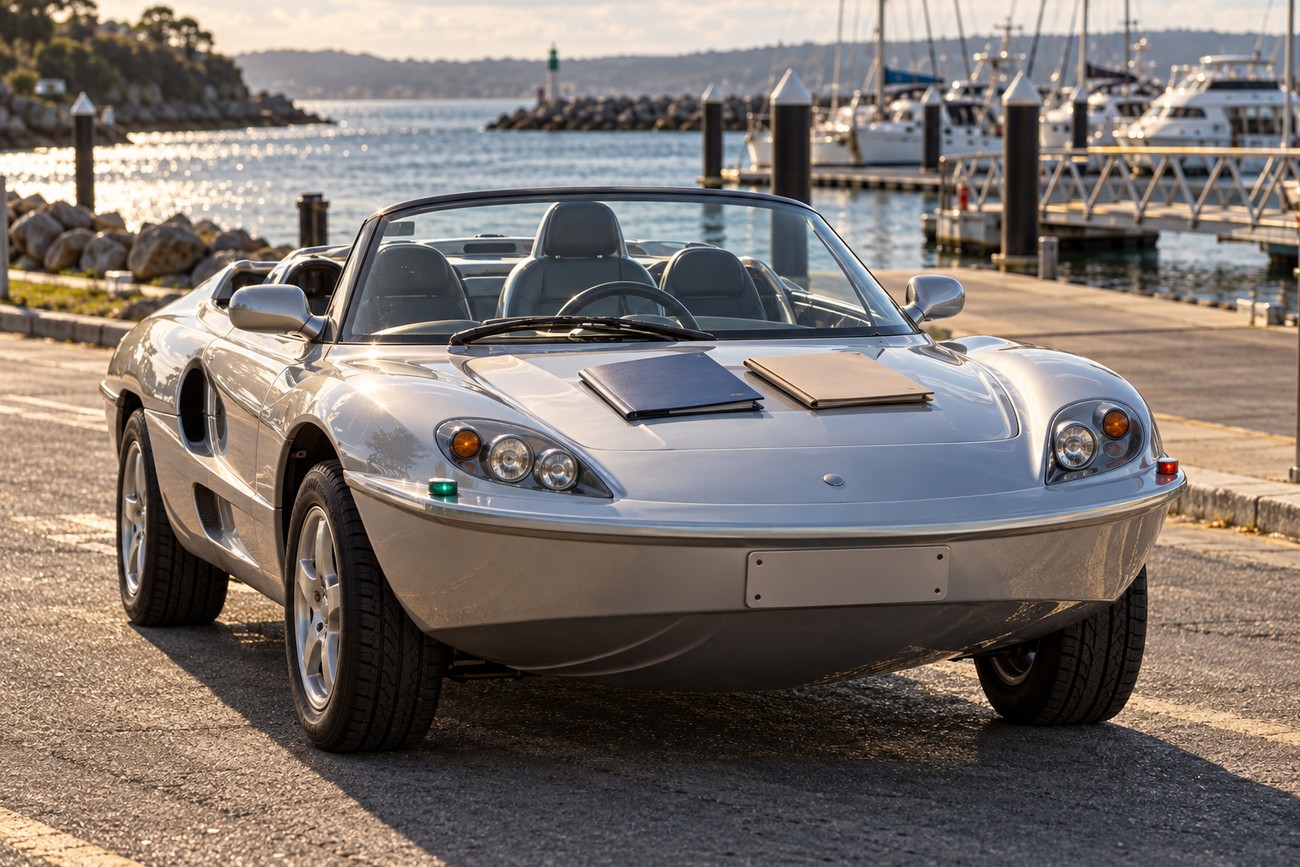
Car registration does not cover marine or inland-water use. It confirms that the vehicle meets the applicable road process; it does not replace vessel registration, a navigation-authority license, or waterway-specific permission. The reverse is also true: marine paperwork does not provide number plates, road tax, or motor insurance.
RCD Category D is another frequent source of confusion. It is a design category describing intended conditions of use, not a universal registration or navigation authorization. Navigation lights, a waterjet, and the ability to retract the wheels may demonstrate functional equipment, but they do not automatically establish legal access to every waterway.
Marketing claims require careful interpretation because the manufacturer’s current description is that the model is a discontinued proof-of-concept. Claims of road and marine compliance may have applied to a particular version and market. Current eligibility must be confirmed individually, with the actual identification number and available records placed before the relevant authorities.
The transition to water mode is also a technical operation rather than a legal approval. Gibbs describes the wheels as retracting in approximately four seconds after water mode is selected, with propulsion supplied by a waterjet. Likewise, “non-sinkable if swamped” wording is not a guarantee against every accident, overload, hull damage, or maintenance failure, and published speed figures are not a universal guaranteed operating speed.
Frequently asked questions
The Aquada’s road and marine requirements must be assessed separately. Registration history, documentation, and operating permissions can vary by country and waterway. The following answers address common questions without treating another vehicle’s approval as proof that a particular Aquada qualifies.
What other vehicles can operate as both cars and boats?
Other amphibious vehicles have included purpose-built road-and-water craft, converted cars, and small recreational designs that use wheels, propellers, or waterjets. Their legal treatment varies widely: some are assessed primarily as road vehicles, some as boats, and some require approval in both categories.
Another vehicle’s registration history cannot prove that an Aquada will qualify. Authorities assess the specific design, identification number, documents, equipment, and destination rules, so comparisons are useful for research only.
What is the current price of a Gibbs Aquada?
There is no dependable current manufacturer list price because the Aquada is no longer produced and is described by Gibbs as a proof-of-concept. Any advertised example is a private-market transaction rather than a current factory offering.
Prices are difficult to compare without checking condition, provenance, import status, missing certificates, storage history, and whether the road and marine systems work together. A cheaper example may require substantial spending on transport, specialist repairs, documentation, and individual certification.
What types of vehicles can travel both on land and underwater?
Amphibious vehicles such as the Aquada are designed for land travel and surface-water operation; they are not underwater vehicles. Underwater-capable machines belong to a different category, including submersibles, remotely operated vehicles, and specialized military or research craft.
A vehicle that can float or drive across the water should not be treated as capable of diving. Its hull, propulsion, buoyancy, pressure resistance, controls, and safety systems are designed for surface operation, and the Aquada is not intended for underwater travel.







