
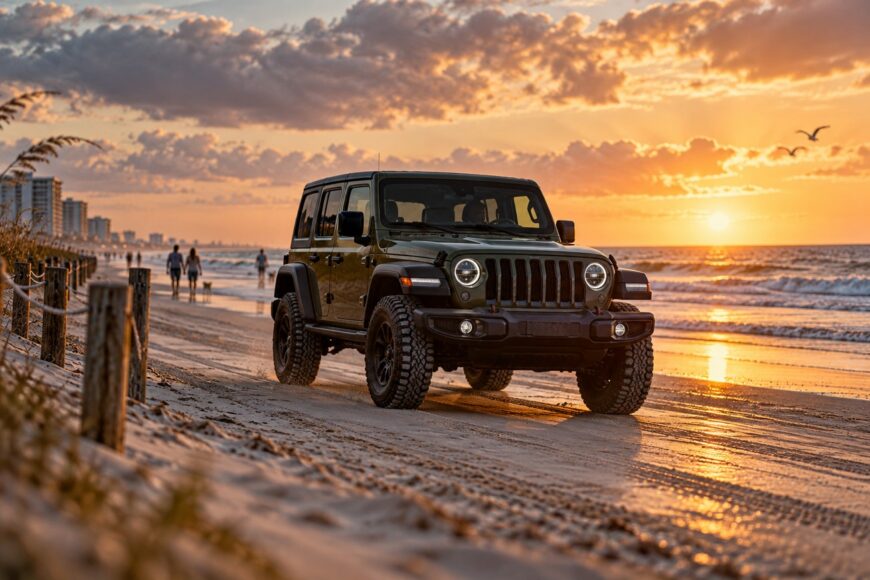
Racing a Jeep Wrangler on Daytona Beach sounds more casual than it is. The Wrangler is capable on loose ground, yet horsepower and four-wheel drive matter less than legal access, speed limits, tide movement, sand conditions, and vehicle preparation. Daytona Beach vehicle access is limited to designated sections and governed by local rules; driving is not unrestricted along the entire coast.
Here, “racing” means controlled beach driving and handling practice, not competitive or high-speed racing. Coastal-zone limits are typically about 10–15 mph, with the exact value depending on the section, season, and posted local rules. A beach vehicle also shares limited space with pedestrians, wildlife, traffic, and changing water conditions, while salt and wet sand continue affecting the Jeep after you leave.
- What “Racing” a Wrangler on Daytona Beach Really Allows
- Why a Jeep Wrangler Can Still Get Stuck
- Prepare the Wrangler Before Entering the Sand
- How to Drive Without Digging In
- The Mistakes That Turn a Beach Run Into a Recovery
- Salt, Sand, and the Cost After the Drive
- Myths to Drop Before You Call It a Race
- Frequently asked questions
- What should I do if a tire loses its bead after airing down?
- How soon should I inspect the Wrangler after a saltwater beach run?
- What tire pressure should I use when driving a Wrangler on sand?
What “Racing” a Wrangler on Daytona Beach Really Allows
Daytona Beach is a regulated driving environment, not an open race course. Vehicle access is permitted only on designated sections, and individual entrances can have different signs, operating conditions, or closures. Local restrictions may also apply to time of day, seasonal zones, parking, and particular beach ramps.
The coastal-zone speed limit is typically about 10–15 mph, although the exact value depends on the section, season, and posted local rules. That limit is also a useful warning about the surface: the beach may look wide and empty, yet braking distances, pedestrians, crosswinds, and soft sand can change quickly. A Wrangler’s ability to accelerate does not remove those hazards.
Check current official access information before driving onto the sand, then read the signs at the entrance. Rules can change with tides, storms, construction, wildlife protection, or seasonal use. A ramp that was open on a previous visit may be restricted today, and a legal access point does not automatically make every nearby strip suitable for driving.
Keep the vehicle within the permitted area and treat the trip as low-speed, controlled driving. The attractive line beside the ocean is also the area where waves, people, and changing sand create the greatest consequences for a mistake. A short, cautious run on a legal section is a different activity from trying to imitate a promotional off-road video.
Why a Jeep Wrangler Can Still Get Stuck
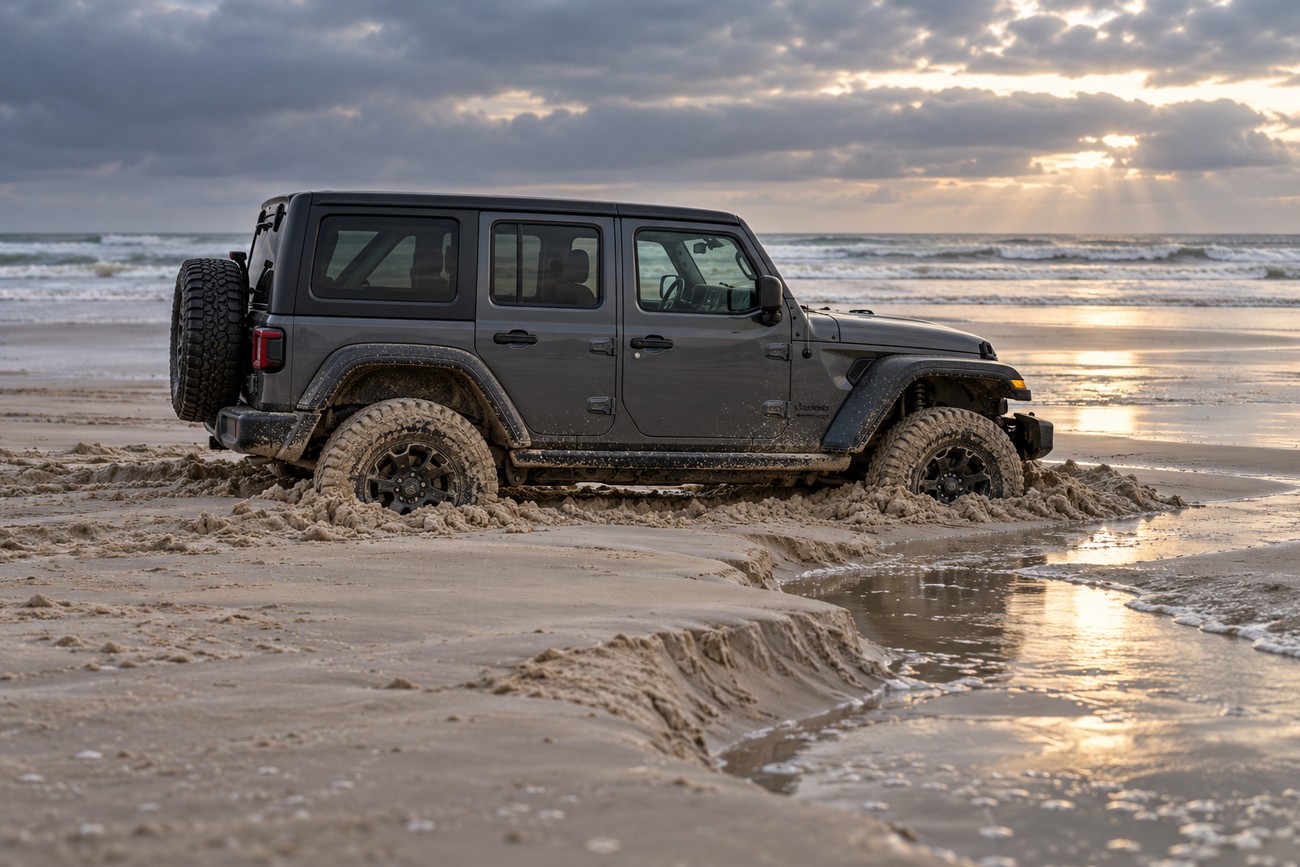
A Wrangler is generally better suited to loose ground than a conventional passenger car, but four-wheel drive does not prevent bogging in soft sand. Firm sand can support the tires well, then give way where a tide has cut a hole, left a soft pocket, or exposed a loose layer beneath a thin crust. Fresh depressions after a tide change deserve particular caution.
The strip that looks firmest near the water can be deceptive. The best usable line is often above the active waterline rather than directly beside the surf, provided that line is legal and checked for ruts and soft pockets. Waterline sand may be denser, but waves can undercut it and leave the vehicle with little room to recover.
Stock road-oriented tires can provide noticeably weaker traction and braking on wet or soft sand than a suitable sand-oriented setup. Soft ground also creates heavy steering, increased fuel consumption, and added drivetrain or brake heat. Passengers, luggage, heavy modifications, lift equipment, and oversize wheels add load or ground pressure, making the Jeep sink deeper and increasing recovery difficulty.
Ride height is no guarantee of flotation. A tall Wrangler can still settle onto its frame or axles in deep ruts or loose sand, leaving the tires unable to generate useful forward motion. Once the chassis is resting on the sand, engine power usually makes the situation worse by digging around the vehicle.
Prepare the Wrangler Before Entering the Sand
Start with the tires, wheels, and load rather than assuming the Wrangler’s factory equipment is ready for beach use. Inspect the tread, sidewalls, valve stems, and bead areas, and remove unnecessary weight. A practical sand-driving starting range is approximately 12–18 psi, adjusted for the Wrangler’s weight, tire construction, wheels, and actual load.
Lower pressure enlarges the contact patch and can reduce sinking. Excessive reduction can cause bead loss, tire damage, or unstable handling, so pressure should be changed deliberately and checked with a reliable gauge. Reduced-pressure tires are unsuitable for ordinary road speeds, and the pressure must be restored before returning to pavement.
Carry a portable or onboard compressor capable of restoring normal road pressure, along with a pressure gauge and basic recovery equipment. A shovel, traction boards, rated recovery points, and suitable straps can help with a controlled recovery when conditions allow. Recovery equipment does not justify entering a section where the tide or pedestrian traffic leaves no safe working space, or where access rules prohibit driving.
Check underbody clearance and protection for the Jeep’s actual setup. Skid protection, exposed lines, loose wiring, and vulnerable suspension components deserve attention before saltwater and abrasive sand reach them. Plan fuel conservatively because soft sand increases rolling resistance and fuel use, while a recovery or detour can extend the trip.
Inspect the entrance and exit ramp before committing to the beach. Loose sand often begins at the ramp, and the first few yards can expose a tire-pressure or loading problem before the vehicle reaches the flatter surface. If the ramp already contains deep failed tracks, choose a different legal route or stay off the sand.
How to Drive Without Digging In
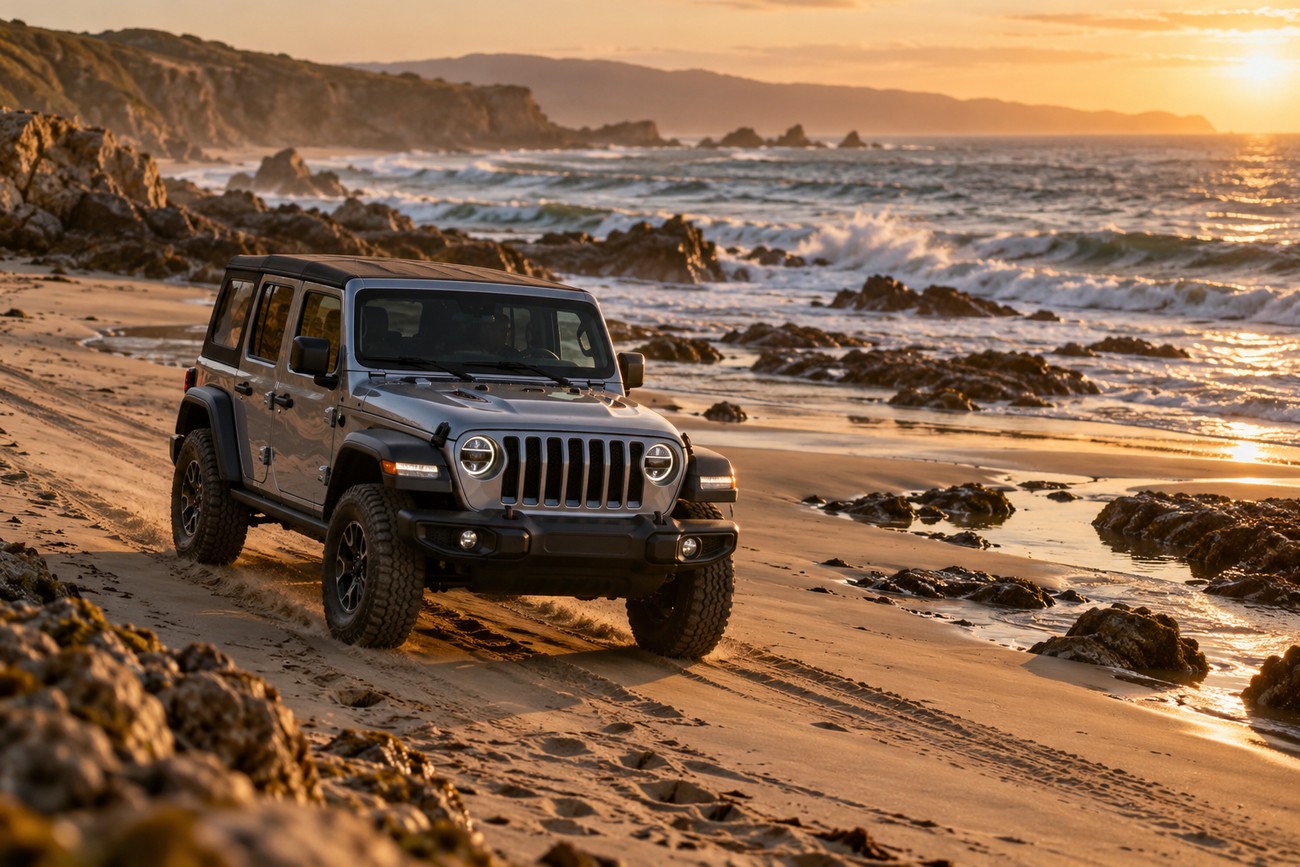
Choose the firmest legal line above the active waterline, then scan well ahead for fresh ruts, wave-cut holes, darker patches, and abrupt changes in texture. Fresh, deep tracks are a warning sign because they may indicate soft sand or repeated failed attempts. Follow a stable existing track only when it is clearly passable and does not lead toward the surf or a restricted area.
Use smooth throttle and steady momentum. On loose sand, controlled wheel rotation is more useful than maximum power; rapid acceleration makes the tires dig instead of roll. Keep steering inputs small, because sharp corrections increase drag and can push the front tires into a soft edge.
If the wheels begin to spin continuously, stop. Straighten the tires, lift off the throttle, and recover along an existing track before the Wrangler settles onto its belly.
Crosswinds can push a tall Wrangler toward the water, especially on an exposed beach. Keep a conservative distance from the waterline and account for wind before a correction becomes urgent. The driver should also leave room for pedestrians, approaching vehicles, and a safe exit rather than selecting the shortest line.
If the Jeep begins to sink, stop spinning the tires. Straighten the wheels, reverse along the existing track if possible, and recover before the chassis settles. Continuing to apply throttle may bury the tires, heat the drivetrain, and turn a minor loss of momentum into a recovery problem.
The Mistakes That Turn a Beach Run Into a Recovery
Full road-tire pressure is a common starting error. It reduces the contact patch and increases ground pressure, so the Jeep can dig in where a properly adjusted tire might have floated across the same section. Entering too fast creates a second problem: speed hides surface changes and makes steering and braking less predictable.
Ignoring tide movement, official markers, and access restrictions can leave a vehicle cut off or outside the permitted area. A route that appears broad at the start may narrow as water advances, while a seasonal or time-based restriction may apply even when the sand looks drivable. Check the route before entering and keep an exit plan that does not depend on the shoreline remaining unchanged.
Wheelspin is rarely a recovery technique. It excavates sand beneath the tires, increases heat, and can leave the Jeep resting on its belly. Four-wheel drive improves traction, yet it cannot overcome unsuitable pressure, deep soft sand, excessive load, or poor judgment.
The ramp deserves the same caution as the beach. A Jeep can pass across firm sand and then fail during the exit because the tires are still soft, the approach is steep, or the ramp has been churned by previous vehicles. Do not improvise a tow near moving water, pedestrians, or other traffic; reposition only when there is a controlled, legal place to do so.
Salt, Sand, and the Cost After the Drive
Salt spray accelerates corrosion in suspension components, brake lines, fasteners, and electrical connections. The damage is often gradual, so a Wrangler may feel normal immediately after the drive while corrosion begins around exposed hardware and connectors. Repeated beach use increases the importance of routine inspection.
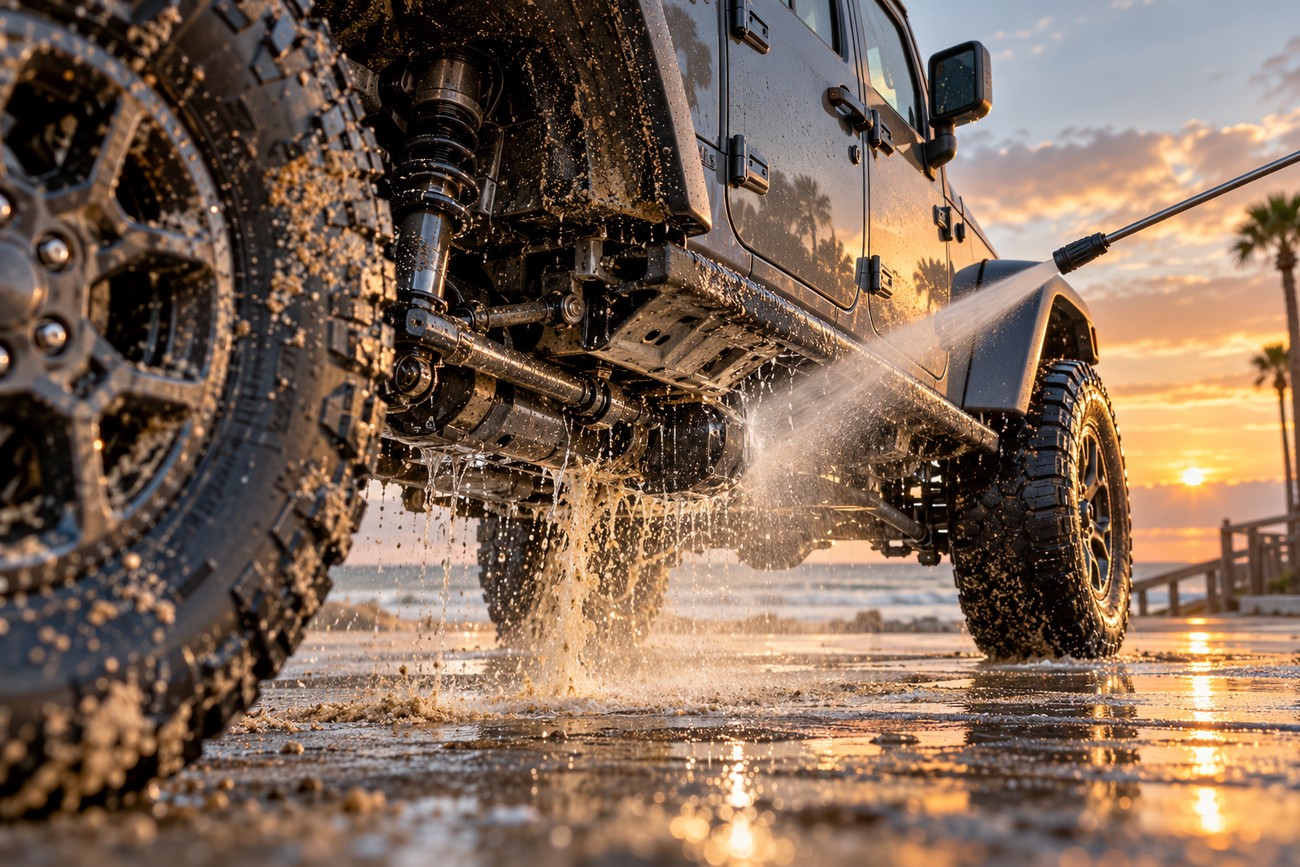
Wet sand can remain in wheel arches, brakes, hubs, and underbody areas after the vehicle appears clean. It acts as an abrasive contaminant around moving or rotating parts, and trapped moisture keeps salt in contact with metal. A rinse that reaches only the painted body leaves much of the relevant contamination behind.
Rinse the underside and wheel arches promptly after leaving the beach, using enough water to flush seams, suspension areas, brake components, and the wheel ends. Avoid directing high-pressure water into seals or electrical connectors from close range. After rinsing, allow the vehicle to dry and look for sand packed around components that are difficult to see from above.
New brake noise, unusual heat, vibration, looseness, damaged boots, or suspension symptoms should lead to an inspection before another beach run. Check wheel-end components, brake hardware, underbody fasteners, and visible electrical connections. A small vibration after sand exposure can indicate trapped material or damage that becomes more expensive if ignored.
Myths to Drop Before You Call It a Race
A Wrangler’s badge and four-wheel drive do not eliminate preparation. Tire pressure, tire construction, load, tide awareness, and smooth control determine whether the vehicle floats across the surface or digs into it. A capable Jeep still needs a suitable line and a recovery margin.
Wet sand is not automatically safer. It may be denser, but the waterline also brings soft pockets, wave damage, and a higher consequence for getting stuck. The firmest usable line is often above the active waterline, where it remains legal and free of fresh ruts.
More height is not the same as flotation. Ground clearance can help with shallow irregularities, yet it does not stop a Wrangler from grounding on its frame or axles in deep ruts or loose sand. Heavy accessories, luggage, and oversize wheels can make that outcome more likely.
Daytona Beach cannot be treated like an ordinary road. Proceed only when current access rules, tide and surface conditions, vehicle setup, and recovery margin are all acceptable. If one of those conditions fails, park off the sand and enjoy the beach without forcing the vehicle into a problem.
Frequently asked questions
Beach conditions can expose equipment problems that are easy to miss during a short drive. These failures need a specific response rather than more throttle or a quick visual check.
What should I do if a tire loses its bead after airing down?
Stop driving immediately and avoid repeated throttle. A tire that has lost its bead can damage the sidewall, wheel, or bead area if the vehicle moves, while further wheelspin can bury the wheel and make the failure harder to service.
Keep the wheel and tire stable, clear people from the recovery area, and use proper tire-service equipment to reseat and inflate the tire. An improvised beach repair with unsuitable tools can damage the tire or create an unsafe seal. If the tire cannot be serviced securely, arrange professional recovery rather than driving on it.
How soon should I inspect the Wrangler after a saltwater beach run?
Rinse the underside and wheel arches immediately after leaving the beach, then carry out a closer inspection the next day. Look for trapped sand, corrosion beginning around fasteners, brake drag, damaged boots, and loose or vibrating wheel-end components.
Pay attention to new brake heat or noise, steering changes, vibration, and electrical faults. Check underbody fasteners and connectors that may be hidden by splash shields or packed sand. If a symptom remains after rinsing, have the affected component inspected before driving on the beach again.
What tire pressure should I use when driving a Wrangler on sand?
A practical starting range is approximately 12–18 psi, adjusted for the Wrangler’s weight, tire construction, wheels, and actual load. Lower pressure can enlarge the contact patch and reduce sinking, but it should be set deliberately with a reliable gauge.
Do not use reduced-pressure tires at ordinary road speeds, and restore normal pressure before returning to pavement. Carry a compressor and monitor the tires for bead loss, sidewall damage, or unstable handling.







