
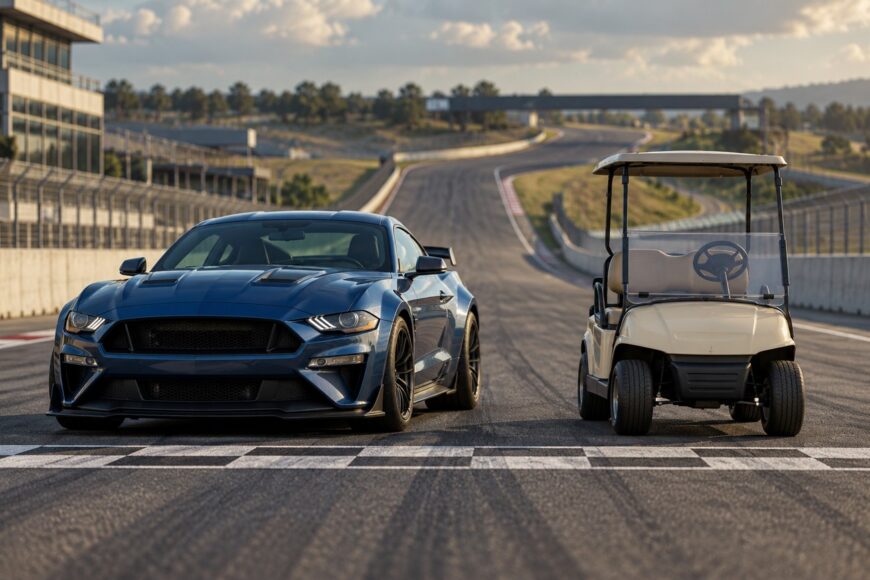
A golf cart lining up beside a Ford Mustang makes for an entertaining start line. A modified cart might launch briskly across a short stretch, especially if the Mustang driver is holding back. That moment says little about how either vehicle will brake, turn, or protect its occupants.
A useful comparison depends on the Mustang’s configuration, the cart’s condition and modifications, the surface, and the course. It also belongs at a supervised closed venue. A quick run on a public road is neither a sound performance test nor an acceptable way to settle the argument.
- What Does “Racing” a Golf Cart Against a Mustang Actually Mean?
- Golf Cart vs. Ford Mustang: The Performance Differences
- Why a “40-Mph” Golf Cart Can Still Be a Poor Race Vehicle
- How to Compare Them Fairly Without Creating a Dangerous Test
- Common Myths About Racing a Modified Golf Cart
- The Bottom Line: Which One Wins?
- Frequently asked questions
- What is the 90-degree rule in golf carts?
- What is the fastest speed a golf cart can reach?
- Why do two identical electric golf carts perform so differently?
What Does “Racing” a Golf Cart Against a Mustang Actually Mean?
A race needs a defined task. A short acceleration run, a top-speed test, a braking exercise, and a lap around a course reward different qualities. A cart can feel lively at low speed because it is light and exposed, yet that sensation does not establish that it can stop or change direction confidently.
An ordinary civilian golf cart typically travels approximately 20–25 mph (about 32–40 km/h). Many modern road-going Mustangs have top speeds noticeably above 100 mph, although the exact limit depends on trim, tires, transmission, package, and electronic restriction. Those figures make the likely outcome of a speed comparison clear, while leaving room for differences between individual vehicles and test conditions.
Mass alone does not decide a lap. The Mustang is much heavier, but it has road-car tires, a chassis built for higher speeds, and substantially greater braking capability. A golf cart’s shorter wheelbase, higher center of gravity, smaller wheels, and limited aerodynamic stability make bumps, turns, and abrupt maneuvers more consequential as speed rises.
Driver protection also belongs in the definition of a meaningful test. A golf cart lacks the full passive-safety protection expected of a passenger car. Any comparison that demands speeds or maneuvers beyond the cart’s safe operating limits has stopped being useful, regardless of what a stopwatch might record.
Golf Cart vs. Ford Mustang: The Performance Differences
The table compares typical vehicles and their operating roles, rather than treating an advertised cart speed or a particular Mustang trim as a universal specification.
| Measure | Stock or modified golf cart | Road-going Ford Mustang |
|---|---|---|
| Typical speed | Approximately 20–25 mph (about 32–40 km/h) in ordinary civilian configuration; kits may advertise approximately 30–40+ mph, subject to verification. | Top speed noticeably above 100 mph for many versions; the exact limit depends on configuration and electronic restriction. |
| Acceleration potential | A modified cart may feel quick over a short, low-speed run; load and battery or engine condition matter. | Built to accelerate across a much broader speed range; results vary by version and traction. |
| Braking | Generally simpler hardware, narrower tires, and fewer vehicle-dynamics aids. | Automotive-grade brakes, commonly with ABS and stability control. |
| Tires and stability | Small wheels, a short wheelbase, and a relatively high center of gravity limit composure, especially on uneven surfaces. | Road-car tires and an integrated chassis provide greater high-speed stability and cornering capability. |
| Occupant protection | Substantially less crash protection than a passenger car. | Designed as a road vehicle with substantially greater occupant protection. |
| Endurance | Higher speeds generally reduce electric range and can increase heat and wear. | Fuel endurance depends on driving conditions and version; designed for sustained road travel. |
| Legal operating context | Road access may require specific classification, equipment, registration, and insurance. | Road use remains subject to local requirements; racing belongs at an authorized venue. |
The braking row matters as much as the speed row. Reaching a marker first is a poor result if the cart cannot slow consistently before the next turn. Narrow tires, simpler brakes, and the absence of equivalent stability aids leave a typical cart with less margin when grip changes.
Cornering widens the gap. On a road course, the Mustang can draw on its tires, chassis, brakes, and aerodynamic stability repeatedly. A tuned cart may be entertaining on a straight, but carrying that pace through turns and over bumps is a different demand.
Endurance is easy to overlook in a brief demonstration. An electric cart driven harder generally loses range, while heat and mechanical load can limit repeat runs. A single clean pass therefore reveals less than a vehicle’s behavior over a full controlled session.
Why a “40-Mph” Golf Cart Can Still Be a Poor Race Vehicle
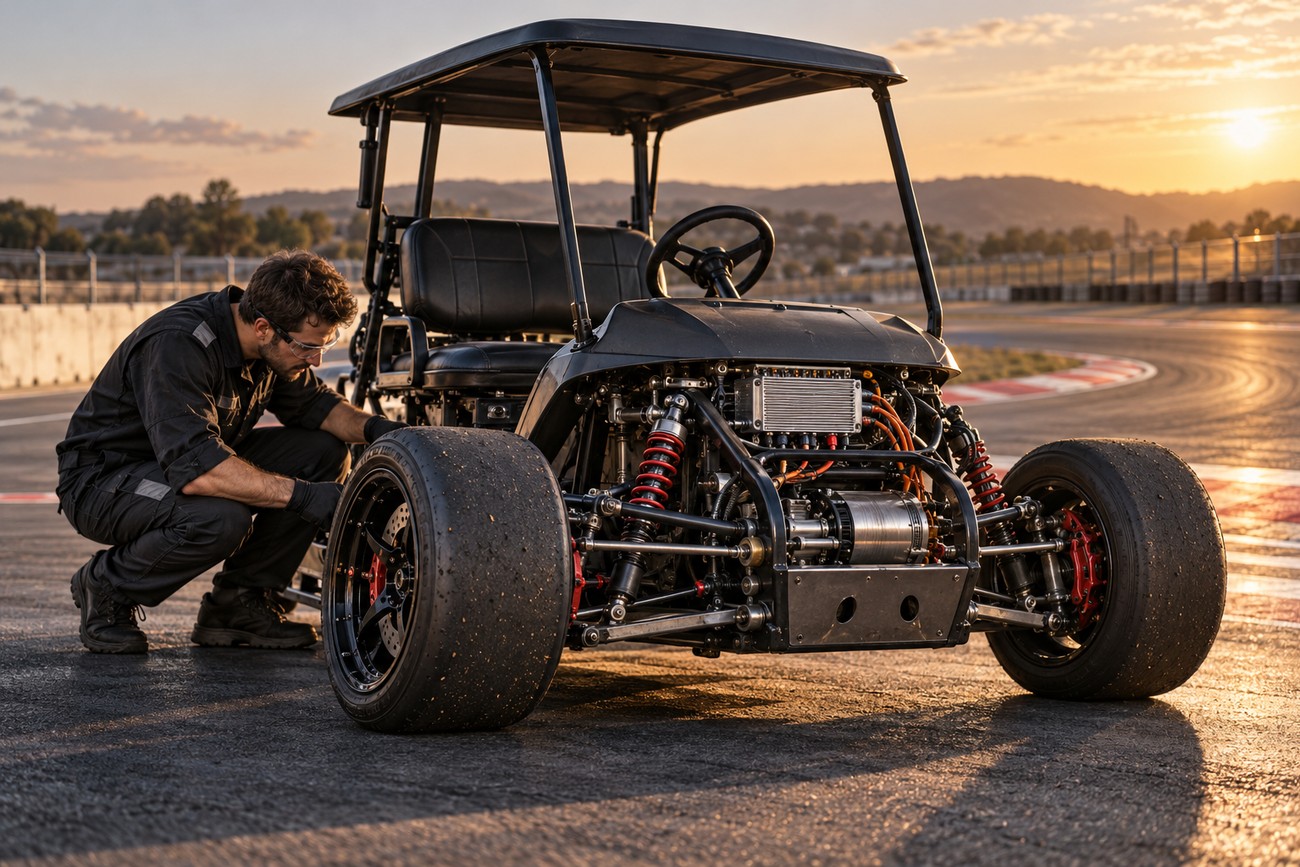
A kit advertised at approximately 30–40+ mph makes a claim about possible speed, not safe handling. The actual result varies with the build and conditions and may fall short when checked by GPS. More importantly, reaching a figure briefly says little about whether the cart remains predictable while braking or cornering.
Extra motor or controller power puts greater demands on tires, brakes, steering, suspension, drivetrain, and thermal capacity. Without matching changes, a cart can accelerate harder yet feel alarming in a bend or slow poorly on a descent. Heat, vibration, and developing play in steering or suspension components are reasons to stop and inspect it, rather than keep testing its top speed.
A lift and larger wheels add another tradeoff. They can reduce acceleration, increase heat and component load, and worsen stability or ride comfort. Bigger wheels may also change what an unverified speedometer reports, making GPS and a stated tire size particularly important when comparing results.
Electric range generally falls as operating speed rises, and speed-focused modifications can accelerate tire and component wear. Two carts with similar hardware may also behave differently if their batteries are in different condition. The practical distinction is between touching a speed once and sustaining controlled, repeatable operation.
How to Compare Them Fairly Without Creating a Dangerous Test
Use a closed private venue with competent supervision, permission to run both vehicles, and rules suited to their different capabilities. Set a conservative test for the cart rather than asking it to follow the Mustang at car-like speeds. Public-road racing is not an acceptable test.
Record the exact Mustang configuration and the cart’s motor or engine, controller, tires, and other modifications. State passenger and cargo load, surface, weather, and battery or engine condition. Runs in the same direction on the same surface help limit avoidable variation, while GPS provides a better check on speed than an advertisement or an optimistic dashboard reading.
Before moving, inspect tires, steering, brakes, fasteners, and, for an electric cart, the battery pack and connections. If braking is evaluated, use a marked, controlled area and a speed within the cart’s safe operating limits; stop if braking changes between runs. A test that reveals a fault has done its job without needing a faster pass.
Wet pavement, sand, dirt, curbs, and uneven ground can expose weaknesses in cart grip and control, particularly with passengers or cargo aboard. Keep those hazards out of a speed test rather than treating them as proof of toughness. Separately, check local rules on vehicle classification, registration, lighting, insurance, and where a cart may operate; permission to drive somewhere does not imply permission to race there.
Common Myths About Racing a Modified Golf Cart
Myth: More motor power turns a golf cart into a small sports car. Reality: Power does not supply sports-car-level brakes, suspension geometry, tires, steering, or crash protection. Bringing those systems up to a more demanding standard can require extensive, costly changes without making the finished vehicle equivalent to a Mustang.
Myth: An advertised 40 mph means the cart is safe at that speed. Reality: A speed claim needs GPS verification under stated conditions, and even a verified result does not establish braking distance or cornering stability. Tires, load, surface, and heat all matter after the speed reading appears.
Myth: Horsepower alone decides the race. Reality: The Mustang’s advantage comes from an integrated combination of power, chassis, tires, brakes, aerodynamics, and safety systems. On a course with turns, the ability to slow and place the vehicle consistently matters more than a striking launch.
Myth: One quick straight-line run proves the build works. Reality: Repeated runs can reveal heat, fading brakes, or looseness that a single pass misses. The venue’s rules and the cart’s limited occupant protection still set boundaries, even if its acceleration is impressive.
The Bottom Line: Which One Wins?
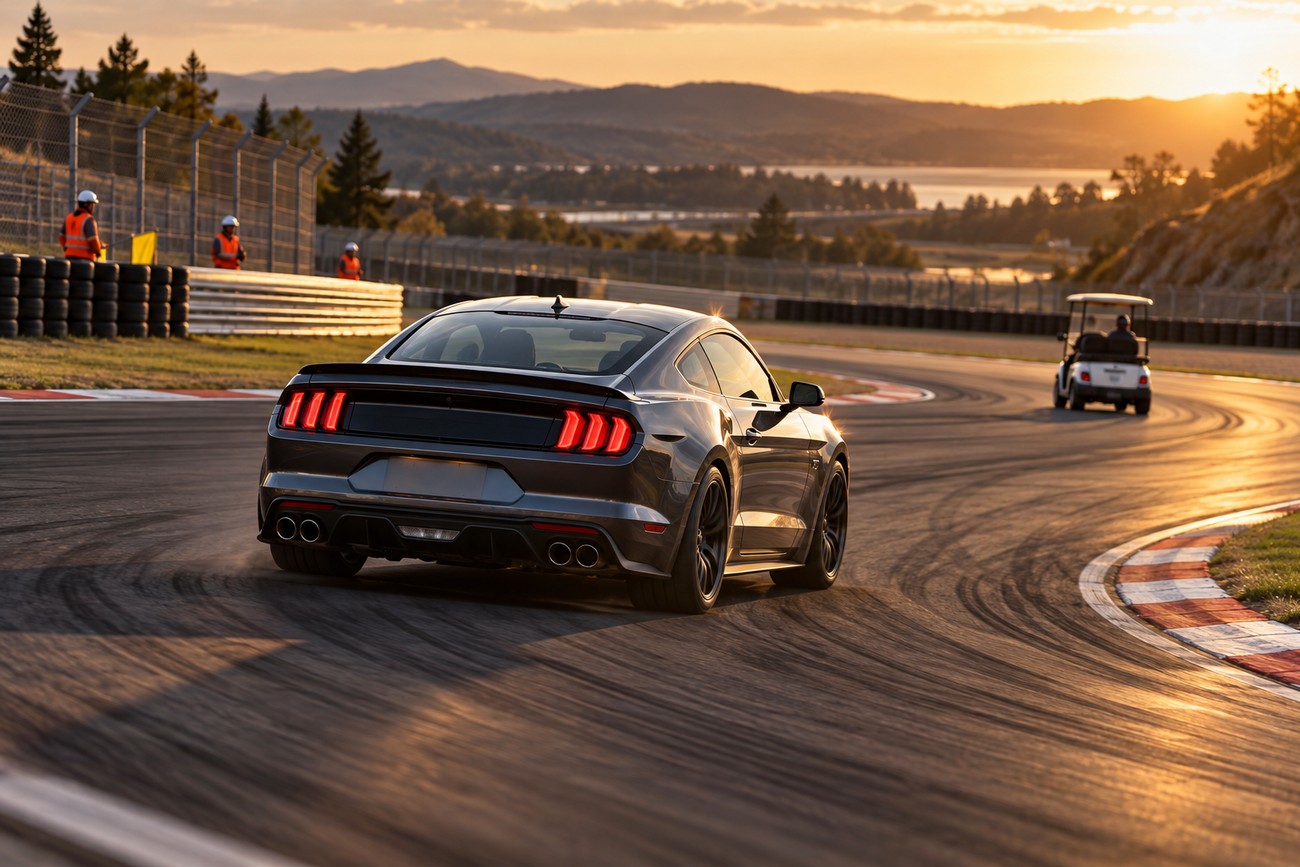
A normal road-going Mustang overwhelmingly wins a meaningful top-speed or road-course comparison. It has the braking, tires, chassis stability, and occupant protection to support performance far beyond the ordinary operating range of a golf cart. The precise margin depends on the Mustang version, the course, and conditions.
A modified cart might be competitive in a narrowly defined low-speed or straight-line novelty event. That is a limited result, not evidence that it can match a Mustang through braking zones and corners. A stock cart’s approximately 20–25 mph (about 32–40 km/h) operating speed makes the distinction especially plain.
Treat a tuned cart as a specialized recreational vehicle. More speed calls for scrutiny of the complete chassis, brakes, tires, steering, thermal capacity, and safety equipment, along with the rules of the venue. If those systems cannot support the proposed test, change the test rather than pushing the cart harder.
Frequently asked questions
Golf-course rules, cart speed claims, and differences between apparently identical carts can cause confusion in this comparison. These details help establish what a cart is permitted to do and what a performance figure actually describes.
What is the 90-degree rule in golf carts?
The 90-degree rule is a golf-course cart-management rule, not a racing technique. Where a course permits it, drivers stay on the cart path until a suitable point near their ball, travel roughly at a right angle toward the fairway, and return to the path at the appropriate point. Follow the course’s posted directions, since access can change with turf and weather conditions.
What is the fastest speed a golf cart can reach?
There is no single fastest speed that describes every golf cart. An ordinary civilian cart typically travels approximately 20–25 mph (about 32–40 km/h); modified high-speed carts and purpose-built vehicles belong in different categories. Kits may advertise approximately 30–40+ mph, but a claim should name the configuration, load, surface, weather, and battery or engine condition, then be checked by GPS. A verified maximum is still separate from a safe operating speed.
Why do two identical electric golf carts perform so differently?
Battery condition is often a major reason: age, state of charge, pack balance, and voltage sag under load can change how strongly a cart accelerates. Controller settings, tire size, and passenger weight can widen the difference even when the carts look alike. Compare them with similar loads and conditions, and check the battery system before concluding that one motor is stronger.







