
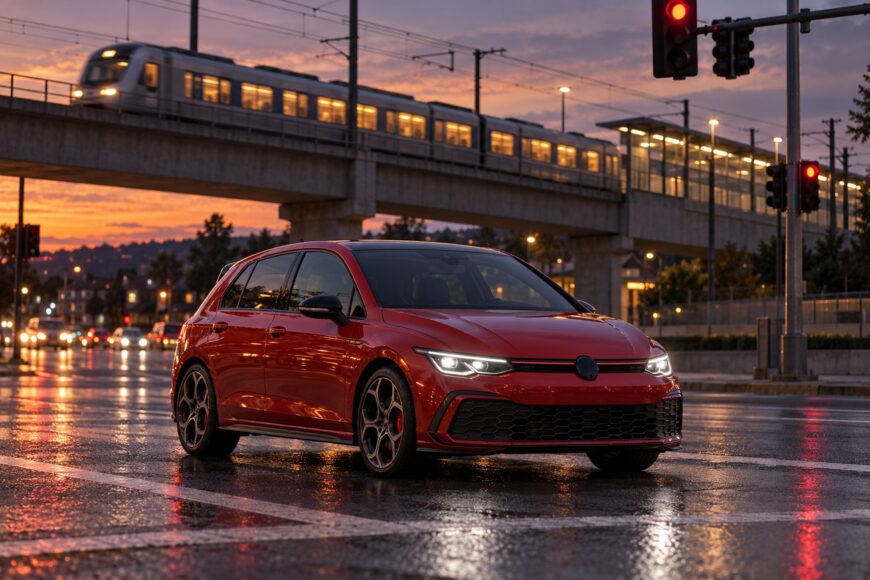
A 241-hp Volkswagen GTI lined up conceptually against a commuter train makes an irresistible visual: a compact turbo hatchback, steel railcars, and two very different ways of covering the same ground. The GTI brings immediate acceleration, flexible torque, and the freedom to choose its route. The train brings a fixed path, scheduled movement, and infrastructure designed to avoid road intersections.
That difference is the real subject. A train may cover ground efficiently without approaching the GTI’s acceleration or maximum speed, while the car can lose its advantage at traffic lights, crossings, congestion, and station-side delays. Any comparison belongs in a thought experiment, on a map, or as legal observation from a permitted public road. It must never become a public-road challenge.
- What This Race Actually Measures
- What the 2026 Golf GTI Brings to the Comparison
- Why the Route and Timetable Usually Decide It
- The Non-Negotiable Safety and Legal Boundary
- The GTI’s Real-World Weak Points
- How to Compare the Two Without Creating a Dangerous Contest
- Frequently asked questions
- How much horsepower does a Stage 2 GTI have?
- What should be documented before making a claim that a GTI beat a commuter train?
What This Race Actually Measures
This comparison measures average journey performance rather than horsepower alone. The GTI can accelerate hard between junctions, change direction, and select a faster road when traffic allows. The train follows a fixed route with stations, control points, and a timetable, yet it avoids the intersections and traffic signals that repeatedly interrupt a road trip.
A train can therefore gain time through predictable movement and infrastructure rather than higher maximum speed. Its route does not need to merge into traffic, wait for a green light, or negotiate a roundabout. The car’s advantage depends on the exact road layout, traffic conditions, and how much of the journey permits uninterrupted travel.
A meaningful comparison requires parallel legal segments with identical start and finish points. Timing the car from one station car park while timing the train from a platform several hundred feet away creates a result that says more about the setup than the vehicles. The same applies when one route includes a crossing, a signal, or a turn that the other route does not face.
A timetable measures movement between control points, not constant speed. A train may accelerate after leaving a station, brake for a platform, wait for a signal, or encounter a temporary restriction. Treating its scheduled departure and arrival as proof of a steady pace turns a complex route into a misleading top-speed comparison.
What the 2026 Golf GTI Brings to the Comparison
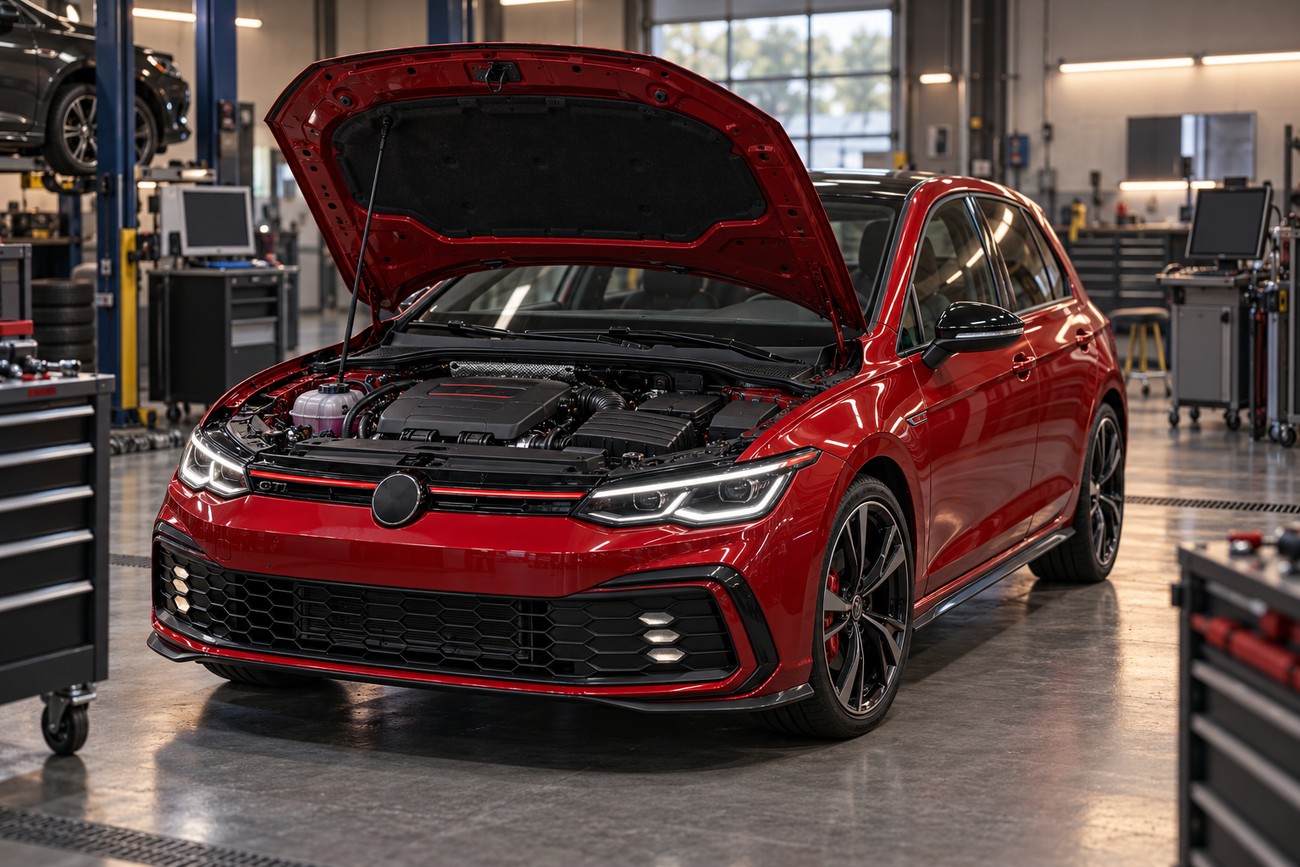
The stock 2026 Volkswagen Golf GTI provides a useful technical baseline: a 2.0-liter turbocharged engine, 241 hp, and 273 lb-ft (370 N·m) of torque. The torque figure is available from 1,600 rpm, which matters in an urban comparison because flexible response at low engine speed is more useful between junctions than a theoretical maximum speed reached far beyond normal traffic conditions.
The power reaches the road through a 7-speed DSG and front-wheel drive. Approximate mass is 1,444 kg. Those figures describe a quick, usable hatchback, yet they do not predict a universal result against any particular train or route.
Front-tire traction often sets the limit before the engine does. Cold, wet, or uneven pavement can make the front wheels slip during acceleration, reducing the benefit of the available torque. A differential can help distribute drive, but it cannot create grip where the tires and surface have little capacity to transmit force.
These specifications apply to the 2026 model and should not be transferred automatically to older Mk7 or Mk8 cars. Generation, transmission, tire condition, fuel, temperature, and vehicle load all affect real-world performance. The specification sheet is a baseline for analysis, not a guarantee of what a particular car will do on a particular morning.
Why the Route and Timetable Usually Decide It
Stations can erase a large part of a train’s apparent speed advantage or disadvantage. A commuter service may spend time braking, boarding passengers, and waiting for a signal. Freight movements, temporary restrictions, and platform congestion can also separate the actual run from the published schedule.
The GTI faces a different collection of interruptions. Traffic lights, crossings, intersections, lane changes, and congestion can turn a powerful car into a series of short accelerations followed by braking. A clear road may produce one result, while a single blocked junction can change the outcome without any mechanical difference in the car.
A departure time is therefore not a precise starting signal. The train may already have moved, remained at the platform, or been delayed before the observer reaches the road. A credible claim must identify the rail line, station, direction, schedule, route, and traffic conditions before anyone can assess what happened.
Distance errors become more dangerous as the car travels closer to the tracks. A driver who misjudges the train’s position, speed, or arrival time has less room to correct the mistake near a crossing or rail corridor. The apparent convenience of a parallel road does not make its sightlines, barriers, or junctions uniform along the entire route.
The Non-Negotiable Safety and Legal Boundary
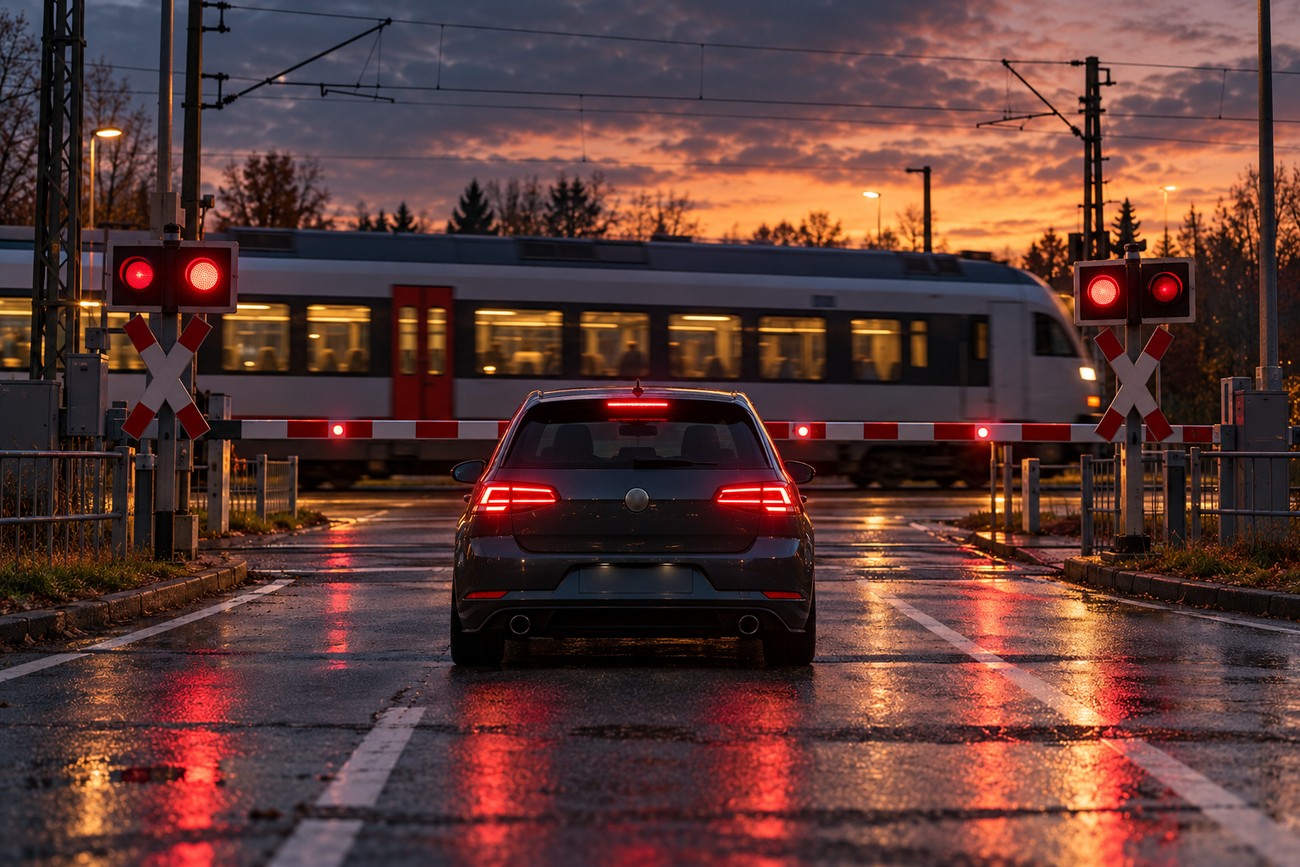
Never cross an active railway crossing against red warning lights, a lowered barrier, a regulator’s signal, a STOP sign, a visible train, or an audible horn. A typical requirement is to stop at least 15 feet, or about 4.6 m, from the crossing, subject to applicable local rules. The correct response is to obey the signals and wait, regardless of how far away the train appears.
Tracks are not a roadway or an overtaking lane. Driving along the rail corridor, using the shoulder to bypass a queue, stopping on the crossing, or passing a lowered barrier creates collision risk and may violate local law. A train is far heavier than a car and cannot stop within a normal automotive stopping distance.
Every active crossing should be treated as a stop-and-observe decision, never as a distance calculation based on how far away the train appears.
For crossings where trains may travel at 110–125 mph (177–201 km/h), FRA rules require an impenetrable barrier to prevent vehicle access. That requirement reflects the consequences of a vehicle entering the rail path, not an invitation to estimate whether a driver can clear it in time. Local signs, signals, and regulations remain controlling wherever you drive.
The GTI’s Real-World Weak Points
Owners commonly identify front-wheel slip as a greater acceleration limitation than insufficient engine power. The issue becomes more apparent on cold, wet, or uneven surfaces, where the front tires must steer and transmit engine torque at the same time. A hard launch can therefore produce wheelspin and noise without delivering the clean progress suggested by the power figure.
The 7-speed DSG can provide quick acceleration, yet repeated hard use may expose abrupt shifts, delays when selecting a gear, or heat-related frustration. Those behaviors depend on conditions and vehicle state, so one sharp shift does not define every DSG-equipped GTI. They do matter when a comparison relies on repeated launches rather than a single controlled acceleration.
About 120 mm of ground clearance leaves limited margin for rough approaches, raised crossings, and damaged pavement. Low-profile factory tires add another constraint: the available sizes include 225/40 R18 and 235/35 R19. A road that looks manageable from a distance can impose a sharp impact on the wheel and tire when approached at speed.
19-inch tires may improve dry grip, yet they are generally more expensive and more vulnerable to potholes than 18-inch tires. That trade-off affects the comparison beyond acceleration. A wheel that delivers more dry-road response may also increase operating cost and the chance of damage on poor roads near stations or crossings.
How to Compare the Two Without Creating a Dangerous Contest
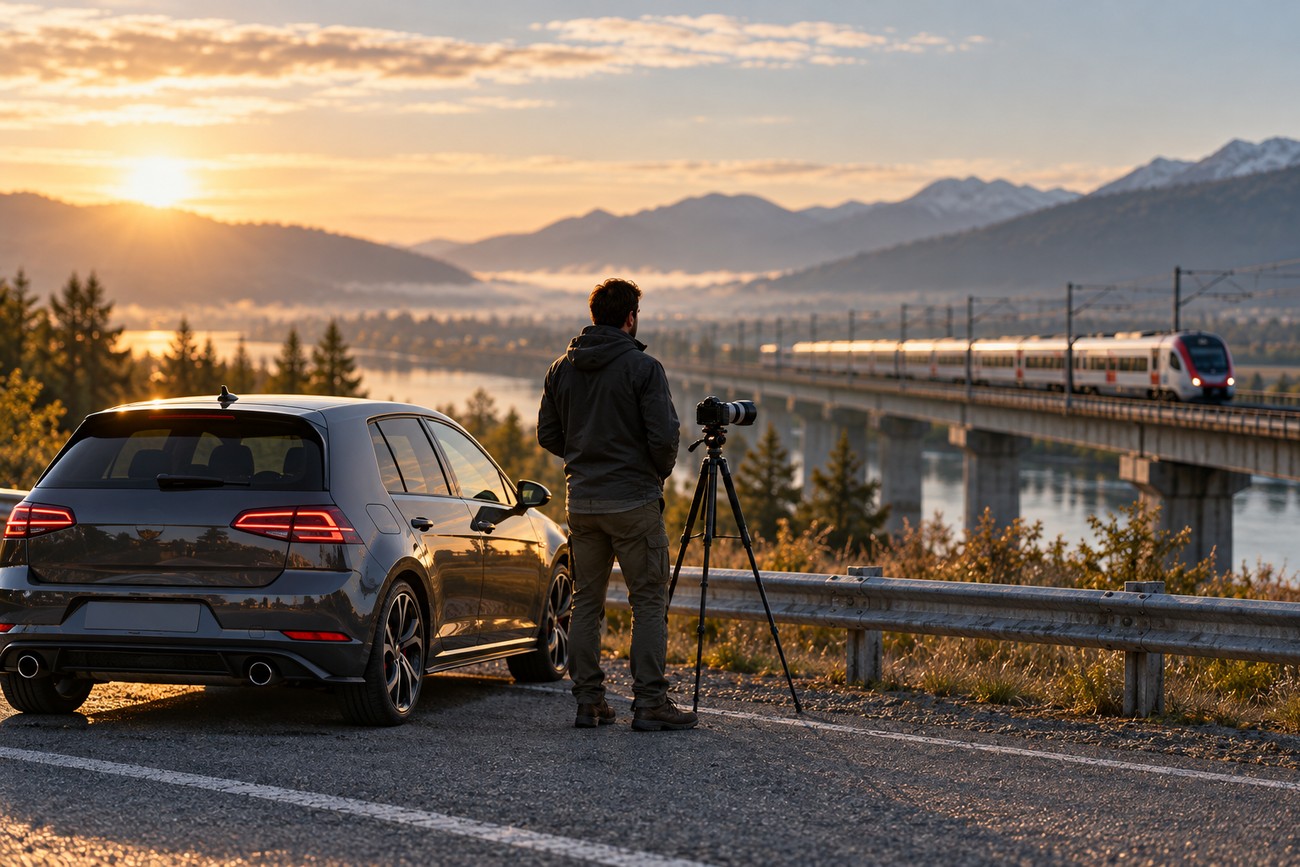
The safest valid format is a hypothetical comparison using maps, public timetables, and clearly stated assumptions. Another acceptable approach is observation from a permitted public road without trying to beat the train or alter the driver’s route. This preserves the interesting engineering question while removing the pressure that encourages illegal decisions.
A fair result needs identical start and finish points and predefined timing rules. The method should state whether timing begins at a scheduled departure, actual movement, or a visible signal, and whether the car is measured door to door or between matching geographic points. Without those rules, a dramatic anecdote cannot be reproduced.
Conditions should include the GTI generation, transmission, tires, fuel, temperature, passenger or cargo load, weather, and traffic. The train’s line, direction, stations, delays, and temporary restrictions belong in the same record. A single run may illustrate one set of conditions; it cannot establish a universal winner.
The 2026 GTI’s official fuel-economy figures are 24 mpg city, 32 mpg highway, and 27 mpg combined. These are laboratory estimates rather than race predictions. They can provide context for the car’s intended road use while saying little about the tire wear, brake load, or drivetrain heat produced by repeated hard acceleration.
Frequently asked questions
The GTI’s stock output provides a baseline, but modified cars can vary widely. Any comparison should identify the vehicle, route, timing method, and conditions. The same documentation also helps keep the observation legal and safe.
How much horsepower does a Stage 2 GTI have?
There is no single universal Stage 2 GTI horsepower figure. “Stage 2” is a tuning label, and the result depends on the hardware package, software calibration, fuel, boost strategy, and dyno method used to measure output.
A meaningful claim should identify the exact modifications and test conditions. The 2026 stock GTI baseline is 241 hp, but that number cannot be used to infer the output of a modified car, and a dyno result from one setup does not automatically transfer to another GTI generation or fuel specification.
What should be documented before making a claim that a GTI beat a commuter train?
Document the rail line, stations, direction, exact start and finish points, published schedule, actual departure and arrival times, delays, traffic, weather, and timing method. Record whether the GTI and train were compared over the same geographic segment and whether any route included crossings, signal delays, or unusual restrictions.
The vehicle record should include GTI generation, transmission, tires, fuel, temperature, passenger or cargo load, and whether the run was a single observation or a repeated test. These details turn an anecdote into a reviewable comparison while keeping the activity within legal, safe observation.







