
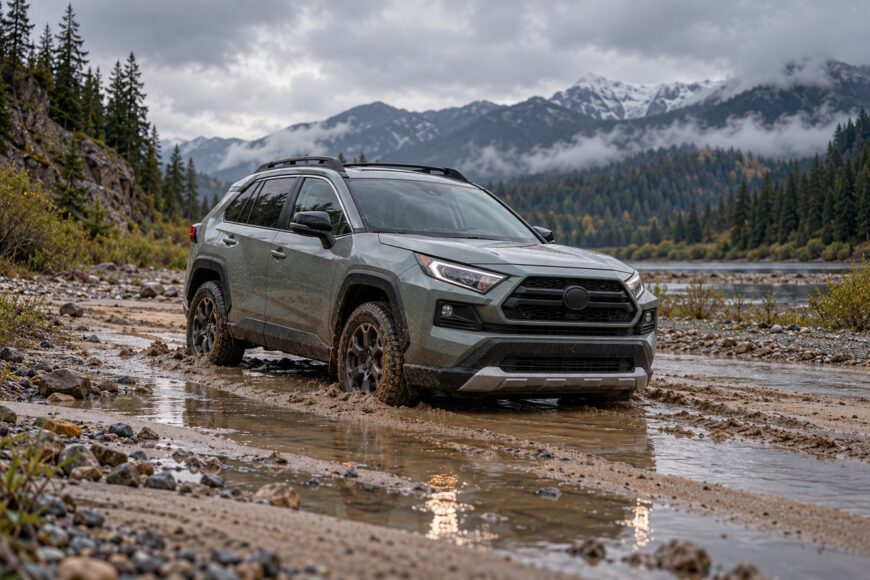
A Toyota RAV4 is not literally swallowed by quicksand, but it can lose traction, dig in, and settle onto its underbody within seconds. Water-saturated loose ground can carry a vehicle briefly, then lose bearing capacity as the vehicle’s load raises pore pressure. The result is a rapid increase in rolling resistance, wheel sinkage, and the risk of high-centering.
AWD and a Sand mode may help the RAV4 manage moderately loose surfaces, yet neither creates grip where tires are sinking. Tire construction, pressure, ground clearance, vehicle weight, and recovery equipment remain decisive. A gasoline RAV4, hybrid, AWD model, and different market specification should not be treated as the same vehicle.
- What Quicksand Does to a Toyota RAV4
- Toyota RAV4 Ground Clearance, Weight, and Towing: What They Mean in Sand
- Why AWD and Sand Mode Cannot Guarantee an Escape
- Before You Enter Soft Sand: Route, Tires, and Recovery Planning
- How to Recover a RAV4 Before It High-Centers
- The Mistakes That Turn a RAV4 Stuck in Sand into a Recovery Job
- Hidden Damage After Sand and Water Exposure
- Is a Toyota RAV4 the Right Vehicle for Deep Sand?
- Frequently Asked Questions
- What car is better than a Toyota RAV4 for driving on deep sand?
- Which RAV4 should I stay away from for sand driving?
- What should I buy instead of a RAV4 if I regularly cross soft sand?
- How can I tell whether a beach or sand track is becoming unsafe before entering it?
What Quicksand Does to a Toyota RAV4
Quicksand is water-saturated, loose ground whose bearing capacity can temporarily fall under a vehicle’s load. As the tires press into it, water and fine particles move within the soil, reducing the firm support available beneath the contact patch. The vehicle then needs more force to move forward, even before the tires begin obvious wheelspin.
The practical failure sequence is less dramatic than the cinematic image of a vehicle disappearing. First, the tires lose useful traction. Next, the driven wheels sink and excavate material, increasing resistance in front of them. As the suspension settles, the underbody can begin dragging across the sand and carrying part of the vehicle’s weight.
Once the underbody is resting on sand, engine torque becomes much less useful. The tires may still rotate, but they cannot press effectively against firm material, while the chassis acts like a broad anchor. AWD can distribute available torque between wheels, but it cannot lift the underbody or restore ground support.
The important decision point comes before high-centering. If the wheels are beginning to sink, stop adding throttle and assess the surface while the vehicle still has some freedom to move. A short pause for clearing sand and building a firm, gradual exit can prevent a minor loss of momentum from becoming a recovery operation.
Toyota RAV4 Ground Clearance, Weight, and Towing: What They Mean in Sand
RAV4 specifications vary by market and version, so the figures below should be read as ranges rather than as one universal vehicle specification.
| Specification | U. S. market | European specifications | Meaning for quicksand recovery |
|---|---|---|---|
| Ground clearance | Approximately 8.1–8.6 inches (206–218 mm), depending on version | Approximately 187–195 mm, depending on version | Clearance delays underbody contact, but it does not prevent wheel linkage or compensate for limited approach, departure, and breakover geometry. |
| Vehicle mass | Approximately 3,370–4,300 lb (1,529–1,950 kg), depending on version | Approximately 1,590–1,730 kg curb mass | Mass affects the load placed on soft ground. A heavier version may settle faster when the surface cannot support it. |
| Maximum towing rating | Approximately 1,500–3,500 lb, depending on configuration | Up to 1,650 kg with a braked trailer, depending on specification | This is a rated trailer load, not a measure of the pulling force available to recover a stuck RAV4. |
Ground clearance matters because the RAV4 needs space beneath the chassis while the tires search for firmer material. It is only one part of the geometry, however. Underbody shields, suspension components, wheel placement, and the shape of the sand around the vehicle determine whether the car can keep moving without dragging.
Mass also varies substantially between versions. Hybrid, gasoline, and AWD configurations can have different weights, drivetrain behavior, equipment, and operating limits. A figure from one brochure or market should not be transferred automatically to another RAV4.
Towing capacity is frequently misunderstood in recovery discussions. A vehicle rated to tow a substantial braked trailer has been assessed for a specific trailer load, hitch arrangement, braking system, and operating condition. That rating does not show how effectively the tires can pull a vehicle out of water-saturated ground.
Why AWD and Sand Mode Cannot Guarantee an Escape

AWD can improve torque distribution on moderately loose surfaces. If one tire has less grip than another, the drivetrain and control systems may help use the available traction more effectively. That benefit is real, but it depends on the tires still having meaningful contact with material capable of resisting the tread.
Sand mode is a control-system setting that may alter throttle response, gear selection, wheel-slip management, or other vehicle behavior for loose surfaces. It does not increase ground clearance, widen the tires’ physical contact area by itself, or change the soil’s bearing capacity. It also cannot prevent the underbody from loading up when the vehicle settles into the sand.
This is where marketing language and engineering limits need to be kept separate. A RAV4 can have useful moderate off-road capability, especially with suitable tires, controlled momentum, and a route that avoids deep or water-affected sections. Road-oriented clearance and geometry still place a practical limit on the terrain it can cross safely.
Variants may use different drivetrain algorithms, battery systems, weights, tires, and thermal limits. A hybrid or AWD badge therefore says less than the complete specification and the condition of the vehicle. When the driven tires are buried or the chassis is grounded, electronic torque distribution has no physical grip to distribute.
Before You Enter Soft Sand: Route, Tires, and Recovery Planning
Route choice is the first recovery tool. Avoid sections that look darker, unusually smooth, waterlogged, or recently disturbed, especially where there is no firm turnaround or retreat route. Sand near the waterline can change rapidly because of tides, groundwater, and local voids, even when the surface initially appears hard.
Plan where you can stop before entering the softest section. A suspiciously soft patch is a poor place to pause, change settings, or inspect equipment. Maintaining a smooth, continuous pace across a firm track is generally safer than making abrupt throttle changes, provided the speed remains appropriate for visibility, surface conditions, and vehicle control.
Lowering tire pressure can enlarge the contact patch and reduce ground pressure, but there is no universal quicksand pressure. The safe setting depends on the tire, load, vehicle, and manufacturer instructions. Use a reliable pressure gauge, avoid guessing from an internet number, and reinflate before returning to firm roads if pressure has been reduced.
Prepare recovery equipment before the vehicle enters deep sand. A practical kit may include traction boards, a shovel, a pressure gauge, an inflator, and suitable attachment equipment connected to approved recovery points. For repeated deep-sand travel, tire suitability and a complete recovery system matter more than the presence of an AWD badge.
How to Recover a RAV4 Before It High-Centers
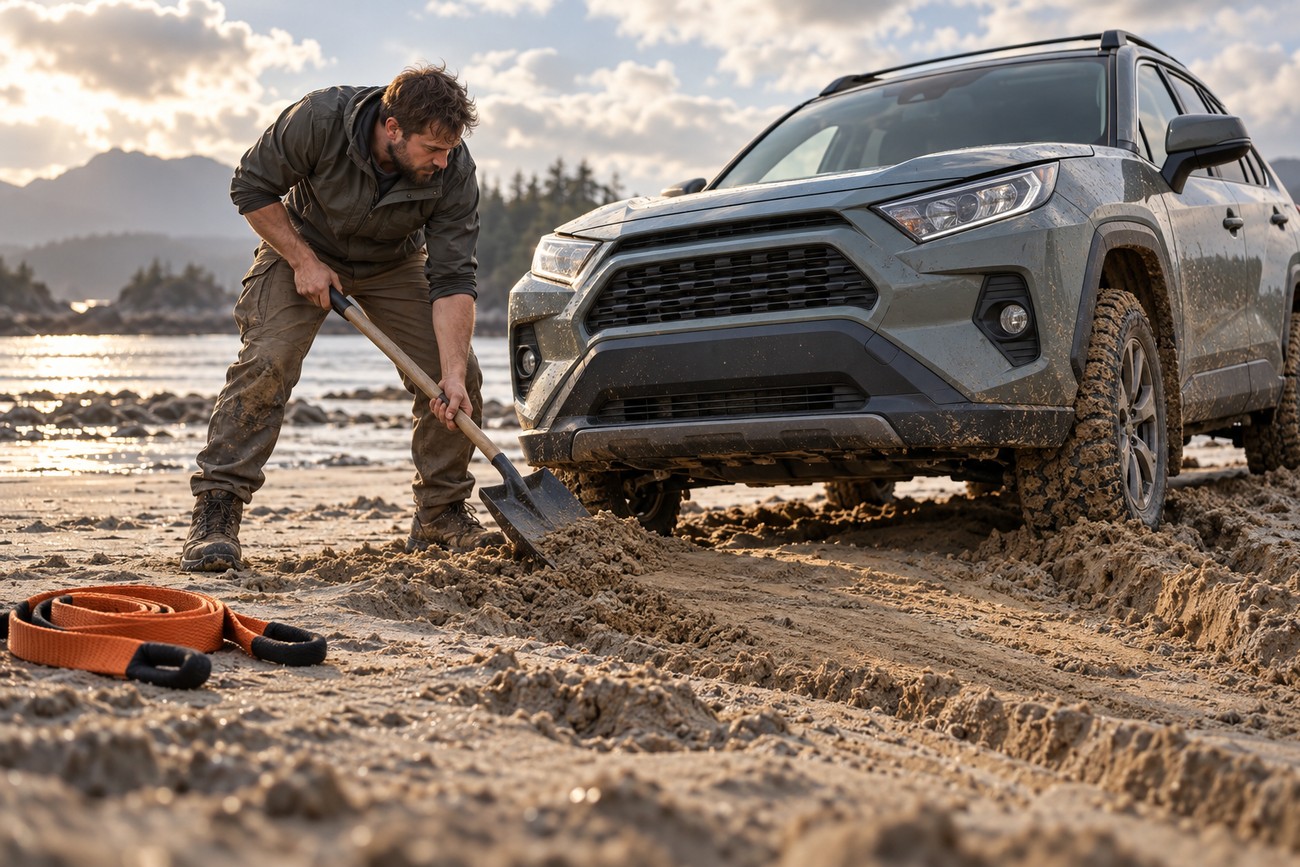
Stop aggressive wheelspin as soon as the RAV4 fails to advance. Full throttle can excavate deep holes under the driven tires, remove the firm layer that was still available, and turn a manageable extraction into a winch-assisted recovery. Set the vehicle securely, check the surroundings, and determine whether the underbody is already supporting part of the load.
If the chassis is still clear, remove sand from in front of the driven wheels and from beneath any low point that is dragging. Level the route rather than digging a narrow vertical hole. The aim is to create a gradual ramp that lets the tires climb onto firmer material while reducing the angle at which the underbody meets the sand.
Stop digging before the underbody loads up. Building a ramp and placing traction boards beneath the tires usually improves the situation more than adding throttle to wheels that are already buried.
Traction boards work only when they are positioned directly under the tires. Slide them as far beneath the contact patch as practical, align them with the intended exit, and clear loose material that would prevent the tread from reaching the board. A board left beside the vehicle provides no traction, regardless of its design.
Use smooth, continuous movement once the path is prepared. Reversing or rocking the vehicle may help in some situations, but follow the vehicle maker’s instructions and avoid abrupt changes between Drive and Reverse. Shock loads can damage driveline components, recovery equipment, or attachment points, particularly when the tires suddenly bite.
The Mistakes That Turn a RAV4 Stuck in Sand into a Recovery Job
Stopping in a soft area removes the momentum that might have carried the vehicle across a firmer track. Drivers often stop to check a route, turn around, or change a setting and then discover that the surface beneath the tires will no longer support an easy restart. If a safe stopping area is available, use it before the surface deteriorates.
Full-throttle wheelspin is another common escalation. The tires dig faster than the vehicle can recover traction, forming deep ruts and pushing sand into a bank ahead of the tread. Short, controlled inputs may be appropriate during a recovery attempt, but repeated spinning without progress is evidence that the method needs to change.
Stability-control intervention can feel like a loss of power when controlled wheel slip would help on a loose surface. The correct setting depends on the RAV4 version and the manufacturer’s operating guidance. Do not assume that disabling every aid is best, and remember to restore the appropriate system once the vehicle is back on a surface where stability assistance is needed.
Unmeasured tire deflation creates a separate risk. Driving on firm ground with incorrectly reduced pressure can damage the tire or compromise steering and braking. Repeated rocking, spinning, and throttle application can also build heat in the transmission or drivetrain, so a sequence that produces no progress should be stopped and allowed to cool before further assessment.
Recovery lines must connect to suitable, approved attachment points. Bumper covers, suspension arms, and random structural parts may bend or detach under load. A recovery attempt can therefore create damage even when the vehicle eventually moves, especially if the line is loaded suddenly or the attachment point is not intended for that force.
Hidden Damage After Sand and Water Exposure
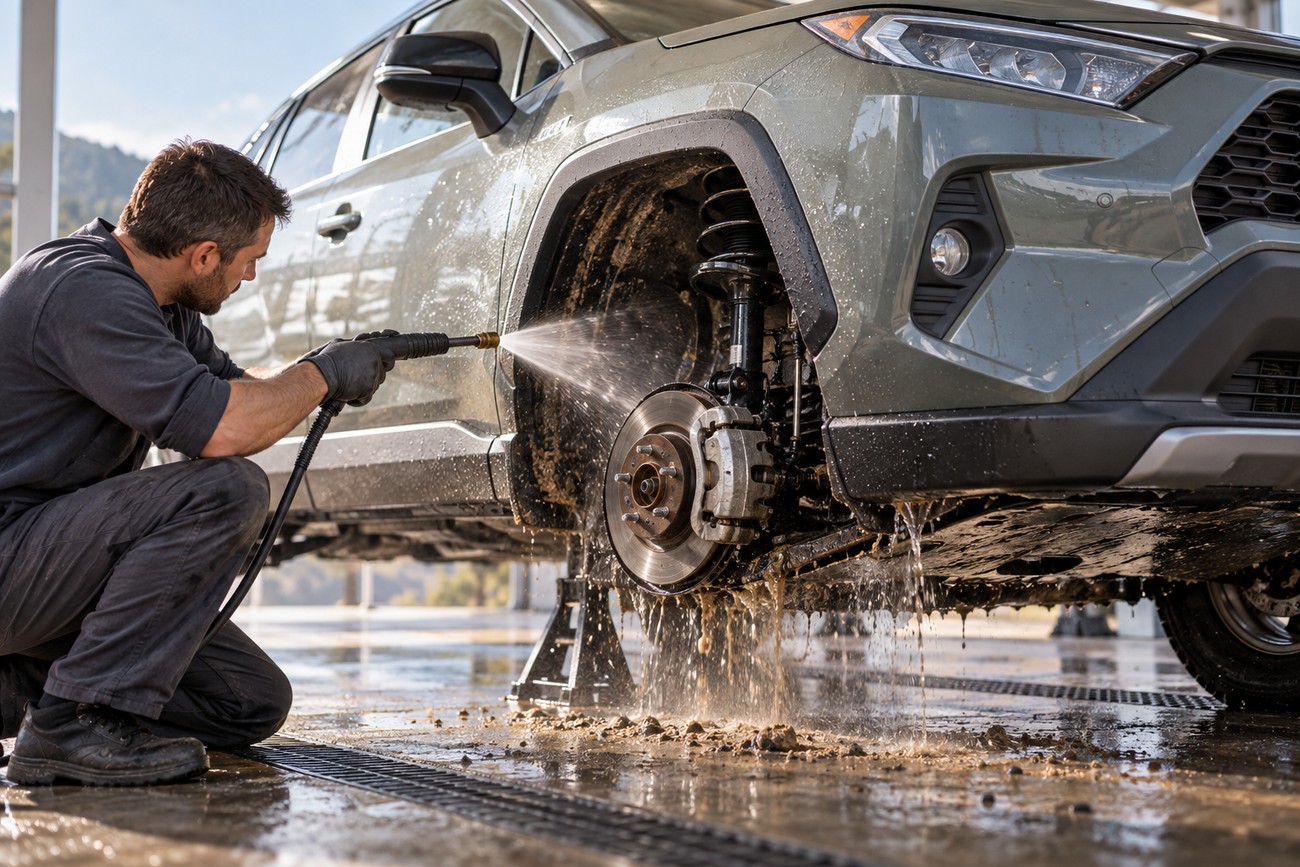
Getting the RAV4 moving again is only the end of the immediate problem. Abrasive sand can remain in the brakes, underbody shields, wheel hubs, seals, and areas around moving components. It may produce rubbing, scraping, uneven braking, or accelerated wear after the vehicle has returned to normal roads.
Water makes the cleanup more important. Sand mixed with water can increase corrosion risk and may remain around electrical connectors or behind protective panels. An exterior rinse removes visible material, but it does not guarantee that abrasive particles have left concealed spaces.
Inspect the vehicle before a long road journey. Look for damaged recovery points, displaced shields, cracked plastic, material packed around the wheels, and signs that a brake or rotating component is contacting sand. Pay attention to unusual brake noise, rubbing, warning lights, changes in steering feel, or any new vibration.
Cleaning should follow the vehicle and component manufacturer’s guidance. Avoid directing high-pressure water into seals, bearings, connectors, or other areas where it could drive contamination deeper. If water exposure was substantial or a warning light appears, a qualified inspection is sensible because electrical and corrosion-related problems may not be visible from outside.
Is a Toyota RAV4 the Right Vehicle for Deep Sand?
A RAV4 may manage moderate loose surfaces when it retains momentum, has suitable tires, and avoids high-centering. A firm track, careful route selection, and a prepared driver can make a meaningful difference. This describes a controlled use case rather than a guarantee for every beach, dune, wash, or water-affected track.
Deep sand exposes the limits of road-oriented clearance, geometry, tire setup, and recovery provisions. The risk rises when the surface is wet, the route has no retreat space, or the vehicle must stop and restart in a soft section. Once the underbody is carrying load, even a functioning AWD system has little opportunity to create useful forward motion.
For occasional travel on moderate loose surfaces, the complete setup matters more than a trim label. Check the actual tires, pressure procedure, approved recovery points, available equipment, and the route conditions. Maximum towing figures should not be used as a substitute for tire grip, underbody clearance, or self-recovery capability.
Frequent deep-sand use calls for a vehicle designed around more than one advertised feature. Evaluate clearance and geometry, tire support, recovery points, thermal durability, and the availability of reliable recovery assistance. A RAV4 can be suitable within a defined envelope, but it should not be treated as an automatic choice for severe or water-affected sand.
Frequently Asked Questions
The answers below apply the same principles to vehicle choice, preparation, and route assessment. Exact capabilities vary by RAV4 version, market specification, tire setup, and surface conditions.
What car is better than a Toyota RAV4 for driving on deep sand?
A vehicle designed for regular deep-sand work should be selected for clearance, tire support, recovery points, underbody protection, and sustained off-road durability. A purpose-built four-wheel-drive vehicle may offer a stronger recovery structure, more suitable tire options, and geometry that reduces the chance of high-centering.
There is no universally best model for every route. The right choice depends on sand depth, vehicle load, distance from assistance, and how often the vehicle will face those conditions. Compare the complete recovery system rather than choosing solely by drivetrain badge or towing rating.
Which RAV4 should I stay away from for sand driving?
Do not screen a used RAV4 by model name alone. Verify its exact market specification, drivetrain, ground-clearance figure, tire type and condition, approved recovery points, and any equipment that affects weight or operating limits.
Also inspect the vehicle for previous underbody impacts, damaged shields, worn tires, warning lights, and signs of water or sand exposure. A well-prepared version may be more useful on moderate surfaces than a nominally better-equipped example with unsuitable tires or damaged recovery hardware.
What should I buy instead of a RAV4 if I regularly cross soft sand?
If soft sand is a regular part of the route, a purpose-built four-wheel-drive vehicle becomes easier to justify when it offers suitable clearance, geometry, recovery points, tire support, and durability under sustained low-speed load. Those features improve the margin before the vehicle loses mobility.
Compare the compromises as well: road comfort, fuel or energy use, maintenance, payload, maneuverability, and the cost of suitable tires and recovery equipment. A higher towing rating alone does not make a vehicle better at crossing soft ground or recovering itself.
How can I tell whether a beach or sand track is becoming unsafe before entering it?
Look for changing surface firmness, darker or wet patches, visible wheel sinkage, water moving closer to the route, and a lack of a firm retreat path. A surface that was passable earlier may become unreliable as tides, groundwater, or local voids alter the ground beneath it.
Do not enter if there is no safe place to turn around, no recovery space, or no practical way to summon assistance. The combination of softening ground and limited retreat options is a stronger warning than the presence of AWD or a Sand mode.







