
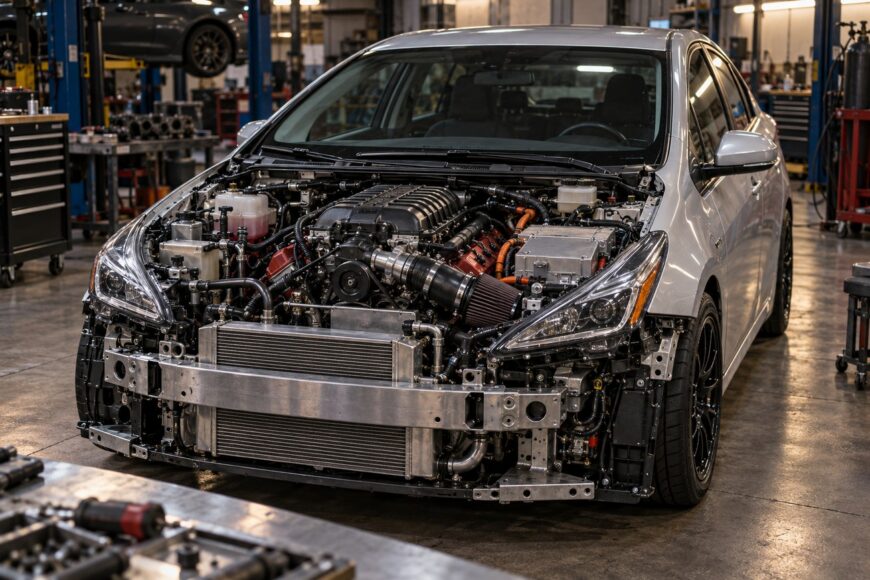
A compact Toyota Prius carrying a supercharged 6.2-liter V8 HEMI is a visual contradiction: an efficiency-focused hybrid body wrapped around an engine built for extreme power and torque. The Hellcat began at 707 hp and 881 Nm, while later versions reached 797–807 hp, and Demon versions produced up to 1,044 Nm.
So, is it possible? Technically, yes. Published Prius projects with Hellcat engines, including claims of approximately 1,000 hp, prove that determined fabricators can make the combination run. They do not prove that the swap is simple, repeatable, affordable, or suitable for normal road use.
The real limits are less spectacular than the dyno number: engine-bay geometry, torque transmission, added mass, cooling, fuel delivery, structural strength, braking, drivability, and legal compliance. A Hellcat Prius is best understood as a near-total vehicle rebuild rather than an engine replacement.
- Is a Hellcat V8 swap into a Toyota Prius actually possible?
- Why the engine bay and drivetrain become the first major obstacles
- The drivetrain and chassis are the real bottleneck
- Cooling, fuel, electronics, and exhaust are not optional upgrades
- What the swap does to Prius economy, usability, and identity
- Budget and street legality can stop the project before the first test drive
- Common myths about building a Hellcat Prius
- Frequently asked questions
- Which Prius has 200 hp?
- What cars can fit a Hellcat engine?
Is a Hellcat V8 swap into a Toyota Prius actually possible?
The Hellcat is a 6.2-liter supercharged V8 HEMI designed for a conventional high-performance drivetrain. A Prius was designed around a compact inline internal-combustion engine and a hybrid system, with completely different assumptions about engine placement, torque delivery, cooling, and control electronics.
That difference does not make the project impossible. One-off Prius Hellcat builds have been published, and some have carried claims of approximately 1,000 hp. Those cars demonstrate that fabrication, engineering, and sufficient budget can overcome the original layout.
The factory output range explains why the project escalates so quickly. A base Hellcat specification produces 707 hp and 881 Nm, later versions reached 797–807 hp, and Demon versions reached up to 1,044 Nm. Every supporting system must therefore be designed around substantial power and torque rather than merely connected to a larger engine.
A documented build is also a poor template for a home bolt-in conversion. The successful examples are custom projects with redesigned structures, drivetrains, electronics, and cooling systems. The result may run and perform on a drag strip while still being unsuitable for daily road use.
Why the engine bay and drivetrain become the first major obstacles
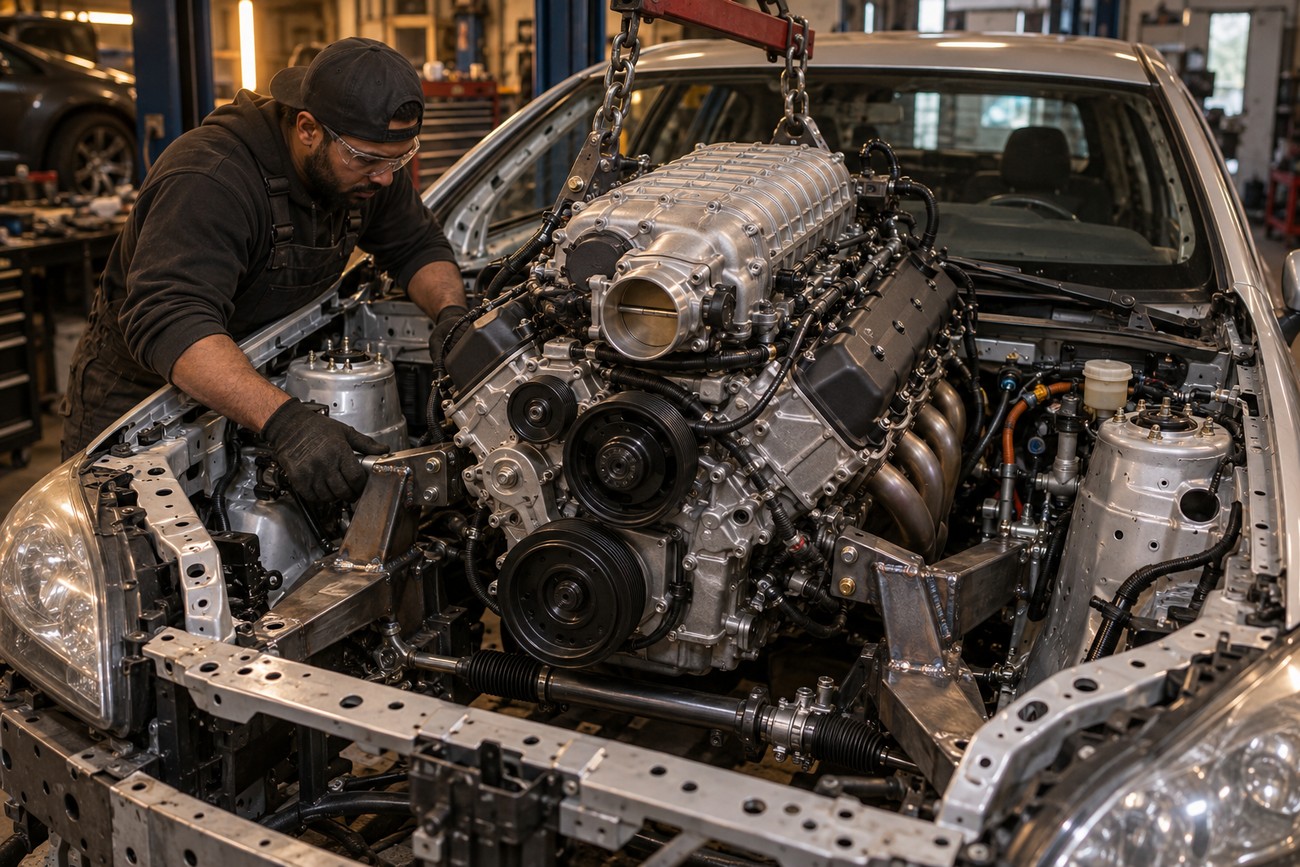
The Prius engine bay was not sized around a large longitudinal V8 and its accessories. The engine, supercharger, exhaust, transmission, and cooling hardware compete for space with the steering system, suspension towers, firewall, and front structure. Major cutting and structural fabrication may be required before the engine can occupy a workable position.
Engine placement affects every later decision. Custom mounts must hold the powertrain securely while preserving driveline alignment, steering clearance, suspension travel, and service access. New subframes or structural supports may be necessary, and those parts must carry engine loads without creating weak points in the body.
The original Prius powertrain architecture is fundamentally different from a conventional Hellcat drivetrain. Depending on the chosen layout, the build may require a compatible transmission, differential, driveshaft or axle routing, and redesigned floor or tunnel sections. Clearance for exhaust components and heat shielding adds another packaging constraint.
The stock Prius transmission is not designed for Hellcat-level torque. Treating it as a ready-made solution risks rapid failure and poor torque control, even if the engine physically fits. A suitable transmission and final-drive arrangement must also work with the selected axles, hubs, differential, and suspension geometry.
Getting the engine under the hood is only a fitment milestone. A usable car needs correct driveline angles, reliable mounts, adequate ground clearance, serviceable components, and predictable power delivery. A crowded engine bay can run on a test stand and still be impossible to cool, repair, or drive safely.
The drivetrain and chassis are the real bottleneck
Peak horsepower attracts attention, but torque management determines whether the car can move without destroying its driveline. Transmission selection, differential behavior, reduction gearing, axle strength, and traction must be developed as one system. A single weak component can turn a powerful build into a sequence of broken parts.
The Prius chassis and suspension were not designed for 700-plus horsepower. More engine mass at the front can worsen front-to-rear balance, change steering response, and reduce available suspension travel. Reinforcement, spring and damper changes, stronger hubs, suitable tires, and revised alignment may all be required to make the chassis controllable.
Validate axle alignment, differential behavior, torque delivery, and brake performance before chasing the advertised dyno output. A lower-powered car that launches, turns, and stops repeatedly is further along than a higher-powered car that only survives one test.
Braking deserves the same attention as acceleration. The car must absorb the added speed and mass without fade, and the brake system must remain predictable as grip changes. Steering response, tire clearance, chassis reinforcement, and suspension geometry also need to be checked together rather than upgraded in isolation.
A successful build is one that can launch, turn, and stop reliably. If the car becomes unstable under power or the front axle loses useful grip, the dyno number has little practical value. That is why extreme Prius Hellcat projects usually require continuous testing and development after the first drive.
Cooling, fuel, electronics, and exhaust are not optional upgrades
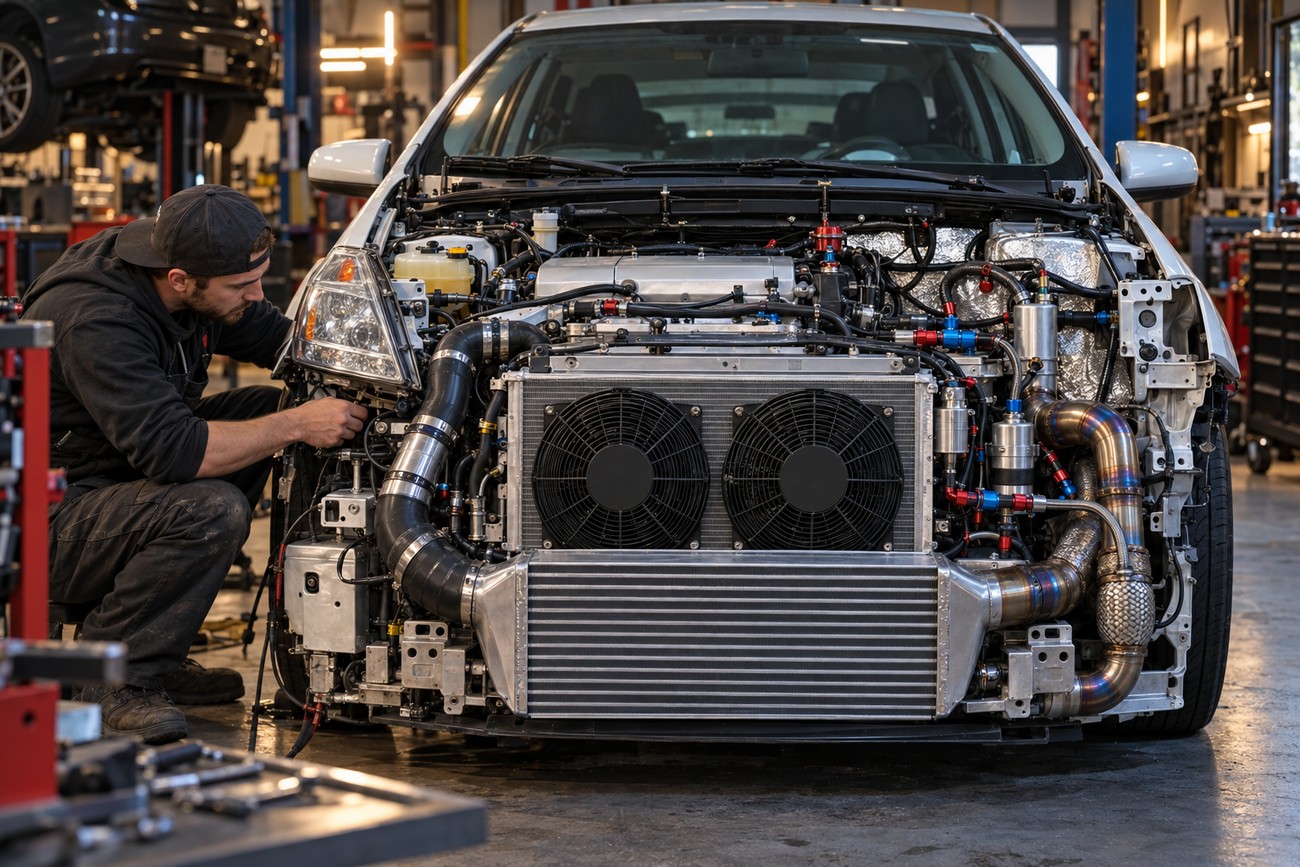
A Hellcat installation requires a new cooling strategy. The radiator, airflow path, intercooler or supercharger heat-management system, fans, hoses, and heat shielding must fit the available space while working at sustained load. A radiator that fits physically may still receive inadequate airflow once the bumper, grille, and other components are installed.
Fuel delivery also needs to match the engine and its calibration. The tank, pump, lines, filtration, pressure control, and fuel-system safety provisions must be compatible with the Hellcat powertrain. The original Prius fuel hardware cannot be assumed to support the new engine simply because both systems use gasoline.
Electrical integration is a separate engineering project. A practical donor package may need the engine, ECU, wiring, accelerator hardware, fuel components, exhaust parts, and transmission. Sensors, throttle control, starting, charging, gauges, cooling fans, and safety interlocks must communicate correctly after the original hybrid control architecture is removed or substantially redesigned.
The Prius hybrid control logic cannot simply be expected to operate normally with a Hellcat V8. The builder must decide which original systems remain, which are deleted, and how the replacement controls handle engine operation and vehicle functions. Exhaust routing must also account for clearance, heat, noise, emissions equipment, and underbody protection.
Starting the engine is only an early milestone. Calibration, heat management, fault diagnosis, and repeatable operation come afterward. A donor engine alone is insufficient because the surrounding control and support systems are part of the powertrain.
What the swap does to Prius economy, usability, and identity
The Prius hybrid system was designed for efficiency, while the Hellcat is designed for extreme power and torque. Installing the V8, its transmission, cooling hardware, fuel system, exhaust, and structural reinforcement changes the vehicle’s mass and balance. It also introduces a maintenance schedule and failure points closer to those of a high-performance custom car than a standard Prius.
Fuel economy loses its original meaning in this configuration. The hybrid system’s efficiency purpose is either removed or heavily compromised, while the Hellcat requires fuel delivery and cooling capacity appropriate to its output. The finished vehicle may retain the Prius body, but it no longer performs the practical role associated with a conventional Prius.
That change affects usability as well. Additional fabrication can reduce luggage space, service access, ground clearance, and cabin comfort. More heat, noise, vibration, and drivetrain harshness may be acceptable for a show display or short drag pass, yet tiresome and difficult to manage on ordinary roads.
For those reasons, most documented extreme Prius Hellcat projects are better classified as drag or show cars rather than practical road-going hybrids. The conversion creates a different vehicle with a Prius shell, not a normal Prius with a replacement engine.
Budget and street legality can stop the project before the first test drive
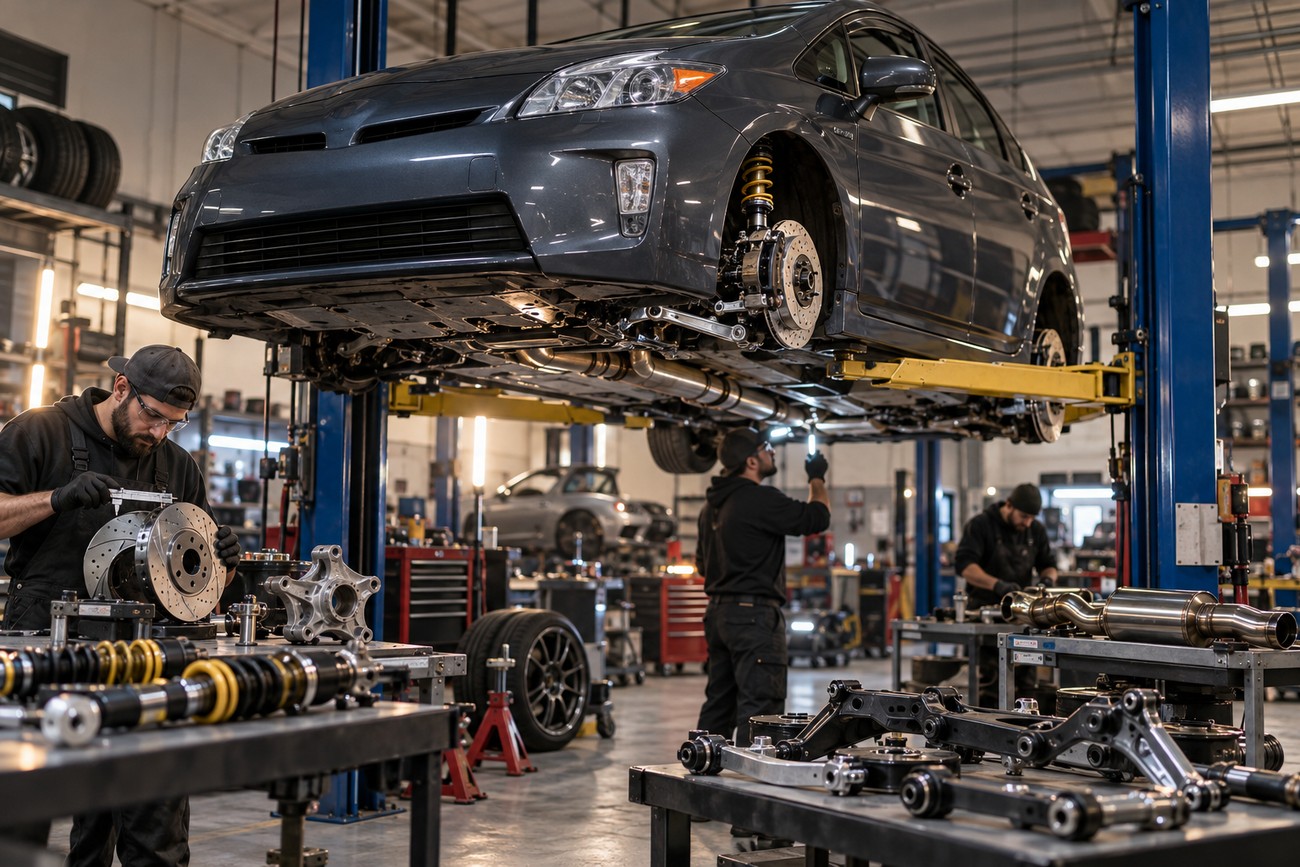
The donor engine is only one cost center. Fabrication, mounts, subframes, transmission work, cooling, fuel delivery, wiring, exhaust, brakes, suspension, safety equipment, and tuning can all require substantial labor and specialized parts. The total project cost can greatly exceed the price of the Hellcat engine itself.
Custom fabrication also creates recurring expenses. A first solution may interfere with steering, overheat, misalign the drivetrain, or fail under load. Reworking those parts is normal in a project of this complexity, so a realistic budget must include testing, troubleshooting, and replacement components.
A technically running car may still be unsuitable for public roads. Inspection authorities may require certification of the modifications, registration updates, emissions compliance, structural review, or evidence that the braking and safety systems meet local requirements. The exact process depends on the jurisdiction and the Prius model year.
Insurance creates another separate issue. A heavily modified car may need specialist coverage, an agreed valuation, or advance approval from the insurer. Registration and emissions rules can also prevent road use even when the engine starts, the car moves, and the fabrication appears professional.
Legal planning should begin before buying parts. Confirm the local rules for engine swaps, emissions equipment, noise, vehicle identity, inspection, and insurance first. Otherwise, the project can become an expensive track-only car by default.
Common myths about building a Hellcat Prius
Myth: buying a used or crate Hellcat engine is enough. Reality: the engine is only the center of a larger system. The build also needs compatible transmission hardware, mounts, structural supports, cooling, fuel delivery, wiring, controls, exhaust, brakes, and a chassis capable of managing the result.
Myth: an internet build proves the swap is easy. Reality: published projects demonstrate possibility, not simplicity or repeatability. A one-off car may use extensive fabrication, specialized tuning, and track-only compromises that are invisible in short videos or photographs.
Myth: horsepower is the only limitation. Reality: packaging, added mass, torque transmission, cooling, braking, vehicle control, and legality are usually harder constraints. Physical fitment does not solve axle alignment, differential behavior, overheating, poor weight distribution, or inspection requirements.
Myth: the finished car will remain both fast and practical. Reality: a Hellcat conversion generally becomes a drag or show car and requires continuing development before it becomes dependable. The sensible success test is repeatable operation: it must start, launch, turn, stop, and stay cool under the intended conditions.
Frequently asked questions
These questions concern specifications and donor-platform selection rather than the basic swap verdict. Exact model-year data and local regulations should be checked separately before planning a build.
Which Prius has 200 hp?
A roughly 200-hp rating depends on the specific Prius generation and hybrid trim. Prius power figures vary by model year, market, and whether the stated number refers to the gasoline engine, the electric system, or a combined system rating.
That figure says nothing about whether the car can accept a Hellcat drivetrain. Verify the exact model-year specification first, then evaluate the body structure, transmission layout, available engine-bay space, and local modification rules.
What cars can fit a Hellcat engine?
A suitable platform needs enough engine-bay volume, a compatible longitudinal or transverse layout, adequate transmission and differential capacity, sufficient cooling space, and structural support for the engine and driveline. It also needs room for exhaust routing, fuel-system hardware, and service access.
There is no universal list of cars that will accept a Hellcat without major work. Platforms originally designed for large engines and high torque usually require fewer structural changes, while compact hybrids such as the Prius demand a full custom powertrain and chassis rebuild.







