
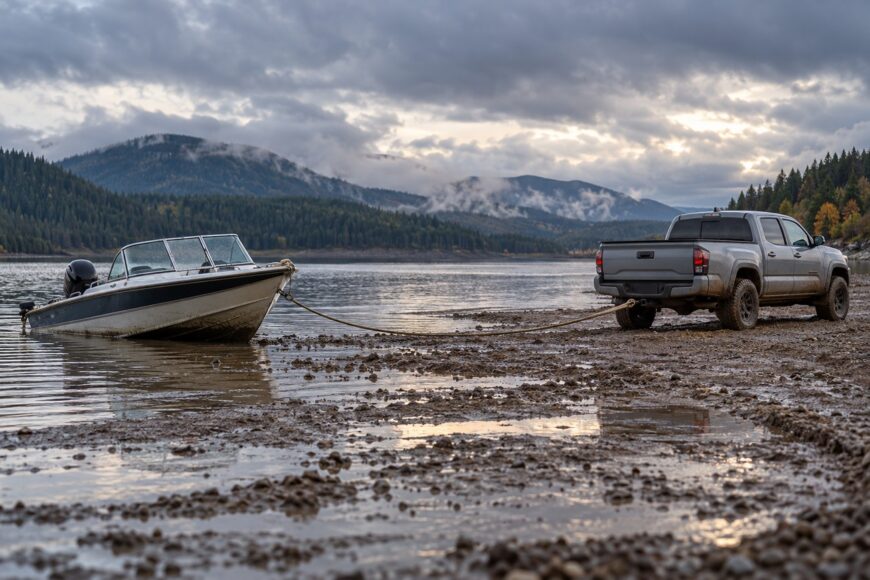
A boat that will not come free from a lake quickly turns a routine launch into a recovery job. The temptation is to apply more throttle with the Tacoma, yet the safer decision is to reduce the boat’s resistance first, then attempt a controlled pull only if the attachment and ground conditions support it.
Mud suction, water in the hull, a poor pull angle, and weak tire traction can defeat a truck that tows the same boat comfortably on the road. The Tacoma’s tow rating applies to a loaded trailer, not as a promise of safe force for extracting a stuck hull.
- First, Work Out What Is Actually Stuck
- Check the Tacoma and Every Connection Before Pulling
- Free the Boat, Then Make a Controlled Pull
- Know When the Tacoma Is Not Enough
- Frequently asked questions
- What is the biggest boat a Tacoma can tow after recovery?
- How deep into the water can a Tacoma drive to reach the boat?
- What if the boat has no verified attachment point for a pull?
First, Work Out What Is Actually Stuck
A boat stuck to a muddy bottom is a different problem from a loaded trailer stuck on a ramp. A hull may be held by suction and soft sediment, while a trailer usually needs traction, a sound connection, and a clear path up the ramp.
Static boat weight gives an incomplete picture. Mud suction, water in the hull, and the pull angle can make extraction resistance substantially higher than the boat’s weight. A sideways or upward pull can also increase resistance and place damaging loads on the boat and recovery equipment.
The 2026 Tacoma is rated to tow up to 6,500 lb only in select configurations; other configurations have lower ratings. That figure describes rated trailer towing, not the force available or safe for extracting a stuck boat. Count the trailer, boat, fuel, and gear when checking road-towing limits.
Check the Tacoma and Every Connection Before Pulling
Verify the exact Tacoma configuration and inspect its recovery equipment before connecting anything. A suitable recovery connection uses an appropriately rated, frame-mounted recovery point with secure, compatible connections. A factory front recovery point is not present on every Tacoma, and a rated rear recovery point is generally not standard.
Check the boat or trailer attachment as carefully as the truck. Do not use a tow ball, bumper, body tie-down loop, cleat, rail, or improvised open hook for recovery. Confirm the rating and condition of the recovery point, shackles, soft shackles, and line, and replace equipment showing cuts, distortion, corrosion, or an uncertain history.
A weight-distributing hitch addresses trailer-towing loads; it is not a rated stuck-object recovery point. A factory-looking hook also needs verification for the direction and type of load. If you cannot identify a frame-mounted point and a secure attachment on the boat or trailer, stop before applying tension.
Free the Boat, Then Make a Controlled Pull
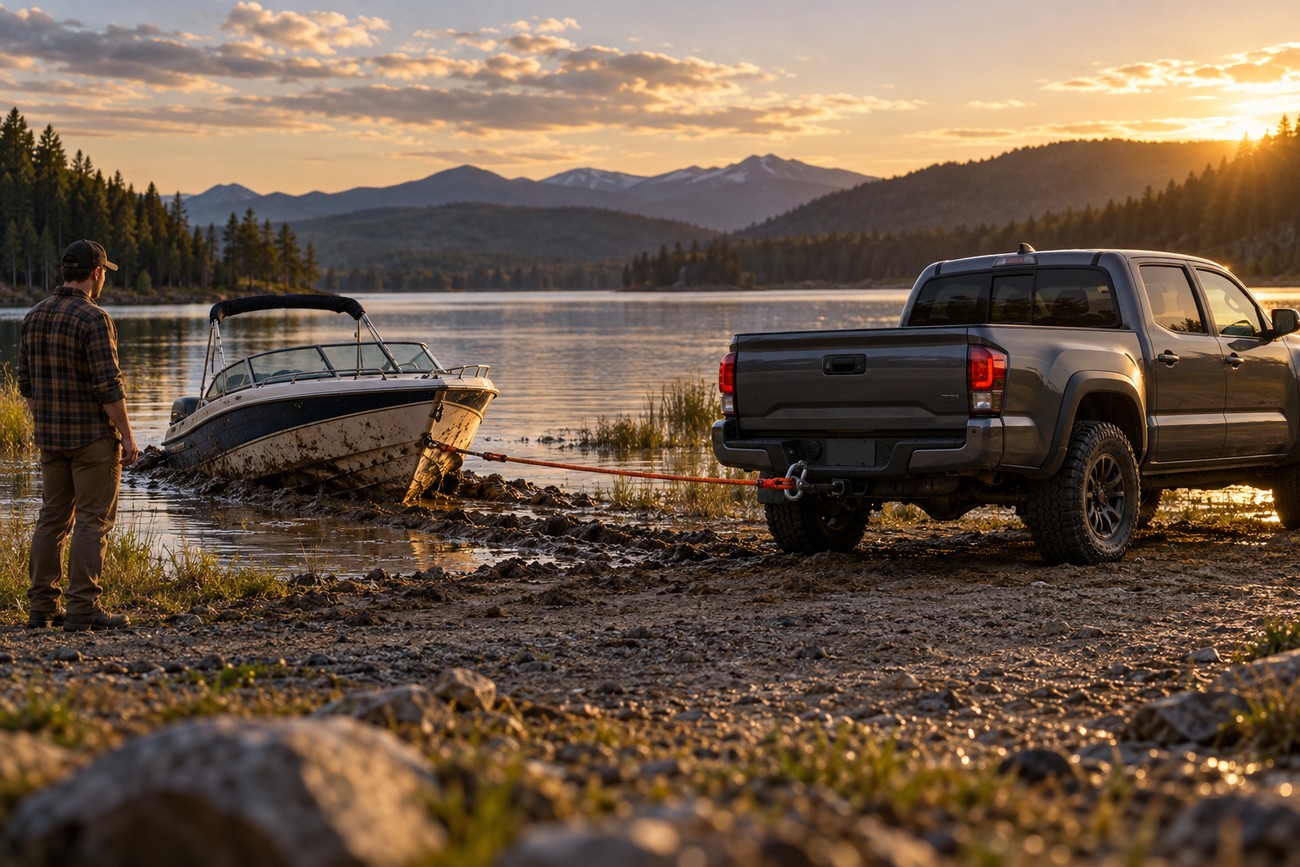
Keep everyone clear of the line and its possible recoil path. Remove loose gear and excess water where feasible, and reduce mud suction by freeing the hull’s edges or changing its position safely. Choose the most direct pull available, with the Tacoma on firm ground rather than farther into the lake.
Use a spotter, keep the line aligned, and begin with a slow, steady application of power. Stop immediately if the tires spin, the line shifts, the truck moves toward unstable ground, or the boat does not respond. Reassess the attachment and the resistance instead of increasing throttle.
A running start or snatch pull is not a substitute for proper equipment. A steady pull is different from a dynamic recovery jerk, which requires purpose-rated attachment points and recovery gear designed for that load. If the hull remains fixed, refloating or winching may be safer than repeating the pull.
Know When the Tacoma Is Not Enough
Stop when the tires spin, suction is deep, the line angle becomes unsafe, or no verified attachment point is available. Rising water exposure is another clear stop sign. A Tacoma that can move a trailer on a dry road may still lack the traction, angle, or recovery setup needed at the shoreline.
The 2026 Tacoma’s up-to-6,500-lb trailer tow rating is not a stuck-boat recovery rating. A deeply stuck boat may require refloating, a properly anchored winch, additional suitable equipment, or professional recovery. A rear recovery setup must be verified because a rated rear recovery point is generally not standard.
After the boat is free, inspect the hull, trailer, winch post, rollers, lights, tires, suspension, and recovery connections. Look for water intrusion, bent components, shifted bunks, and damage around the attachment point. Tow the boat away only after the trailer is stable and roadworthy.
Frequently asked questions
These decisions depend on the specific Tacoma, the fully loaded trailer, the boat’s attachment points, and the shoreline conditions. The limits below help separate road towing from water recovery.
What is the biggest boat a Tacoma can tow after recovery?
Up to 6,500 lb applies only to select 2026 Tacoma configurations, with lower limits on others. For road towing, compare the specific truck’s rating with the loaded trailer, boat, fuel, and gear—not the boat’s advertised dry weight. Recovery from mud remains a separate problem.
How deep into the water can a Tacoma drive to reach the boat?
There is no single safe Tacoma water-entry depth established here. Keep the truck on stable ground, avoid driving farther into the lake to gain reach, and check the owner’s manual, surface conditions, and water risks before any entry.
What if the boat has no verified attachment point for a pull?
Do not pull from a cleat, rail, fitting, or other unverified point. Obtain an attachment method verified for that boat and the intended load, or use a qualified recovery service with suitable equipment.







