
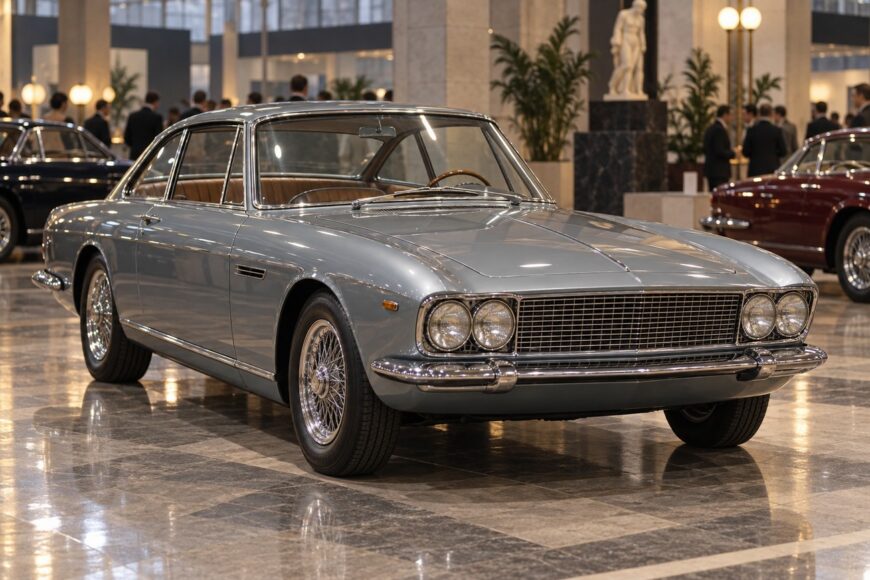
The Prince Skyline Sport presents a deliberate historical tension: its Italian body suggests a dramatic sports car, while its mechanical package belongs to a heavier and more conventional luxury coupe. Identified as the BLRA-3, it was associated with Giovanni Michelotti and gained a visual identity that remains more memorable than its outright performance.
The car’s history also requires careful separation. It debuted at the 1960 Turin Motor Show, yet Japanese series production began in April 1962. The Italian-built exhibition car, the Japanese production program, disputed production totals, and specifications sometimes attached to a different 1963 model are often blended together. A sound assessment starts by keeping those stories apart.
- From Turin Show Car to Japanese Production
- Michelotti Styling and the Small-Series Body
- BLRA-3 Specifications: What the Numbers Actually Say
- A Luxury Coupe, Not a Secret Racing Car
- Rarity, Production Numbers, and Restoration Risk
- Buying and Authenticating a Skyline Sport Today
- Frequently asked questions
- What is the best Japanese coupe car?
- What is the rarest Japanese car?
- What is the most famous Japanese sports car?
- How should an uncertain Skyline Sport production number be written in a sale listing?
From Turin Show Car to Japanese Production
The Prince Skyline Sport was identified as BLRA-3 and made its public debut at the Turin Motor Show in 1960. Giovanni Michelotti designed the body, giving Prince a distinctly international statement at a time when Japanese manufacturers were developing their own higher-end identities. The car’s appearance carried the authority of an Italian coachbuilt design, even though its later production story was rooted in Japan.
The Turin exhibition car was built in Italy, while the series production program was implemented in Japan. That difference matters because a show car is often prepared for display, photography, and press attention under conditions that do not govern a low-volume production vehicle. Details of trim, body construction, fittings, and finish should therefore be checked rather than assumed to have survived unchanged.
Japanese series production began in April 1962. The delay between the Turin debut and production reflects the practical work required to adapt an Italian-designed, small-series body to a Japanese manufacturing program. It also explains why claims based solely on photographs of the Turin car can mislead a restorer trying to determine whether a surviving detail is original to a production BLRA-3.
For historians, the distinction adds value rather than diminishing the car’s importance. The Skyline Sport records a period when Prince used an Italian design language to position a Japanese automobile as a luxury product, while the production car remained tied to the company’s existing engineering resources.
Michelotti Styling and the Small-Series Body
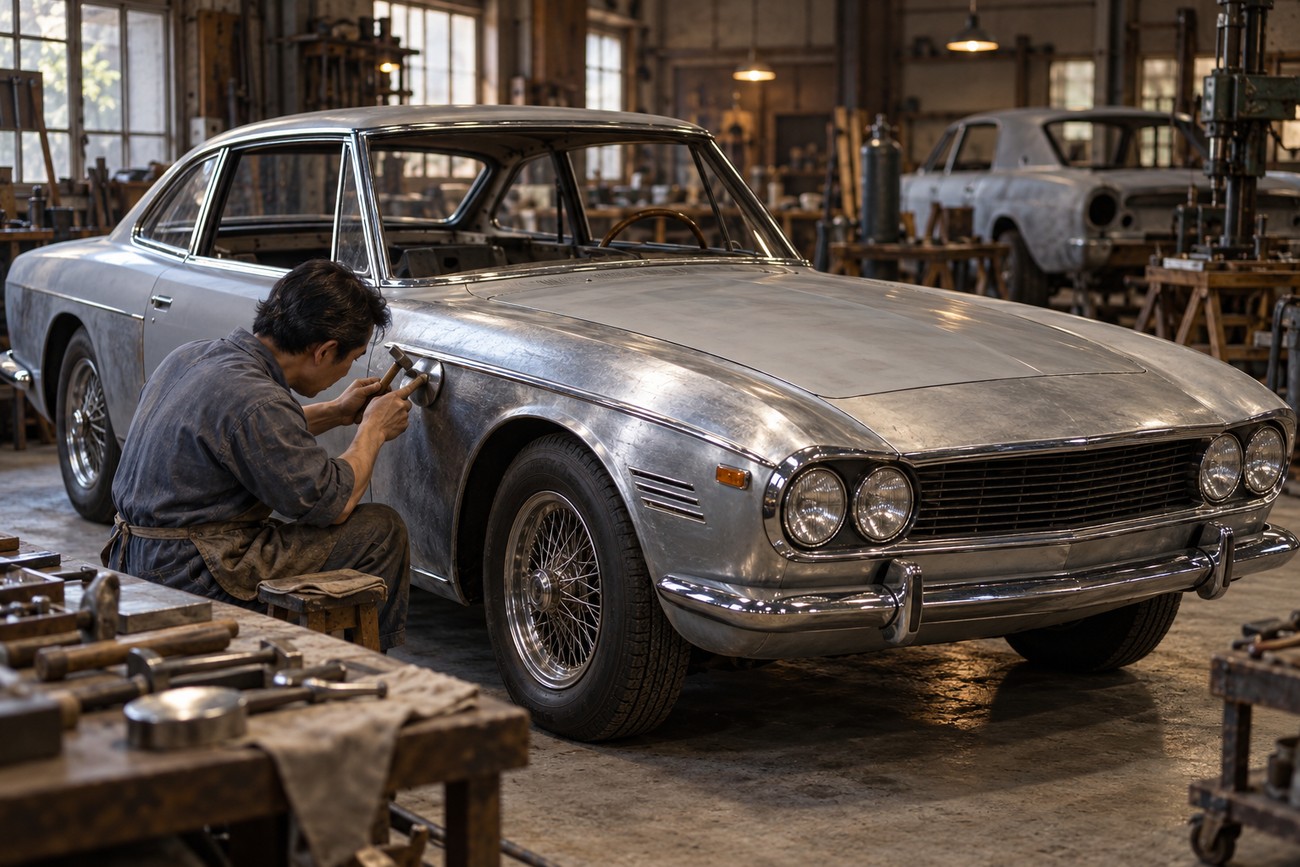
The Skyline Sport was offered as a coupe and a convertible, with bodywork produced in small numbers and partly by hand. That method allowed a distinctive shape to reach the market without the industrial investment required for a high-volume model. It also placed the car closer to a limited-production luxury commission than to an ordinary family sedan with cosmetic alterations.
Michelotti’s design gives the car its strongest identity. Long proportions, formal surfacing, and carefully treated trim create an impression of speed even when the underlying specification remains restrained. The visual drama is historically significant, yet it should not be mistaken for evidence of a dedicated racing specification.
Partly hand-built construction can produce individual differences in panel gaps, trim alignment, fasteners, and attachment details. Such variation may be original rather than proof of careless restoration. A surviving car should therefore be judged against period documentation and physical evidence, rather than against a single photograph treated as an absolute factory template.
The same construction method creates a serious ownership issue. A missing grille detail, ornament, window surround, or bespoke body section may have no normal replacement-market solution. Mechanical components can sometimes be researched through related Prince models, while decorative parts may require specialist fabrication, careful pattern-making, or the recovery of an original piece to copy.
BLRA-3 Specifications: What the Numbers Actually Say
The following figures describe the BLRA-3 coupe and keep the commonly mixed engine and performance data attached to the correct model.
| Specification | BLRA-3 coupe |
|---|---|
| Dimensions | 4,650 × 1,695 × 1,385 mm |
| Wheelbase | 2,535 mm |
| Mass | 1,350 kg |
| Engine | GB4, 1,862 cc inline overhead-valve four-cylinder |
| Power | 94 PS at 4,800 rpm |
| Torque | 153 Nm at 3,600 rpm |
| Claimed top speed | 150 km/h |
| Standard tyre | 5.90-15-4PR |
The 1,862 cc engine displacement is often rounded to 1.9 liters; it does not indicate a separate engine version. Readers should also avoid merging these figures with a separate or mixed 1963 Prince Skyline Sport Coupe listing that cites 1,189 cc, 55 PS, and about 60 cars. Those data should not be used to describe the BLRA-3 without further evidence.
A Luxury Coupe, Not a Secret Racing Car
The specification places the Skyline Sport in a clearer category than its name might suggest. Its mechanical specification was substantially related to the Prince Gloria 1900, and the GB4 was a conventional inline overhead-valve four-cylinder. That relationship gave Prince a workable luxury-car foundation, rather than an exotic engine developed for competition.
At 1,350 kg and 94 PS, the coupe had considerable mass for its output. Its 153 Nm of torque arrived at 3,600 rpm, which suited measured road progress more than explosive acceleration. Descriptions of the car as calm or composed are therefore more credible than claims that it delivered the character of a lightweight sports machine.
The claimed 150 km/h top speed should be read in its period context. It was a meaningful figure for a Japanese luxury coupe of the early 1960s, yet it does not transform the car into a racing derivative. The Italian styling, the word “Sport,” and the public attention surrounding the Turin debut can all encourage modern readers to overstate what the engine and weight actually promised.
This distinction is useful when assessing an example today. The Skyline Sport’s appeal rests on its design, rarity, and place in Prince’s development of an upscale automobile. A buyer seeking sharp handling or strong acceleration should evaluate it as a historic grand-tourer-style coupe, with the limitations that follow from its conventional engine and substantial mass.
Rarity, Production Numbers, and Restoration Risk
Nissan gives an approximate production figure of about 60 cars. Some secondary publications suggest a wider range of 60–200, but the upper figure is not adequately confirmed. The responsible description is therefore an approximate Nissan figure accompanied by a clear note that historical sources do not establish a universally accepted exact total.
Rarity affects more than a car’s position in a collection. Body panels, glass, trim, ornaments, and other decorative components were produced for a very small program, so the normal supply chain for restoration parts is thin or absent. Reproducing a lost item can involve research, measurement, tooling, and finish work that exceed the apparent value of the component itself.
Available owner material is limited, and there is no substantial systematic dataset of complaints from which to draw broad reliability conclusions. The practical risk is easier to identify: a car may be mechanically serviceable while remaining incomplete in ways that are expensive to correct. A missing trim piece can become a larger problem than a routine engine repair.
The Gloria relationship helps with historical understanding and may assist parts research, yet it does not guarantee interchangeability. Ordinary Skyline or Gloria components must be checked against dimensions, mounting points, and catalog numbers. Similar appearance is weak evidence when the surviving population is small and production details may vary.
Rarity also does not equal mechanical uniqueness. The Skyline Sport can be culturally important and difficult to replace while sharing substantial engineering with a related Prince model. That combination is precisely why restoration planning should separate the value of the body and history from the availability of routine mechanical service parts.
Buying and Authenticating a Skyline Sport Today
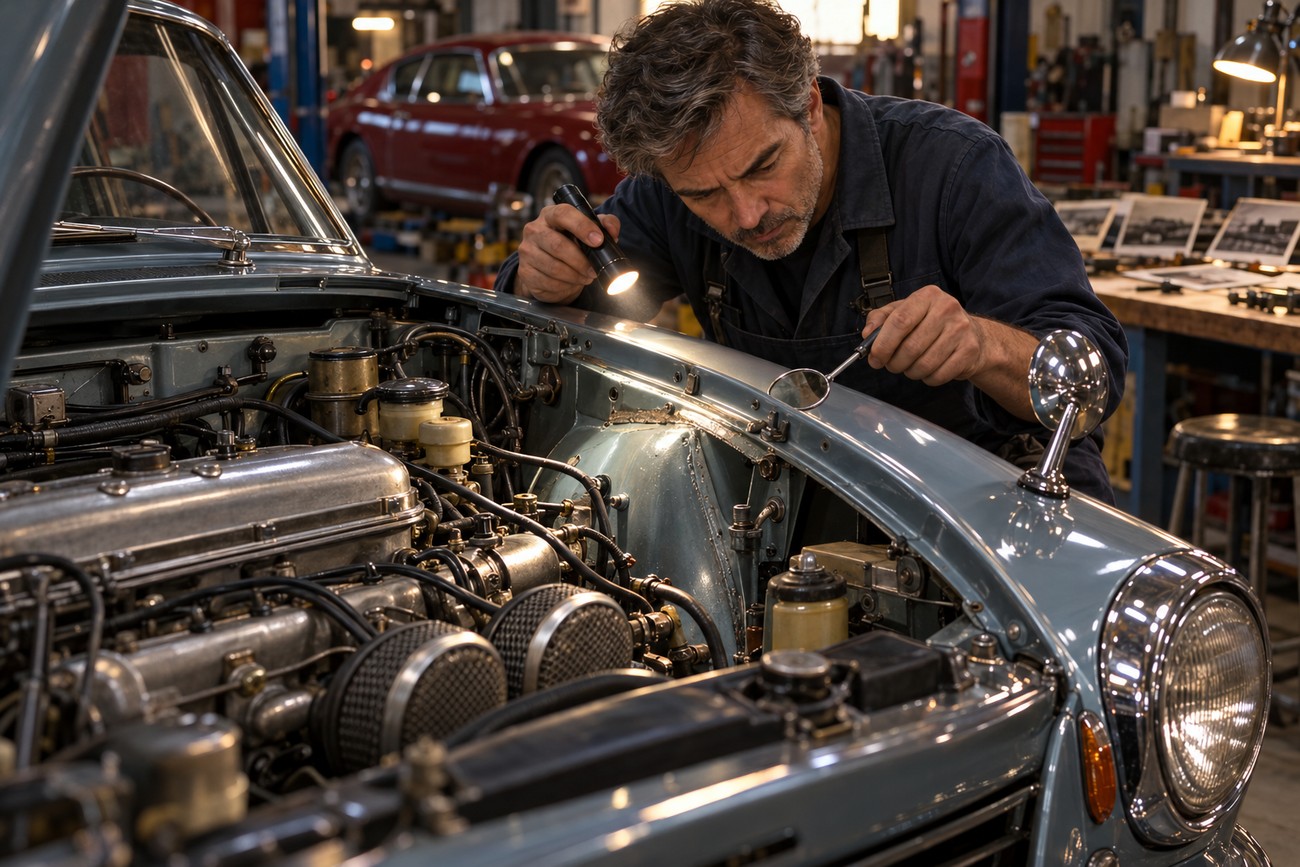
A prospective buyer should begin with the complete car rather than its silhouette. Authentication needs to cover the body, chassis, engine, trim, and the rare factory specification as one connected record. A convincing Michelotti shape alone cannot establish that a car is a genuine BLRA-3 or that its major components belong together.
Inspect the body for evidence of repairs, replacement sections, and alterations around distinctive openings and trim mounts. Compare surviving fittings with period photographs and available catalog material, allowing for differences between the Italian exhibition car and Japanese production cars. The goal is to understand the car’s construction history, not to force every irregularity into a theory of originality.
Engine identification deserves equal care. The GB4 specification, engine markings, chassis evidence, and documented repairs should be considered together. A related Prince or Skyline component may be a sensible service solution, yet it should be recorded as a replacement or adaptation when its original application cannot be demonstrated.
Physical interfaces settle parts questions more reliably than visual similarity: measure the component, inspect its mounting points, and compare the catalog reference before accepting a donor part from an ordinary Skyline or Gloria.
Documentation should state uncertainty plainly. If the production history is incomplete, describe the total as disputed and distinguish Nissan’s approximate figure from the broader secondary range. A careful sale listing also identifies non-original trim, reconstructed panels, and replacement mechanical parts, giving the next custodian a usable basis for further research.
Finally, budget for the rarest items first. Routine mechanical work can often be planned once the specification is understood, while a missing body or decorative element may require a custom solution with no predictable market benchmark. The best purchase is the most coherent and documented example available, rather than the car with the most impressive appearance in photographs.
Frequently asked questions
The questions below place the Skyline Sport’s styling, rarity, performance, and production history in context. They also distinguish collector appeal from practical ownership considerations. Where historical totals remain uncertain, the wording reflects that uncertainty.
What is the best Japanese coupe car?
There is no single best choice because the answer depends on the priority: styling, historical importance, performance, parts support, or rarity. The Prince Skyline Sport is a strong design statement and an important early luxury coupe, yet its 1,350 kg mass, conventional GB4 engine, and scarce body parts make it less suitable for modern driving than many later Japanese coupes.
For a collector, its value lies in the combination of Michelotti styling and limited production. For regular use, easier parts access, stronger performance, and better-documented service support may matter more than exceptional rarity.
What is the rarest Japanese car?
No universal ranking can be given. Factory records may be incomplete, surviving examples may be misidentified, and disputed production totals can describe different stages of a model’s history or confuse related versions.
The Skyline Sport illustrates the problem clearly: Nissan states approximately 60 cars, while some secondary sources suggest 60–200 without adequately confirming the upper figure. A rarity claim is strongest when it combines reliable production documentation with a verifiable surviving car, rather than relying on a repeated number alone.
What is the most famous Japanese sports car?
Public fame and collector scarcity measure different things. Later Japanese performance icons are more widely recognized for racing success, tuning culture, and measurable speed, while the Skyline Sport is better understood as an early luxury coupe with an important international design connection.
That distinction does not reduce its historical importance. It prevents the car from being placed automatically in the same category as later high-performance models simply because it carries the Skyline name and a sporty visual identity.
How should an uncertain Skyline Sport production number be written in a sale listing?
A careful listing should state: “Nissan gives an approximate production figure of about 60 cars; some secondary sources suggest 60–200, but the exact total remains unresolved.” This wording identifies the primary published figure, discloses the competing range, and avoids presenting either estimate as a verified exact count.
The listing should then focus on the individual car’s evidence: body and chassis identity, engine, trim, restoration history, and documentation. Those details are more useful to a buyer than an unsupported claim that the entire production total has been conclusively established.







