
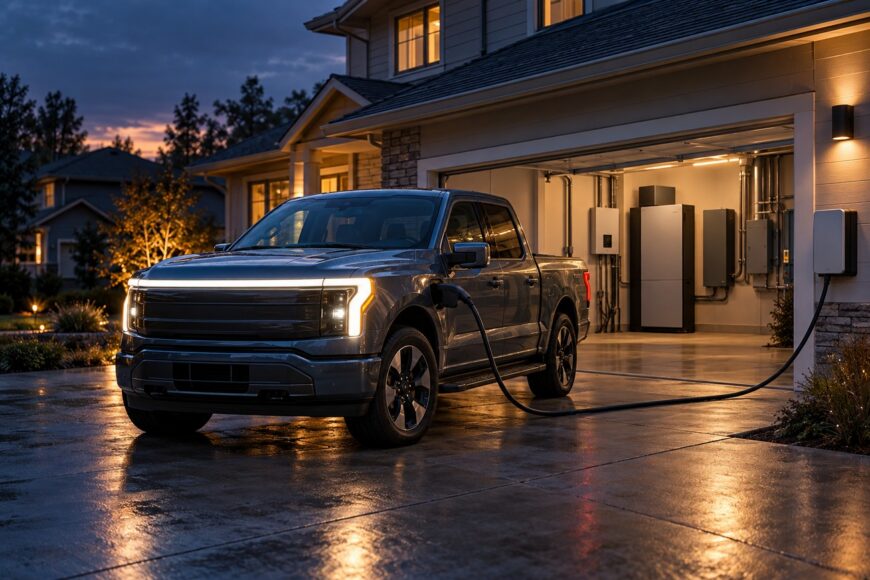
Using a Ford F-150 Lightning as a home battery can provide backup power without fuel deliveries, engine maintenance, or a separate generator taking up space. Its large traction battery can keep essential household circuits operating during an outage, while the truck remains a useful vehicle if its charge is managed carefully.
The arrangement is not a plug-and-play whole-home generator, however. Ford’s multi-day claims depend on usable battery capacity, household consumption, and conservation. Heavy heating, cooling, or cooking loads can shorten runtime substantially. The required charging equipment, electrical isolation, permits, installation cost, and need to protect the truck’s driving range also affect the practical result.
- How the F-150 Lightning Powers a House
- How Long Can an F-150 Lightning Power Your Home?
- What Your House Can Actually Run
- Installation, Permits, and the Cost Nobody Sees
- The Trade-Offs: Battery Wear, Cold Weather, and Software
- Common Mistakes and Safer Operating Rules
- Is F-150 Lightning Backup Power Worth It?
- Frequently asked questions
- How long can my F-150 Lightning power my house?
- What happens when the Lightning reaches its backup reserve?
How the F-150 Lightning Powers a House
Ford Intelligent Backup Power is the integrated bidirectional system that allows the Lightning to send stored energy into a home. It requires a Ford Charge Station Pro and Home Integration System; the truck’s battery does not provide this function merely because it can supply power to selected devices through ordinary vehicle outlets.
The energy path runs from the Lightning through the Charge Station Pro to the Home Integration System and its home inverter. The inverter converts and manages the battery power for the household electrical system, with approximately 9.6 kW of continuous backup output. Depending on the configuration, the system can also handle short-duration current of up to approximately 80 A at 240 V.
Transfer equipment separates the house from the utility grid when grid power fails. NEC/UL-compliant transfer equipment and islanding protection prevent the home from sending electricity onto utility lines, where it could endanger line workers and damage equipment. A licensed electrician must design and install this separation as part of the permitted system.
In practice, installers commonly place selected circuits on a backed-up panel or equivalent protected arrangement. Refrigeration, lighting, general outlets, a gas furnace or boiler, and internet equipment are typical priorities. The system’s safety depends on the complete installation, so an improvised cable or household receptacle cannot substitute for the transfer equipment.
How Long Can an F-150 Lightning Power Your Home?

Runtime depends on usable energy and measured daily consumption, rather than the truck’s battery label alone. The Standard Range battery is approximately 98 kWh, while the Extended Range battery is approximately 131 kWh. After reserves and conversion losses, practical energy available to the home is often approximately 70–90% of nominal battery capacity.
Ford cites about three days at approximately 30 kWh per day, with up to about ten days possible under substantial conservation and with sufficient usable capacity. Those figures describe specific consumption assumptions. A home using electric resistance heat, air conditioning, an electric range, or an electric water heater can consume its available energy much faster.
Real-world runtime is often about one to three days when ordinary heating, cooling, or electric cooking loads remain active. A carefully managed critical-load setup may last longer, while a cold-weather home with electric heating may last substantially less. The inverter’s approximately 9.6 kW continuous limit also matters when several appliances operate at once.
A useful estimate starts with the battery capacity, applies the expected usable-energy allowance, and divides that result by the home’s measured daily consumption. Utility-bill averages can hide short, high-demand events and seasonal changes, so a household should measure its intended backup circuits before relying on a runtime estimate.
What Your House Can Actually Run
The backed-up load must fit both the inverter and the battery budget. Refrigerators, lights, internet equipment, phone chargers, and selected receptacles are usually manageable when coordinated. A gas furnace or boiler may also be practical because its controls, blower, or circulation pump typically require substantially less energy than electric resistance heating.
Electric ranges, resistance water heaters, large HVAC systems, saunas, and similar loads can exceed the practical limits of a 9.6 kW continuous backup supply or drain the battery rapidly. Motors and compressors also draw startup current, so an appliance that appears acceptable from its nameplate rating may still create a difficult transient when it starts.
Before installation, measure the actual consumption of candidate circuits with a suitable wattmeter or monitoring device. The electrician can then size the backed-up panel around observed continuous demand and startup behavior, rather than assuming that the whole house can operate normally.
Installation, Permits, and the Cost Nobody Sees
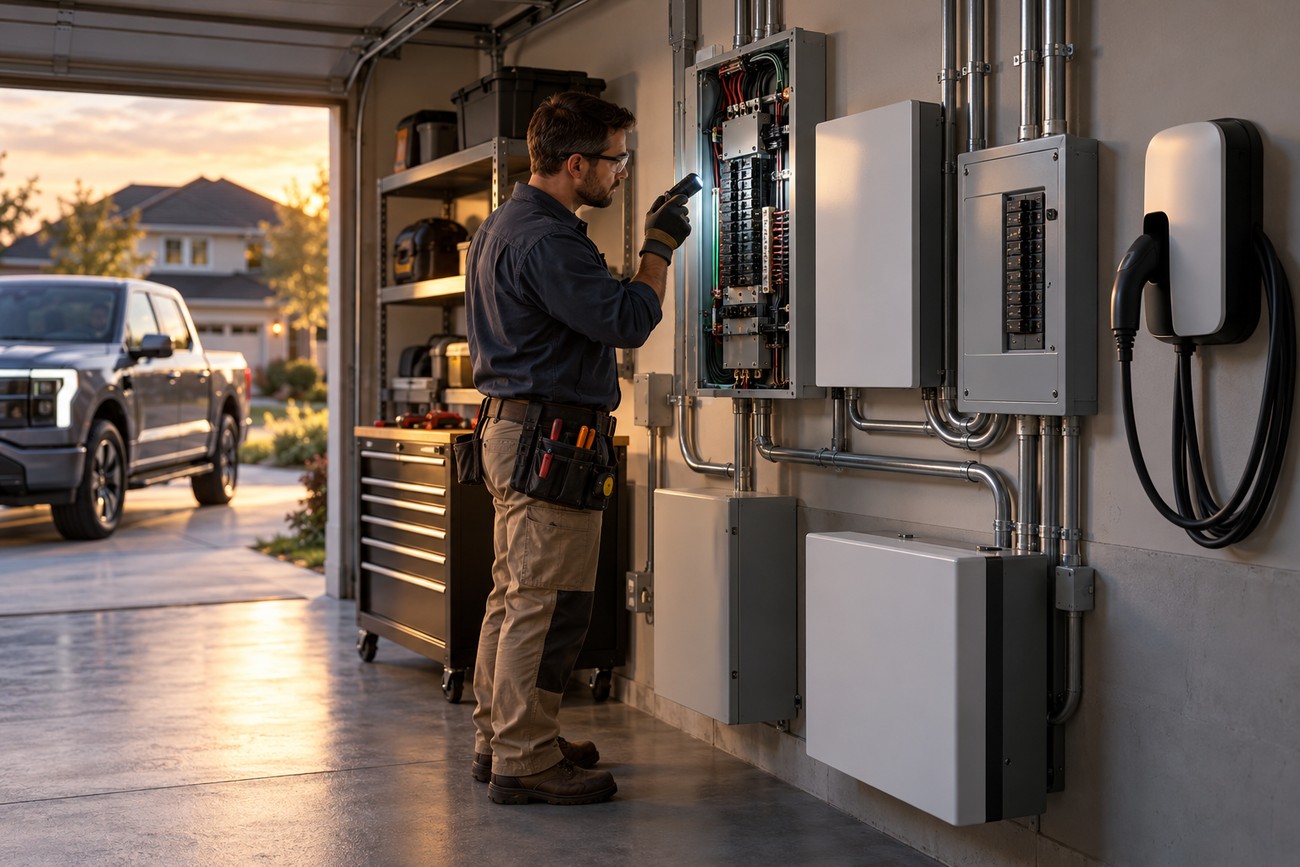
Buying the Lightning does not create a working home backup system. A licensed electrician must install the Charge Station Pro, Home Integration System, inverter-related equipment, transfer equipment, and any required panel or wiring changes. Local permits, utility requirements, and inspection rules also apply.
The installation must prevent backfeeding and unintentional islanding whenever the utility grid is down. Depending on the property, that may require panel upgrades, new conduit, additional disconnects, or a dedicated backup subpanel. Existing electrical capacity and the distance between the vehicle equipment and the main panel can materially change the work involved.
In the United States, reported Home Integration System equipment and installation costs are approximately $4,000–$7,000 or more. This is a planning range rather than a universal quote. Region, panel capacity, wiring, permits, utility procedures, and site conditions can move the final price substantially.
Marketing language can make the connection sound simple, while owners may face several weeks to several months for equipment scheduling, electrical work, permits, utility coordination, and commissioning. Ask for a written scope that identifies the backed-up circuits, isolation method, inspection responsibilities, expected controls, and total installed cost.
Insurance questions deserve attention before work begins. Some insurers or local authorities may require notification or approval for a vehicle-based backup system. Unauthorized modifications or unapproved wiring can create code, warranty, and insurance disputes after a fault or fire.
The Trade-Offs: Battery Wear, Cold Weather, and Software
Deep home-backup discharges add battery cycles and can contribute to long-term degradation. That does not make occasional backup use impractical, but it means the truck is doing additional work beyond driving. Owners who regularly empty the battery for household loads should consider how that use fits their expected vehicle life and warranty terms.
Cold conditions can reduce the effective energy available to the home and increase the rate of state-of-charge decline. This matters most when an outage coincides with electric heating or other large winter loads. The same displayed battery percentage can therefore deliver a different practical result under different temperatures and household demands.
Heavy discharge can also produce noticeable fan noise and heat as the battery and power electronics cool themselves. Some owners report delayed or failed automatic transfers, the need for manual intervention, or unclear energy information in the app. These reports do not establish a universal failure, but they support testing the system before an emergency and learning the manual operating procedure.
The setup is primarily a backup system rather than a guaranteed solution for weeks of autonomous operation. Once the truck is depleted, continued home power depends on restoring grid service or finding an approved way to recharge it. The official arrangement is also intended mainly for home backup, not full vehicle-to-grid electricity sales.
Common Mistakes and Safer Operating Rules
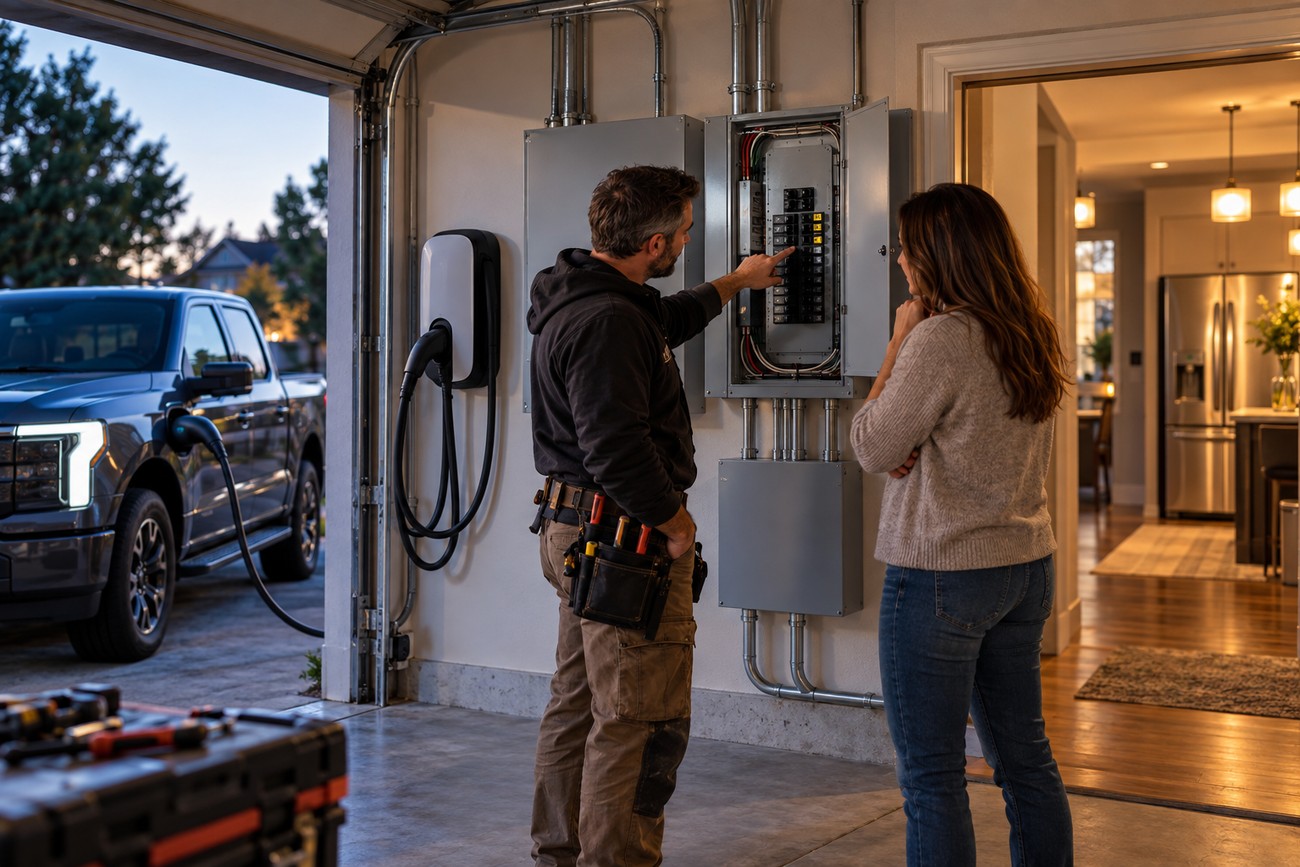
Never plug the truck into a household outlet or use a reverse-plug arrangement to energize the home. Direct outlet backfeeding without approved transfer equipment is dangerous and illegal because it can energize utility lines during an outage. Only an engineered, code-compliant isolation system should connect the vehicle battery to the home wiring.
Select and verify critical circuits before an outage rather than adding appliances casually during one. Keep refrigeration, communications, lighting, and essential heating controls ahead of discretionary loads. Avoid charging another EV, running high-power tools, or using electric heating equipment unless the system design and remaining battery clearly support it.
Some owners choose an 80–90% charge target and set a separate minimum backup reserve to protect driving range. That reserve is a personal operating decision: prioritizing extended home backup can leave the truck unavailable for transportation, while preserving mobility reduces the energy available to the house.
Improvised wiring, unauthorized equipment changes, and unapproved circuit additions can create code violations as well as warranty or insurance disputes. A simple operating card near the backup panel can identify the protected circuits, maximum intended loads, shutdown procedure, and the person to contact for service.
Is F-150 Lightning Backup Power Worth It?
The system is strongest for households that already want an F-150 Lightning and need short-duration backup for carefully selected circuits. Fuel-free operation and a large battery can provide useful resilience during outages, especially where the existing electrical infrastructure can accept the required equipment without major upgrades.
The case is weaker for someone seeking a cheap generator replacement, whole-home operation, or long-term off-grid power. Installation may cost approximately $4,000–$7,000 or more in the United States, heavy loads remain restricted, runtime is uncertain, and deep discharges add battery cycling. If the vehicle must remain available for driving, part of its charge also has to be reserved.
Value depends on the local installation quote, panel and wiring condition, household load profile, climate, and tolerance for managing backup circuits. The Lightning does not provide home backup simply because it has a large battery; the Ford Intelligent Backup Power equipment and a compliant electrical installation are essential.
For an owner who wants refrigeration, lighting, communications, and selected heating controls covered during short outages, the arrangement can be practical. It should be evaluated as an integrated backup system with defined limits, rather than as a silent, unlimited whole-home generator or a full vehicle-to-grid income system.
Frequently asked questions
Two decisions shape how useful the system will be during an outage: which household loads to support and how much charge to keep for driving. Measured consumption helps estimate runtime, but heating, cooling, and cooking can change that estimate quickly. Setting a backup reserve in advance helps keep the truck available for travel.
How long can my F-150 Lightning power my house?
Estimate runtime by dividing usable battery energy by measured daily household consumption. A Standard Range battery is approximately 98 kWh, and an Extended Range battery is approximately 131 kWh; after reserves and conversion losses, approximately 70–90% of nominal capacity may be available to the home.
That is why the same truck might provide roughly one day, about three days, or much longer in a carefully conserved setup. Ford cites about three days at approximately 30 kWh per day and up to about ten days with substantial conservation, while homes that keep ordinary heating, cooling, or electric cooking active often see about one to three days.
What happens when the Lightning reaches its backup reserve?
When the configured minimum charge level is reached, home backup stops to preserve the remaining battery charge. The owner must treat that reserve as a driving and emergency-mobility decision, not as extra house capacity. If most of the battery is used for home loads, the truck may no longer have enough energy for normal travel until it can be recharged.
Set the intended reserve before an outage and avoid assuming that the system will preserve enough charge for every trip. An 80–90% charge target leaves less energy available than a full charge; a separate minimum backup reserve protects driving flexibility while reducing the energy available to the house. The appropriate balance depends on outage risk, travel needs, and access to charging.







