
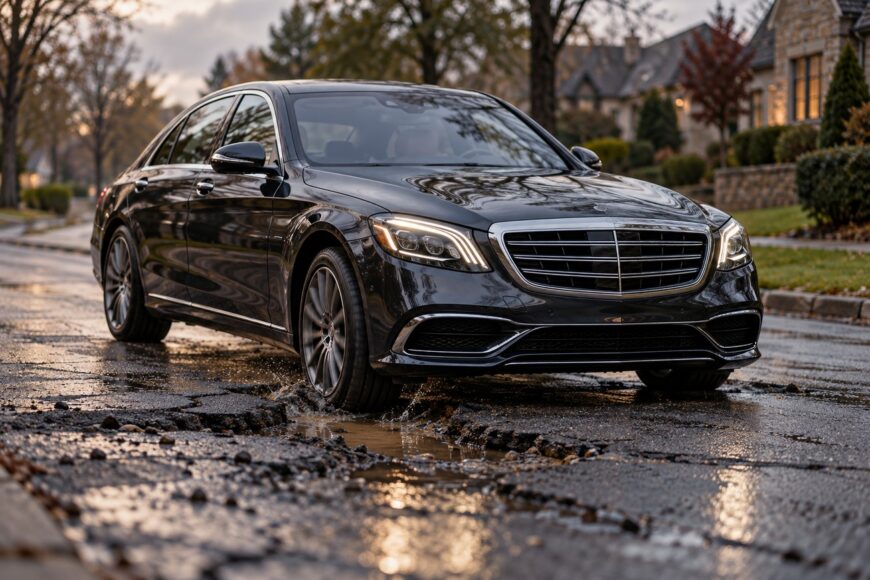
A Mercedes S-Class can make a pothole feel surprisingly mild. Its air suspension and, on some versions, active body control can reduce the sharpness felt in the cabin, control rebound, and keep the body composed. The impact energy still reaches the tire, wheel, hub, and suspension, however, so comfort must be separated from mechanical protection.
A meaningful pothole test therefore examines more than the initial thump. It considers the suspension specification, tire condition, pressure, road visibility, speed, steering reaction, and how quickly the heavy sedan settles afterward. It also looks for expensive faults that owners may dismiss as normal S-Class behavior, including rear tapping, clunks, rattles, unusual rebound, and warning messages.
- What a Mercedes S-Class pothole test should measure
- How AIRMATIC and E-ACTIVE BODY CONTROL react to a pothole
- What the road actually feels like from the cabin
- Why a smooth ride does not protect the wheel
- Car-to-X pothole warnings: useful, but not magic
- Common mistakes and hidden failure signs after bad roads
- How to evaluate a used S-Class that has seen rough roads
- The pothole-test verdict: impressive mitigation, limited protection
- Frequently asked questions
- Which Mercedes-Benz S-Class years should I avoid buying for pothole-prone roads?
- How can I turn off the Mercedes pothole warning?
- What should I do if my S-Class makes a rhythmic tapping noise after hitting potholes?
- What is the average lifespan of a Mercedes S-Class suspension system?
What a Mercedes S-Class pothole test should measure
A useful test begins with cabin disturbance. The driver should note the sharpness of the impact, movement through the seat and steering wheel, and whether passengers are thrown upward or sideways. Body control after the pothole matters just as much: a car that absorbs the first hit but continues to float or rebound slowly has not fully controlled the event.
Steering reaction is another important measure. A pothole can disturb the front wheel, change the steering angle briefly, or expose looseness in a tire, wheel, hub, or suspension component. The test should also check whether the car tracks straight afterward and whether the steering wheel remains centered.
Mercedes develops suspension behavior on special surfaces at its Immendingen proving ground, including comfort tracks with artificial bumps and potholes. Such a surface provides repeatable conditions for comparing damping and body control. Urban potholes are less predictable, with irregular edges, standing water, different depths, and impacts that may load one side of the car more heavily.
The result depends on the exact car. An S-Class may use AIRMATIC, while some versions have E-ACTIVE BODY CONTROL. Tire profile, inflation pressure, wheel size, selected drive mode, vehicle load, and road visibility also affect the outcome. A comfort-focused suspension can reduce cabin shock while leaving the tire and wheel exposed to the same basic geometry of the hole.
How AIRMATIC and E-ACTIVE BODY CONTROL react to a pothole
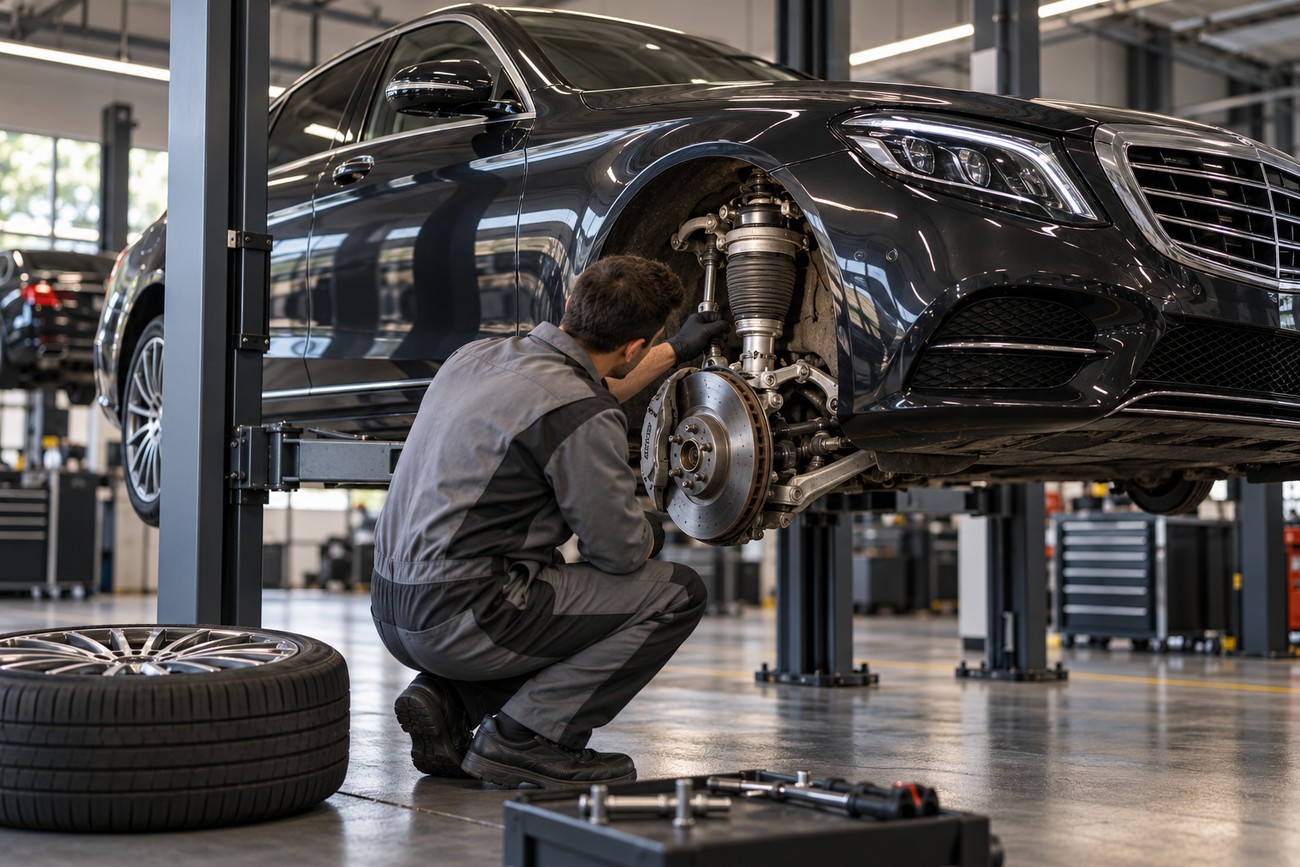
The response begins with information gathering. Forward-facing cameras can scan the road ahead, while suspension sensors and control software assess the car’s movement. Where the relevant equipment and conditions are available, the system can use this information to adapt damping before the vehicle reaches a bump or pothole.
That predictive chain is more sophisticated than a single soft setting. Short, sharp defects require a different response from long waves in the road, bridge joints, or a speed hump. The suspension is continuously balancing wheel movement, body motion, and the need to keep the tire in contact with the surface.
Applicable active-suspension versions can manage left and right wheel or body behavior separately. This matters on an offset pothole, where one side of the car drops while the other remains supported. Independent control can limit the body reaction, although it cannot remove the force acting through the affected wheel.
The strongest benefit is often apparent over medium undulations, joints, and speed humps. These events give the camera and control system useful information and allow the suspension to shape the body response over a longer interval. A deep, sharp pothole gives the tire and wheel little time or distance to absorb the impact, so the result is less dramatic than promotional demonstrations suggest.
Road scanning also has practical limits. A dirty camera, poor weather, low visibility, an unusual road edge, or software logic that does not recognize the defect can reduce the predictive response. Some Mercedes descriptions mention comfort-enhancing intelligent damping up to 10 metres before an obstacle, while official material does not establish that as a universal fixed distance for every S-Class.
What the road actually feels like from the cabin
With a properly functioning predictive or active setup, the first impression is usually a smaller cabin disturbance. Road tests have described less bouncing over speed humps and potholes, with the body settling more quickly after the wheel crosses the defect. The occupants may hear or feel the event without being thrown around by it.
A less sophisticated setup, a disabled function, or a system operating with a fault can produce a different reaction. The jolt may become more obvious, and the body may rebound or continue moving after the wheel has cleared the pothole. The S-Class’s size and mass make that motion noticeable when damping cannot control it effectively.
Comfort also changes with the selected mode and vehicle condition. A sportier setting can reduce body movement while transmitting more surface detail, whereas a comfort setting may allow a softer initial response. Neither mode changes the depth of the pothole or guarantees that the wheel has escaped damage.
The useful distinction is between perceived impact and actual impact. The suspension can soften the cabin response and reduce bouncing, yet the tire still enters the hole, the wheel still encounters its edge, and the suspension still carries the resulting load. A quiet, calm cabin is a reason to inspect carefully, not proof that the road event was harmless.
Why a smooth ride does not protect the wheel
The S-Class remains a heavy sedan with substantial mass and inertia. Active damping can manage how that mass moves, but it cannot make the vehicle weightless. A deep or sharp pothole can still transmit damaging forces through the tire sidewall, wheel rim, hub, and suspension mounting points.
Impact geometry matters as much as depth. A square-edged hole, a pothole encountered at an angle, or a defect hidden by water can load one tire abruptly. Low-profile tires provide less sidewall movement to absorb the event, while an aged or damaged tire may have less reserve even when its pressure appears correct.
Inflation pressure is equally important. An underinflated tire can allow the rim to contact the road edge, while an incorrect pressure can alter steering response and suspension behavior. Tire condition, sidewall damage, tread wear, and the correct pressure should be checked before judging the suspension.
Mercedes predictive systems are designed to mitigate the perceived impact and control body motion. They do not guarantee protection from tire, wheel, hub, or suspension damage. If the car has suffered a severe pothole strike, inspect the wheel and tire even when the occupants felt only a muted thump.
Car-to-X pothole warnings: useful, but not magic

Car-to-X can complement the camera-based system with connected road information. Mercedes materials describe pothole data being delivered through the cloud, allowing a vehicle to receive information about a defect that may have been detected or reported earlier. Nearby Mercedes vehicles may also receive the warning when the relevant connected services are available.
Some Mercedes descriptions refer to an approximate warning window of about 10 seconds. That gives the driver time to reduce speed, increase attention, or choose a safer line. It is a warning function, however, rather than an autonomous evasive maneuver.
The quality of the warning depends on connectivity, available reports, software, location data, and the conditions surrounding the road event. A newly formed pothole may have no connected record, while a road section can change after construction, rain, or repeated traffic. Camera visibility still matters because the suspension may need to combine external data with what it sees directly.
Car-to-X is therefore best treated as an additional information source. It cannot replace attentive driving, a clean forward-facing camera, or sensible speed on damaged roads. Connected features also depend on online services and are not a permanently available offline guarantee.
Common mistakes and hidden failure signs after bad roads
The first mistake is assuming that every S-Class has the same suspension capability. AIRMATIC and E-ACTIVE BODY CONTROL are different levels of equipment, and the presence of air suspension alone does not confirm every predictive or active function. Buyers should verify the actual specification and the condition of the system rather than relying on the badge or a sales description.
Advertising demonstrations create another trap. Artificial bumps and controlled proving-ground surfaces are useful for development, including the comfort tracks at Immendingen, but an irregular city pothole can have a sharper edge and a worse entry angle. Owners also sometimes ignore tires and pressure because the cabin felt composed during the impact.
Separate tire, wheel, hub, and suspension noises before blaming active damping. A rhythmic rear tap after pothole impacts deserves that sequence of checks because the noise may come from a rotating or loosened component rather than the damping system itself.
Reported warning signs include rhythmic tapping from the rear, clunks, rattles, unusual rebound, and suspension or chassis messages. Pothole-related complaints can involve suspension wear or a wheel-hub issue, and a noise that repeats with wheel speed has a different diagnostic direction from a noise that appears only when the body moves.
Complex air and active suspension systems can make diagnosis and repair more expensive when faults, leaks, sensor problems, or calibration issues occur. Poor weather, a dirty camera, and an unusual pothole can also reduce predictive performance without proving that the entire system has failed. New sounds should be investigated promptly rather than accepted as a normal S-Class trait, while a single unexplained noise should not trigger expensive parts replacement without testing.
How to evaluate a used S-Class that has seen rough roads
Start by verifying the equipment and service history. Confirm whether the car has AIRMATIC or E-ACTIVE BODY CONTROL, which modes are available, and whether the connected and camera-based functions operate without warnings. Review records for suspension work, leaks, wheel replacements, alignment, and repeated warning messages.
Inspect all four tires and wheels closely. Look for sidewall damage, uneven wear, repaired rims, bends on the inner rim, and pressure readings that differ from the manufacturer’s specification. A comfortable road test cannot prove that a wheel, tire, hub, or suspension component is undamaged.
During the drive, use several surfaces at moderate speed and listen for changes with steering angle, wheel speed, braking, and body movement. Check whether the car tracks straight, whether the steering returns normally, and whether the body settles after a bump. Behavior can vary with the selected mode, the exact suspension version, and the car’s current load.
A specialist inspection is appropriate when there is a warning, leak, uneven ride height, repeated tapping, or unusual rebound. Diagnostic equipment, a lift inspection, and a road test can separate a tire or wheel problem from an air-suspension, hub, or active-control fault. Service records and system condition provide a stronger buying basis than a smooth demonstration drive alone.
The pothole-test verdict: impressive mitigation, limited protection

The S-Class is genuinely impressive at reducing perceived impact and controlling body motion when the relevant suspension is functioning correctly. Camera input, damping control, and connected road data can work together to prepare the car for some defects. The improvement is most convincing over repeated undulations, joints, speed humps, and moderate road damage.
A conventional deep pothole still wins against the system’s promise if the test is about mechanical protection. The wheel and tire must cross the hole, and the heavy body still carries substantial inertia. Even a muted impact can leave a bent rim, damaged tire, stressed hub, or suspension noise.
For owners, the practical rule is simple: use the technology to reduce workload and cabin disturbance, then continue driving attentively. Keep tires correctly inflated, keep the camera area clean, slow down for visible defects, and investigate new noises or warning messages. The suspension specification, selected mode, road conditions, and vehicle maintenance all affect the result.
Judge comfort and damage prevention separately. The S-Class can make a pothole feel smaller; it cannot make a deep pothole safe at speed.
Frequently asked questions
The right buying decision depends on the car’s equipment, condition, service history, and response during an inspection. The following answers address common questions about pothole warnings, suspension noise, and expected system life.
Comfort during a test drive does not rule out hidden wheel, tire, hub, or suspension damage. Warning messages and unusual behavior should be investigated before purchase or continued driving.
Which Mercedes-Benz S-Class years should I avoid buying for pothole-prone roads?
There is no universal S-Class year or trim that can be declared safe from pothole-related problems. Compare the actual suspension equipment, documented servicing, wheel-and-tire specification, warning history, and the results of an independent inspection.
A well-maintained car with correctly specified tires can be a better purchase than a newer example with neglected wheels, warning messages, or unexplained suspension noise. Ask for a cold-start check, a scan of stored faults, and evidence of previous wheel, tire, air-suspension, or alignment work before buying.
How can I turn off the Mercedes pothole warning?
The control path depends on the model year, software version, market, and equipped assistance package. Check the driver-assistance or connected-services menus and the owner’s manual for the specific vehicle; menu names and available controls can differ.
A pothole warning is separate from the predictive suspension function. Turning off an audible or visual alert may leave suspension control unchanged, while disabling a broader assistance feature could affect other functions. Confirm what the setting controls before changing it, and avoid treating the warning as a substitute for reducing speed.
What should I do if my S-Class makes a rhythmic tapping noise after hitting potholes?
Reduce speed and inspect the affected tire and wheel as soon as it is safe. Look for a bulge, cut, pressure loss, a visibly bent rim, or loose debris, then check the instrument panel for suspension or chassis warnings.
If the noise continues, changes with wheel speed, or is accompanied by vibration, pulling, uneven ride height, or fluid loss, arrange specialist diagnosis before extended driving. A rhythmic tap can involve the tire, wheel, hub, or suspension, so replacing active-damping parts without identifying the source is poor diagnostic practice.
What is the average lifespan of a Mercedes S-Class suspension system?
There is no single reliable lifespan figure for AIRMATIC or active suspension. Condition, road use, leaks, calibration, tire pressure, maintenance, vehicle load, and the quality of previous repairs matter more than mileage alone.
Warning messages, a car that settles unevenly after parking, repeated compressor operation, unusual rebound, and new noises are more useful indicators than an age-based estimate. A documented inspection can identify whether the issue is a small air leak, a sensor or calibration fault, a worn mechanical component, or a larger active-suspension problem.







