
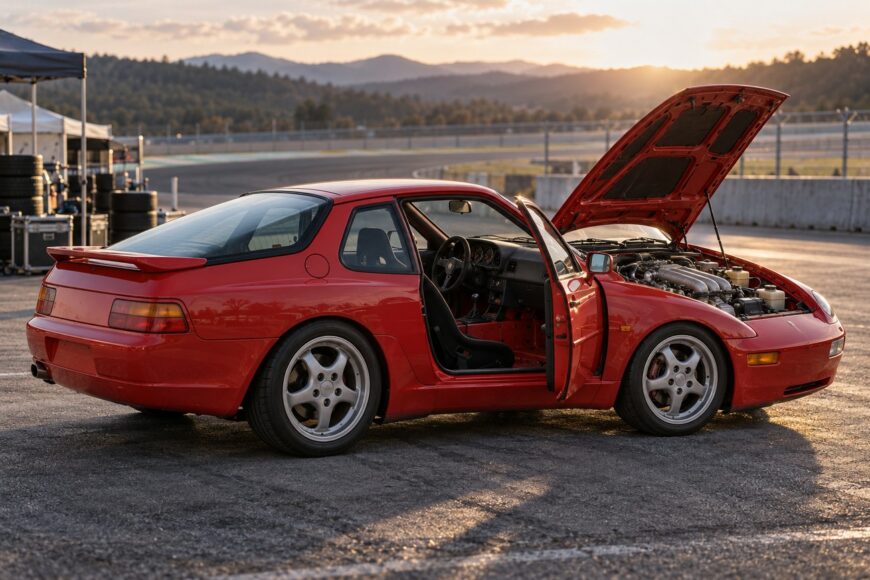
The Porsche 968 Club Sport is not more powerful than the standard 968. Its approximately 240 PS / 176 kW engine remains unchanged, yet the stripped cabin, lower mass, and firmer chassis make it a far more focused car. This is the central appeal: the Club Sport gains urgency through what Porsche removed and how it set up the remaining hardware.
It is a front-engine, rear-wheel-drive three-door coupe with a rear-mounted transaxle, a two-seat configuration, and a six-speed manual gearbox. Built from 1993 to 1995 for enthusiast driving and amateur track use, it was never intended to be an easy luxury daily driver. The buyer’s real choice is between an authentic, well-maintained car with credible track history and a cosmetically converted or overvalued 968 wearing the right visual cues.
- What the Porsche 968 Club Sport Really Is
- Club Sport vs. Standard 968: Where the Speed Comes From
- Why the Four-Cylinder Feels Different on Road and Track
- The Ownership Reality: Maintenance, Noise, and Missing Comfort
- How to Tell a Real Club Sport from a Conversion
- The Compromises That Decide Whether You Will Keep It
- Frequently asked questions
- How much is a Porsche 968 Club Sport worth today?
- How many Porsche 968 Club Sports were made?
- What is the average price of a Porsche 968 Club Sport?
What the Porsche 968 Club Sport Really Is
The 968 Club Sport is often misunderstood because its badge sits within the Porsche family, where rear-engine layouts dominate the conversation. Its engine is mounted at the front, the driven wheels are at the rear, and the gearbox is mounted at the rear as part of a transaxle system. That arrangement helps distribute mass along the car more evenly than the layout of many contemporary rear-engine Porsches.
Power comes from a 3.0-liter naturally aspirated, water-cooled, DOHC inline-four with 16 valves and VarioCam. It produces approximately 240 PS / 176 kW at 6,200 rpm and 305 Nm at 4,100 rpm. The large capacity per cylinder gives the engine strong mid-range response, although it also brings more low-rpm vibration than many buyers expect from a Porsche.
Every Club Sport uses a six-speed manual; there was no automatic option for this version. The two-seat cabin, reduced equipment, and lighter components were part of the model’s purpose, rather than cosmetic changes made to an ordinary 968. Porsche presented it as a car for amateur drivers who wanted a more direct starting point for road and track use.
Equipment was not identical on every car. The intended specification minimized comfort equipment, while genuine factory options could include air conditioning, a sunroof, or ABS. Later owners also retrofitted equipment, removed interior parts, or changed suspension and wheels, so a simple visual checklist cannot establish identity on its own.
Club Sport vs. Standard 968: Where the Speed Comes From
The Club Sport’s advantage is mainly approximately 100 kg less mass and a more focused chassis. Engine output is broadly the same as in the standard 968, and published acceleration figures are close enough that claims of a dramatic straight-line advantage should be treated skeptically.
| Item | 968 Club Sport | Standard 968 |
|---|---|---|
| Engine output | Approximately 240 PS / 176 kW; 305 Nm | Approximately 240 PS / 176 kW; 305 Nm |
| Transmission | Six-speed manual; no automatic option | Manual or automatic, depending on specification |
| Mass | Approximately 100 kg lighter | Heavier, with more comfort equipment |
| Equipment | Two seats, reduced insulation, fewer comfort features | More equipment and greater everyday usability |
| Suspension | Lowered and firmer, intended for amateur track driving | Less track-focused road setup |
| 0–100 km/h | Approximately 6.3–6.5 seconds | Close to the Club Sport in published testing |
| Top speed | Approximately 255–257 km/h | Dependent on specification; broadly similar |
The weight reduction came from simpler trim, less sound insulation, Recaro seats, and the deletion of equipment such as electric windows, air conditioning, and audio systems in the cleanest lightweight specification. That makes the car feel more responsive in changes of direction and under braking. It does not turn the 968 into a modern supercar, and the acceleration figures remain modest by current performance-car standards.
The suspension is equally important. A lower, firmer setup gives the car a more immediate response and better support during repeated cornering, but it also reduces compliance on broken pavement. A standard 968 can be the faster and more comfortable choice on an uneven road if the Club Sport has tired dampers, unsuitable tires, or poorly chosen aftermarket modifications.
Why the Four-Cylinder Feels Different on Road and Track
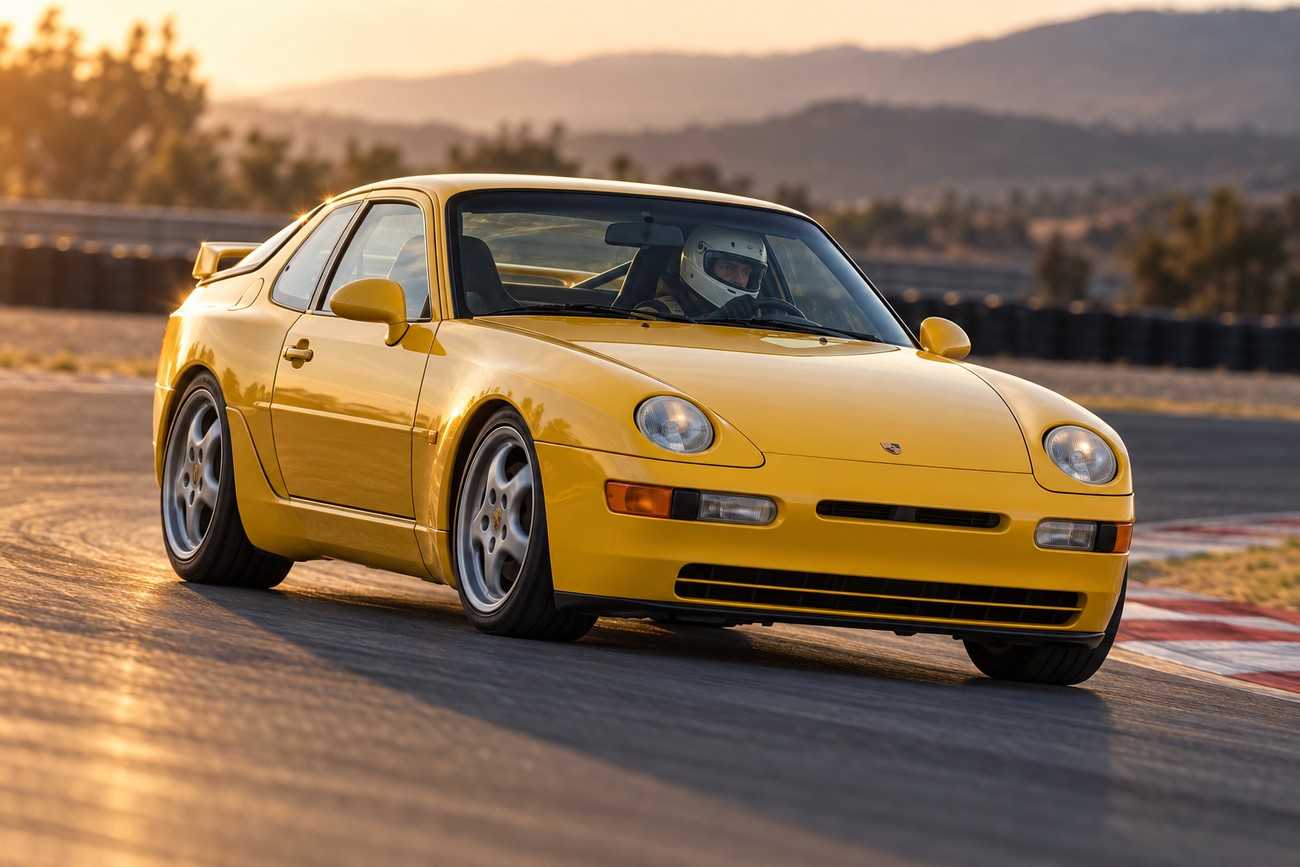
A 3.0-liter four-cylinder is unusual enough to define the car’s character. The engine has useful torque and a direct throttle response, yet its large reciprocating masses can transmit noticeable vibration at low rpm. With minimal insulation, the mechanical character is easy to hear and feel rather than filtered through a quiet cabin.
The rear-mounted transaxle contributes to a neutral, stable balance. The car rotates progressively when it is correctly set up, and experienced drivers value that predictability more than a spectacular launch figure. This is a Porsche that rewards carrying speed through a sequence of corners, using the chassis and manual gearbox together.
On track, the firm lowered suspension provides useful body control and repeatable responses. The same calibration can feel nervous near the limit if the tires are too aggressive, the alignment is wrong, or the dampers are worn. Reduced mass does not eliminate the consequences of driver error, and a mistake at the limit can still damage a rare body shell or expensive suspension components.
Road use exposes the compromise quickly. Expansion joints, rough asphalt, and long highway runs produce noise, vibration, and fatigue. The Club Sport is enjoyable on a good back road and credible at a track day, but the specification demands more tolerance from its occupants than a standard 968.
The Ownership Reality: Maintenance, Noise, and Missing Comfort
The four-cylinder engine does not make this a cheap Porsche to maintain. Timing-belt work, rollers, seals, and the VarioCam system deserve documented attention before purchase. If the service history is vague, the buyer should budget for a proper inspection and potentially substantial corrective work rather than assuming that a smaller cylinder count means lower ownership cost.
Maintenance costs can be comparable with those of more prestigious Porsche models. A neglected belt system or unresolved VarioCam problem can turn an apparently affordable car into an engine-repair project. Service records should identify what was replaced, when it was replaced, and whether the work included the associated rollers and seals rather than only the belt itself.
The cabin is another decisive issue. A clean lightweight specification generally lacks air conditioning, audio, electric windows, and other equipment that most drivers now regard as ordinary. Minimal sound insulation also means that road noise can overwhelm a modest stereo and make a long trip tiring even when the car is mechanically healthy.
Ergonomics vary with the driver. The Recaro seats hold the body securely, but their shape will not suit everyone, and the relatively high steering-wheel position can be awkward for drivers above approximately 185 cm. A short test drive is insufficient; sit in the car long enough to assess knee angle, shoulder position, entry, and whether the seat can be adjusted without compromising control.
How to Tell a Real Club Sport from a Conversion
Authentication starts with the VIN and factory documentation, then continues through the car itself. The market includes standard 968s converted with seats, wheels, suspension, deleted trim, or painted details associated with the Club Sport. A convincing interior cannot compensate for inconsistent paperwork, an unclear production history, or a body shell that shows evidence of serious repair.
Inspect the body geometry, panel gaps, underside, suspension pickup points, and accident repairs. Fresh paint is not proof of quality; on a track-used car, it may conceal repaired impact damage, corrosion, or repeated cosmetic work. Track preparation can also hide heavy wear in wheel bearings, bushings, brakes, and the transaxle.
Authenticity is a chain, not a single part. VIN, factory equipment, body geometry, underside condition, and service history should tell the same story; Recaro seats or missing air conditioning alone prove very little.
Original Recaro seats, wheels, body details, and other specific parts can be scarce and expensive. Their presence supports a consistent history, while their absence does not automatically disqualify a car if documented changes explain it. Genuine cars could have factory options such as air conditioning, a sunroof, or ABS, and later owners may have added similar equipment.
The best inspection compares the car with period documentation and records the exact specification rather than applying a rigid “no comfort equipment” rule. A factory-optioned Club Sport is different from a standard 968 with later parts, but both may look similar in an online advertisement. This distinction matters because collector pricing depends on provenance as much as appearance.
The Compromises That Decide Whether You Will Keep It
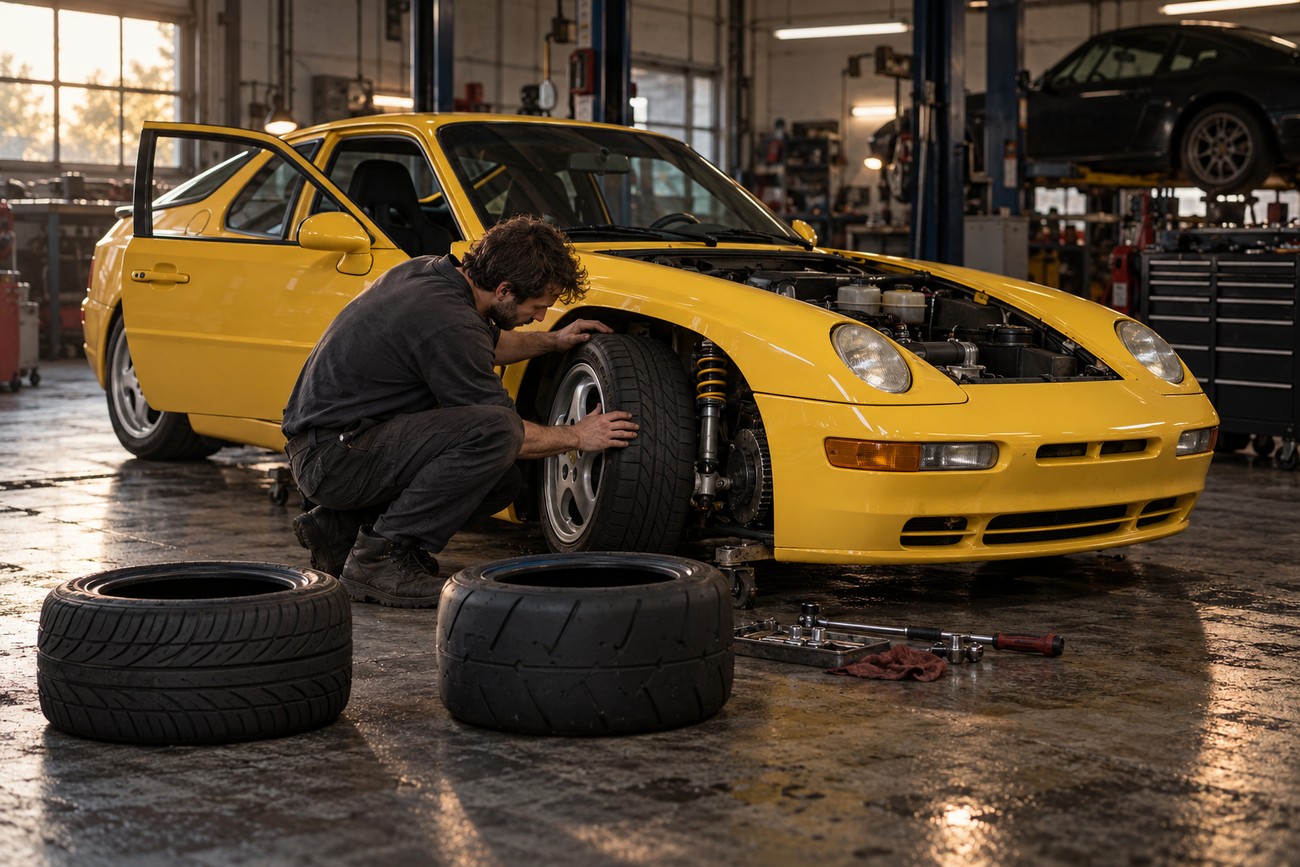
As a daily driver, the Club Sport asks for patience. Firm suspension, cabin noise, limited storage, and reduced equipment are manageable for occasional use, but poor roads and long commutes expose the compromises every day. Someone buying it for the badge may quickly regret the absence of comfort that enthusiasts consider part of its identity.
Tire choice has an outsize effect on the car. Profile, compound, age, and alignment change the balance between precision and compliance. Very stiff track-oriented tires can make the car nervous on public roads, while a more road-focused setup may give up some immediate response in exchange for better confidence and grip over imperfect surfaces.
Cheap suspension or brake modifications deserve particular suspicion. Unmatched dampers, excessive spring rates, incorrect ride height, or poorly chosen bushings can reduce both reliability and balance. Factory-like components with a documented setup are usually easier to evaluate than a collection of fashionable parts whose geometry, alignment, and maintenance history are unknown.
Track history is not automatically a negative. A high-mileage car that was serviced methodically after regular track use may be safer than a low-mileage example that sat for years and received little preventive maintenance. The risk comes from undocumented abuse, hidden crash damage, and deferred mechanical work.
Rare parts also complicate insurance and repairs. Some insurers and repair shops may not distinguish a Club Sport from a standard 968, while original seats, wheels, and trim can be difficult to replace after an accident. Rising collector interest increases the risk of paying a premium for a conversion, so condition, authenticity, and service evidence must justify the price rather than the badge doing all the work.
Frequently asked questions
How much is a Porsche 968 Club Sport worth today?
Its value depends on authenticity, originality, condition, service records, accident history, and the condition of rare parts. A documented factory Club Sport with sound geometry and credible maintenance can sit in a very different market category from a converted 968 or a heavily modified track car.
Use completed sales as the stronger reference and treat advertised prices as intentions rather than evidence. Market location also matters, especially because parts availability, registration requirements, and specialist knowledge vary between countries.
How many Porsche 968 Club Sports were made?
Production totals should be checked against authoritative Porsche documentation because figures repeated in enthusiast discussions and marketplace listings can vary. A claimed number without a clear source is weak evidence when assessing a specific car.
For a buyer, the exact total is less useful than confirming whether the individual vehicle’s VIN, factory specification, and history are consistent. Documentation should take priority over a seller’s rarity claim.
What is the average price of a Porsche 968 Club Sport?
An average price is misleading because the market combines original cars, modified track cars, and standard 968 conversions. These categories have different mechanical risks, authenticity, parts value, and long-term desirability.
Compare cars by condition and provenance first, then review verified sale results in the relevant market. A high-mileage example with excellent records can be a better purchase than a low-mileage car with uncertain maintenance, but neither deserves a collector premium without credible identity and condition.







