

An 887-hp all-wheel-drive hypercar facing a swamp is a striking contradiction. The Porsche 918 Spyder has the power, traction, and electric drive hardware to move across difficult surfaces, yet Porsche does not publish a certified wading depth or safe puddle speed for the car.
That leaves a practical concern beneath the spectacle: whether the powertrain, electric motors, or all-wheel drive makes standing water safe. They do not. A 918 Spyder can face risks to its air intake, low underbody, connectors, sensors, high-voltage components, and cabin electronics long before a driver sees an immediate failure.
The real danger is often delayed. A car may keep running after water contact, then develop corrosion or intermittent electrical faults later. “Through a swamp” works as a dramatic image, but the available technical information does not establish that the 918 Spyder is suitable for swamp driving.
- What the 918 Spyder’s Specifications Actually Say
- Why a Puddle Can Be More Dangerous Than It Looks
- The Myths and Mistakes That Turn Water Into a Repair Bill
- What to Do After the 918 Touches Deep Water
- Frequently asked questions
- How much is a Porsche 918 Spyder worth today after water exposure?
- What should an owner document before a water-damaged 918 Spyder is moved?
- How much is a 918 Spyder worth today?
- What is known as the poor man’s Porsche?
- How many 918 Spyders are left?
What the 918 Spyder’s Specifications Actually Say
The 918 Spyder is a plug-in hybrid built around a naturally aspirated 4,593 cc V8 plus two electric motors. Total system output is 652 kW/887 hp. Those figures describe acceleration and propulsion, but offer no measurement of water protection or ground clearance in flooded conditions.
Porsche quotes official combined fuel consumption of 3.0–3.3 L/100 km under a standardized laboratory cycle. That result belongs to a controlled test procedure, not mud, standing water, wheelspin, or slow travel over a damaged track. It should not be used as an estimate for swamp driving.
The claimed electric range is 16–31 km, depending on conditions and driving mode. This indicates how the plug-in hybrid system can operate under relevant road-use conditions; it does not show how the battery, motors, or control electronics respond to immersion or high-pressure spray.
The important omission is specific: Porsche does not publish a certified wading depth or safe puddle speed for the 918 Spyder. Without that specification, a precise “maximum safe depth” quoted in an advertisement or SEO article has no clear factory basis.
Why a Puddle Can Be More Dangerous Than It Looks
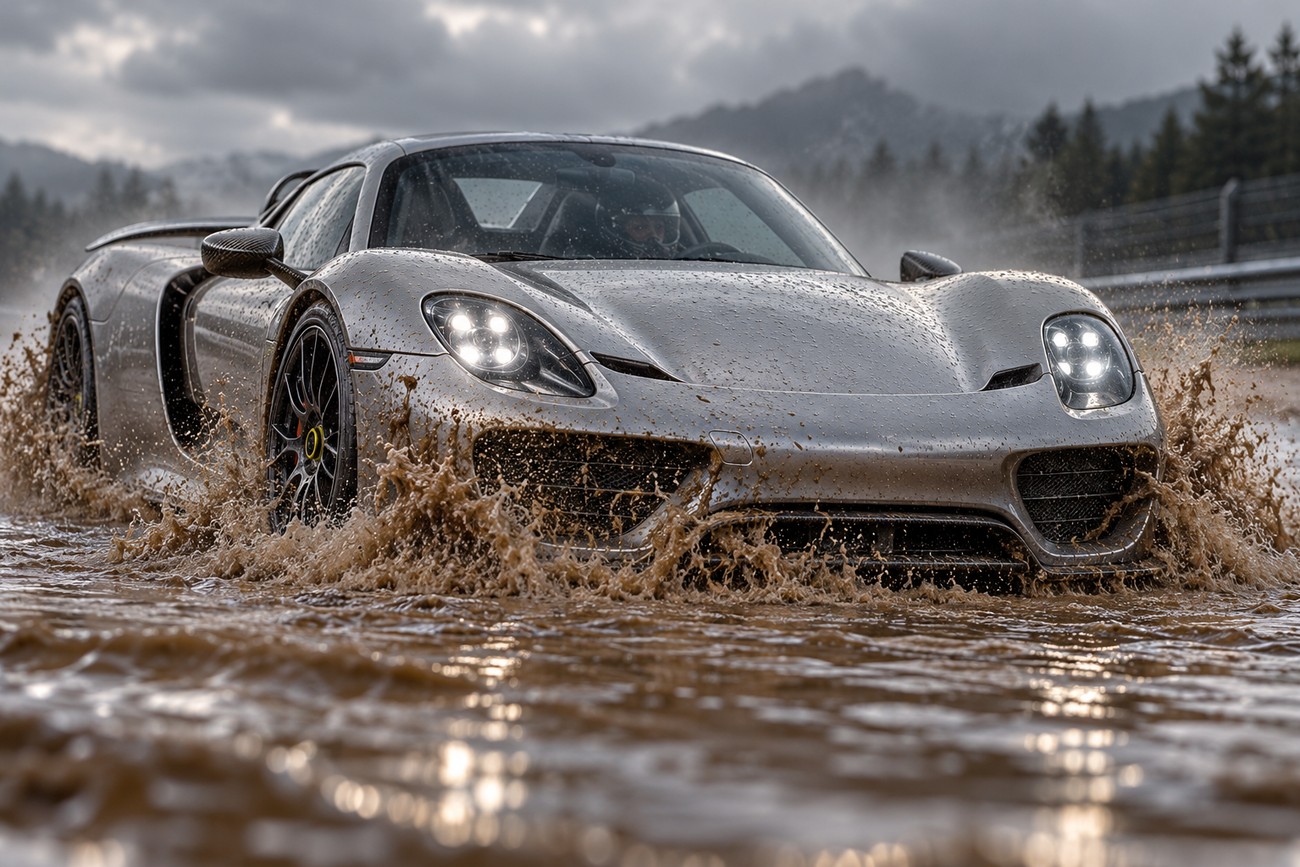
The 918 Spyder’s low ground clearance, aerodynamic elements, and open air intakes increase exposure to water. A shallow-looking pool can send spray into areas designed around airflow and performance rather than repeated submersion. The intake is a particular concern because water entering the engine’s breathing path can cause serious mechanical damage.
Speed makes shallow water more hazardous. Pressurized spray can reach areas that calm water might never touch, including connectors, sensors, control modules, and power connections. In a hybrid hypercar, water may also affect high-voltage components and the insulation protecting them.
Standing water hides potholes, washouts, debris, and open manholes. A driver who cannot see the road surface cannot reliably judge the load on the suspension, the depth beneath each wheel, or the route out. All-wheel drive can distribute torque between driven wheels, but it does not create a certified ability to ford water.
The risk therefore has several layers. A vehicle may avoid an immediate stall while moisture enters its underside, wiring, or electronic housings. The absence of a dramatic failure is a poor test of its condition because corrosion and unstable electrical behavior can develop after the vehicle appears dry.
The Myths and Mistakes That Turn Water Into a Repair Bill
All-wheel drive and electric motors are easy to mistake for off-road equipment. Their purpose is to manage propulsion and performance, not to approve a particular water crossing. The 3.0–3.3 L/100 km consumption figure creates a similar trap: it is a standardized laboratory result, not a real-world estimate for mud, standing water, or off-road use.
Public evidence of 918 Spyders driving through swamps is limited, so isolated stories should be treated carefully. Some Porsche owners have reported abnormal lighting behavior or a spoiler that will not retract after moisture exposure. These are limited anecdotal reports, not a universal 918 diagnosis, but they illustrate how water-related faults may appear in systems unrelated to the engine itself.
Cabin flooding deserves particular caution. Important electronic components may be located beneath the driver’s seat, so water reaching the interior can create a much more serious inspection problem than wet exterior panels. Moisture trapped beneath trim or around wiring may remain after the carpets and visible surfaces feel dry.
The most damaging assumption is that a successful restart proves the car is unharmed. Corrosion can progress quietly, while intermittent faults may appear only under vibration, heat, charging, or another wet-weather event. A rare hybrid also requires specialist assessment, and water or corrosion damage may lead to a warranty dispute.
What to Do After the 918 Touches Deep Water

If warning messages, unusual lighting, a non-retracting spoiler, or abnormal mechanical or electrical operation appears, stop driving and arrange recovery. Repeated restarting can complicate diagnosis and may expose wet systems to additional electrical load. Recovery should avoid turning a questionable water contact into a longer drive.
A professional inspection should include insulation testing, high-voltage components, connectors, control modules, sensors, and the underside. External drying is useful for access and preservation, but it does not establish that moisture has left sealed connectors, wiring routes, or underbody cavities.
If water entered the cabin, avoid restarting the vehicle and leave it safely. Photograph the waterline, cabin, visible contamination, warning messages, and the vehicle’s recovery condition before moving it, where circumstances allow. Keep the record for insurance assessment, since documented water and corrosion damage can affect both coverage discussions and future ownership records.
Frequently asked questions
Water exposure makes a 918 Spyder’s condition and documentation especially important when assessing its value. The questions below also address what to record before recovery. For broader context, they cover the car’s present value, a common Porsche nickname, and the limits of public survival counts.
How much is a Porsche 918 Spyder worth today after water exposure?
There is no single fixed value after water exposure. A documented flood event, corrosion, incomplete inspection, or major repair history can materially reduce buyer confidence, even if the vehicle later runs correctly.
Specialist buyers will usually care about the quality of the records, the extent of the intrusion, high-voltage inspection results, and whether repairs are traceable. An undocumented car with unexplained electrical symptoms may be valued very differently from one with a complete professional assessment and clear provenance.
What should an owner document before a water-damaged 918 Spyder is moved?
Photograph the waterline, cabin, seats and floor, visible contamination, warning messages, lighting behavior, and any unusual spoiler or electrical operation. Also record the vehicle’s position and recovery condition, provided doing so is safe.
Avoid restarting the car to demonstrate that it still works. The images, recovery report, and inspection paperwork can help an insurer or specialist establish the sequence of events and distinguish water damage from later repair effects.
How much is a 918 Spyder worth today?
Its present value depends on condition, mileage, provenance, service records, specification, market timing, and inspection results. A clean, well-documented example is assessed very differently from a car with unresolved electrical faults or a questionable history.
What is known as the poor man’s Porsche?
“Poor man’s Porsche” is an informal label applied to various cars at different times, usually models that offer some Porsche-like driving character or styling for less money. It is not an official Porsche designation, and the phrase does not identify a specific modern substitute for the 918 Spyder.
How many 918 Spyders are left?
A reliable public count of surviving 918 Spyders is not established here. Production records and individual market listings do not necessarily show which cars remain roadworthy, stored, damaged, or privately held.







