
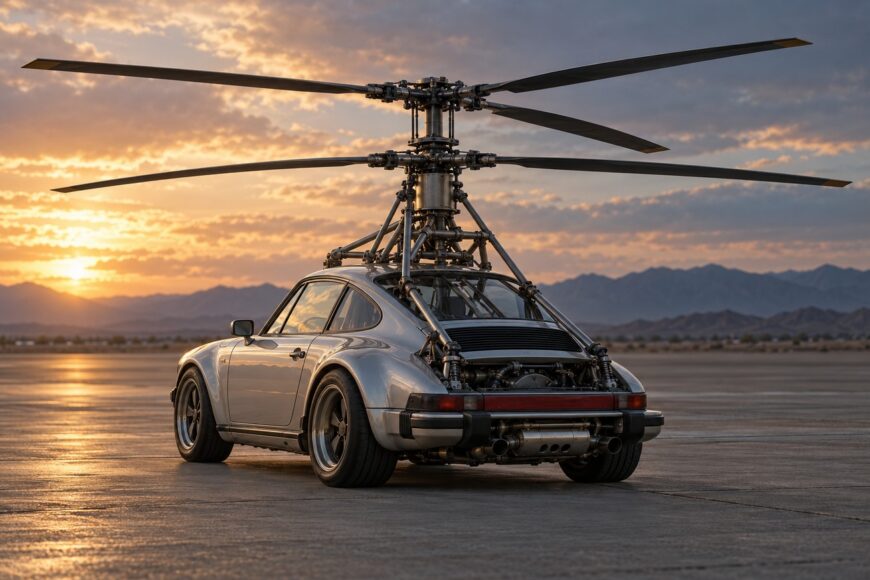
A Porsche 911 carrying helicopter rotors is a striking visual contradiction: a low, rear-engine sports car built to exploit tire contact suddenly wearing the machinery of a vertical-flight aircraft. The image suggests a flying Carrera, yet the difficult question begins after the spectacle. Could the car’s structure, rear-engine balance, powertrain, and aerodynamics support controlled flight, or would the rotors produce only an impressive but impractical prototype?
The flying Carrera remains a hypothetical engineering concept, not a production Porsche configuration. The 911 is already an unusually sophisticated road machine, but its performance comes from managing weight transfer, tire loading, airflow, drivetrain response, and electronic control. This distinction matters because helicopter lift and road-car downforce solve different physics problems.
- The Flying Carrera Thought Experiment: What Would Count as Flight?
- Why the 911’s Rear-Engine Layout Matters More Than the Rotors
- How Helicopter Rotors Create Lift—and Why the Carrera Cannot Simply Borrow Them
- The Hidden Engineering Problem: Structure, Torque, Vibration, and Control
- What the 911’s Aerodynamics Can—and Cannot—Do
- Power, Acceleration, and All-Wheel Drive: The Numbers in Context
- The Real-World Trade-Offs: Why the “Flying” Upgrade Would Be a Bad Daily Driver
- Could a Porsche 911 Really Become a Rotorcraft?
- Frequently asked questions
- How fast do helicopter rotors go?
- Would a fighter pilot automatically know how to fly a helicopter?
- Why is flying over Mount Everest difficult for helicopters?
The Flying Carrera Thought Experiment: What Would Count as Flight?
A vehicle does not become an aircraft merely because rotating blades are attached to it. Vertical flight requires enough lift to support the complete vehicle, including its structure, occupants, fuel or energy storage, and flight hardware. The rotors must also generate that lift in a controllable way while the vehicle remains stable through changes in power, attitude, and airflow.
Three separate tasks would have to be solved. The first is vertical lift: the rotors must accelerate air downward strongly enough to overcome weight. The second is forward motion, which requires a different balance of thrust, drag, and attitude. The third is high-speed road stability, where the tires must remain loaded and the body must manage airflow close to the ground. A system optimized for one task can interfere with the others.
That is why a rotor-equipped 911 would be more than a body modification. Helicopter-style rotors would need to manage torque reaction, vibration, structural loads, and control authority. The system would need a way to change lift and attitude deliberately, while the car’s original suspension, steering, brakes, and body remained reliable under loads they were never designed to withstand.
The 911 does not “defeat” physics through a magical layout or a special badge. Its behavior is explained by rear-engine balance, chassis development, aerodynamics, drivetrain engineering, and electronic control working together. A flying version would have to add an aircraft control system without losing the road behavior that makes the Carrera recognizable.
Why the 911’s Rear-Engine Layout Matters More Than the Rotors
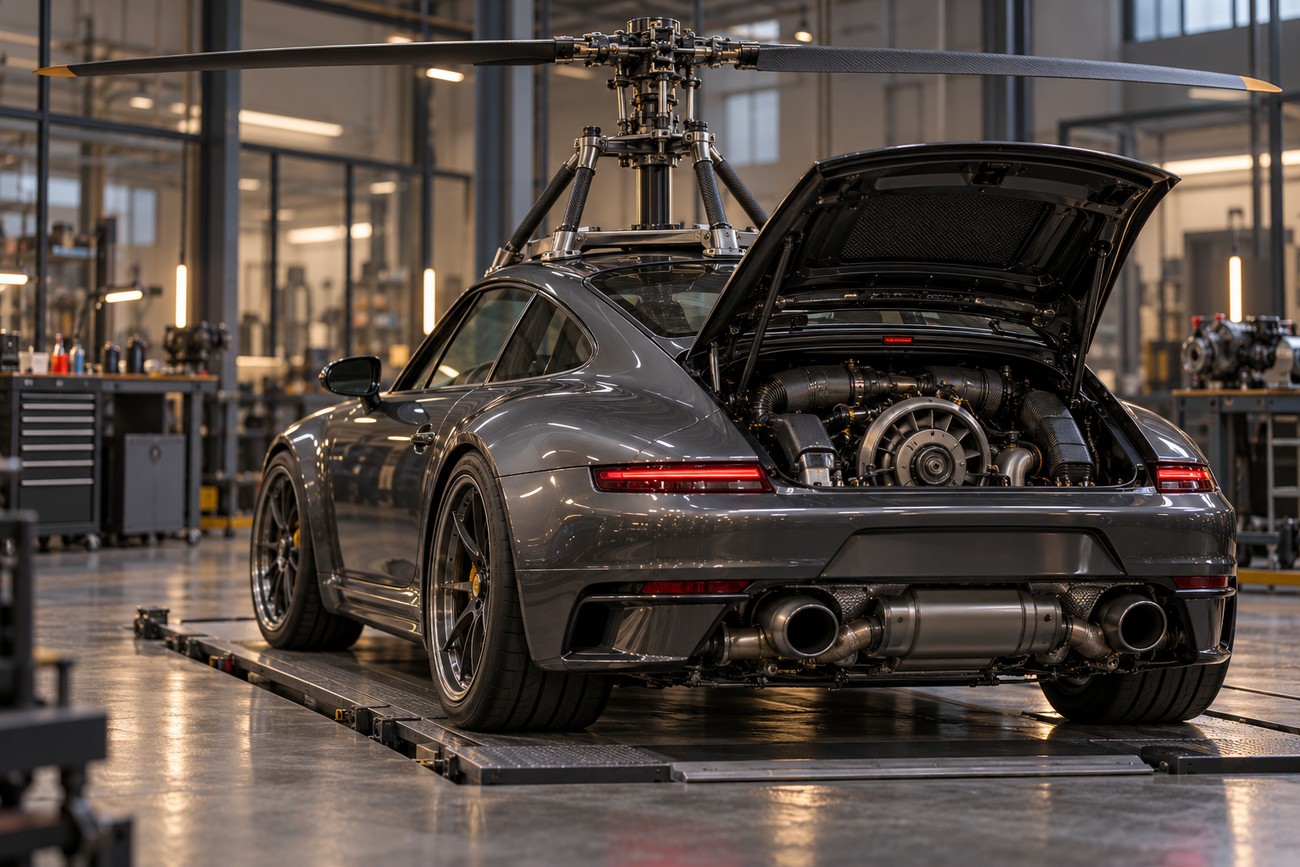
The Porsche 911 is historically rear-engined, with the engine positioned behind the rear axle. That location puts substantial weight over the driven rear tires, helping them use the available torque under acceleration. It also influences braking, corner entry, and the way the car responds as the tires approach their grip limit.
Rear weight can be useful because it improves traction when power is applied. It also changes the car’s rotational behavior in a corner: the front and rear axles do not carry equal loads, and the driver must understand how those loads move during braking and throttle changes. Modern chassis systems make the behavior more manageable, but they do not erase the underlying mass distribution.
Mounting a rotor system above or behind the cabin would introduce a second, very different mass problem. Hardware placed high on the body would raise the center of gravity, while a long rotor mast or rear assembly could alter the car’s rotational balance. The result could be slower or less predictable responses in yaw and pitch, precisely where a road car depends on quick, controlled reactions.
The compact 911 platform has been refined continuously around road contact. Its rear-engine architecture is part of a carefully managed system involving suspension geometry, tire behavior, cooling, braking, and aerodynamic loading. A rotorcraft conversion would require new load paths through the body, likely changing the basic structure rather than simply adding equipment to it.
There is also a practical difference between carrying mass and transmitting force. A luggage compartment can support an object’s static weight; a rotor hub must transmit changing thrust and torque, including vibration and control inputs. The 911’s rear-engine balance may help it put power to the ground, but it does not automatically make the car easier to lift into the air.
How Helicopter Rotors Create Lift—and Why the Carrera Cannot Simply Borrow Them
Helicopter rotors generate lift by accelerating air downward through rotating blades. Each blade acts as an aerodynamic surface, and its angle, shape, and speed determine how much force it can create. The total thrust must vary smoothly because the aircraft needs to rise, descend, hover, and respond to changes in weight and atmospheric conditions.
Rotor thrust depends on blade geometry, blade pitch, rotational speed, air density, and the load being supported. Increasing blade pitch can increase lift, but it also increases aerodynamic drag and the power required to turn the rotor. More engine power alone does not solve that trade-off; the rotor, transmission, cooling system, and structure must all tolerate the resulting loads.
There is no single universal helicopter rotor speed. The correct operating value depends on rotor size, blade design, loading, and operating conditions. A larger rotor can produce the required lift with a different combination of rotational speed and blade loading than a smaller rotor. Blade-tip speed also matters because aerodynamic efficiency, noise, compressibility effects, and structural stress change as the tips move faster.
A powered main rotor creates a torque reaction that must be countered by a tail rotor, coaxial system, or another control arrangement. Without that counterforce, the fuselage would tend to rotate in the opposite direction from the main rotor. The control system must also manage collective pitch for total lift and cyclic pitch for changes in rotor-disc attitude.
That requirement exposes the mismatch with a road-going Carrera. The engine and transmission are designed for acceleration, sustained road speed, and wheel torque, with their own cooling and lubrication priorities. They are not automatically suitable for continuous rotor thrust, rapid power changes, or the torsional behavior of an aircraft transmission. A workable conversion would need to coordinate power delivery, lift, torque, and attitude through dedicated flight controls.
The Hidden Engineering Problem: Structure, Torque, Vibration, and Control
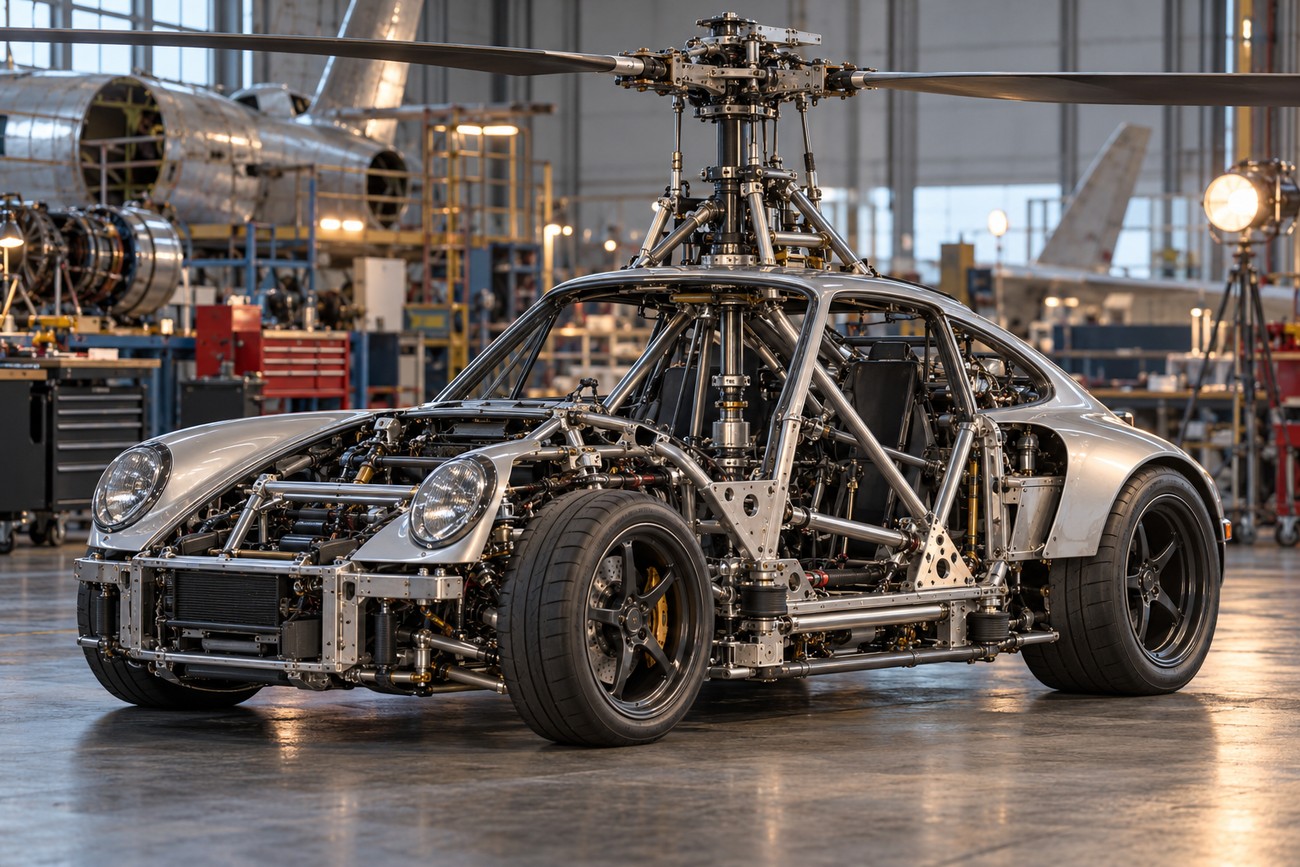
The most obvious failure point in a dramatic rotor concept is often the least visible: the structure beneath the rotor hub. Thrust and torque cannot be fed into a roof skin or attachment points without a suitable structural load path. They must travel through a reinforced load path into the strongest parts of the chassis without causing local deformation, fatigue damage, or unacceptable changes in body stiffness.
Rotating machinery adds another layer of difficulty. Even a well-balanced rotor system produces changing aerodynamic and mechanical forces. Those forces can enter the cabin as vibration, reach the drivetrain through mounts, and accumulate as fatigue in joints and structural members. A road car’s refinement targets and suspension loads are fundamentally different from those of an aircraft carrying a rotating lift system.
Torque control would require dedicated hardware and software. The main rotor’s reaction torque must be balanced, while cyclic and collective inputs must produce predictable changes in attitude and lift. The control system would need authority during takeoff, hover, transition, landing, and any situation where power or airflow changes abruptly.
Engine output is only one part of the power problem. A 911 powertrain may deliver impressive road acceleration, yet a rotorcraft needs power through a different transmission path and often for a different duration. Gearing, cooling, lubrication, engine response, and power reserve would all need to match the rotor’s operating range.
The integration challenge becomes more severe when the car must remain usable on the ground. A rotor mast, tail-control arrangement, or supporting frame could obstruct visibility, increase width or height, and compromise access to the engine and service points. Removing that equipment for road use would create another engineering and operational problem rather than a simple transformation.
What the 911’s Aerodynamics Can—and Cannot—Do
The 911’s active rear spoiler is a load-management device, not a decorative accessory. It operates in positions and modes including Eco, WET, and emergency braking, changing the way airflow loads the rear of the car. At 90 km/h, the cited behavior places the spoiler in the Eco position, while emergency braking increases load on the rear axle.
That extra rear load can help maintain tire contact and stability when the car is decelerating hard. The spoiler works within a road-car aerodynamic system that includes the body shape, underbody airflow, suspension attitude, and tire forces. Its purpose is to keep the car controlled against the pavement as speed and braking demand change.
Helicopter lift is a different phenomenon. A rotor accelerates air downward to create an upward force; a road-car spoiler redirects airflow to create a useful aerodynamic load on the vehicle. Downforce increases the force pressing tires into the road, while rotor lift attempts to remove the vehicle from the road. The two effects cannot be treated as interchangeable versions of the same aerodynamic advantage.
Rotor airflow could also interfere with the body’s carefully managed pressure distribution. The rotor wash might disturb cooling air, alter rear-deck loading, or create unstable interactions around the cabin and spoiler. High-speed road stability therefore provides no proof of airborne capability. It shows that the 911 is effective at maintaining controlled tire contact, which is almost the opposite design objective.
Power, Acceleration, and All-Wheel Drive: The Numbers in Context
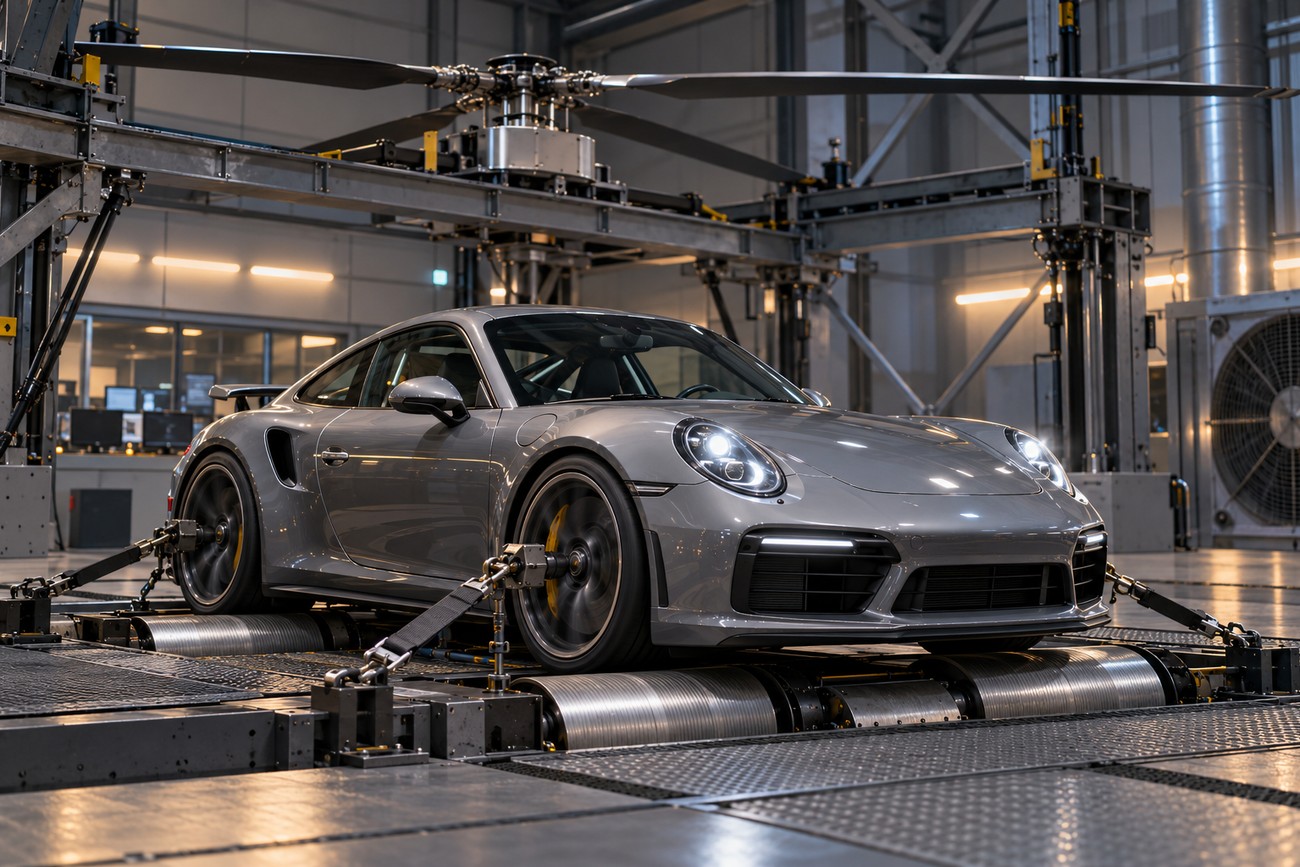
The 911 already produces performance figures that can make a rotor concept seem plausible at first glance. A cited 911 Carrera with Sport Chrono reaches 100 km/h in 3.5 seconds and has a 308 km/h top speed. Those figures describe a specific configuration and demonstrate how efficiently the car uses its available power on the ground.
A cited 911 Turbo S reaches 100 km/h in 2.7 seconds and has a 330 km/h top speed. The cited modern 911 Turbo S configuration uses a 3.8-liter flat-six, 580 hp, 750 Nm, and a 7-speed PDK. These are road-performance specifications, however, and acceleration statistics do not answer whether the engine, transmission, or chassis can support sustained vertical thrust.
The difference is easiest to see in the energy path. On the road, the engine turns the wheels through the transmission, and the tires convert torque into forward acceleration. In flight, the powerplant must drive a rotor system while the structure carries thrust and torque into the airframe. The car’s top speed tells us little about the reliability or efficiency of that second arrangement.
All-wheel drive is primarily a traction and power-delivery aid. Carrera 4 and Carrera 4S versions may differ from rear-wheel-drive models by about 0.1 seconds to 100 km/h, while the dry-road difference may feel slight. The advantage becomes more relevant when grip changes, such as during rain, cold conditions, or hard acceleration on a less forgiving surface.
That makes all-wheel drive a poor substitute for aircraft control. It can distribute engine torque between the axles and reduce wheelspin, but it cannot counter main-rotor torque, control pitch, or provide lift. Choosing all-wheel drive for a flying Carrera would address road traction while leaving the central flight problems untouched.
The Real-World Trade-Offs: Why the “Flying” Upgrade Would Be a Bad Daily Driver
High-performance 911 versions show how quickly capability can create compromises. Turbo and GT-oriented cars are often praised for stability and precision, yet criticized as harsh or noisy in urban use. A chassis that feels secure at speed can transmit more road texture at low speed, and a driver who rarely reaches the car’s performance limits may experience the compromise more often than the benefit.
Ownership costs also extend beyond the headline specification. Comfortable seats and useful equipment may require expensive options rather than being standard. Buying a high-performance 911 for image alone can offer little practical benefit in ordinary driving, especially when the owner spends most of the time in traffic, on imperfect pavement, or looking for parking space.
Rotors would magnify those compromises. Their noise, vibration, packaging demands, and operating constraints would dominate the vehicle’s daily character. Even if the system could be engineered to function in the air, the car would need a safe way to handle the transition between a road machine and an aircraft. A working concept would not, by itself, establish where or how it could legally operate.
The same caution applies to conventional used 911s. Finding a sound older example can be a long and stressful process; one cited search for a 996 lasted about six months. Condition, maintenance history, and structural integrity matter more than a compelling photograph, particularly when age has exposed the car to deferred repairs or modifications.
Older 911 designs bring another context issue. Air-cooled generations remain culturally important, but older designs can conflict with modern environmental requirements and usage restrictions. Enthusiasm for the original engineering does not remove the need to check where and how the vehicle can be used. The lesson carries directly to a rotor-equipped concept: mechanical fascination must be matched with inspection, operating context, and realistic expectations.
Could a Porsche 911 Really Become a Rotorcraft?
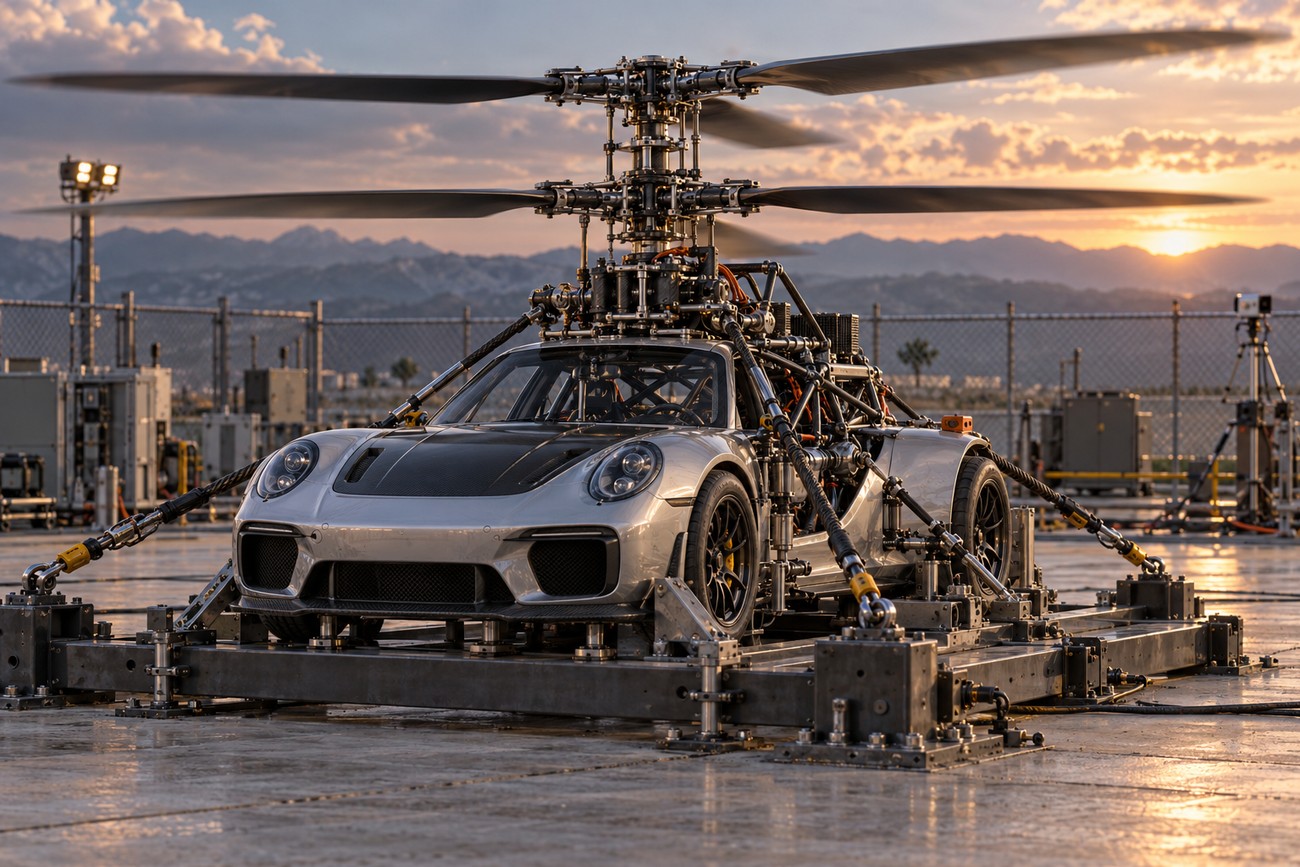
A static display could place rotors on a 911 body with relatively little concern for flight loads. An experimental aircraft would require a redesigned structure, a suitable power path, aircraft controls, and extensive testing. A usable road-and-air vehicle would add an even harder requirement: it would need to remain predictable and maintainable in both environments.
Attaching helicopter blades to a 911 body would therefore be the least important part of the conversion. The hard work would lie in the rotor hub, transmission, reinforced load path, vibration control, torque management, and flight-control system. Each of those systems would interact with the rear-engine layout, cooling arrangement, center of gravity, and road aerodynamics.
The 911’s active aerodynamics, rear weight distribution, and electronic systems are designed around controlled road contact. They help the car manage tire forces during acceleration, cornering, and braking. Rotor lift works toward a different result, so the systems cannot simply be combined by adding more power or changing the spoiler position.
The most convincing explanation for the 911’s performance is integrated chassis and aerodynamic engineering. Its achievement is not that one component makes it fly; it is that many physical effects are managed with unusual precision. A flying Carrera is a useful thought experiment because it makes that achievement easier to see.
Frequently asked questions
Rotor speed is only one factor in producing lift. Pilot experience also differs between aircraft types. At high altitude, air density and available power create further limits.
How fast do helicopter rotors go?
There is no single universal rotor speed. The operating value depends on rotor size, blade geometry, loading, and operating conditions, so a large rotor and a small rotor can produce the required lift through different combinations of rotational speed and blade pitch.
Rotor rpm is only one part of the engineering picture. Blade-tip speed also matters because the blade tips travel much farther during each revolution on a larger rotor. Designers must balance lift, aerodynamic drag, noise, structural stress, and the available power. A rotor-equipped 911 could not be designed responsibly around a generic rpm number taken from another helicopter.
Would a fighter pilot automatically know how to fly a helicopter?
No. A fighter pilot would bring valuable aviation knowledge, including an understanding of weather, energy management, navigation, aircraft systems, and emergency procedures. That background does not automatically provide helicopter-specific control skills.
Helicopter flight requires coordinated management of collective pitch, cyclic control, torque reaction, attitude, and power. Those inputs interact continuously, particularly during hovering, low-speed maneuvering, takeoff, and landing. Aircraft experience would be transferable in broad terms, but safe control of a rotorcraft requires specific training and practice.
Why is flying over Mount Everest difficult for helicopters?
High altitude reduces air density, which makes it harder for rotor blades to generate lift. Many engines also produce less available power in thin air, while the helicopter still has to support its own weight, occupants, fuel, and equipment.
Temperature, payload, rotor aerodynamics, and weather compound the problem. A helicopter may have enough performance in one set of conditions and insufficient margin in another. Wind, turbulence, and limited landing options make the operating environment more demanding still, so altitude capability cannot be judged from engine power alone.







