
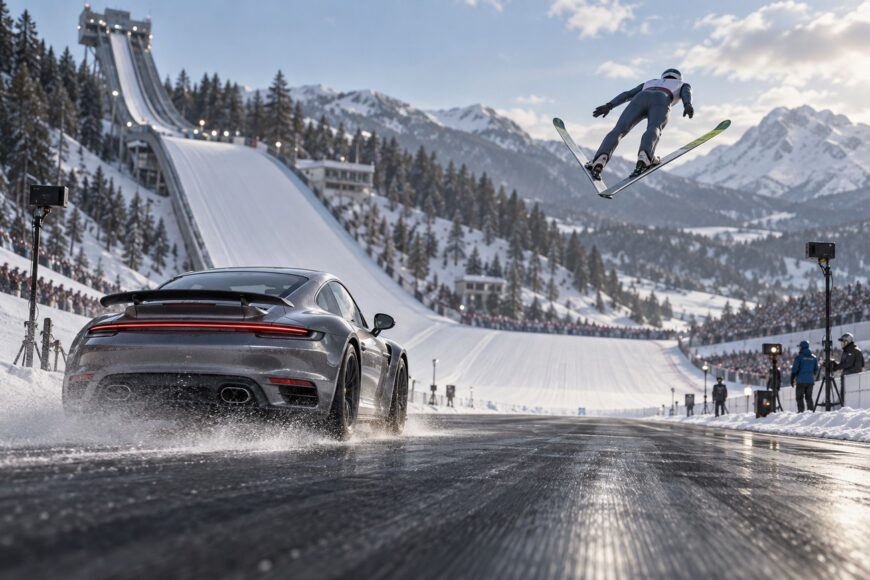
A Porsche 911 Turbo S and a ski jumper can both cover 400 feet, but the distance is easy to misread: 400 feet is approximately 121.9 meters, not 400 meters. That is a meaningful stretch of road for a car accelerating from a standstill, yet a reachable jump distance for an elite athlete on a suitable hill.
The start line decides much of this contest. The Porsche must build speed from zero; a jumper leaving the takeoff has already accelerated down the in-run. Without synchronized timing and an agreed start point, there is no measured head-to-head winner. The car is the likely choice for a short run from rest, while a takeoff-to-landing comparison gives the athlete a rolling start.
- 400 Feet Is 121.9 Meters, Not 400
- What the Porsche Must Do to Win the Distance
- Why the Ski Jumper Starts With an Invisible Advantage
- The Numbers Side by Side: Car Performance and Jumping Records
- Who Covers 400 Feet Faster?
- The Myths That Make This Showdown Look Easier Than It Is
- Frequently asked questions
- How much does rollout change a Porsche acceleration comparison?
- What is faster than a 911 Turbo S in a short straight-line run?
- What’s faster than a 911 Turbo S?
- Which Porsche 911 has the most comfortable ride?
- 2022 Porsche 911 Turbo S vs. a ski jumper: Which covers 400 feet faster?
400 Feet Is 121.9 Meters, Not 400
Ski-jumping distances are recorded in meters, so the conversion comes first. Approximately 121.9 meters is the target in this comparison. Treating 400 feet as 400 meters makes the challenge more than three times longer and changes any conclusion drawn from it.
On a suitable large hill, approximately 121.9 meters is demanding without being an extreme distance for a top jumper. A jump of that length establishes that the athlete can reach the mark; it does not reveal how many seconds elapsed between takeoff and landing. The car’s distance would likewise need its own measured time.
Jump length also differs from the distance a moving object travels along its path. The official measurement places the landing on the hill; the skier’s flight follows a trajectory through the air. A precise stopwatch contest must specify whether “121.9 meters” means road distance for the car and official jump distance for the athlete, rather than assuming those are identical physical paths.
Nor does the longest jump automatically win a ski-jumping competition. Landing quality, telemarketer, and style contribute to the judged result, alongside wind and gate compensation. Those factors matter to sporting performance even though none supplies the missing time over approximately 121.9 meters.
What the Porsche Must Do to Win the Distance
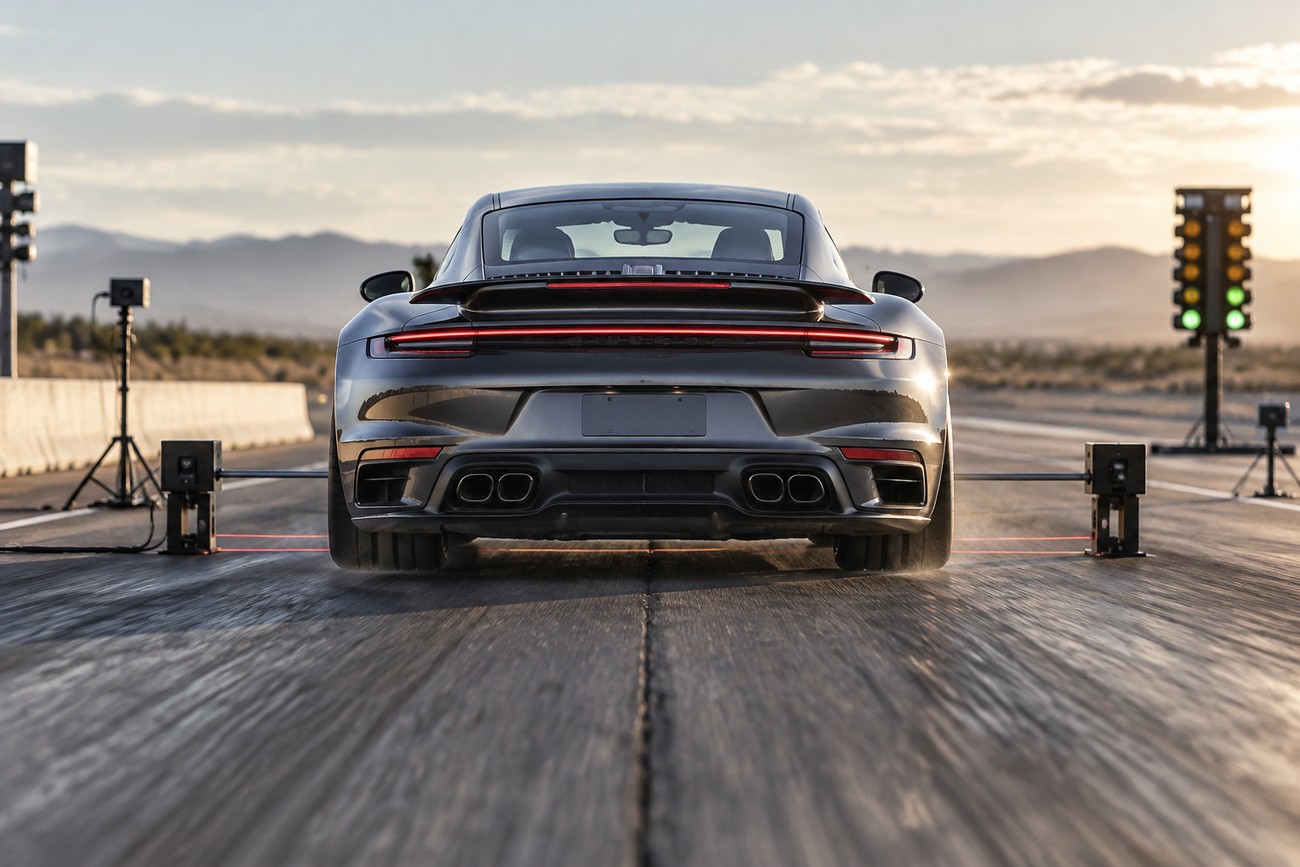
The relevant Porsche result is its elapsed time over approximately 121.9 meters from a defined start. The current 911 Turbo S is officially rated at 711 PS of system power and 0–100 km/h in 2.5 seconds with Sport Chrono. That acceleration claim signals a formidable launch, but it is not a published time for the full distance in this contest.
All-wheel drive and an 8-speed PDK help the car deploy power and maintain acceleration. Still, a quoted 0–100 km/h figure cannot be stretched into a dependable 121.9-meter result: the car continues beyond the point at which it reaches 100 km/h, and its speed over the remaining distance matters. Maximum speed is even less useful on so short a course.
Surface grip, tire condition, temperature, and launch procedure can change the measured run. Timing convention matters too: a result that allows rollout starts its clock after the car has begun moving, unlike a strict standstill measurement. The 2.5-second claim belongs to the current car with Sport Chrono, not to every Turbo S in every set of conditions.
The 2025 hybrid Turbo S is listed at approximately 1,740 kg and a 322 km/h top speed. Neither figure decides this sprint. Mass may affect how the car feels through changes of direction, while the stated top speed lies far outside what a 121.9-meter comparison tests.
Why the Ski Jumper Starts With an Invisible Advantage
A ski jumper does not arrive at the takeoff from a standstill. The in-run converts the descent into speed before flight begins. Start the skier’s clock at takeoff and the Porsche’s clock at rest, and the athlete receives the benefit of acceleration that happened before timing started.
Starting both clocks from rest creates a different contest, one that includes the skier’s trip down the in-run. It also requires an agreed finish: the car crosses a mark on the road, while the skier reaches a measured landing point on a sloped hill. A fair test must define those lines before either participant moves.
Flight is not a flat-ground sprint. Hill profile and wind influence how far the athlete can carry speed through the air, and official results account for wind and gate changes. Landing quality and style then affect the competition score. These rules make the sport fairer on its own terms, but they do not turn jump results into standardized stopwatch runs.
Record distances deserve particular care. Men’s jumps beyond 250 meters are associated with specialized ski-flying hills and demanding conditions, not an ordinary, repeatable 121.9-meter test. Ryoyu Kobayashi’s reported 291-meter jump is not accepted by FIS as an official record, so it cannot be substituted for a recognized benchmark.
The Numbers Side by Side: Car Performance and Jumping Records
These figures establish the scale of the contest, while the final column shows why they cannot be read as a head-to-head time.
| Measure | Figure | Measurement limitation |
|---|---|---|
| Target distance | 400 feet, approximately 121.9 meters | A distance target, not an elapsed time. |
| Current Porsche 911 Turbo S | 711 PS; 0–100 km/h in 2.5 seconds with Sport Chrono | Published acceleration covers a speed interval, not 121.9 meters. |
| 2025 hybrid Turbo S | Approximately 1,740 kg; 322 km/h top speed | Mass and maximum speed do not determine short-course time. |
| Previous 992 Turbo S | 650 hp; 800 N·m; 0–100 km/h in 2.7 seconds; 330 km/h top speed | A different version; its acceleration claim is not a 121.9-meter result. |
| Domen Prevc jump | 254.5 meters, cited as an officially recognized benchmark | Jump distance gives no flight time. |
| Nika Prevc jump | 236 meters, listed as the women’s official record in the 2025 source context | Record distance does not establish time to 121.9 meters. |
| Ryoyu Kobayashi jump | 291 meters, reported but not accepted by FIS as an official record | It should not be presented as the official record. |
The directly comparable item is the approximately 121.9-meter target. The Porsche acceleration figures measure time to a speed; the ski-jumping figures measure landing distance. Neither column supplies the elapsed time that would settle this contest.
The two Porsche versions also should not be blended into one specification. The current car’s 711 PS and 2.5-second claim with Sport Chrono differ from the previous 992 Turbo S figures of 650 hp, 800 N·m, and 2.7 seconds to 100 km/h. That distinction matters if the proposed matchup names a model year.
Long jumps demonstrate that the target distance is within the sport’s reach under suitable conditions. They do not show how quickly a jumper reaches it, and a disputed distance cannot strengthen a timing argument simply by being larger.
Who Covers 400 Feet Faster?
There is no official synchronized head-to-head measurement here, so an exact winning time or margin would be invented. A defensible test would time each participant over a defined approximately 121.9-meter distance and state whether both clocks begin at rest. It would also document the car’s launch conditions and the skier’s start and finish lines.
With both participants timed from rest over a comparable short distance, the Porsche is the likely winner. Its current 0–100 km/h claim of 2.5 seconds with Sport Chrono supports that expectation, although it does not prove a particular 121.9-meter time. The skier would first have to build speed down the in-run.
If timing begins when the athlete leaves the takeoff, the comparison changes fundamentally. The jumper starts that measured phase with speed already gained, while a car timed from standstill still has to launch. Any result under those rules would describe two different start conditions, even if both clocks were accurate.
A comparable test would need more than a shared stopwatch: it would need a meaningful way to map road distance against the hill’s jump measurement. Until that protocol exists, “likely” is more honest than a categorical win for either side. The Porsche’s short-run performance and the spectacle of a long jump are impressive for different reasons; record distance is not a substitute for race time.
The Myths That Make This Showdown Look Easier Than It Is
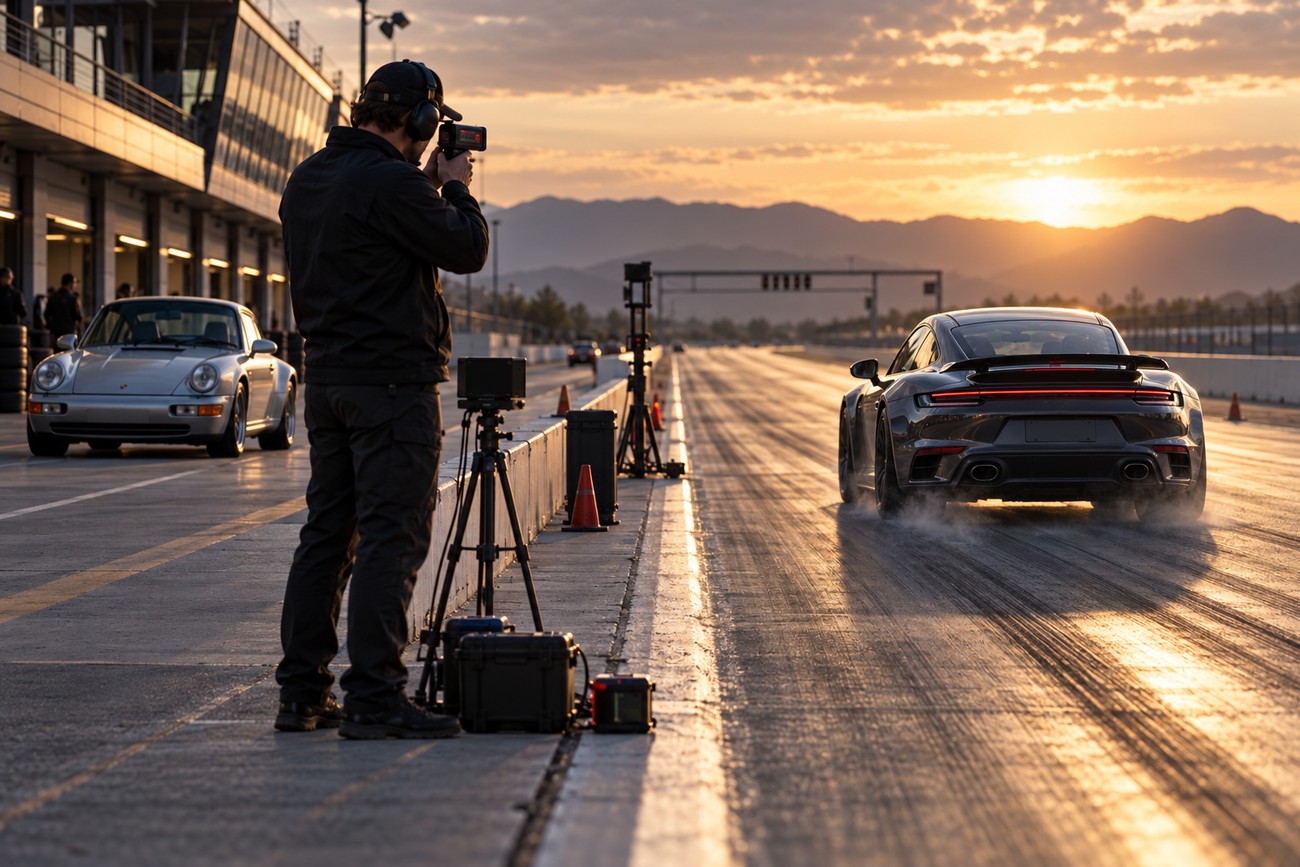
The biggest error is treating 400 feet as 400 meters. A distance of 400 meters is about 3.3 times as long as 121.9 meters. A comparison built on the wrong distance can make a reachable mark for an elite jumper look out of reach.
Another shortcut treats the Porsche’s 2.5-second 0–100 km/h claim as a result any driver can repeat. It applies to the current Turbo S with Sport Chrono; tires, grip, temperature, launch execution, and timing method still matter. The previous 992 Turbo S is commonly listed at 2.7 seconds to 100 km/h and a 330 km/h top speed, so its figures should remain separate.
Top speed does not settle a short-distance race, just as jump length does not supply flight time. The hybrid Turbo S is listed at approximately 1,740 kg and 322 km/h, versus the earlier 330 km/h top-speed figure. Greater output can coexist with added mass and a different sense of agility; neither observation predicts an exact run over approximately 121.9 meters.
Finally, a reported 291-meter jump is not automatically an official record. FIS does not accept Ryoyu Kobayashi’s attempt as one. Keeping recognized results, disputed attempts, and measured times in separate categories is essential to making this matchup intelligible.
Frequently asked questions
The answers below focus on timing conventions and model choices that can change how the comparison is interpreted.
How much does rollout change a Porsche acceleration comparison?
Rollout can make a quoted acceleration time appear quicker because the clock starts after the car has begun moving. Its effect depends on the timing method, so there is no sound universal adjustment to subtract or add. Compare results only when the start trigger and rollout policy are stated; otherwise, two “0–100 km/h” times may measure slightly different events.
What is faster than a 911 Turbo S in a short straight-line run?
The answer depends on the distance, launch surface, and vehicle category. Another vehicle may gain an advantage after the launch even if it loses the first few meters, while a purpose-built drag vehicle is judged under different conditions from a road car. Specify the finish distance and whether both vehicles start from rest before treating any ranking as meaningful.
What’s faster than a 911 Turbo S?
There is no single ranking across every performance test. Acceleration from rest, a rolling-speed run, top speed, and a circuit lap reward different capabilities. A vehicle that is quicker in one can be slower in another, so the useful answer names the test and compares measured results from it.
Which Porsche 911 has the most comfortable ride?
A comfort-oriented 911 Carrera configuration is generally a better starting point than a track-focused specification, but no trim guarantees the softest ride on every road. Wheel and tire choices, suspension settings, and pavement condition can change the result substantially. For a buyer, a drive over the roads used most often is more informative than choosing by the model’s acceleration figure.
2022 Porsche 911 Turbo S vs. a ski jumper: Which covers 400 feet faster?
For a 2022 Turbo S, use the previous 992 Turbo S specification rather than the current hybrid car’s 711 PS claim. That earlier version is commonly listed at 650 hp, 800 N·m, and 0–100 km/h in 2.7 seconds. Over 400 feet, or approximately 121.9 meters, it remains the likely winner if both are timed from rest under comparable rules; a skier timed only from takeoff has already accelerated down the in-run, so no winner can be established without an agreed test.







