
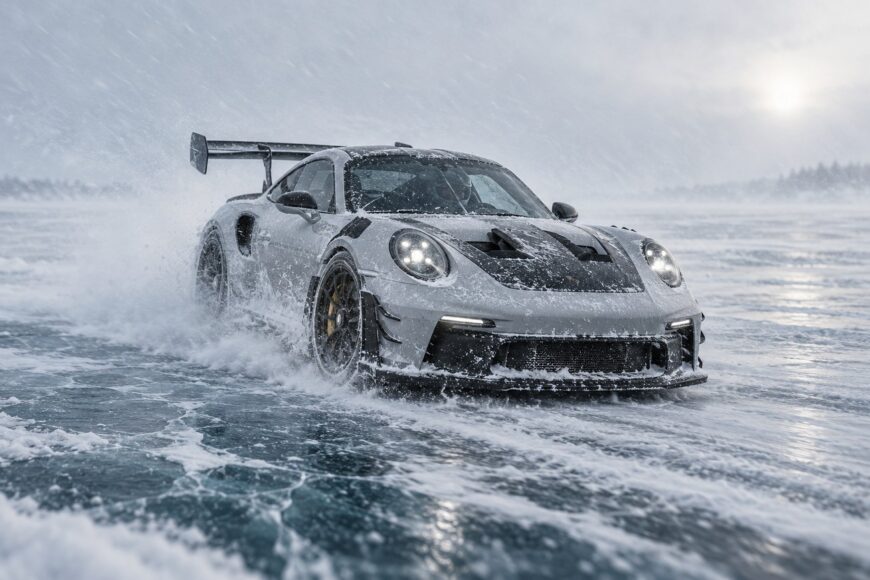
A 525-hp Porsche 911 GT3 RS, an enormous rear wing, and Lake Winnipeg disappearing into a blizzard make a striking picture. The car looks like a race machine dropped into a white, hostile landscape, with its aero hardware promising control while the surface beneath it offers almost none.
That is the central contradiction. The 992-generation GT3 RS can generate approximately 860 kg of maximum downforce at high speed, yet downforce cannot make up for extremely low tire-surface friction. On bare ice, temperature, micro-roughness, snow, slush, and tire behavior decide the limit long before the engine’s capability does.
A dramatic clip therefore shows only the visible part of the event. It rarely shows the ice verification, tire specification, tire pressure, weather monitoring, recovery vehicles, or the slow preparation behind a short run. The useful question is less whether the Porsche can make spectacular footage than what the footage leaves out.
- The Winnipeg Ice Run Is More Complicated Than the Video
- Why 860 kg of Downforce Cannot Rescue a Car on Ice
- Tires, Temperature, and Surface Texture Decide the Outcome
- The Failure Modes Hidden by a Hero Run
- Aero, Tires, and Ice: What Actually Controls the Result
- What the GT3 RS Specification Tells You—and What It Does Not
- Frequently asked questions
- How much does a GT3 RS wing cost?
- Which car is called the “poor man’s Porsche”?
The Winnipeg Ice Run Is More Complicated Than the Video
A frozen-lake video can prove that a car moved across a particular section of ice under particular conditions. It cannot, by itself, establish that the GT3 RS is controllable across Lake Winnipeg or that the same result is repeatable. Camera framing can compress apparent distance, obscure speed, and remove the physical cues that tell a driver how quickly the surface is changing.
Winnipeg and Manitoba conditions can include blizzards, whiteouts, snow drifts, hidden cracks, soft snow, and rapid temperature changes. A clean-looking white surface may conceal a ridge, a weak area, or a change from firm snow to slush. Reflected light and blowing snow also make it harder to judge distance and speed, especially on an open lake with few fixed reference points.
The missing data matters. Viral footage commonly omits measured ice temperature, ice thickness, tire specification, tire pressure, and the exact filming logistics. Without those details, viewers cannot separate the vehicle’s capability from a carefully selected surface, a controlled route, or a brief moment in favorable conditions.
Safe frozen-lake practice depends on local rules, engineering verification of ice conditions, weather monitoring, and recovery planning. The vehicle model does not replace those checks. A lake that appears suitable for one activity may still contain conditions unsuitable for a fast, heavy, low-clearance sports car with concentrated dynamic loads.
Why 860 kg of Downforce Cannot Rescue a Car on Ice
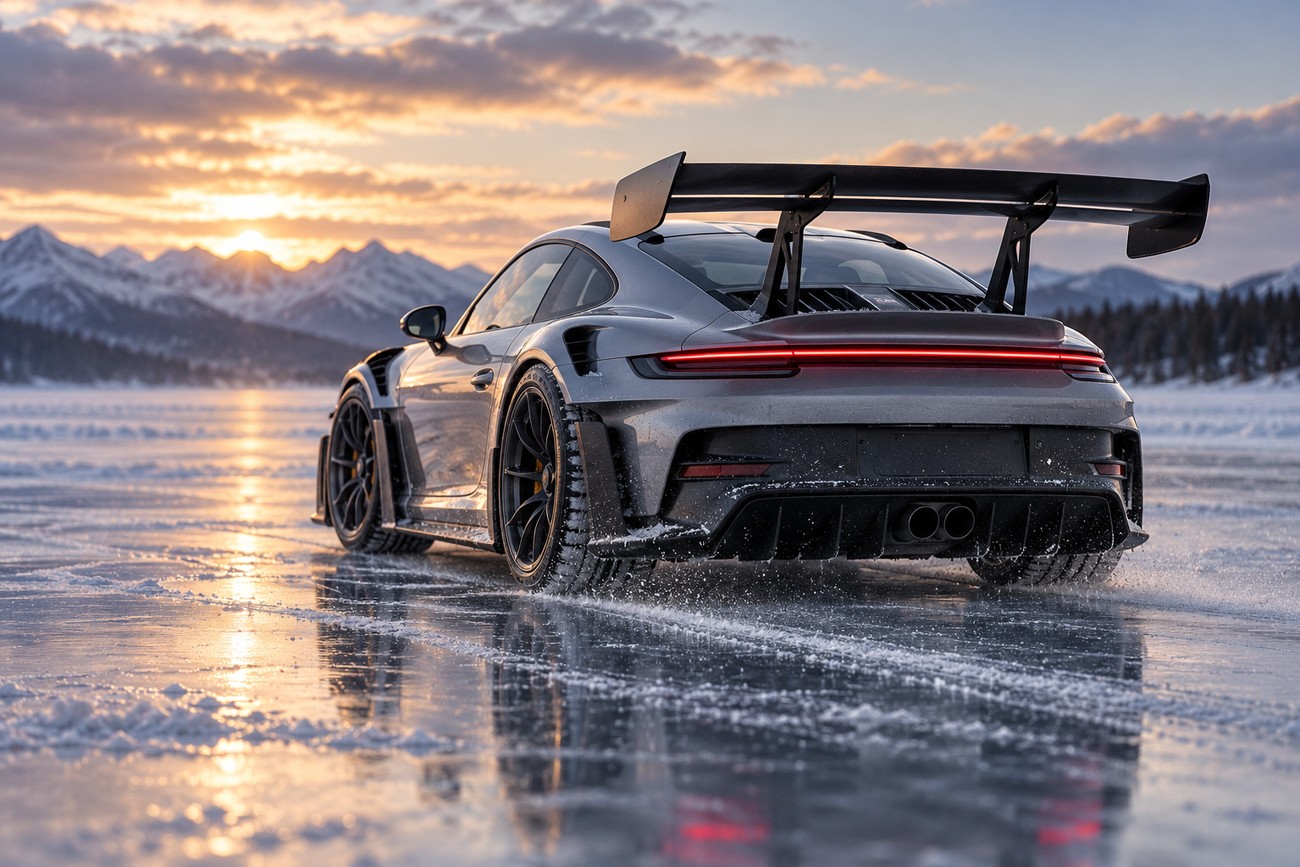
A tire produces usable cornering or braking force through friction with the surface. More vertical load can increase that force when the surface has enough friction to use it. On bare ice, the tire-surface coefficient of friction is extremely low and varies with temperature, micro-roughness, snow, and slush, so the available force can remain small even as the car becomes aerodynamically loaded.
The 992-generation Porsche 911 GT3 RS is officially rated at approximately 860 kg of maximum downforce at high speed. That figure describes aerodynamic load under high-speed conditions; it does not mean the car gains an equivalent reserve of grip on every surface. If tire-surface friction remains very low, the extra aero load may not deliver the expected cornering or braking benefit.
The car’s active aerodynamics include a large rear wing, DRS, and directed cooling channels. These systems change aerodynamic load and drag, but they do not increase the tire-surface coefficient of friction. Their effect also varies with speed, yaw, pitch, and the car’s attitude, which can make the vehicle more sensitive to wind and surface disturbances rather than magically adhesive.
That sensitivity matters in a blizzard. A gust, snow ridge, or slight yaw change can alter the aerodynamic balance while the tires are already operating close to a very low-grip limit. The driver may feel a car that is stable in a straight line and then loses its direction abruptly once the available friction is exceeded.
The large-wing myth survives because downforce is highly effective on suitable track asphalt. Ice changes the calculation. A wing can load the tires, yet it cannot supply the missing surface texture or prevent a long slide when braking or turning demands exceed what the ice can transmit.
Tires, Temperature, and Surface Texture Decide the Outcome
Ice traction is governed primarily by the tire-surface coefficient of friction, not by engine power or aerodynamic spectacle. Tire compound, pressure, surface temperature, ice texture, snow crust, and slush all affect that relationship. A setup that feels precise on a dry circuit may offer little warning before sliding on a frozen lake.
Many track compounds and semi-slicks harden in low temperatures and may lose effectiveness. The change can be especially misleading because the steering may still feel sharp while the braking and acceleration limits have quietly fallen. Applying more throttle then exposes the problem quickly, particularly with a naturally aspirated engine that responds directly to pedal input.
Ice texture is another hidden variable. Fresh transparent ice and older matte ice can behave differently because micro-roughness changes the available grip. A thin film of snow or slush can alter the surface again, sometimes producing a more progressive response and sometimes creating an inconsistent transition between grip levels.
Air temperature is not the whole story. Sun exposure can make the upper layer more slippery even in severe cold, so surface temperature needs separate attention. A slower, more predictable winter setup may therefore behave better than a harder track-oriented tire, although no tire choice makes an unverified lake surface suitable for a stunt.
The Failure Modes Hidden by a Hero Run
The familiar complaint that the GT3 RS “goes straight and then suddenly lets go” has a straightforward technical explanation. On low-grip ice, the usable margin can be narrow, and a small increase in steering, throttle, or braking demand can exceed it. Once the tires slide, the driver has less authority to change direction, regardless of how much aerodynamic hardware the car carries.
Braking can feel equally deceptive. Downforce may increase tire loading at speed, but it does not eliminate long braking distances when the ice coefficient of friction is extremely low. A driver who brakes as if approaching a dry track corner can run out of surface grip before the car reaches the intended turn-in point.
Ruts, snow drifts, and crusted ridges add another layer of risk. The GT3 RS has low ground clearance, a large rear wing, directed aero channels, vulnerable wheels, and carbon-fiber elements that can be damaged by rough ice or compacted snow. Crosswinds can move the car laterally, while a whiteout reduces the driver’s ability to judge both distance and changing surface shape.
Surface verification and the recovery plan come before throttle technique on a serious ice session. The short hero clip may represent hours of controlled preparation, route management, warming, camera protection, and standby support that never reaches the edit.
Common mistakes include confusing downforce with grip, choosing unsuitable tires, and driving as if the surface were dry asphalt. Sudden throttle, braking, or steering inputs can provoke a breakaway that a smoother approach might have avoided, but smooth inputs cannot compensate for weak ice or an unsuitable route.
The apparent simplicity of filming is also misleading. Ice work can require route control, recovery support, slow technical preparation, protection for cameras in freezing conditions, and backup vehicles. Those resources explain why a polished clip should be treated as selected evidence of one moment, not as a complete demonstration of safe repeatability.
Aero, Tires, and Ice: What Actually Controls the Result
Each part of the package affects a different limit. The table separates what can change vehicle behavior from what it cannot solve on a frozen lake.
| Factor | What it can influence | What it cannot solve |
|---|---|---|
| Power | The 4.0-liter naturally aspirated flat-six and 386 kW (525 hp) can change acceleration and throttle response. | Power cannot create tire-surface friction and can exceed the available grip more quickly. |
| Active aerodynamics | The large rear wing, DRS, and directed cooling channels alter aerodynamic load and drag at speed. | They cannot make bare ice behave like track asphalt or guarantee braking and cornering control. |
| Tires | Compound, pressure, temperature, and construction strongly influence the usable grip range. | No tire choice removes the need to verify the surface, weather, and route. |
| Ice texture | Micro-roughness, snow, and slush change the tire-surface coefficient of friction and the predictability of breakaway. | A visually smooth or apparently solid surface does not prove consistent strength or grip. |
| Weather | Temperature, wind, sun exposure, drifting snow, and visibility affect both the car and the driver’s perception. | Good visibility or cold air alone cannot rule out cracks, soft snow, or changing surface conditions. |
| Logistics | Local compliance, engineering verification, monitoring, recovery planning, and technical support reduce operational uncertainty. | Logistics cannot turn an unsuitable lake, tire, or weather window into a safe driving environment. |
What the GT3 RS Specification Tells You—and What It Does Not
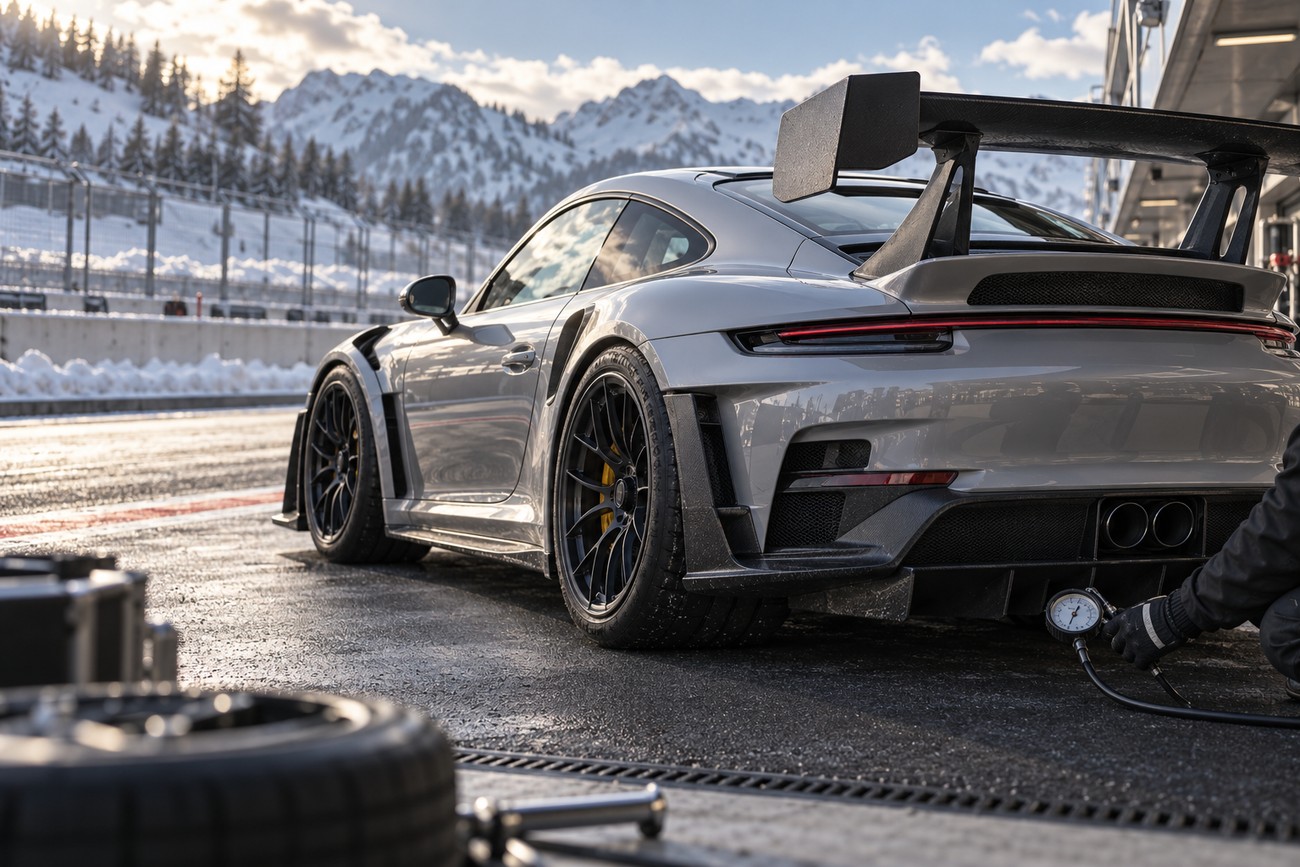
The Porsche 911 GT3 RS is a track-focused road car. Its current factory specification uses a 4.0-liter naturally aspirated flat-six producing 386 kW (525 hp), with an aerodynamic package designed to produce substantial load at high speed. Those specifications explain why the car is so compelling on a circuit.
They do not identify the car as an ice vehicle. Factory dry mass varies by market and equipment; Weissach and other options can increase mass, so there is no single universal figure that should be used for every GT3 RS. Even a relatively light sports car still places dynamic loads on a surface whose strength and grip may vary across a short distance.
Low mass can help a car change speed, and power can make it exhilarating on suitable pavement. Neither overrides the extremely low and variable coefficient of friction on ice. The same specification sheet that signals track performance says little about behavior over transparent ice, snow crust, slush, crosswinds, or hidden ridges.
The meaningful context is therefore the entire operating environment. Tires, surface condition, temperature, visibility, verification, and recovery planning determine whether the car has usable control. The engine and wing explain the spectacle; they do not certify the lake.
Frequently asked questions
The questions below address common points about the GT3 RS’s components and the informal comparisons often made about Porsche-like cars. The answers depend on the exact part, market, and context.
How much does a GT3 RS wing cost?
There is no single reliable price for a GT3 RS wing. A comparison must specify whether it covers the wing element, the complete assembly, the material, the market, labor, associated hardware, and the replacement context.
Repairing or replacing a carbon-fiber component can involve different parts and procedures than replacing a standard exterior panel. A quoted figure without those details may compare unlike components, so the exact part identification and vehicle specification should be confirmed first.
Which car is called the “poor man’s Porsche”?
“Poor man’s Porsche” is an informal nickname applied to different cars in different contexts. It is not a technical category and does not identify one universally accepted model.
The nickname may refer to a car with perceived similarities in layout, styling, or driving character. It should not imply equivalence to a 911 GT3 RS, whose track-focused engineering and performance envelope are specific to that car.







