
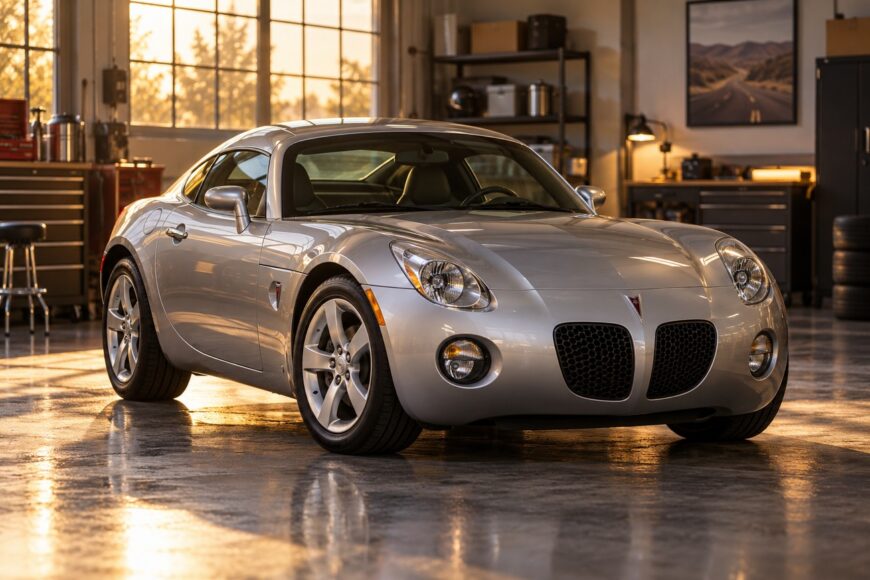
“About 1,200” is the figure most people remember, while the more specific total commonly cited for the Pontiac Solstice Coupe is 1,266 examples. That difference matters when you are checking a listing, judging an asking price, or searching for a replacement body panel. A car advertised as a rare Coupe must first be proven to be one.
The Coupe has genuine enthusiast appeal: two seats, rear-wheel drive, compact dimensions, and a distinctive fastback/targa-style body. It also brings serious compromises. The cabin is tight, the trunk holds only 108 liters, rear visibility is weak, and Coupe-specific parts can be much harder to find than shared GM mechanical components. A cheap example can become expensive quickly if its body or roof has been damaged.
- Why the Pontiac Solstice Coupe Is So Rare
- Pontiac Solstice Coupe Specifications and Engines
- Coupe or Roadster? How to Avoid the Most Expensive Listing Mistake
- What It Is Like to Live With a Solstice Coupe
- Buying a Used Pontiac Solstice Coupe: The Checks That Matter
- Does Rarity Make the Solstice Coupe a Good Collector Buy?
- Frequently asked questions
- How many Pontiac Solstice Coupes were actually built?
- Which year of the Pontiac Solstice Coupe is considered the best?
- How rare is a Pontiac Solstice Coupe?
Why the Pontiac Solstice Coupe Is So Rare
The production Pontiac Solstice Coupe appeared in 2008 after the design had been shown at auto shows, including its New York auto show presentation. It was developed as a fixed-roof counterpart to the Solstice roadster, with a fastback/targa-style roof treatment that gave the small sports car a more unusual profile. U. S. sales began in early 2009.
The commonly cited total is 1,266 Coupes. “About 1,200” is therefore a useful shorthand, but it hides the fact that this was a tiny production run even within a low-volume sports-car family. The precise number also matters because advertisements, parts searches, and collector discussions often mix prototypes, production cars, and model-year references.
Pontiac’s market life ended when General Motors discontinued the brand in 2010. That timing limited the Coupe’s production window and removed a factory brand network that might otherwise have supported owners for longer. Shared GM components can still help with mechanical repairs, yet the end of Pontiac makes original Coupe body and interior pieces a separate sourcing problem.
Scarcity should be treated as a buying constraint rather than proof of investment value. There are few cars to choose from, and the best examples can command attention out of proportion to their age. A rough or badly repaired car remains a rough or badly repaired car, regardless of how small the production number looks in a sales description.
Pontiac Solstice Coupe Specifications and Engines
The Coupe uses GM’s Kappa platform, with a two-seat cabin and rear-wheel drive. Its compact footprint helps explain the car’s lively character, while the short body leaves little room for luggage or easy access. Catalog data can vary by market and version, so engine output should be checked against the VIN and engine code rather than copied from an online listing.
| Specification | 2.4-liter naturally aspirated | 2.0-liter turbocharged |
|---|---|---|
| Listed power | Commonly listed at 179 hp | Listed at 260–264 hp, depending on source and version |
| Transmission options | Five-speed manual or five-speed automatic | Five-speed manual or five-speed automatic |
| Drivetrain | Rear-wheel drive | Rear-wheel drive |
| Seating | Two | Two |
| Commonly listed dimensions | Approximately 3,993 × 1,811 × 1,273 mm | |
| Wheelbase | Approximately 2,416 mm | |
| Trunk capacity | 108 liters | |
The naturally aspirated 2.4-liter engine is commonly listed at 179 hp and is the simpler specification on paper. The 2.0-liter turbo is listed at 260–264 hp depending on the source and version, making it substantially more performance-oriented. Those figures should not be treated as interchangeable catalog trivia: they affect the car’s character, maintenance priorities, and likely purchase price.
Both five-speed manual and five-speed automatic transmissions appear in catalog data. The manual suits drivers who want a more direct connection with the rear-drive chassis, while the automatic can make city use easier. On a turbo Coupe especially, the automatic may feel less immediate when accelerating or driving quickly through corners.
Coupe or Roadster? How to Avoid the Most Expensive Listing Mistake
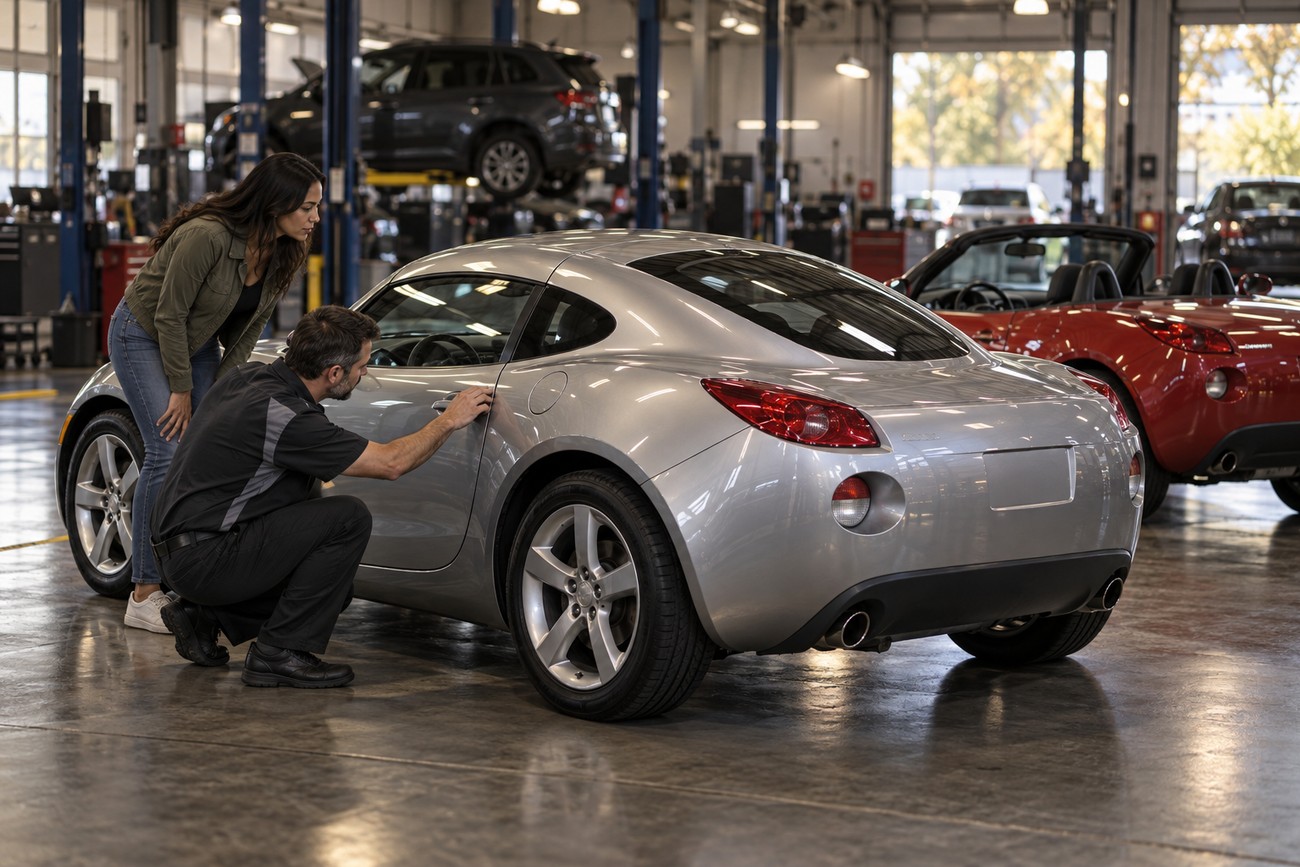
The Solstice Coupe and Solstice roadster are separate body styles. The Coupe is a distinct fastback/targa-style design, rather than a roadster fitted with an aftermarket roof. Because the two cars share a name, platform, and many mechanical components, online listings sometimes blur the distinction.
Photographs can be misleading when the roof is cropped out, the car is shown from a favorable angle, or a seller has copied details from another listing. Some advertisements also contain incorrect body descriptions or mismatched VIN information. A modified roadster may look unusual without being a factory Coupe.
Before paying a rarity premium, compare the VIN with factory documentation and confirm the body configuration through a reliable vehicle-history source. Check the engine code as well, particularly if the advertisement claims the car has the 2.0-liter turbo. A headline power figure is less dependable than the vehicle’s identification records.
- Confirm that the VIN belongs to a factory Coupe.
- Inspect the roof design, glass, rear bodywork, and fastback structure in person.
- Match the engine code and transmission to the seller’s description.
- Request photographs of the VIN plate, title, service records, and factory labels.
- Check whether any roof or body modifications have been documented and professionally completed.
What It Is Like to Live With a Solstice Coupe
The Solstice Coupe is a compact sports car first and a transport solution second. Its two-seat cabin makes it unsuitable for carrying passengers beyond one companion, while the 108-liter trunk leaves little flexibility for luggage. Entry and exit can also be awkward, especially for taller drivers or anyone using the car as a daily commuter.
The driving position and rear-wheel-drive layout provide the appeal enthusiasts expect from a small sports car. The same compact, firm character can become tiring over long trips, where limited storage, a tight cabin, and road noise matter more than they do on a short weekend drive.
Rear visibility is a frequent complaint. The fastback-style body restricts the view behind the car, making parking and lane changes more dependent on careful mirror adjustment and, where fitted, parking aids. This is a practical concern rather than a cosmetic quibble: a minor parking mistake can be costly when Coupe-specific rear body panels and trim are difficult to replace.
The five-speed automatic generally feels less immediate than the manual, particularly with the turbo engine and during performance-oriented driving. That does not make every automatic a poor choice; it means the test drive should include low-speed maneuvering, full-throttle response, and manual gear selection if available. Buyers expecting grand-touring comfort may find the Coupe too specialized for regular long-distance use.
Buying a Used Pontiac Solstice Coupe: The Checks That Matter
Begin with the Coupe-specific body before moving on to routine mechanical checks. Inspect the roof alignment, panel gaps, glass, rear quarters, hatch area, and interior trim for evidence of impact or poor reconstruction. On a rare car, a cosmetically presentable repair can conceal a parts problem that becomes expensive only after ownership has begun.
Accident history deserves particular attention. Uneven gaps, overspray, inconsistent fasteners, mismatched paint, or water intrusion can indicate work that was completed for appearance rather than long-term durability. A purchase discount can disappear quickly if the repair must be dismantled and redone because the correct Coupe panels are unavailable.
Inspect Coupe-specific panels, roof alignment, and repair quality before assuming that ordinary GM mechanical parts will make the car easy to restore. Scarce body components can dominate the final repair bill.
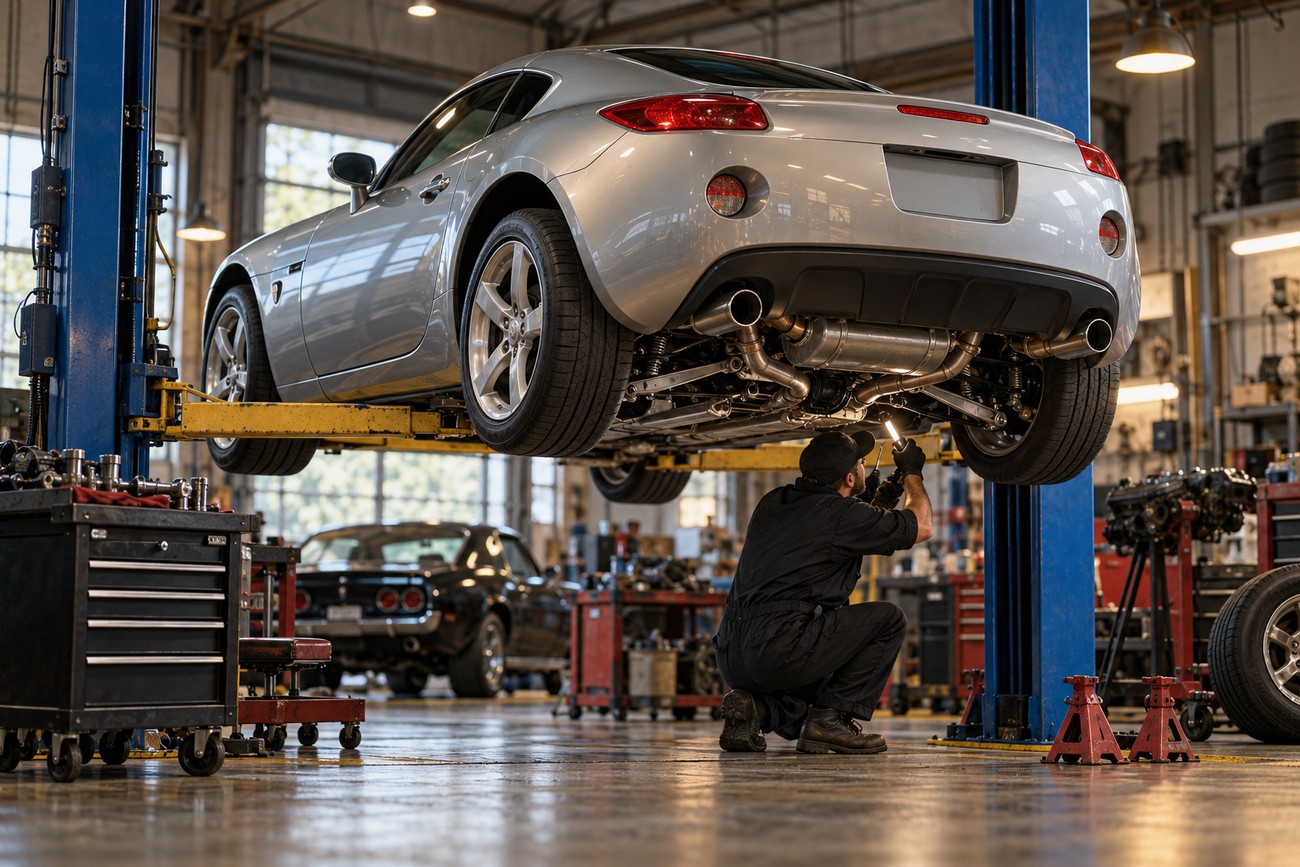
The 2.0-liter turbo requires a closer look at boost-related hardware, cooling, and maintenance history. Check for warning lights, inconsistent boost delivery, overheating evidence, neglected fluids, and undocumented modifications. The 2.4-liter naturally aspirated car has different performance expectations, so verify the engine rather than accepting a seller’s description or a generic parts-store lookup.
Shared GM and Kappa components can make mechanical sourcing more manageable. The Saturn Sky and Opel GT are related GM Kappa models, and their relationship may help identify compatible platform solutions or donor parts. That advantage has limits: a part that fits the suspension or drivetrain does not automatically solve a missing Coupe fender, roof component, dashboard piece, or interior trim panel.
Arrange an inspection with a technician familiar with Kappa-family vehicles if possible. Ask for a written assessment covering structure, cooling, drivetrain, suspension, electrical faults, and previous repairs. Service records are especially valuable because they reveal whether the car was maintained as a road-going sports car or repeatedly modified and returned to stock without proper documentation.
Does Rarity Make the Solstice Coupe a Good Collector Buy?
The Coupe has a credible enthusiast case: its fastback/targa-style design is unusual, the production run was tiny, and the rear-wheel-drive Kappa platform gives it a distinct identity. These qualities can make a documented, original, well-maintained car more desirable than an ordinary used sports car of similar age.
Scarcity does not guarantee reliability, appreciation, or easy resale. The market for a rare two-seat Pontiac is narrow, and low liquidity can make both buying and selling slow. Asking prices for sound cars may appear disproportionate to their age because the supply of good examples is limited, while a lower-priced car may require restoration that costs more than the initial saving.
Production references can also create confusion. The commonly cited breakdown distinguishes 102 prototypes from 2009, 1,152 production Coupes from 2009, and 12 cars from 2010. Those figures describe production references; they do not create a universal ranking in which one year is automatically the best choice.
Condition, originality, documentation, and drivetrain specification should lead the decision. A clean 2.4-liter car with sound bodywork and complete records may be a safer ownership proposition than a neglected turbo car carrying a more impressive specification. Buy the individual vehicle, budget for scarce parts, and treat rarity as part of the ownership equation rather than as a financial guarantee.
Frequently asked questions
How many Pontiac Solstice Coupes were actually built?
The commonly cited total is 1,266 Pontiac Solstice Coupes. The frequently quoted production breakdown is 102 prototypes from 2009, 1,152 production Coupes from 2009, and 12 cars from 2010.
That breakdown explains why “about 1,200” appears so often. It is a rounded shorthand, while the more specific figure depends on whether a source counts prototypes and how it labels production year. Buyers should use the VIN and factory documentation to establish what a particular car is.
Which year of the Pontiac Solstice Coupe is considered the best?
There is no universally best year based on the production references alone. The 2009 and 2010 figures identify when cars were built, while condition, documentation, engine, transmission, originality, and repair history usually have a greater effect on ownership quality.
A 2010 reference should not automatically justify a premium, just as a 2009 car should not be dismissed without inspection. The better purchase is the example with sound structural repairs, verifiable identity, and a maintenance history that matches its drivetrain.
How rare is a Pontiac Solstice Coupe?
The Pontiac Solstice Coupe is exceptionally scarce within the Solstice range, with 1,266 examples commonly cited. Its rarity comes from the limited Coupe production run and the end of Pontiac’s market life in 2010.
That scarcity makes correct identification important. A roadster, a modified car, and a factory Coupe can look similar in an incomplete online advertisement, yet their parts situation and market appeal are different.







