
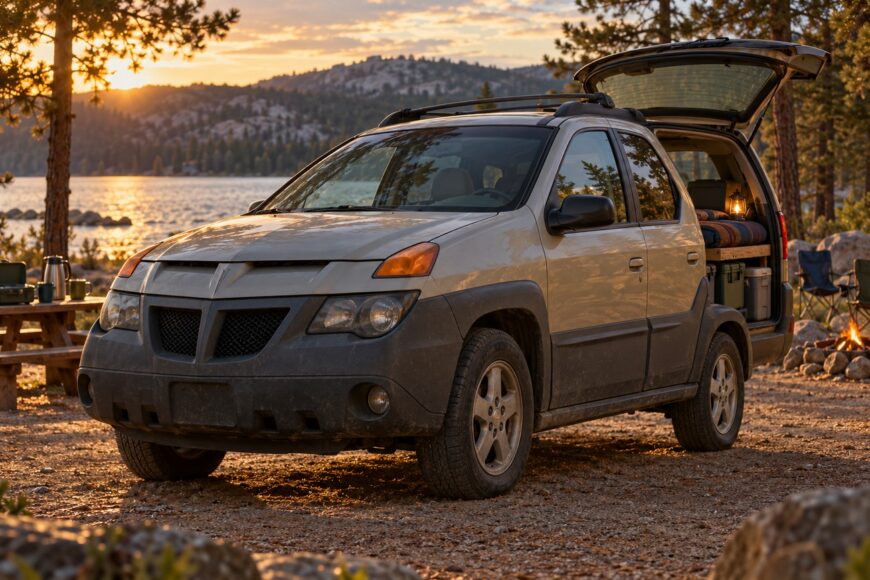
The Pontiac Aztek earned its reputation through its styling, yet its cabin contains one of the more thoughtful camping layouts of its era. The five-door crossover was shaped around active travel, with a flat sleeping area, storage niches, power outlets, and a factory camping package that turned the rear compartment into a compact overnight setup.
That contradiction raises a useful question: was the Aztek a failed product, or a misunderstood utility vehicle that arrived before its niche was ready? The answer depends on the example and the buyer. Entry into inexpensive camper ownership can be appealing, while aging electronics, scarce body parts, fuel consumption, and transmission risk can quickly erase the bargain.
- How the Pontiac Aztek Became a Punchline
- What the Aztek Actually Offers on the Road
- The Camper Trick That Fans Still Defend
- The Hidden Costs of Living With an Aztek
- Buying a Used Pontiac Aztek Without Regretting It
- From Breaking Bad Prop to Cult Camper
- Frequently asked questions
- Where is Walter White’s Pontiac Aztek now?
- Why did the Pontiac Aztek fail even though its interior was so practical?
- What is the coolest Pontiac car of all time?
How the Pontiac Aztek Became a Punchline
The Pontiac Aztek was introduced in 1999 and produced from 2000 to 2005, with a facelift introduced in 2002. Pontiac presented it as an active-lifestyle vehicle with a future-oriented camper concept. The intended customer was expected to carry sports equipment, sleep inside, and treat the vehicle as a flexible base for weekends away.
Its styling overwhelmed that message. The high nose, split-looking front treatment, heavy plastic cladding, and unusual proportions made the Aztek an easy target for jokes. Buyers saw a vehicle that looked awkward before they had a chance to evaluate its folding seats, cargo platform, or camping equipment. Positioning also created problems: the Aztek carried the expectations of a modern family crossover while delivering an interior and driving experience that felt closer to a practical minivan.
Calling it the worst car ever is misleading. The Aztek was not a complete technical collapse, and its basic engine and suspension architecture drew on widely used GM components. The market failure was primarily a styling and positioning failure. A vehicle can be genuinely useful and still lose buyers if its appearance, price expectations, and advertised identity do not align.
The facelift improved the presentation, yet it could not reverse the first impression already attached to the name. Later cultural exposure gave the Aztek a second identity, especially through Breaking Bad, where it became associated with Walter White. That association reinforced the joke for many viewers while giving surviving cars an unexpected source of recognition among enthusiasts.
What the Aztek Actually Offers on the Road
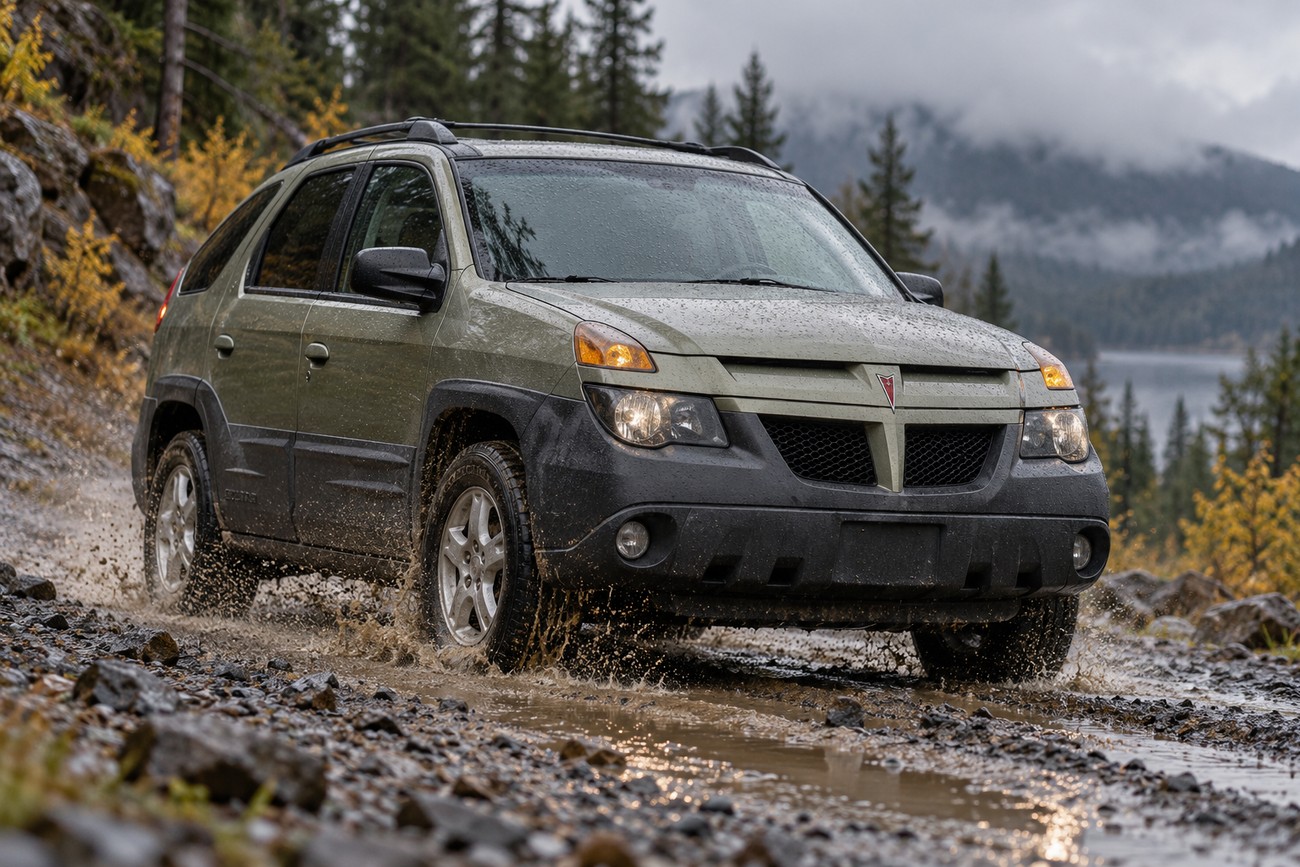
Every Aztek used the 3.4-liter LA1 gasoline V6, with a displacement of 3,350 cm³. Output was approximately 185–188 hp and approximately 284 N·m of torque. A four-speed 4T65-E automatic with adaptive control handled the transmission duties, and front-wheel drive was standard.
Optional AWD engaged automatically through a viscous coupling. It improves traction on wet roads, loose gravel, and moderate snow, which suits the Aztek’s travel brief. The system does not provide the hardware or durability expected of a serious heavy-duty off-road vehicle. Repeated abuse on difficult terrain can turn an apparently useful traction aid into an expensive drivetrain problem.
The dimensions explain some of the interior’s usefulness. The Aztek is approximately 4.58–4.63 m long, 1.87 m wide, and 1.70 m high, with a 2,751 mm wheelbase and approximately 180 mm of ground clearance. Those figures give it useful road presence and cargo space without making it a full-size SUV. On the road, the V6 is adequate for normal family and camping use, though the four-speed automatic and vehicle weight produce a relaxed rather than energetic character.
Fuel economy is a clear ownership compromise: approximately 11–12 L/100 km combined, above 13 L/100 km in the city, and approximately 9–9.5 L/100 km on the highway. Highway speed also exposes the body shape’s poor aerodynamics through wind noise and rising consumption. Braking hardware is conventional for the period, with front disc brakes and rear drum brakes; the rear drums add maintenance work and feel less reassuring than four-wheel discs on a heavily loaded vehicle.
The Camper Trick That Fans Still Defend
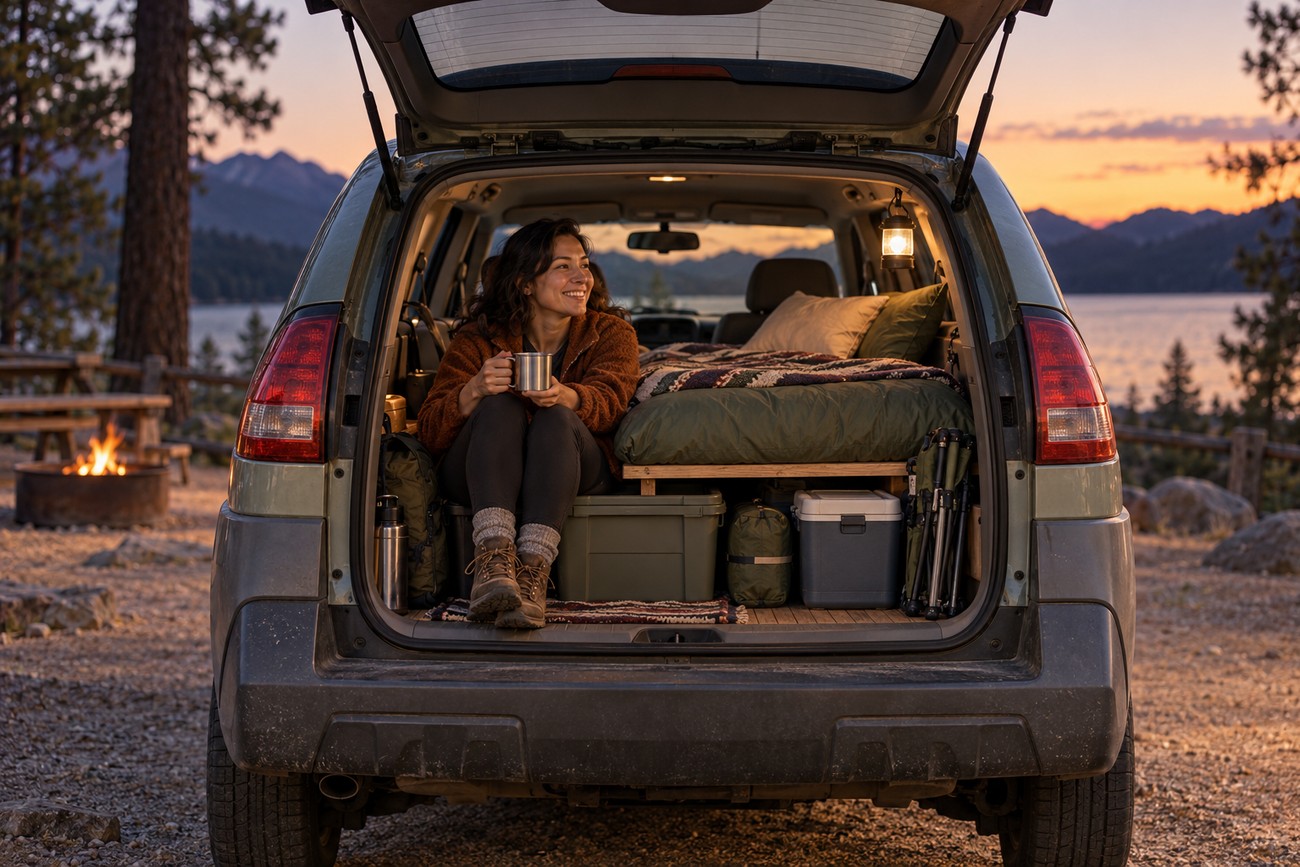
The factory camping package is the reason the Aztek remains interesting after its styling jokes have faded. It included a rear sliding cargo platform, a tent, an inflatable mattress, and a removable center-console cooler. The rear seats fold to create a flat sleeping surface, allowing the vehicle to function as a compact overnight shelter without a permanent conversion.
In normal configuration, the cargo area holds approximately 1,280–1,286 liters. With the seats folded, capacity rises to more than 2,600 liters. The arrangement works because the Aztek treats cargo access and sleeping space as connected problems: equipment can be loaded low, the platform brings heavy items toward the rear, and the cabin can be rearranged without specialized construction.
The sliding platform is particularly useful for bicycles, boxes, and camping equipment. It reduces the need to reach deep into the cargo bay, a small detail that becomes valuable when the vehicle is packed at a campsite. Storage niches and camping-oriented power outlets add practical value, while the removable cooler frees the center console for a different layout when overnight equipment is not needed.
There are limits. The inflatable mattress and flat floor provide a practical place for occasional nights, yet interior dimensions, ventilation, privacy, and weather protection remain below a dedicated camper’s standard. The tent expands the usable living area, but setting up still takes time, and the vehicle remains dependent on its aging original equipment.
That limitation explains the small Aztek camper community in the United States. Owners exchange ideas for interior conversions, camping electrics, alternative tents, and replacement mattress solutions. The platform becomes attractive after buyers stop asking it to be stylish or luxurious and judge it as an inexpensive way to try compact camper life.
The Hidden Costs of Living With an Aztek
Daily use reveals compromises that a nostalgic review can overlook. Thick rear pillars and the body shape create poor rear visibility, making reversing stressful in tight spaces. The cabin is criticized for cheap plastic, rattles, and weak sound insulation, while the upright body generates noticeable wind noise on the highway.
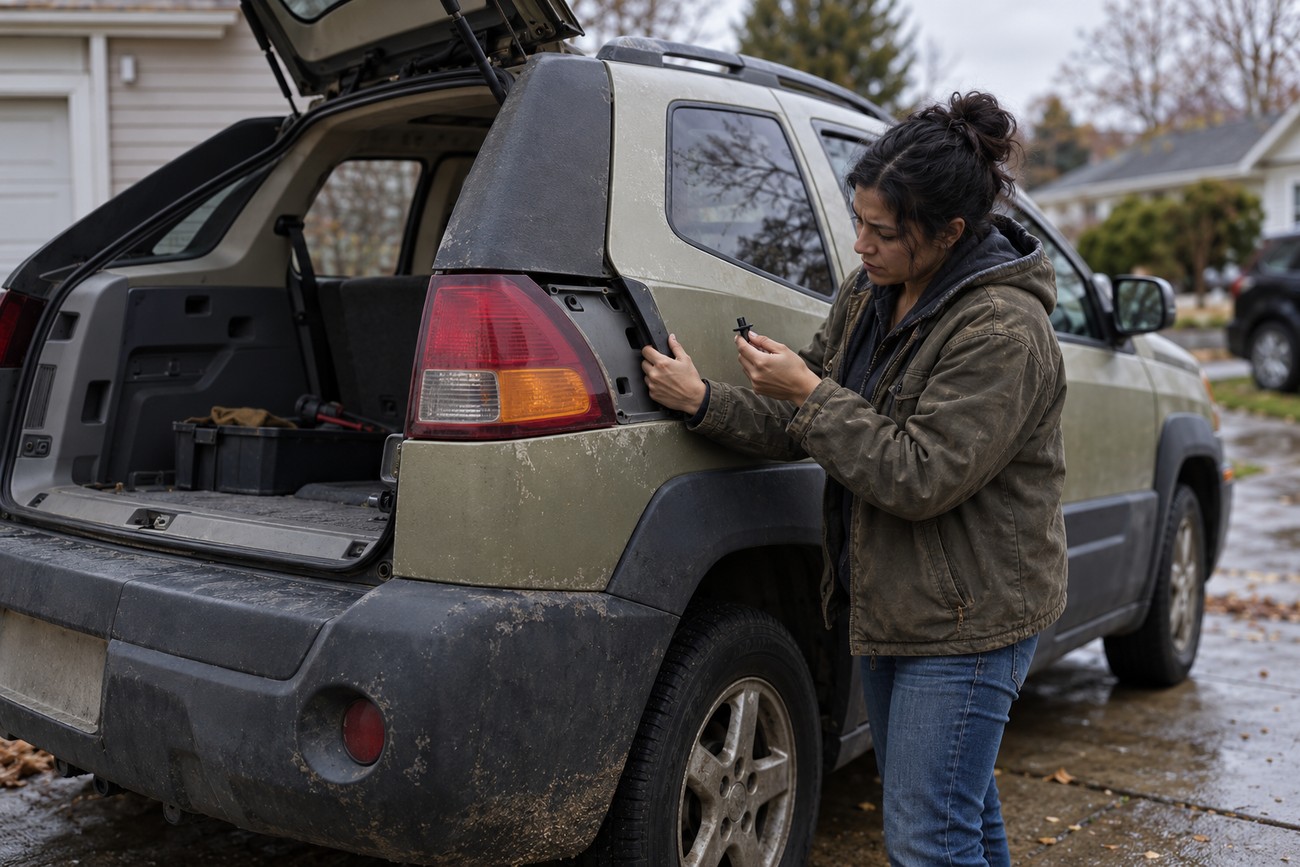
Paint is prone to chips, and exterior plastic or unpainted trim can fade, crack, or lose its surface finish. Small broken clips and trim pieces matter because model-specific replacements are harder to find than common mechanical parts. A neglected Aztek can therefore look tired even when its engine remains serviceable.
Common GM mechanical parts can keep an Aztek moving, yet they do little for a cracked lamp, missing trim panel, or damaged body mount. The parts question has to be separated into mechanical support and model-specific restoration.
Many engine and suspension components are shared with mass-market GM vehicles such as the Montana, which can simplify routine mechanical work. Body panels, lighting, interior trim, and other model-specific parts remain scarce and expensive, especially after collision damage. A cheap purchase can become impractical when a minor accident requires a long search for an original lamp or body section.
AWD cars carry an additional aging risk. The viscous coupling, hubs, and bearings can require costly attention, and faults in sensors, wiring, or control modules add diagnostic uncertainty. These issues do not make every Aztek unreliable, but they make condition and maintenance history more important than the vehicle’s cult image.
Buying a Used Pontiac Aztek Without Regretting It
Start with the four-speed 4T65-E automatic. A scan and a proper road test should look for delayed engagement, harsh or inconsistent shifts, slipping, abnormal noises, and evidence of neglected fluid service. A worn transmission can determine whether the car is economically viable, so cosmetic appeal and a complete camping package should come later in the decision.
Inspect the sills and structural rails for corrosion, along with suspension mounting areas and the underside. Check the AWD system for correct operation and inspect the viscous coupling, hubs, bearings, and related drivetrain components. On a front-wheel-drive car, this particular repair burden is lower, though the transmission and structural inspection remain essential.
A transmission scan and AWD inspection deserve priority over cosmetic repairs. Rare trim is inconvenient; a failing 4T65-E or AWD system can decide whether the purchase makes financial sense at all.
Test every electrical function, including sensors, switches, warning lights, power outlets, and control modules. Examine suspension wear, steering behavior, tire condition, and braking performance. The rear drums deserve attention because neglected hardware can complicate service on a heavy, fully loaded crossover.
Operate the sliding cargo platform with the vehicle empty and loaded if possible. Overloads or unsecured cargo can stress and damage the guides, turning one of the Aztek’s best features into a repair item. Before agreeing on a price, verify the availability and cost of rare lighting, body, interior, and camping components in your market. Buying solely because the car appeared in Breaking Bad is a reliable way to overlook the expensive problems underneath.
From Breaking Bad Prop to Cult Camper
Breaking Bad gave the Aztek a durable cultural identity through Walter White. The car became a visual shorthand for an unglamorous life, which helped preserve the public image of the Aztek as a symbol of automotive failure. Television recognition, however, does not describe the condition or usefulness of every surviving example.
Enthusiasts judge the vehicle by a different set of standards. They value the flat sleeping surface, flexible cargo area, automatically engaging AWD, and low-cost entry into compact camper ownership. Its rarity and odd character also make it easier to remember than a more competent but anonymous family crossover.
The cult appeal works only when buyers accept the compromises. The Aztek is noisy, fuel-hungry by modern family-car standards, difficult to repair after body damage, and vulnerable to age-related electrical and drivetrain faults. Its AWD is best understood as a traction aid for travel rather than an invitation to heavy off-road driving.
That leaves the Aztek in an unusual position. The mainstream view sees an awkward product that missed its market, while the camper community sees an honest, practical platform with genuine utility. Both interpretations can be accurate: the car failed as a broad lifestyle proposition and succeeded as a niche tool for owners willing to maintain its weak points.
Frequently asked questions
The Aztek’s cultural reputation and practical strengths often lead to different questions. Some focus on its connection with television, while others concern its design and long-term appeal. The answers depend on separating the surviving vehicles from the image attached to the model.
Where is Walter White’s Pontiac Aztek now?
The specific Aztek associated with Walter White is a screen-used or screen-associated television vehicle, separate from the ordinary production cars that remain with private owners. Its documented history belongs to the production and memorabilia world, while its exact condition and present location can depend on which vehicle used for a particular scene is being discussed.
This distinction matters because several Azteks could be connected with filming, publicity, or replica use. A surviving private car is not automatically the television car, even if it has the same color, trim, or visible wear. The show’s association gives the model cultural value, though it does not remove the need to verify a vehicle’s provenance.
Why did the Pontiac Aztek fail even though its interior was so practical?
Practicality could not overcome the gap between the Aztek’s styling, market positioning, and buyer expectations. Pontiac presented it as a modern active-lifestyle vehicle, yet many customers saw an awkward and expensive family crossover with a low-rent interior. The camping concept also required occasional use and personal tolerance for setup, so it could not justify the purchase for buyers who wanted a conventional daily vehicle.
The result was a product with useful engineering trapped inside an unconvincing identity. The factory package offered genuine convenience for compact camping, though it did not deliver the space, privacy, or weather protection of a full camper. Market success depends on the whole proposition, and the Aztek’s appearance and positioning dominated its practical strengths.
What is the coolest Pontiac car of all time?
There is no objective single winner. A fair comparison should separate performance, design, cultural impact, usability, and historical importance. A high-performance Pontiac may lead on speed, while another model may have stronger styling or broader cultural recognition.
The Aztek belongs in the discussion for a different reason. Its cult status comes from unusual character, real cargo and camping utility, rarity, and the reversal of its public image. It is unlikely to win a conventional beauty contest, yet it can be the coolest Pontiac for someone who values a distinctive, usable camper platform over auction value or outright performance.







