
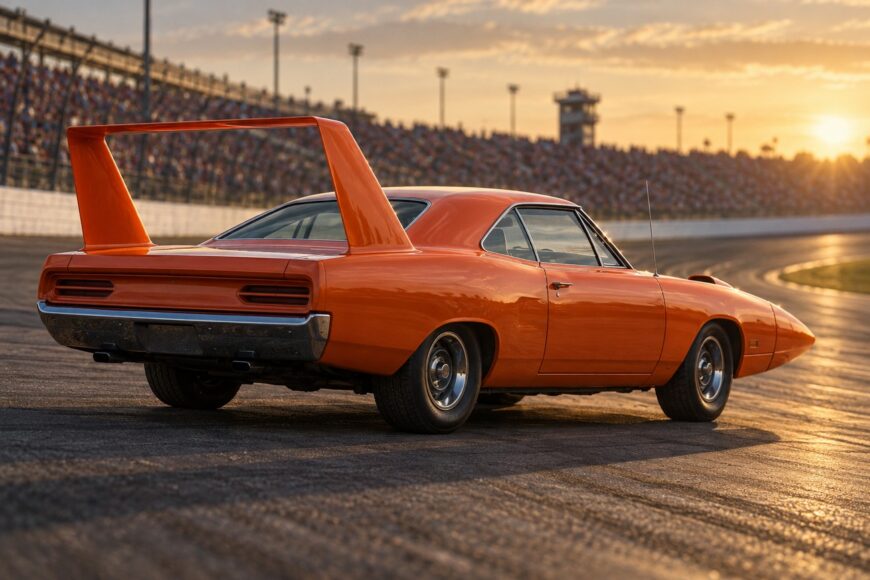
The Plymouth Superbird carries an enormous rear wing that looks almost absurd on a road car, especially at ordinary traffic speeds. Its height, long nose, and exposed supports make parking, garage storage, and daily driving awkward. The design becomes easier to understand once the wing is treated as an aerodynamic device rather than a styling accessory.
The engineering problem was a racing compromise. Plymouth needed a road-legal car whose aerodynamic package could work on a fast oval, yet the same nose and wing could add drag and hurt acceleration in a short straight-line test. That also makes appearance a poor guide to authenticity: a convincing wing and nose can be fitted to another car without reproducing the original structure, dimensions, or identification evidence.
- Why the Superbird Wing Had to Sit So High
- The Nose and Wing Were One Aerodynamic Package
- NASCAR Rules Turned Race Engineering into a Street Car
- Why It Could Lose to a Road Runner in a Straight Line
- Downforce, Drag, and the Setup Most People Miss
- The Ownership Trap: Original Car, Replica, or Restored Survivor?
- Frequently asked questions
- How many Plymouth Superbirds exist today?
- What is the rarest color on a 1970 Plymouth Superbird?
- What car had the big wing?
- Was the Plymouth Superbird banned from NASCAR for being too fast?
Why the Superbird Wing Had to Sit So High
The Superbird’s wing was raised to reach cleaner, less disturbed airflow above the roof and its wake. A lower wing would have spent more of its time in turbulent air produced by the roof and rear bodywork, reducing the consistency of its aerodynamic effect. The height therefore served a functional purpose, even though it also created the car’s most recognizable visual feature.
Height alone did not guarantee maximum downforce. The wing’s effect depended on speed, airflow, and its angle of attack. Noticeable aerodynamic benefit began at roughly 60 mph (97 km/h), so the assembly contributed little useful grip during slow urban driving while still adding weight, width, and potential clearance problems.
Increasing rear downforce generally increased drag as well. It also placed greater loads on the tires, suspension, bodywork, and wing mounts. The practical result was a device tuned for high-speed stability, with compromises that were easy to feel when the car was used away from a racing circuit.
The Nose and Wing Were One Aerodynamic Package
The wing makes sense only as part of the complete Superbird aerodynamic system. At the front, the car used an approximately 20-inch nose extension that reduced front-end lift. At the rear, the wing helped stabilize and load the rear axle, giving the car a more balanced response at speed.
Airflow also depended on the underbody, rear body shape, wing height, and wing angle. Treating the rear wing as an isolated spoiler misses the design objective: the nose managed the front axle, while the rear assembly controlled the balance of the car behind it. The two ends had to work together as the car moved through the air.
The wing struts had structural duties, yet their shape and position also influenced airflow and lateral stability. This is one reason replacement parts cannot be judged by appearance alone. A small difference in height, spacing, or geometry can change the way the package loads the car and can place additional stress on the surrounding panels.
NASCAR Rules Turned Race Engineering into a Street Car
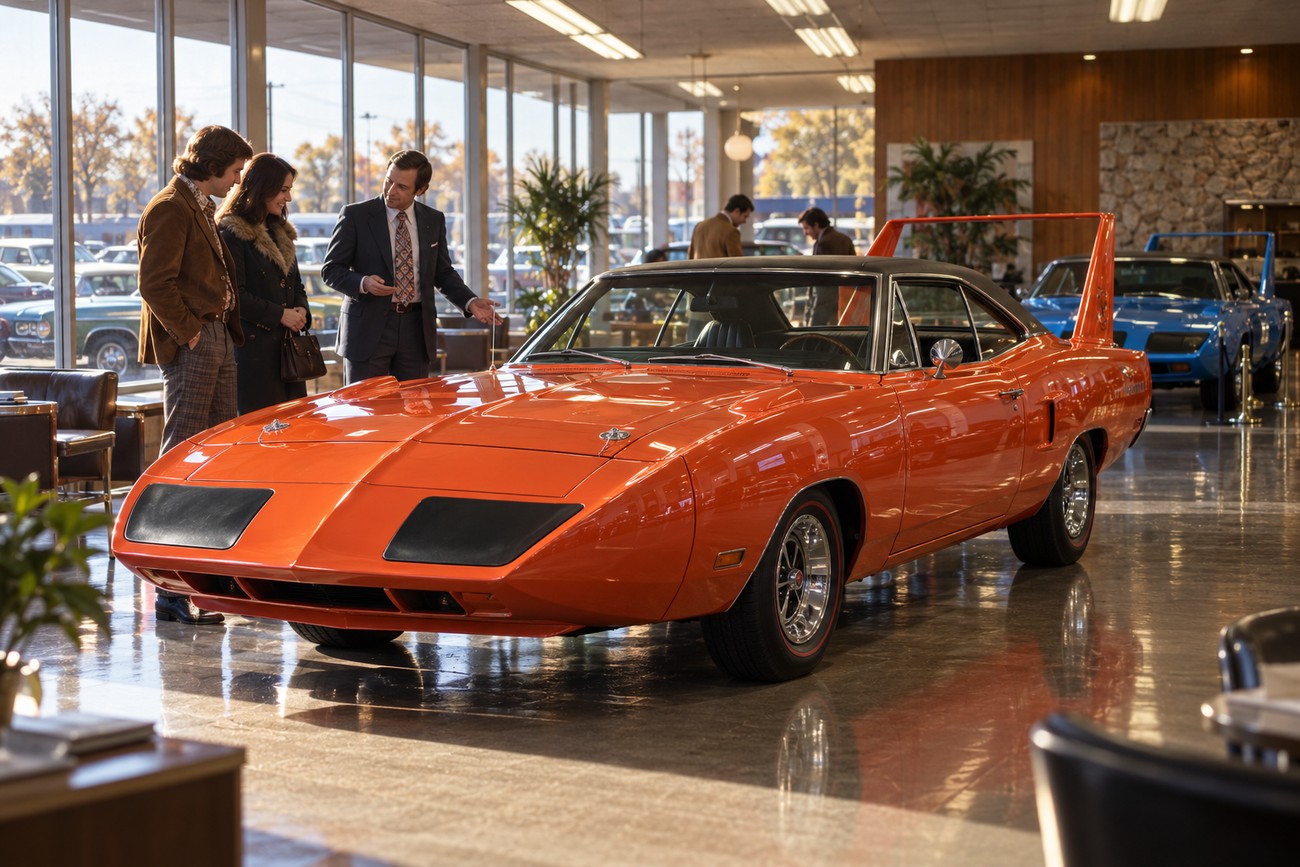
The Superbird existed because NASCAR required relevant racing designs to be available to customers. Plymouth therefore had to build a customer-available version of its aerodynamic race concept rather than keep the nose and wing confined to a small competition fleet. The road car was a homologation tool as much as it was a showroom model.
For the 1970 model year, Plymouth produced approximately 1,920 Superbirds. That production requirement explains why the public saw the same extreme proportions associated with NASCAR: a long pointed nose, deeply altered front bodywork, and a rear wing mounted high above the deck.
The street version should still be understood in period context. It was a powerful road car with competition-derived aerodynamics, not a modern purpose-built track car with electronically managed aero, current tires, and contemporary suspension control. Its shape came from the need to make racing hardware available to buyers under the rules of the time.
Why It Could Lose to a Road Runner in a Straight Line
A Superbird could lose a quarter-mile test or a road test to an ordinary Road Runner. The reason is straightforward: the nose and wing could generate useful downforce while also creating additional aerodynamic resistance. More load on the tires does not automatically produce a quicker launch or a faster short sprint.
The Superbird’s advantage appeared more clearly at racing speeds, particularly when stability through fast corners mattered. A car that remains settled on a high-speed oval can be more effective over a lap even if it gives away acceleration on a short straight. That distinction is central to understanding why the wing was worthwhile.
Related wing-car testing at 125 mph reported about 100 pounds less drag and a noticeable increase in downforce. Those results provide useful evidence that the concept worked, although they are not an exact specification for every production Superbird. Vehicle configuration, wing setting, tires, ride height, and test method all affect the measured result.
Downforce, Drag, and the Setup Most People Miss
The wing angle of attack could be changed for track conditions. A more aggressive angle generally increased rear downforce and drag, which could improve cornering security while reducing straight-line speed or maximum speed. A lower-drag setting could make sense on a track with long straights, provided the car retained sufficient stability.
There is no universal Superbird downforce figure. Practical estimates sometimes cite approximately 650–750 pounds of downforce at speed, while published tests of related wing cars report different load distributions. Those numbers cannot be transferred to every production car without stating the speed, angle, measurement location, vehicle configuration, and test method.
The same qualification applies to the common claim that the giant wing was purely decorative. It was raised to reach cleaner air and did create a functional aerodynamic load. The useful effect simply arrived at speed, and it came with drag, chassis loading, and a setup compromise.
More height or more wing angle did not automatically make the car faster. The objective was a workable balance between front lift reduction, rear stability, tire capacity, and drag. That balance explains why a specification that helped a fast oval could be counterproductive in a city, on a drag strip, or during a casual road test.
The Ownership Trap: Original Car, Replica, or Restored Survivor?
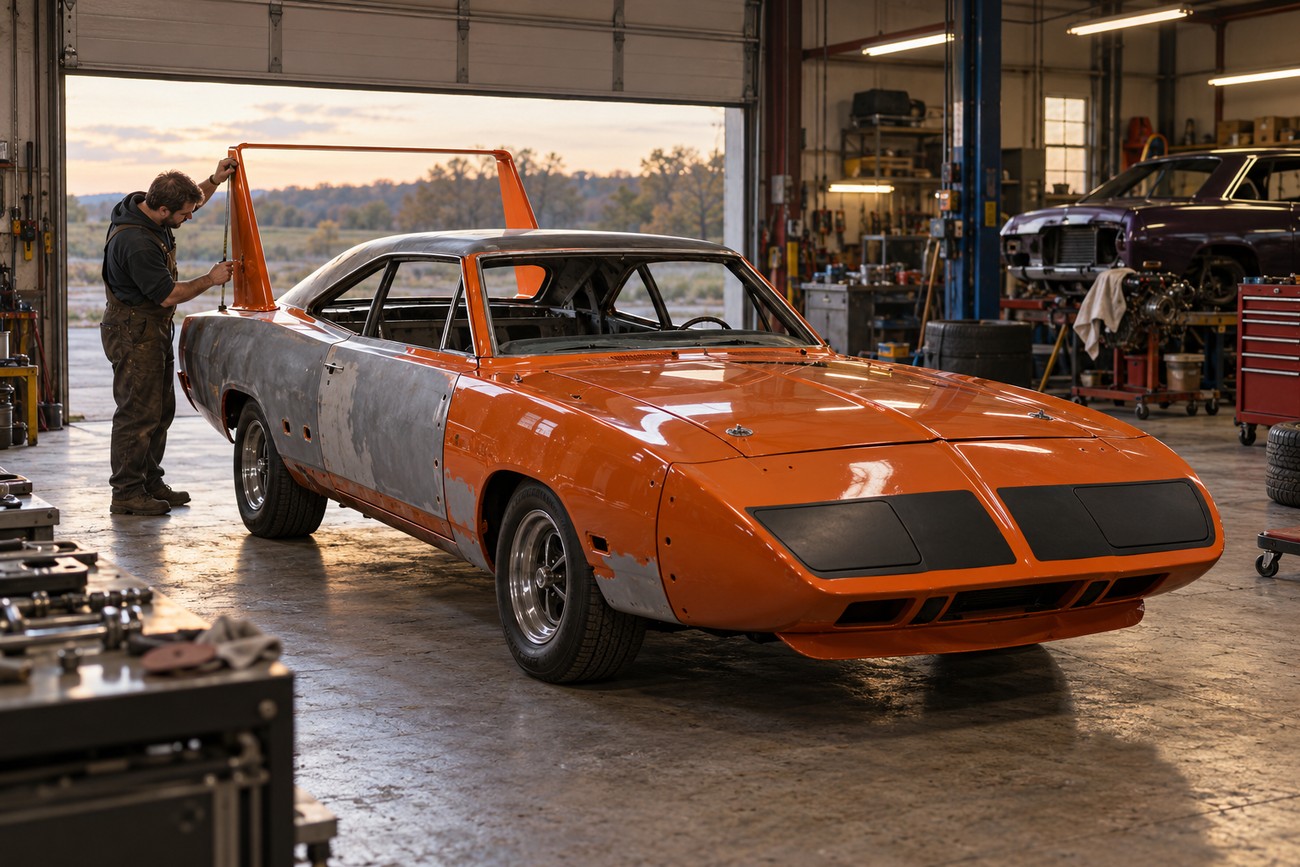
Living with a Superbird requires accepting its physical compromises. The long nose complicates parking and visibility near obstacles, while the tall wing can create garage-clearance problems. At speeds below the range where the aerodynamics become useful, the package mostly adds size, mass, and inconvenience to an already large classic car.
Restoration can be expensive because the nose, wing struts, and specialized trim are difficult to replace with universal components. A fresh paint finish may conceal poor panel dimensions, incorrect mounting points, or repairs around the wing supports. Age-related inspection should also cover the vinyl roof, paint, brakes, ball joints, and rubber components.
Mount geometry, weld quality, panel dimensions, markings, and identification evidence matter more than a freshly painted wing or a convincing visual presentation.
A replica or converted Road Runner can look persuasive while lacking the authentic body and identification evidence of a factory Superbird. Buyers should inspect the car’s identification records, factory configuration, dimensions, markings, weld areas, and the relationship between the nose and wing mounts. A body kit establishes appearance; it does not establish origin.
Available owner discussions do not systematically establish a universal durability problem with the wing itself or its mounts. Condition must therefore be inspected on each car. Check for distortion, corrosion, cracked surrounding metal, loose fasteners, uneven geometry, and signs that the supports have been modified during restoration.
Frequently asked questions
The Superbird’s production history is documented more clearly than the survival rate or the history of every individual example. Registry information, build records, and physical inspection remain important when a car is being bought or represented as original.
How many Plymouth Superbirds exist today?
Plymouth produced approximately 1,920 Superbirds for the 1970 model year. That figure describes original production, not the number surviving today. Some cars have been lost, dismantled, altered, or converted, while replicas and re-bodied examples can complicate informal counts.
A reliable surviving total requires marque registries and documented cars rather than a simple subtraction from production. For a specific example, the useful evidence includes identification records, factory configuration, ownership history, and inspection of the body and aerodynamic components.
What is the rarest color on a 1970 Plymouth Superbird?
There is no safe universal answer without a documented production-color breakdown. An unusual color can indicate a rare factory combination, a later repaint, or a restoration choice, so color alone cannot prove rarity.
Buyers should verify the build record, surviving paint evidence, and factory configuration before assigning significance to an uncommon finish. Documentation is more reliable than an auction description or the visual impression of a freshly restored car.
What car had the big wing?
The famous big-wing road car was the Plymouth Superbird, a 1970 model created from a NASCAR-driven aerodynamic program. It belongs to the broader “wing car” category, yet its identity depends on the specific Plymouth body alterations, nose, wing arrangement, and factory evidence.
The term should not be used for every modified muscle car carrying an aftermarket wing. A convincing exterior kit can reproduce the silhouette while omitting the original structure, dimensions, markings, and identification trail.
Was the Plymouth Superbird banned from NASCAR for being too fast?
That is an oversimplified version of the story. NASCAR’s homologation rules required the relevant design to be available to customers, and later rule restrictions affected how such cars could compete. The history cannot be reduced to a simple ban caused by one speed advantage.
The Superbird’s aerodynamic benefit was real, especially at high speed, yet its performance depended on the track, setup, tires, and rules in force. Separating homologation requirements from later restrictions gives a more accurate explanation than treating the car as simply outlawed for being too fast.







