
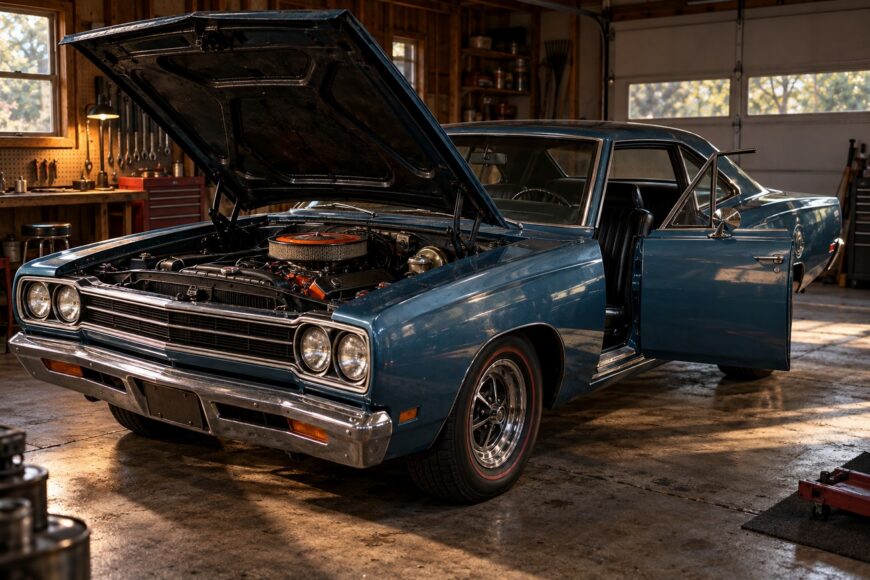
The Plymouth Road Runner was engineered as a deliberate compromise: big-block performance at a price made possible by cutting equipment, insulation, and comfort. Its aggressive image came from a simple formula—substantial V8 power, a standard four-speed in 1968, and minimal decoration—rather than from luxury or sophisticated chassis hardware.
That formula still shapes every buying decision. The famous “beep-beep” identity can distract buyers from drum brakes, absent limited-slip equipment, period gross horsepower ratings, hidden rust, and incorrect engine or option claims. A sound Road Runner deserves respect, but its badge and paint cannot replace documentation, a lift inspection, and a careful reading of the specification.
- Why the Road Runner Was Built Differently
- 1968 Road Runner Specs: The Numbers Need Context
- Hemi, Six Pack, and the 1969–1970 Changes
- 1968–1970 Road Runner: What Changed by Model Year
- The Ownership Problems the Brochure Does Not Emphasize
- How to Inspect a Road Runner Before Buying
- Road Runner Myths That Distort Value and Performance
- Frequently asked questions
- What is the rarest Plymouth Road Runner?
- How can you tell a real Hemi Road Runner from a Hemi clone?
- What should a buyer check first on a restored Road Runner?
Why the Road Runner Was Built Differently
Plymouth built the Road Runner around performance per dollar. The car combined a large-displacement V8 with reduced sound insulation, limited comfort equipment, and restrained decoration. That approach kept the original purchase price under control and made the car feel direct, loud, and mechanical.
The resulting noise and firm ride were part of the design brief. Thin insulation allows more engine, exhaust, tire, and road sound into the cabin, while a basic interior offers fewer ways to isolate occupants from vibration. Treating those traits as unexpected defects leads to the wrong restoration target; adding modern insulation may improve usability while moving the car away from its original character.
Low equipment also creates a reversal in today’s market. Trim pieces, emblems, horn components, and interior parts that were once inexpensive can now be difficult to source and expensive to replace correctly. A stripped-down car may have cost less when new, while an incomplete original example can cost more to return to factory specification than a better-equipped car with intact parts.
The “beep-beep” horn is a signature identity feature built around the Road Runner’s cartoon association. It helps establish the car’s presentation, yet it does not prove the engine, body, or option authenticity. A correct horn on a car with an incorrect drivetrain remains a correct horn, not evidence of a factory performance specification.
1968 Road Runner Specs: The Numbers Need Context
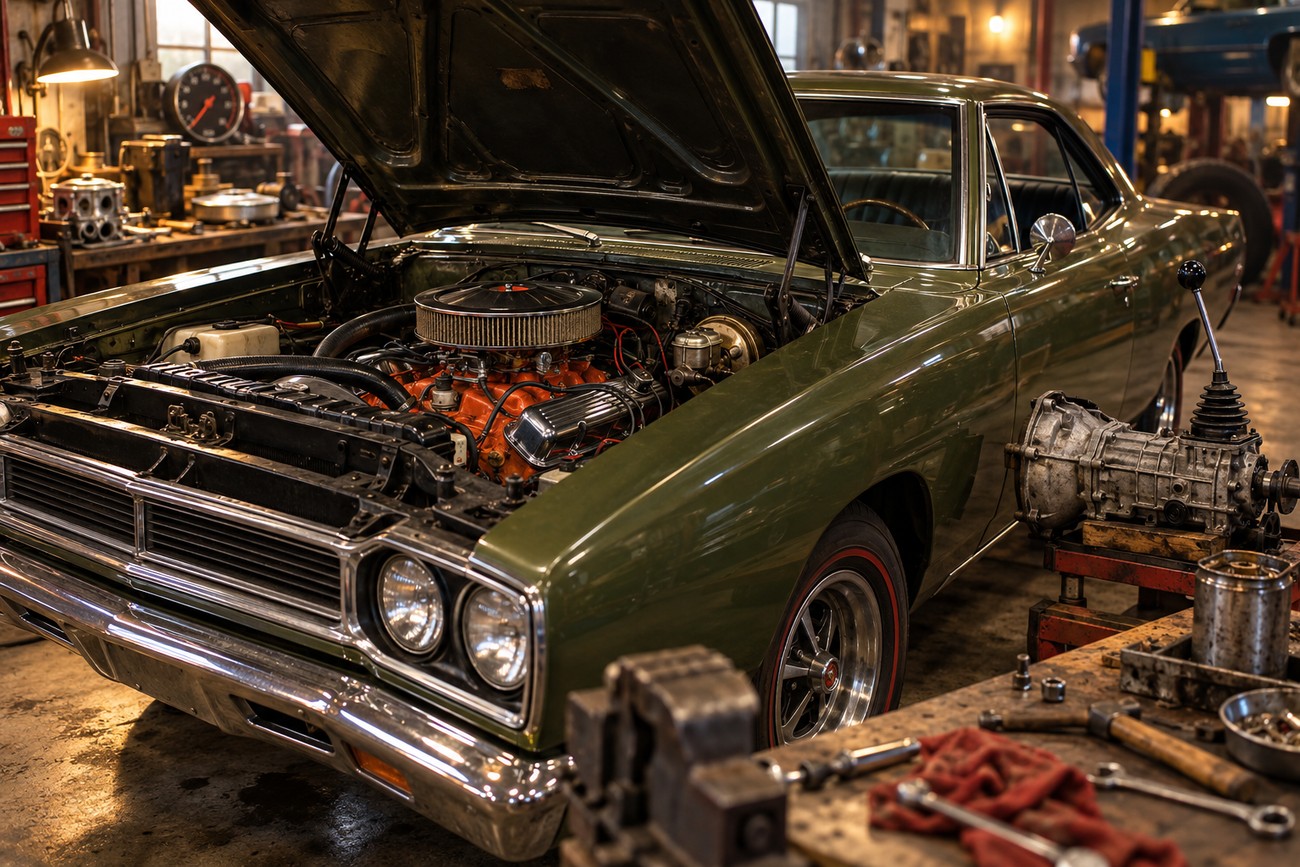
The 1968 baseline was a 383 cu in V8 rated at 335 SAE gross hp and 425 lb-ft. Those figures describe the period factory testing convention, with the engine evaluated under conditions that differ from modern vehicle-installed ratings. Period gross horsepower cannot be directly compared with modern SAE net horsepower, and it certainly cannot be treated as a wheel-horsepower figure.
Transmission equipment was unusually significant to the car’s identity. The four-speed manual was standard in 1968, while the TorqueFlite automatic was optional. A four-speed therefore confirms a transmission choice, but it does not establish a particular rear axle, limited-slip differential, or other performance equipment.
Basic braking hardware was less ambitious than the Road Runner’s image suggests. The base system used 11-inch drum brakes, while front disc brakes and power assist were optional. A car advertised as a hard-driving big-block muscle car could therefore require more pedal effort and show less resistance to repeated hard stops than a buyer might expect.
Limited-slip was not standard in 1968. Without it, available engine torque can overcome traction at one rear wheel while the other contributes less to the launch. The correct build sheet and option codes matter because an apparently serious performance car may have left the factory with an open differential.
Hemi, Six Pack, and the 1969–1970 Changes
The optional 426 Hemi gave the Road Runner a different level of specification. Its factory rating was 425 SAE gross hp and 490 lb-ft, and the 1968 option cost $714. That price and the documented equipment make a real Hemi car a specific configuration, rather than a description that can be applied to any Road Runner with a large engine.
The 440 Six Pack broadened the high-performance story during the 1969 model year. It appeared during that model year and carried a period factory classification of 390 hp and 490 lb-ft. Production timing matters because a 1969 car built before the option’s introduction cannot be authenticated by simply matching a later 1969 specification sheet.
First-generation Road Runner production covered 1968–1970, with body, engine, and equipment details changing within that span. The model year printed in a listing is only the starting point. A production date, fender tag, build sheet, and matching component codes provide the more useful chain of evidence.
Torque figures also require disciplined wording. Sources cite 425 lb-ft for a 1969 383 and 420 lb-ft for a 1970 figure; the year and measurement method must be verified against the build sheet and the source’s rating convention. Those numbers should be treated as a documentation issue rather than as a universal specification that applies to every car carrying the same badge.
The 383 Road Runner itself was a special combination using components associated with the 440, so displacement alone does not describe its configuration. That detail explains why a 383 Road Runner should be assessed by its documented combination rather than compared casually with every other Mopar 383.
1968–1970 Road Runner: What Changed by Model Year
The table separates the documented 1968 baseline from later model-year developments. It avoids treating all 1969 cars as identical and flags torque figures that require source and documentation checks.
| Model year | Engine and rating context | Transmission and equipment context | Major change or verification issue |
|---|---|---|---|
| 1968 | 383 cu in V8; 335 SAE gross hp and 425 lb-ft | Four-speed manual standard; TorqueFlite automatic optional; 11-inch drum brakes standard; front discs, power assist, and limited-slip differential were not standard | Optional 426 Hemi rated at 425 SAE gross hp and 490 lb-ft; option cost was $714 |
| 1969 | 383 specifications require year and source verification; sources cite 425 lb-ft for a 1969 383 | Equipment must be confirmed from the individual car’s documentation | 440 Six Pack arrived during the 1969 model year and was rated at 390 hp and 490 lb-ft under the period factory classification |
| 1970 | Torque figures vary by source and method; a 420 lb-ft figure is cited for a 1970 specification | Confirm the actual transmission, axle, brake, and option codes rather than assuming equipment from the badge | Verify the model year, production date, build sheet, and source measurement method before comparing torque figures |
The table illustrates why a year-by-year listing is insufficient for a purchase decision. A 1969 Road Runner may fall on either side of the 440 Six Pack’s introduction, and similar-looking cars can carry different factory combinations. Documentation should follow the car, not merely the advertisement’s engine description.
First-generation cars from 1968 through 1970 share the Road Runner identity while differing in details that affect driving, restoration, and value. A correct assessment records the actual body configuration, engine, transmission, axle, brakes, and production timing. It also separates factory equipment from later upgrades.
The Ownership Problems the Brochure Does Not Emphasize
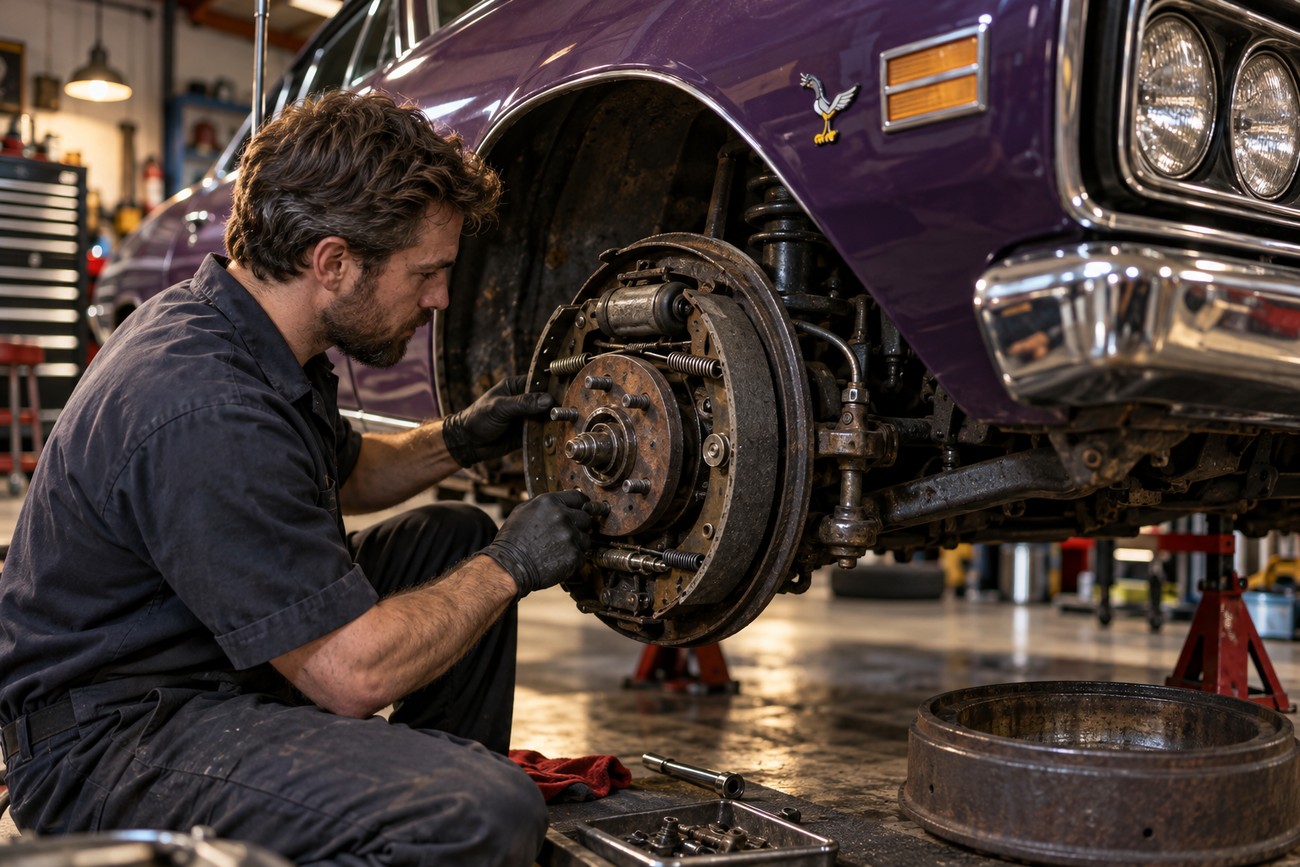
Drum brakes are the clearest example of a specification that can conflict with the car’s reputation. The 11-inch drums can require more pedal effort, and repeated hard braking places greater demands on their ability to shed heat than an upgraded disc system. A buyer planning spirited road use should inspect adjustment, drum condition, hydraulic components, and any conversion work before judging the car’s performance.
Cabin noise and ride firmness follow the same original-cost logic. Sparse sound insulation transmits more mechanical and road noise, while the basic suspension and tire choices can make the car feel abrupt on poor pavement. These traits may be acceptable to an owner seeking period character, yet they become a practical burden during long drives and should be included in the ownership budget.
An open differential can also change the car’s behavior under acceleration. If limited-slip equipment is absent, one rear tire may spin while the other delivers less useful drive. Installing wider tires or a more aggressive axle ratio without checking wheel clearance, cooling, driveshaft condition, and transmission health can add stress faster than it adds usable performance.
Carbureted Road Runners reward systematic diagnosis. Ignition timing, fuel level, vacuum leaks, and deteriorated vacuum lines can all affect starting, throttle response, and drivability. Replacing parts at random often masks the cause and can leave a car with an apparently expensive engine that still runs poorly.
High-output versions place added demands on cooling, brakes, tires, and the rear axle. A clean engine bay does not establish that the radiator, hoses, brake system, axle, and driveshaft are suitable for the car’s actual use. The same inspection applies to a modified car: the component that looks impressive may be less important than the supporting systems that keep it reliable and controllable.
How to Inspect a Road Runner Before Buying
Start with identity and documentation before evaluating horsepower. Compare the VIN, fender tag, build sheet, and matching component codes as a group. The purpose is to establish what the car was built as, then determine which parts remain original, which were replaced, and which were added later.
Next, put the car on a lift. Inspect the floors, rockers, frame rails, suspension mounting points, and areas where repaired metal meets original steel. Thick restoration coatings can conceal corrosion, seams, and poorly executed repairs, while glossy paint can make structural work difficult to judge from above.
Then evaluate the mechanical systems as a connected package. Check the brakes and hydraulic assistance, cooling system, axle, driveshaft, transmission, steering, and tire clearance. A four-speed does not prove a performance axle or limited-slip differential, and a large engine does not prove that the rest of the car was equipped or restored to support it.
Cosmetic originality comes after structural soundness. Compare trim, emblems, interior pieces, and horn components with the documented specification, while treating missing or reproduced parts as both cost and authenticity issues. A Hemi clone or Six Pack tribute may be an enjoyable car, but it should not be priced as an original factory example without documentary proof.
Use the inspection findings to separate three values: the car’s condition, its documented configuration, and the cost of correcting its defects. That approach prevents a freshly painted shell or an impressive engine swap from absorbing the budget that should have been reserved for floors, brakes, cooling, and drivetrain work.
Road Runner Myths That Distort Value and Performance
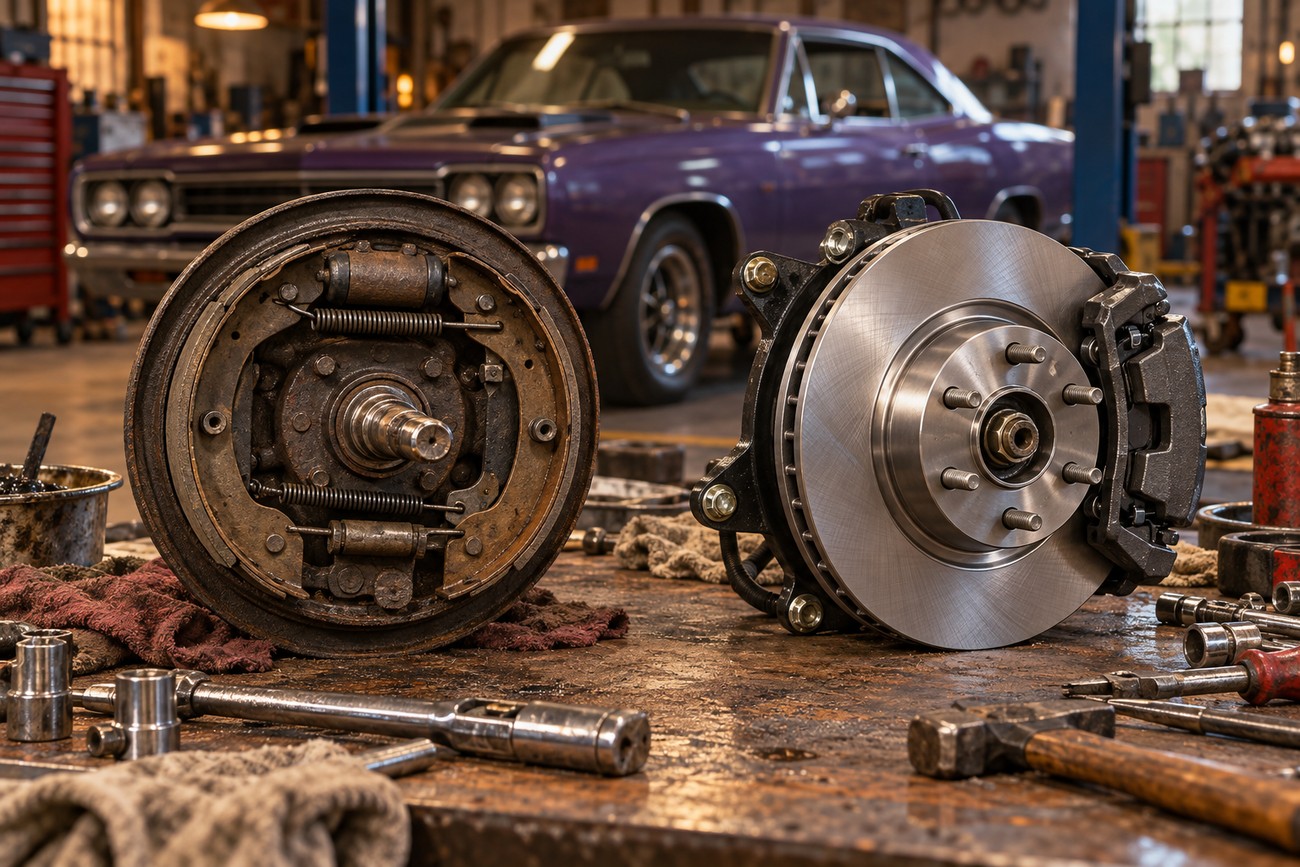
Myth: every Road Runner had disc brakes. Reality: the 1968 base braking system used 11-inch drums, while front disc brakes and power assist were optional. A buyer who assumes discs are standard may overlook a system that needs more effort and has less tolerance for repeated hard stops.
Myth: 335 hp is a modern performance output. Reality: the 1968 figure was 335 SAE gross hp, and period gross horsepower cannot be directly compared with modern SAE net horsepower. It does not state wheel output, and actual performance depends on condition, tuning, compression, exhaust, fuel, and drivetrain losses.
Myth: every 383 Road Runner is effectively a Hemi car. Reality: the 426 Hemi was a separate option, while the standard 1968 engine was the 383 cu in V8. The Road Runner 383 used a special combination with components associated with the 440, but displacement alone does not establish Hemi equipment or factory rarity.
Myth: every 440 Road Runner carried the 440 Six Pack’s 390-hp rating. Reality: 390 hp and 490 lb-ft refer to the 440 Six Pack under the period factory classification, and the option arrived during the 1969 model year. Engine claims should therefore be tied to production date, documentation, and matching components before they influence price or restoration decisions.
Frequently asked questions
What is the rarest Plymouth Road Runner?
There is no defensible single answer based on a Hemi badge, a beep-beep horn, or appearance alone. Rarity must be tied to a documented combination of engine, options, production date, and body configuration, then judged alongside condition and surviving evidence.
A seller’s rarity claim should identify the specific factory configuration and support it with the VIN, fender tag, build sheet, and matching component codes. Without that evidence, a scarce-looking car may be a modified example, a tribute, or a later combination assembled from unrelated parts.
How can you tell a real Hemi Road Runner from a Hemi clone?
Verify the VIN, fender tag, build sheet, and matching component codes together. The documentation should support the factory Hemi configuration, while the engine, transmission, axle, and other relevant components should be assessed for consistency with that record.
An engine swap does not establish factory origin. A Hemi clone can be a worthwhile performance car, but its description and price should reflect the conversion unless the documentary chain proves that the car left the factory as a Hemi Road Runner.
What should a buyer check first on a restored Road Runner?
Establish the documentation first, then inspect the structural metal on a lift. That order reveals whether the car is the claimed configuration and whether floors, rockers, frame rails, and suspension mounts are sound beneath the restoration materials.
After the shell, evaluate brakes, cooling, drivetrain, tires, and axle condition. Cosmetic originality and missing trim should be considered before discussing price, while a polished engine bay or fresh paint should never displace structural and documentary evidence.







