
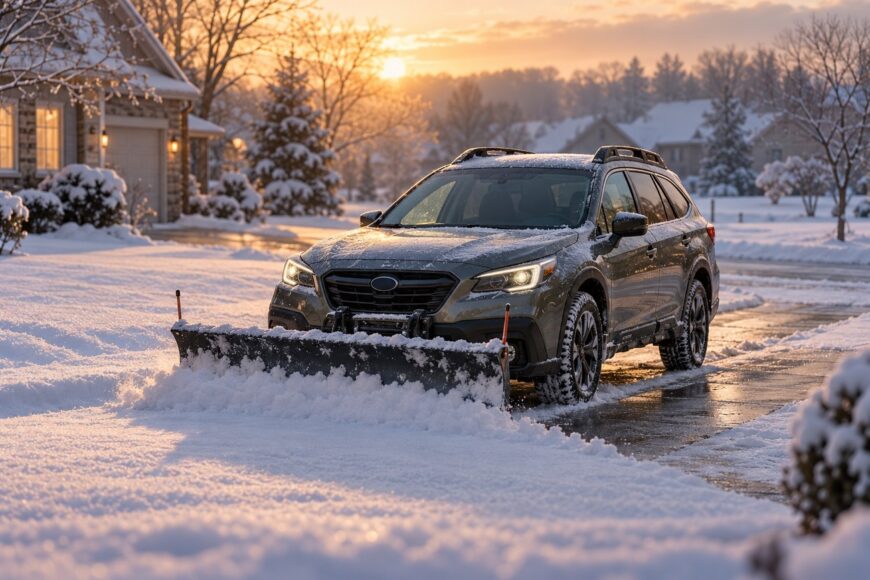
The logic is tempting: the Subaru Outback has permanent all-wheel drive, useful ground clearance, and, on applicable versions, X-Mode for snow. Those features can make it confident on an unplowed road, so fitting a blade may seem like a natural extension of its winter capability.
The important distinction is between driving through snow and repeatedly pushing it. An Outback may handle occasional light cleanup on private property with carefully matched equipment, while regular work in deep, wet, or packed snow places demands closer to those faced by a work vehicle. The decision depends on how much snow you move, how often you do it, and how much mechanical risk you are prepared to accept.
- Can a Subaru Outback Actually Plow Snow?
- What the Outback Brings to Winter Work
- Why a Plow Is Hard on an Outback’s Unibody Chassis
- The Safer Light-Duty Approach: Tires, Blade Size, and Technique
- Common Outback Plowing Mistakes and Failure Points
- When an Outback Makes Sense—and When to Use Something Else
- Frequently asked questions
- Which Subaru Outback year should you avoid for snow plowing?
- How do I put my Subaru Outback in snow mode?
- What should I inspect after using an Outback to push snow?
Can a Subaru Outback Actually Plow Snow?
A Subaru Outback can manage limited, light-duty snow clearing under controlled conditions, but its ability to travel through snow does not establish that it is suitable for regular plow work. Permanent S-AWD can help the car maintain traction, and its raised body gives it more clearance than an ordinary passenger car. Neither feature provides a rating for repeated pushing with a front-mounted blade.
Driving through a drift mainly asks the tires to maintain grip while the vehicle moves forward. A plow adds continuous resistance, leverage, and occasional shock loads when the blade meets a packed ridge, frozen rut, or heavy windrow. Wet snow can build a substantial wall in front of the blade, forcing the drivetrain and front structure to work far harder than they would during ordinary winter travel.
The chassis is another important limitation. The Outback uses a unibody construction rather than the conventional body-on-frame structure found on many pickup trucks. That design is well suited to normal road use and moderate off-road travel, yet it does not provide the same straightforward frame-based mounting structure as a snowplow-equipped pickup.
For a private driveway, light and frequent clearing may be workable if the attachment is small, vehicle-specific, and professionally installed. Commercial routes, long driveways, deep banks, and repeated heavy passes call for a pickup, UTV, or compact loader with purpose-built equipment. AWD can improve traction, but it cannot remove the loads created when a blade is blocked by dense snow.
What the Outback Brings to Winter Work
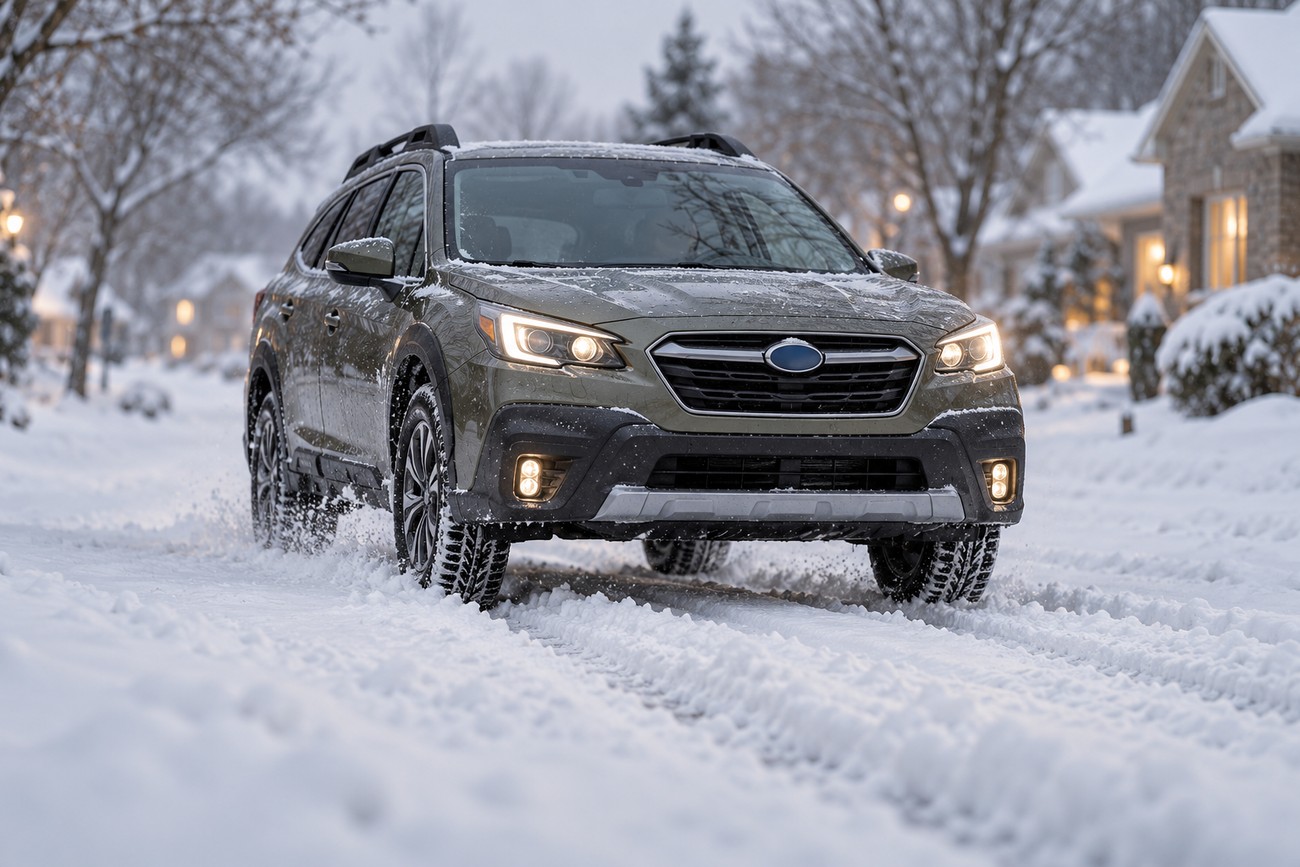
The Outback’s strongest argument is its winter mobility. Current specifications cite 213 mm of ground clearance, while 220 mm also appears in specifications for other generations or markets. That height helps the vehicle stay above loose snow and reduces the chance of grounding on an unplowed surface.
Permanent Subaru S-AWD distributes drive to maintain traction as conditions change. In some markets and configurations, X-Mode adapts the drive system, engine, and transmission for snow, mud, and sand driving. This can make controlled movement at low speed easier, especially when one or more tires begin to lose grip.
Powertrain choice changes the feel of the vehicle, though it does not change the basic suitability question. A cited official specification for a 2.5i version lists 175 hp, 235 Nm, Lineartronic, and S-AWD. Higher-output versions are listed at 260 hp and 277 lb-ft, giving them more available engine performance for climbing or towing.
More power should not be treated as permission to use a larger blade. The limiting factor may be traction, front-axle load, mounting strength, the Lineartronic transmission, or the resistance of the snow itself. X-Mode is a travel aid for difficult surfaces; it is not a professional snowplow operating mode.
Why a Plow Is Hard on an Outback’s Unibody Chassis
A blade transfers force through its mount into the front structure of the vehicle. As the Outback pushes, those forces reach the suspension, steering components, differentials, and the points where the equipment is attached. A sudden impact with frozen snow or a hidden obstacle adds a shock load that normal road driving rarely produces.
Repeated heavy pushing can also stress the CVT/Lineartronic and driveline. The transmission may be able to deliver the engine’s output during ordinary acceleration, yet plowing creates sustained resistance at low speed, often with frequent changes between forward and reverse. That operating pattern is harder on the system than simply towing a load on a prepared road.
A unibody chassis does not offer the same frame rails and attachment options as a conventional pickup chassis. A certified, vehicle-specific mount can distribute loads more carefully than improvised brackets, but it cannot create the structural reserve of a framed work truck. Mounting points, underbody panels, steering clearance, and suspension travel all need to be checked for the exact generation and equipment.
Blade size matters as much as blade weight. A large pickup-style plow can overload the front axle, reduce steering response, and increase leverage on the mounting structure. A smaller, lighter attachment lowers the risk, although it does not make repeated heavy clearing harmless.
The Safer Light-Duty Approach: Tires, Blade Size, and Technique
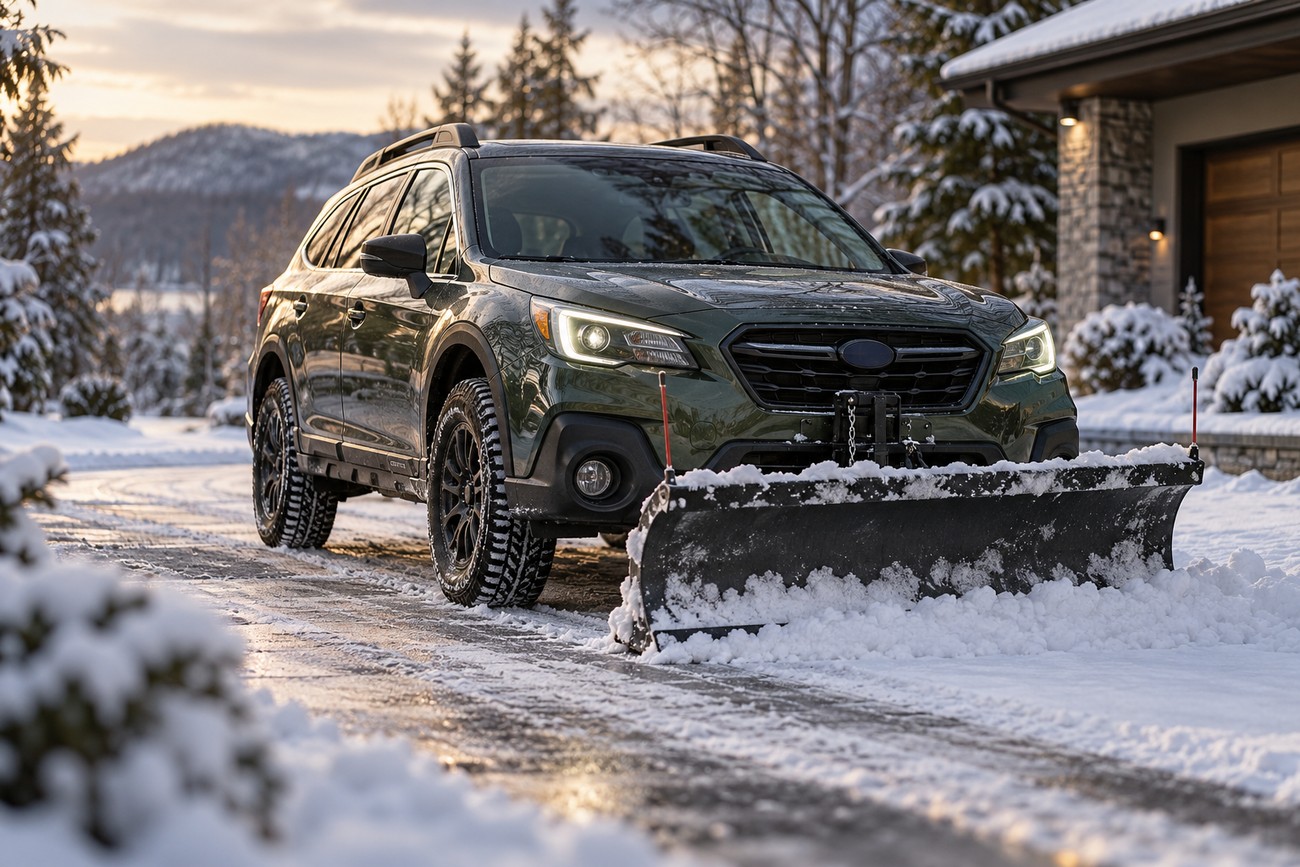
Start with quality winter tires matched to the vehicle and the conditions. AWD helps the Outback use available grip, but it cannot create grip where the tires have little ability to bite. Tire condition, pressure, and tread performance often determine whether the car can start moving once the blade begins to meet resistance.
Use the smallest and lightest equipment that can perform the intended task. Keep the blade engagement shallow, work at low speed, and make short passes. Clearing a driveway several times during a storm places less shock into the vehicle than waiting until a deep, wet bank has to be rammed all at once.
Clear early with shallow passes whenever possible. A deep, wet bank turns a manageable traction task into a high-resistance push that can overload the blade, front structure, and drivetrain together.
Wet, heavy snow creates substantially greater resistance than loose snow. Avoid hard-packed banks, frozen piles, and any pass that requires the vehicle to maintain momentum against a solid wall. If the tires spin, the blade stops advancing, or the drivetrain feels strained, reduce the load and change the technique rather than adding throttle.
Front-mounted equipment adds weight and leverage to the front axle. That can reduce steering precision, increase suspension compression, and narrow the handling margin on an already slippery surface. Test the vehicle at low speed after installation, including braking and turning, before committing to a full clearing job.
Common Outback Plowing Mistakes and Failure Points
The first mistake is treating AWD as a plow-readiness feature. S-AWD improves starting traction and control, but it cannot overcome a blocked blade or the resistance of dense snow. Wheelspin may be the visible symptom, while the deeper problem is excessive load on the transmission, mount, or front structure.
Ground clearance is also easy to overvalue. Specifications vary by generation and market, with 213–220 mm appearing in different references. That helps prevent belly contact in loose snow, yet it does not protect the car from a packed windrow, a crusted surface, a deep rut, or the impact forces created when the blade hits a frozen obstruction.
An unverified mount creates another avoidable risk. The attachment should be designed for the exact Outback generation and installed without interfering with steering, cooling, sensors, suspension movement, or underbody protection. A bracket that physically fits may still transmit unsuitable loads into a vulnerable part of the unibody.
Continuing after warning signs can turn a minor problem into an expensive repair. Watch for steering changes, unusual drivetrain noise, vibration, warning lights, fluid changes, or contact underneath the vehicle. Regular plowing can expose a passenger crossover to work loads beyond its practical chassis margin, making it an uneconomical choice even when it remains mechanically functional.
When an Outback Makes Sense—and When to Use Something Else
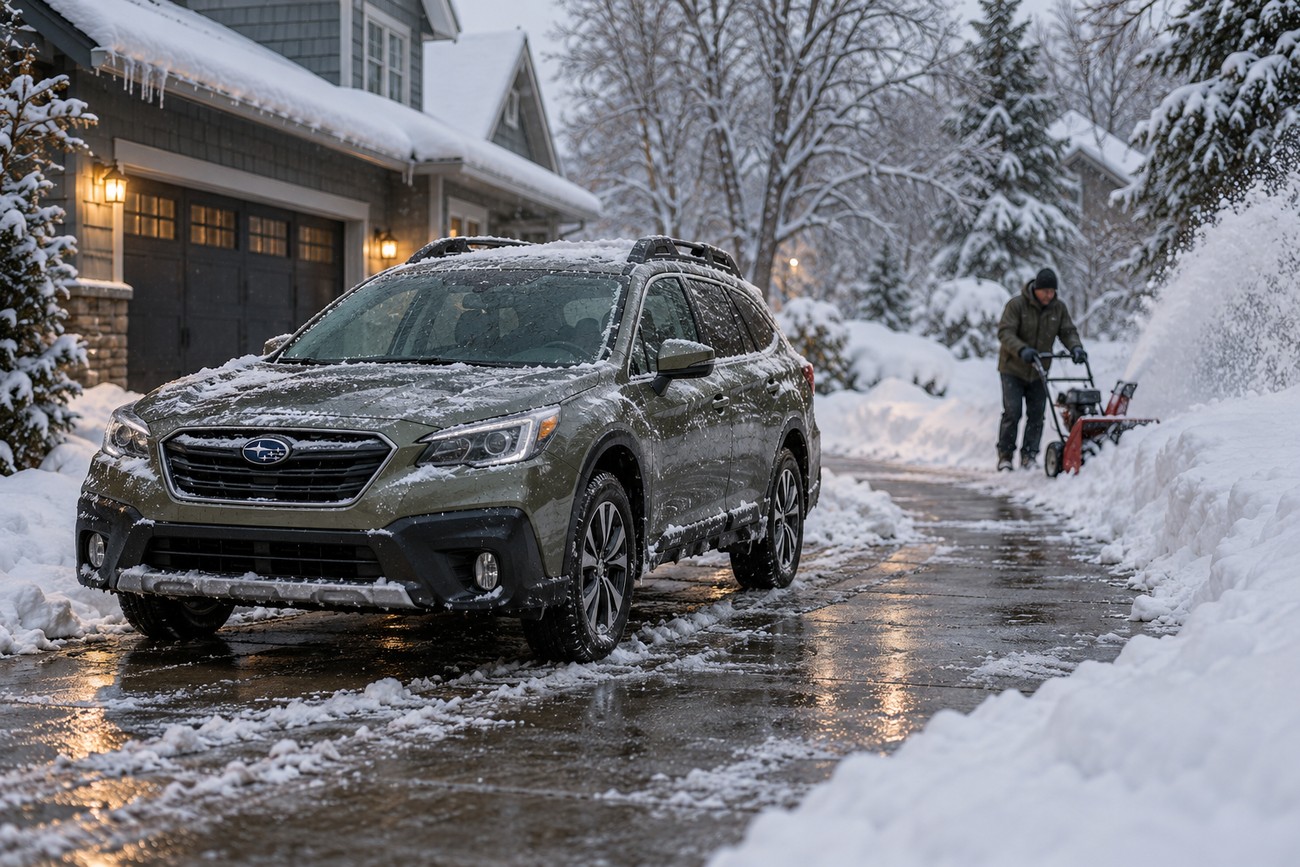
The Outback makes the most sense as a winter-capable vehicle that can perform limited, carefully managed cleanup. Occasional work on a small private driveway may be reasonable with a light attachment, shallow passes, suitable tires, and frequent clearing. The owner should accept that this is a compromise rather than a factory-defined work role.
A Capital One winter test covered snow between 6 inches and 1 foot with the Outback in X-Mode. That result demonstrates useful mobility in deep snow. It was a mobility test, not a durability test of repeated plowing, so it does not establish long-term suitability for a blade.
Official Subaru specifications cited for some versions list towing capacity up to 3,500 lb. Towing capacity and snow-plow suitability are separate engineering questions: a trailer load follows the vehicle through a controlled connection, while a blade continuously pushes against changing resistance and applies leverage to the front structure.
For frequent, deep, wet, or commercial snow removal, a pickup, UTV, or compact loader with purpose-built attachments is generally the better tool. These vehicles offer equipment designed around their chassis, easier service access, and a larger margin for repeated shock and pushing loads. Keeping the Outback for transportation may also protect a relatively valuable passenger crossover from damage that its winter traction cannot prevent.
Frequently asked questions
The right answer depends on the vehicle’s generation, equipment, condition, and intended workload. The questions below address the decisions that are easiest to oversimplify.
Which Subaru Outback year should you avoid for snow plowing?
The available evidence does not support naming one universal Outback model year to avoid. A year-specific decision should begin with the generation and market specification, then confirm that compatible mounting hardware exists for that exact vehicle.
Inspect the vehicle’s maintenance condition, transmission behavior, suspension, steering, and underbody before considering an attachment. A well-maintained example with properly matched light equipment may be a better candidate than a newer vehicle with worn components or an unverified mount. No model-year ranking removes the basic unibody and light-duty limitations.
How do I put my Subaru Outback in snow mode?
Use X-Mode where the vehicle is equipped with it. Availability and controls vary by market and configuration, so the owner’s manual should determine the exact activation procedure and the conditions for using each setting.
Selecting X-Mode changes the vehicle’s behavior for snow, mud, or sand driving. It does not activate a plow-specific setting, and the available information does not establish such a feature. Use the mode to support controlled travel while managing blade depth and vehicle load separately.
What should I inspect after using an Outback to push snow?
Inspect the plow mount and its mounting points for movement, cracks, bent hardware, or fresh contact marks. Check the steering and suspension for changes in alignment, noise, looseness, or uneven ride height, and look underneath for impact damage or crushed panels.
During a slow test drive, pay attention to vibration, driveline noise, delayed engagement, warning lights, and changes in steering or braking. Check for fluid leaks or unusual fluid changes before the next operation. Any new symptom warrants diagnosis before more snow is pushed.







