
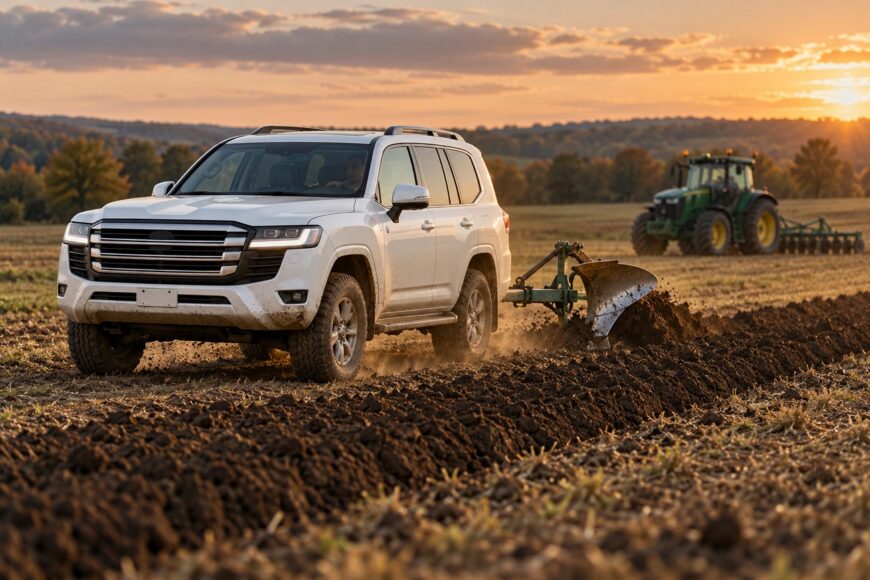
A Toyota Land Cruiser can produce impressive traction with four driven wheels, substantial mass, and a low-range gearbox. That combination may pull a plow across suitable ground, yet it does not make the SUV a tractor. The same weight that helps the tires grip can also compact topsoil and leave deep ruts.
Field results depend on wheelspin, furrow consistency, drivetrain temperature, fuel use, and soil moisture. The useful question is therefore about conditions, setup, and duty cycle rather than engine power alone. A Land Cruiser may handle occasional light work, while repeated full-depth plowing places demands on the vehicle that its design was not primarily intended to meet.
- Can a Toyota Land Cruiser Really Plow a Field?
- Traction Matters More Than Peak Horsepower
- How to Set Up the Land Cruiser and Plow
- Why the Drivetrain Can Overheat or Wear Quickly
- Soil Damage: When the Land Cruiser Becomes Too Heavy
- Land Cruiser vs. Tractor for Field Plowing
- Common Mistakes and Myths About Plowing With an SUV
- A Practical Go-or-No-Go Decision
- Frequently asked questions
- What is the most common problem with a Toyota Land Cruiser?
- How should I choose a plow for a Land Cruiser?
Can a Toyota Land Cruiser Really Plow a Field?
Yes, a Land Cruiser can pull a plow occasionally under suitable conditions. Its four-wheel drive, low-speed control, and ready-to-drive mass of approximately 2.3–2.8 tonnes for most generations can provide substantial traction. That capability is useful for a limited task, such as opening a small area in firm, reasonably dry soil.
The qualification matters because a tractor delivers steady draft work through a system designed around agricultural implements. A tractor’s gearing, cooling, hydraulic control, axle layout, and implement linkage are intended for repeated field operation. A Land Cruiser’s factory 4WD modes and low range are designed for off-road movement and obstacle control, rather than continuous plowing loads.
Extra mass creates a direct trade-off. It can help the tires maintain contact with the soil, especially where a lighter vehicle would spin, while also increasing surface compaction and rutting. The result can be a vehicle that moves the plow successfully but leaves poorer soil conditions for the next operation.
Regular plowing also exposes the difference in control. A deeply engaged implement can pull the vehicle sideways, vary its working depth, or cause repeated traction changes. If the driver has to correct those problems with the throttle, the Land Cruiser may advance while producing uneven furrows and placing additional heat and stress into the drivetrain.
Traction Matters More Than Peak Horsepower
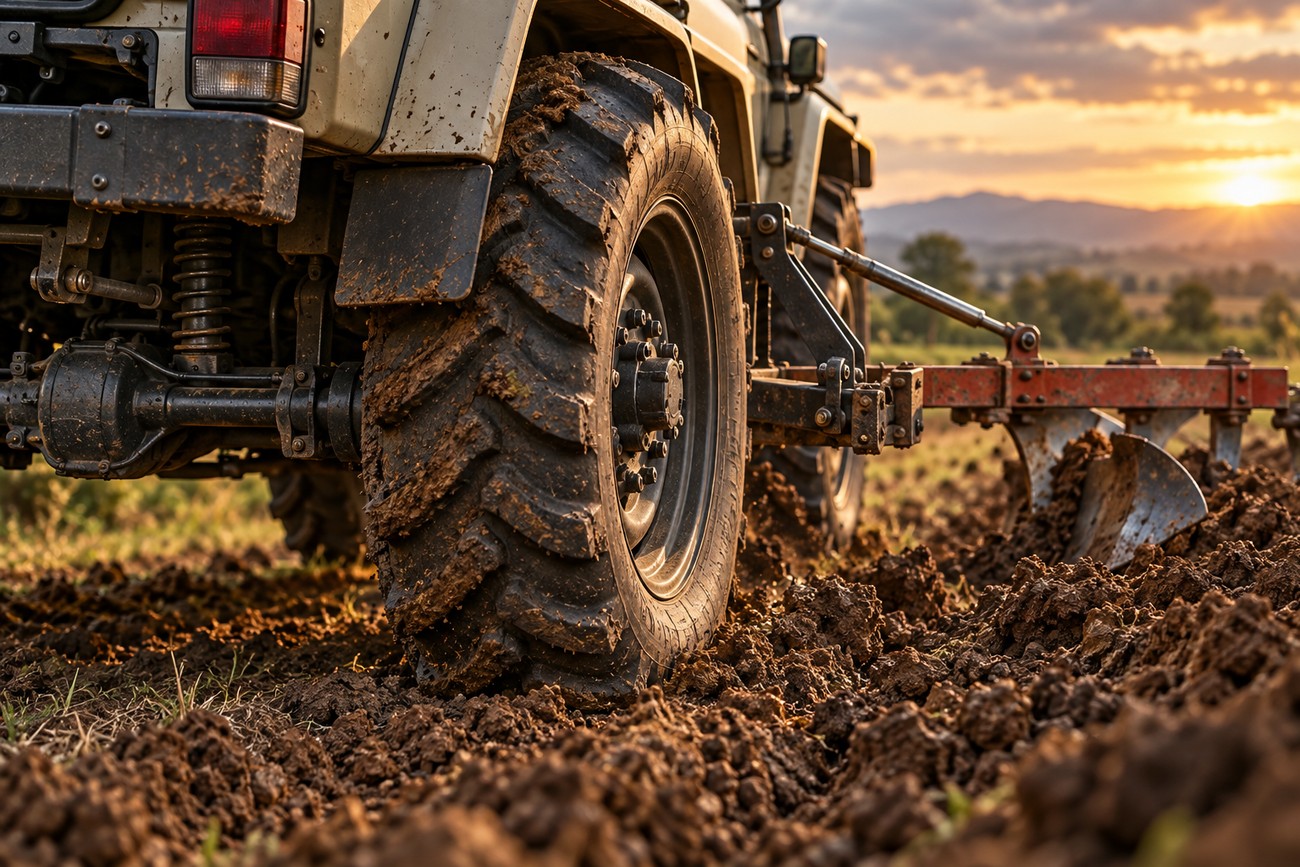
Field traction begins at the contact patch between the tires and the soil. Tire pressure, ballast, tread condition, soil moisture, soil structure, gearing, and plow load all influence whether the vehicle moves forward or excavates holes. A powerful engine can supply more torque than the tires can transmit, causing wheelspin instead of useful draft.
Insufficient ballast or incorrect tire pressure can sharply increase wheelspin. Excessive pressure reduces the tire’s ability to conform to irregular ground, while excessive deflation can destabilize the tire and increase heat. The practical target is a tire setup that provides a suitable contact patch without exceeding the tire’s operating limits.
Useful torque at low speed and suitable transmission ratios usually matter more than peak horsepower. A vehicle that delivers controllable torque through a low enough gear can maintain steadier movement, while a high-powered vehicle in an unsuitable ratio may alternate between spinning and surging. Typical tractor plowing speed is approximately 4–8 km/h, while an SUV in real field conditions may be slower and unstable because of wheelspin, changing soil resistance, and possible drivetrain heat.
The plow itself is part of the traction equation. Working depth, attack angle, width, soil moisture, and soil structure determine the draft load. A Land Cruiser that handles a light, well-adjusted implement in firm ground may struggle with the same implement after rain or at greater depth.
How to Set Up the Land Cruiser and Plow
Begin with the implement rather than the accelerator. The plow should have regulated working depth, a correct attack angle, and attachment geometry that keeps the load aligned with the vehicle. Set these factors gradually on a short test pass, because poor adjustment can create unnecessary draft load and unstable furrows.
Use the lowest suitable low-range gear when the ground and vehicle allow it, and select a conservative speed. Practical advice often favors avoiding sustained full throttle in low range, although this is guidance rather than a universal formal rule for every Land Cruiser generation, tire, soil, or implement. The correct setting depends on maintaining steady progress without continuous wheelspin or excessive engine effort.
Correct plow depth, attack angle, and tire setup before adding throttle. Sustained full-throttle work in low range is a warning sign that the load or adjustment needs attention, rather than a reliable solution to poor progress.
Tire pressure requires restraint. Lower pressure may improve traction by enlarging the contact patch, but excessive reduction raises the risk of bead unseating and tire overheating. Follow the tire manufacturer’s limits and account for the side loads and heat generated by field work; pressures suitable for slow trail travel are not automatically suitable for sustained draft.
Ballast can improve traction, yet every added kilogram can also increase ground pressure and vehicle load. Use only the amount needed for stable control, and inspect the hitch or attachment points for alignment and movement before working. If the plow repeatedly jumps out of the soil, varies depth, or pulls the vehicle sideways, stop and correct the setup instead of compensating with more throttle.
Why the Drivetrain Can Overheat or Wear Quickly
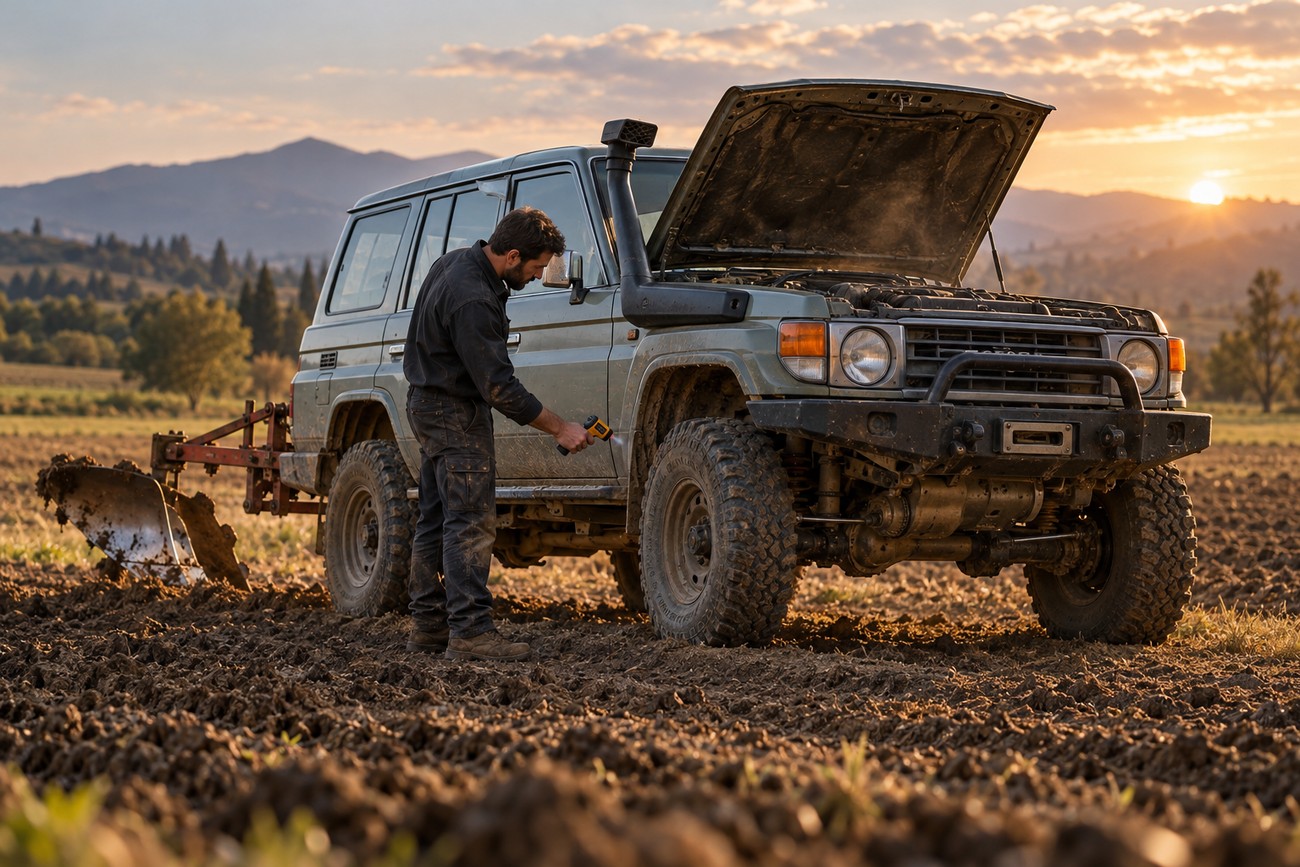
Plowing combines high resistance with low vehicle speed, often providing less ram airflow through the cooling system than ordinary road towing. Long periods of high load at low speed can raise temperatures in the automatic transmission, transfer case, differentials, and related oils. The driver may feel the vehicle still pulling while the thermal margin is steadily shrinking.
Ordinary trailer towing is a poor comparison. A road-going towing rating varies by Land Cruiser version, market, and model year, and it applies to the conditions and connection described by the manufacturer. It does not automatically authorize pulling a deeply engaged agricultural implement that continuously creates draft resistance and changing side loads.
Repeated field work can accelerate wear in tires, suspension components, axles, CV joints, the transfer case, and brakes. Hitch loads may also move differently from a trailer because a plow transfers changing forces directly into the vehicle as it enters and leaves the soil. These stresses can accumulate even when no immediate component failure occurs.
Monitor temperature information available for the specific vehicle, and stop if warning signs appear. Rising transmission temperature, unusual smells, slipping, harsh shifts, driveline noise, or a change in steering behavior should end the test rather than prompt more throttle. Cooling capacity and service condition matter as much as engine output.
Soil Damage: When the Land Cruiser Becomes Too Heavy
The Land Cruiser’s mass of approximately 2.3–2.8 tonnes for most generations can help the tires stay engaged with the ground. That advantage has a soil cost: the tires apply substantial load over the contact patches, and repeated passes can compact the upper soil layer. Deep ruts also create drainage and later cultivation problems.
Wet ground raises the risk. Moist soil usually offers less stable support, so the tires spin more readily and cut into the surface. The vehicle then creates a cycle of wheelspin, rutting, and compaction, while the plow may produce inconsistent depth as the chassis moves through the damaged track.
Mass is therefore a poor stand-alone measure of suitability. A heavy SUV may grip better on one field and damage it more severely on another. Soil structure, moisture, tire width, pressure, ballast, and the number of passes all affect the outcome.
On some fields, a lighter tractor with suitable tires can complete the work faster and cause less soil damage. That does not make a lighter machine universally superior; it shows why traction must be judged together with ground impact. Avoiding work during wet conditions is often more valuable than adding power or weight.
Land Cruiser vs. Tractor for Field Plowing
The comparison below is qualitative because Land Cruiser generations, tractors, soils, and implements vary widely.
| Factor | Toyota Land Cruiser | Purpose-built tractor |
|---|---|---|
| Traction | Strong 4WD mobility, with results strongly affected by tires, pressure, ballast, and soil condition | Designed around agricultural tires, axle loads, gearing, and draft work |
| Low-speed control | Low range can provide control, although field speed may become slow and unstable under load | Designed for controlled, repeatable working speeds |
| Cooling under draft load | Cooling and drivetrain systems are designed for the vehicle’s intended duty cycles, including road and off-road use | Cooling and transmission systems are designed for repeated agricultural loads |
| Implement adjustment | Usually offers less specialized depth, draft, and hydraulic control | Provides purpose-built implement attachment and adjustment systems |
| Soil impact | Mass can improve grip while increasing rutting and topsoil compaction | Varies by tractor and tire setup; may reduce damage on some fields when properly matched |
| Maneuverability | Good general mobility, but plow alignment and body geometry can limit field control | Configured for turning, implement clearance, and repeated headland work |
| Occasional plowing | Possible under suitable conditions with a manageable, correctly adjusted implement | Well suited |
| Repeated plowing | Higher risk of heat, wear, fuel waste, and soil damage | Designed for regular agricultural draft work |
The Land Cruiser’s advantage is versatile 4WD mobility, while the tractor’s advantage is controlled, repeatable draft work. Suitability depends on soil, moisture, plow setup, and frequency of use rather than vehicle weight alone.
Common Mistakes and Myths About Plowing With an SUV
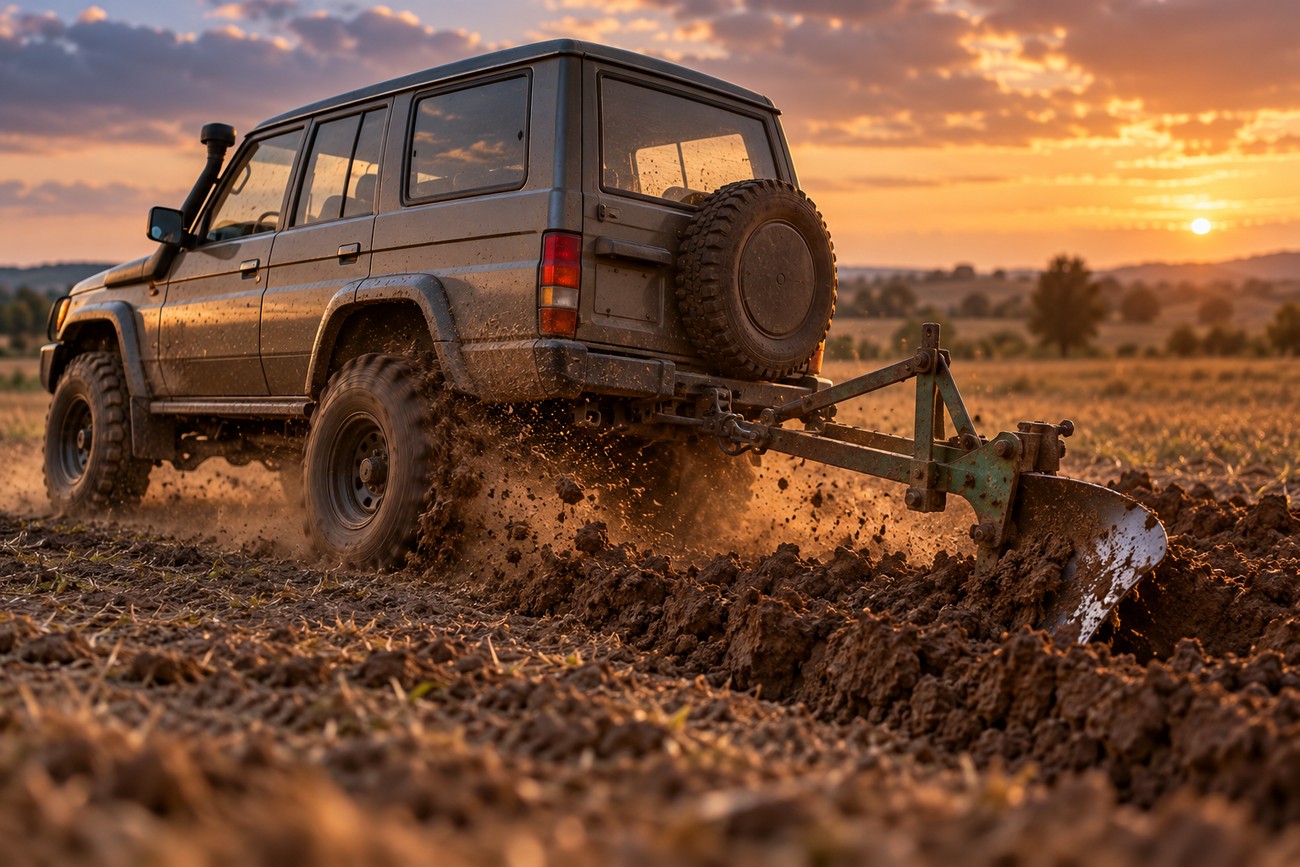
One common mistake is avoiding low range and asking a high gear to carry a deeply engaged plow. Another is attaching the implement without considering ballast, tire pressure, attachment geometry, or working depth. These choices can produce wheelspin, jerky movement, and uneven furrows even when the engine has ample power.
Trailer towing is also frequently confused with draft work. A road-going trailer rating does not describe the continuous, changing resistance created by a plow in the soil. The connection, load path, cooling demand, and steering forces are different, so a legal towing number should not be treated as a field-plowing specification.
Wet soil compounds nearly every problem. It increases wheelspin, rutting, and compaction, while making depth control less consistent. Ignoring transmission, transfer-case, differential, or oil temperatures can turn a short test into accelerated wear, especially during prolonged low-speed operation.
Four-wheel drive and low range improve mobility and control, but they do not turn an SUV into an agricultural tractor. A powerful engine cannot compensate for unsuitable tires, poor implement adjustment, excessive moisture, or unstable traction. Extra vehicle weight helps only until its soil and drivetrain costs outweigh the traction benefit.
A Practical Go-or-No-Go Decision
Proceed only after checking field moisture, soil structure, plow adjustment, tire condition and pressure, ballast, attachment geometry, and the vehicle’s cooling capacity. A short test pass should show stable traction, controlled depth, and an even furrow without continuous throttle or wheelspin. If any of those conditions is missing, the work is poorly matched to the vehicle.
Temperature monitoring is essential during the test and during any longer operation. Watch for signs of transmission or driveline heat, and respect the service condition of the automatic transmission, transfer case, differentials, axles, CV joints, suspension, and brakes. Road-legal towing limits also vary by Land Cruiser version, market, and model year; they do not equal approval for field plowing.
Occasional light work under suitable soil conditions is more defensible than repeated full-depth plowing. The implement should impose a manageable load, and the operator should be able to stop without relying on sustained full throttle to maintain movement. Wet ground, heavy draft, unstable furrows, or rising temperatures are clear reasons to stop.
For regular agricultural draft work, choose a purpose-built tractor. A Land Cruiser can be a capable occasional helper, especially where access and general off-road mobility matter, but its fuel use, soil impact, and duty-cycle limits make it a poor long-term substitute for a tractor.
Frequently asked questions
What is the most common problem with a Toyota Land Cruiser?
There is no single universal fault across all Land Cruiser generations, markets, and powertrains. Ownership issues depend on the specific engine, transmission, age, maintenance history, and operating environment.
Plowing creates a separate risk from ordinary ownership: sustained low-speed, high-load work can raise temperatures in the automatic transmission, transfer case, differentials, and related oils. A vehicle that performs well on roads or trails may still be poorly suited to repeated draft work. The relevant warning signs are heat, slipping, abnormal noises, and accelerated wear rather than one defect shared by every Land Cruiser.
How should I choose a plow for a Land Cruiser?
Choose an implement with adjustable working depth and attack angle, attachment geometry that keeps the load aligned, and a working load the vehicle can control without continuous wheelspin. The plow should allow gradual adjustment during a test pass, because soil resistance changes with depth, moisture, and structure.
Match the plow to the vehicle’s tires, ballast, low-range gearing, and cooling capacity rather than selecting it by engine power alone. A smaller or lighter implement that maintains stable draft can produce better field results than a larger plow that causes surging, uneven furrows, or drivetrain heat. A factory tow hitch and its road-going rating do not automatically make it suitable for a deeply engaged plow.







