
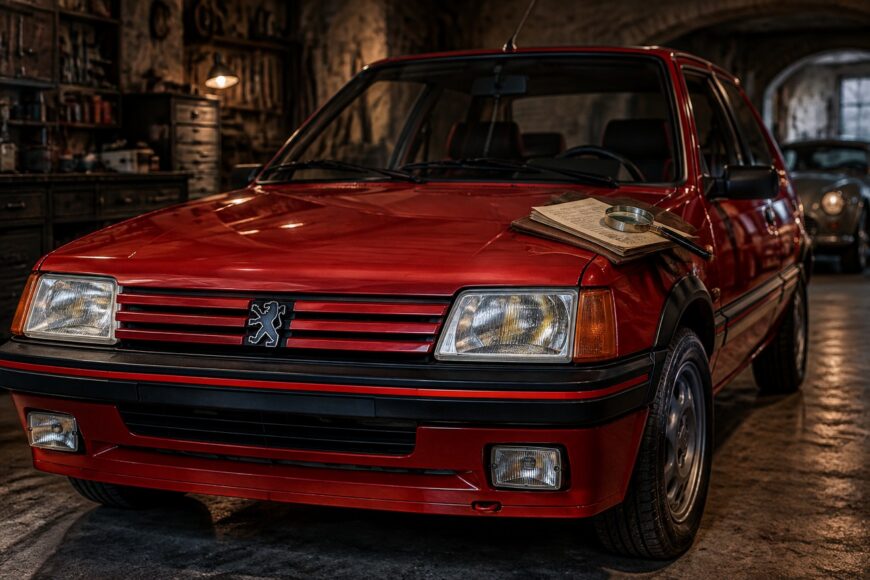
A convincing GTI badge, red trim, broad arches, and carefully chosen photographs can belong to a converted Peugeot 205. A genuine 205 GTI 1.9 may present the opposite problem: replacement engine parts, altered wiring, repaired bodywork, and missing original trim can make an authentic car look doubtful. The two situations are easy to confuse if the inspection starts with appearance.
Factory identity, present specification, and condition are separate findings. The first concerns what the shell was built as; the second records what is fitted today; the third determines whether the car is usable, safe, and worth buying. A replacement component can reduce originality without proving that the car was born as another model, while a tidy conversion can imitate the mechanical details of a GTI without having its factory identity.
Buy the evidence in sequence. Begin with the physical identity of the car and its records, then compare the engine, brakes, suspension, shell, and trim with a market- and year-appropriate specification. This approach avoids declaring a car fake because of one changed part, while still exposing a 205 whose story depends almost entirely on a badge.
- Start with identity: VIN, paperwork, and factory specification
- Check the 1.9 engine without falling for horsepower claims
- Look underneath: brakes, rear beam, and conversion clues
- Inspect the shell for rust, repairs, and donor-car work
- Treat badges, wheels, and cabin trim as supporting evidence
- Genuine 1.9 GTI or lookalike: what each clue can prove
- Make the buying decision when the evidence conflicts
- Frequently asked questions
- How much is a Peugeot 205 1.9 GTI worth?
- How many Peugeot 205 GTIs are left?
- Why does Peugeot have a bad reputation?
Start with identity: VIN, paperwork, and factory specification
The first task is to compare the VIN stamped into the car with the registration document, ownership records, and any historic paperwork. The location and format of the stamping can vary with market and production details, so do not apply a universal decoding rule from an online chart. What matters initially is that the physical identity agrees with the documents and that the documents describe the car being offered.
Next, seek factory specification evidence appropriate to the car’s market and year. Period brochures, parts information, marque records, and specialist documentation can help establish whether the body and equipment are consistent with a 1.9 GTI. None should be used in isolation: catalogs can contain errors, markets received different specifications, and many cars have been repaired or modified during decades of ownership.
Altered, damaged, or poorly presented identity markings deserve an explanation before any money changes hands. A dirty or repainted area is not automatically evidence of fraud, especially on a car that has undergone legitimate restoration. A VIN that does not match the paperwork, appears re-stamped, or is surrounded by suspicious metalwork is a more serious issue because it prevents a reliable link between the shell and its recorded history.
An engine swap does not automatically erase a car’s factory GTI identity. The shell may have started life as a GTI and later received another engine, or a replacement XU9JA may have been fitted to a genuine shell. The correct conclusion is narrower: the present engine does not establish the original identity on its own, so the shell, records, and factory evidence must carry that part of the assessment.
A listing, seller’s description, or GTI badge has little evidential weight compared with consistent documents and physical identity. Ask the seller for photographs of the VIN, copies of relevant records, and a clear account of major repairs or changes before arranging a long-distance inspection. Evasive answers do not prove a fake, but they increase the cost and risk of verification.
Check the 1.9 engine without falling for horsepower claims
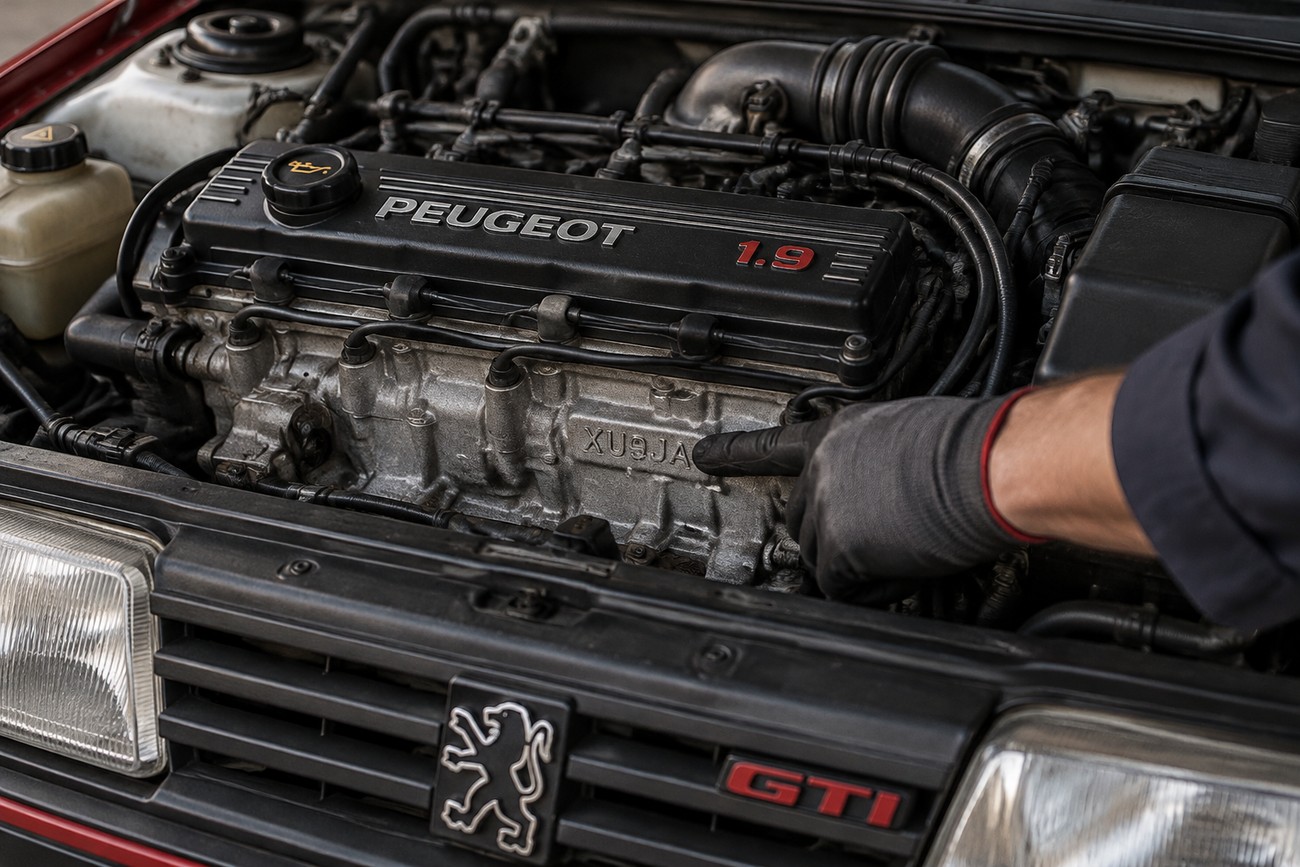
The core reference for the 1.9 engine is 1905 cc, with XU9JA serving as an important engine-code reference. Read the code from the engine itself where possible, then compare it with invoices, registration information, and the way the engine is installed. A matching code is useful evidence, although it still does not prove that the engine is original to the shell.
Look beyond the casting or stamped code. Examine the engine mounts, ancillary brackets, intake and fuel system, exhaust routing, cooling arrangement, wiring, and fuse connections. A professionally installed replacement can be mechanically sound, while cut wiring, improvised brackets, mismatched connectors, or unexplained fuel-system changes suggest that the present configuration needs a more detailed assessment.
Power figures are a poor authentication test. Listings and catalogs cite 120, 128, 131, and 132 hp, with differences arising from market, year, measurement method, or simple catalog error. One advertised number cannot prove that a car is genuine, and a dynamometer result cannot reconstruct the shell’s factory identity.
Performance should therefore be treated as a maintenance clue. A tired engine, poor compression, incorrect ignition settings, worn transmission, blocked exhaust, or fuel-system fault can make a genuine GTI feel slow. Conversely, a brisk road test may reflect an engine swap or extensive tuning in a car that was never a factory 1.9 GTI.
Record what is fitted today rather than forcing the evidence into a yes-or-no answer. The most useful report might read: genuine GTI shell supported by documents, replacement engine of uncertain history, altered wiring, and non-standard exhaust. That description is more valuable to a buyer than an unsupported declaration based on the engine code alone.
Look underneath: brakes, rear beam, and conversion clues
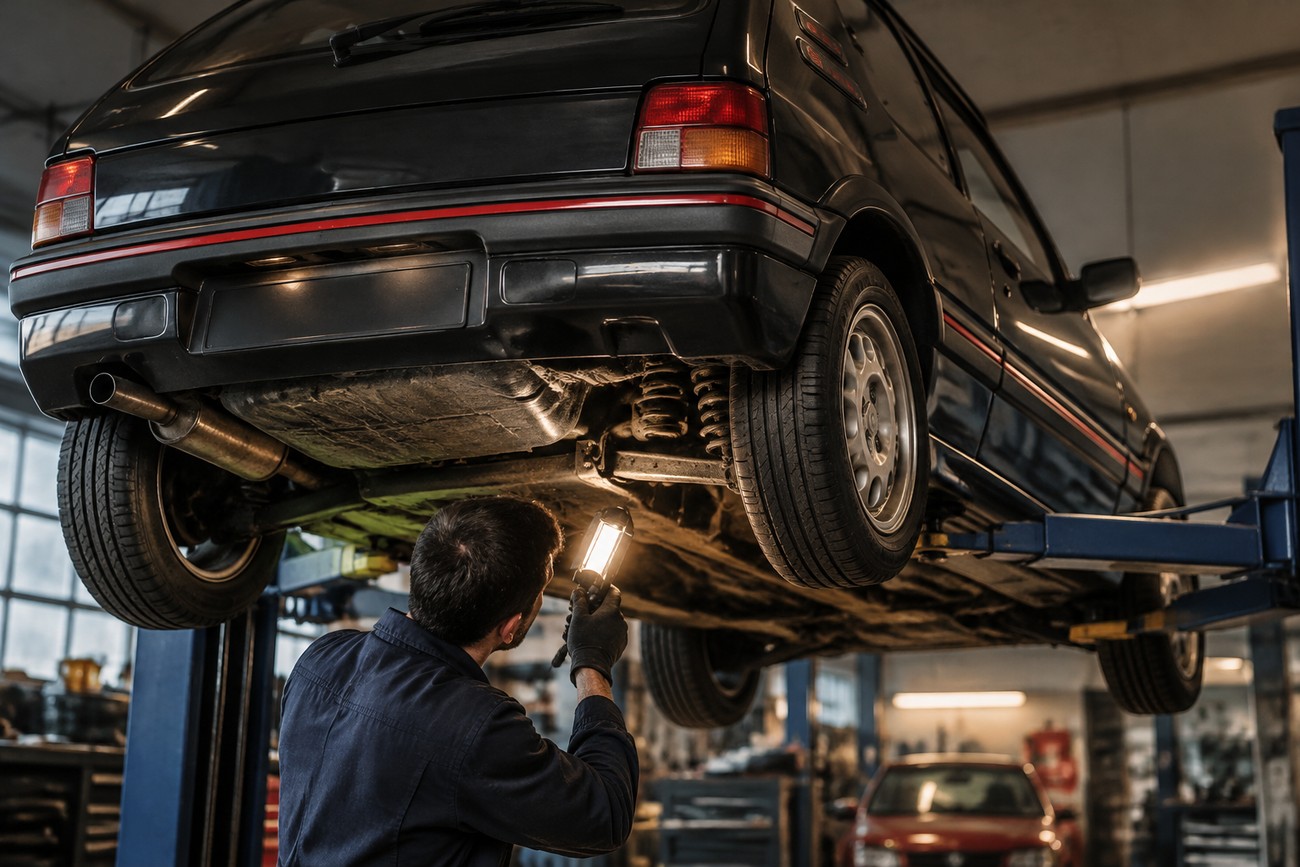
An underside inspection can separate a coherent car from a cosmetic conversion. Check the brake layout, calipers, discs, lines, hoses, rear beam, mounting areas, and evidence that assemblies have been removed or installed. A road test can show that the car stops and turns; it cannot show whether the hardware belongs to the claimed specification or was recently transplanted.
The 1.9 GTI is associated with rear disc brakes. Rear drums should not be presented as its standard factory specification; they are commonly associated with the 1.6 GTI. This distinction is useful, but it remains supporting evidence because brake assemblies can be changed, and a genuine car may have received different parts during repair or restoration.
Front MacPherson struts and a rear torsion-beam layout are shared basic 205 architecture. Their presence therefore does not establish a GTI identity. Inspect the beam mounts, torsion-bar area, strut towers, brake-line routing, and signs of non-factory brackets, while comparing the findings with records and the rest of the car.
A conversion may use genuine GTI components and still be a conversion. That does not make it automatically unsafe or worthless, but it changes what you are buying. Conversely, a genuine GTI with a replacement beam or updated brakes remains capable of having a factory GTI identity, provided the shell and records support it.
Ask for photographs from below before committing to an inspection. If the seller only supplies clean exterior images, assume that the most important evidence is still missing. A lift inspection is especially important where the car has new paint, an unusually clean engine bay, or a claim that all mechanical work has been completed without invoices.
Inspect the shell for rust, repairs, and donor-car work
Paint quality is a poor substitute for structural inspection on a 205 of this age. Examine the sills, floors, inner panels, suspension mounting points, bulkhead areas, wheel wells, and underside for corrosion and previous repairs. Look for changes in texture, uneven seams, fresh underseal, overspray, and paint transitions that indicate local work rather than a coherent restoration.
Pay particular attention to the places where the shell carries suspension and drivetrain loads. A car can present straight panels and an attractive finish while hiding corrosion around mounting points or poorly executed accident repairs. A magnet, inspection light, paint-depth readings where appropriate, and photographs taken before cleaning can help, but none replaces an experienced physical inspection.
Evidence of several donor cars is not proof of a fake. Older performance cars commonly acquire doors, wings, interiors, engines, and mechanical assemblies from other examples. The concern is whether the seller describes that history accurately and whether the resulting structure is sound. A documented shell with replacement panels may be preferable to an apparently original car with concealed corrosion.
Claims about galvanized components do not provide a universal authenticity test or a guarantee against rust. Even where particular later components or repairs involved corrosion-resistant treatment, age, storage, accident damage, and poor repairs remain relevant. Treat any claim about galvanizing as background information, then inspect the actual shell.
A genuine factory GTI can still be a bad purchase if the structure is unsound or the repairs are beyond your budget. Identity affects provenance and value; it does not repair rotten sills, restore distorted mounting points, or make an unsafe car economical. Obtain an independent estimate for structural work before treating a verified identity as a reason to proceed.
Treat badges, wheels, and cabin trim as supporting evidence
Exterior styling can reveal an inconsistent story, but it cannot settle the question. GTI badges, wheel designs, arches, bumpers, side trim, seats, steering wheels, and instruments can all be transplanted through ordinary ownership. A car that looks exactly right may have been built from a standard 205, while a genuine GTI may have lost its original wheels or interior during years of use.
Inspect how the parts are fitted. Misaligned trim, fresh holes, mismatched fasteners, unused wiring, different aging between panels, and upholstery that does not match the rest of the cabin can expose a conversion or a series of later changes. These details are useful because they test the seller’s story, not because any single cosmetic feature is a definitive identifier.
Originality of trim is separate from factory identity. Replacement seats or a later dashboard can reduce collector appeal and affect the price, yet they do not automatically turn a genuine GTI into a fake. Conversely, a complete GTI-style interior does not establish what the shell was built as.
Compare wear with the claimed history. A car said to have been stored for years but showing recent installation marks, uniformly new trim, and no dated records deserves more questions. A worn cabin with period invoices may be less attractive but more credible. The useful test is whether the condition, installation quality, and documentation tell one consistent story.
Genuine 1.9 GTI or lookalike: what each clue can prove
No single component settles factory identity. Use the evidence hierarchy below to separate what a finding supports, what else could explain it, and what should be checked next.
| Finding | What it supports | Why it may mislead | Next check |
|---|---|---|---|
| Physical VIN agrees with registration and ownership records | A credible link between the inspected shell and its recorded identity | Records can contain errors, and identity markings may have been repaired or altered | Inspect the stamping, surrounding metal, historic documents, and market-specific factory evidence |
| Factory or specialist records describe a 1.9 GTI | Strong support for the car’s original model identity | Records may be incomplete, copied incorrectly, or refer to another vehicle | Match the records to the physical VIN and inspect the shell for repairs or identity changes |
| 1905 cc engine with an XU9JA reference | A configuration consistent with the 1.9 engine specification | The engine may have been swapped, rebuilt, tuned, or installed in another 205 | Check mounts, wiring, fuel system, invoices, and the relationship between engine history and shell records |
| Advertised output of 120, 128, 131, or 132 hp | Only a description of a reported catalog or listing figure | Figures vary by market, year, source, and measurement, and can contain errors | Use the engine code and physical specification as evidence; treat performance as a condition issue |
| Rear disc brakes | A mechanical feature associated with the 1.9 GTI | The rear beam and brakes can be transplanted into an ordinary shell | Inspect beam mounts, brake lines, fasteners, repairs, and supporting records |
| MacPherson front struts and a rear torsion-beam layout | Basic 205 architecture | These arrangements are shared by other 205 variants | Check the complete brake and suspension specification rather than relying on layout alone |
| Clean paint, GTI badges, correct-looking wheels, or red interior details | A visually coherent presentation, possibly consistent with a GTI | Trim and styling parts are interchangeable and can be fitted to a conversion | Look for installation evidence, dated records, consistent wear, and VIN-based identity |
| Rust, repaired panels, or donor components | Information about condition and restoration history | Repair work does not by itself prove that the car was never a GTI | Assess structural quality separately and compare the repairs with the seller’s account |
The strongest conclusion comes from several independent clues agreeing with one another. Documented factory identity carries more weight than interchangeable trim, while engine and brake specifications support the finding only after possible replacements and conversions have been considered.
Keep authenticity, originality, and condition in separate columns in your inspection notes. That simple discipline prevents a sound but modified GTI from being dismissed as a fake, and prevents an attractive conversion from being priced as an untouched factory car.
Make the buying decision when the evidence conflicts

One possible outcome is a documented genuine GTI with modifications. The shell and records support the factory identity, but the engine, rear beam, brakes, trim, or wiring have been replaced. Value the car according to its present specification and the quality of the work, while recording which original parts remain and whether the changes can be reversed.
A second outcome is a convincing conversion with honest disclosure. It may have the correct-looking engine, rear discs, interior, and exterior trim, and it may drive well. It should still be described and priced as a conversion unless factory identity is established through the shell and records. Honest history can make such a car worth considering; it cannot turn the conversion into a documented GTI.
The third outcome is unresolved or suspicious identity. Examples include an unexplained VIN discrepancy, altered identity markings, missing records combined with a highly modified shell, or a seller who refuses an independent inspection. In that situation, the risk is not limited to mechanical cost. Ownership, registration, insurance, and future resale can all become more difficult depending on the jurisdiction.
Use a disciplined buying sequence:
- Request the VIN, registration documents, ownership history, restoration invoices, and photographs of major identity areas.
- Compare the physical shell with market- and year-specific factory evidence before evaluating cosmetic details.
- Arrange an independent inspection on a lift, including the brakes, rear beam, mounting points, wiring, and underside repairs.
- List missing original parts and non-standard work separately from structural defects.
- Reflect uncertain provenance, reduced originality, and necessary repairs in the offer rather than relying on the seller’s label.
- Walk away if identity markings are altered without a credible explanation or if access to the evidence is repeatedly obstructed.
A tired car feeling slow is a maintenance concern, not reliable evidence that it began life as another model. Likewise, a fast car is not automatically genuine. The buying decision should rest on the quality of the identity evidence, the safety of the shell, and the cost of bringing the present specification to the standard you actually want.
Frequently asked questions
Value depends on more than a GTI badge or a tidy finish. Documented identity, originality, and structural condition each affect a buying decision. Survival figures require a defined country and registry, while broad opinions about Peugeot say little about an individual car.
How much is a Peugeot 205 1.9 GTI worth?
Its value depends first on whether the factory identity is documented, then on retained original parts, structural condition, mechanical quality, and the quality of any restoration. A verified GTI with modified trim may be worth more than an attractive conversion, but a structurally poor genuine car can be a worse purchase than a sound, honestly described non-original example.
Assess the car in separate categories: identity, originality, condition, and documentation. Missing trim or a replacement engine can reduce collector appeal without disproving the shell’s identity. Current prices also depend on country, date, specification, and buyer demand, so a live valuation requires comparable cars in the same market rather than a universal figure.
How many Peugeot 205 GTIs are left?
There is no reliable single global total. Registration-based figures vary by country and may exclude cars that are stored, exported, off the road, dismantled, converted, or incorrectly recorded. One registry may include only currently licensed cars, while another may include stored or temporarily inactive vehicles.
A registry count should therefore be treated as a count of vehicles meeting that registry’s criteria, not a complete survival figure. Counts also need to distinguish surviving GTI shells from conversions and cars carrying GTI trim. For a particular purchase, a traceable identity, credible records, and a shell worth preserving matter more than an unverified population estimate.
Why does Peugeot have a bad reputation?
A broad brand reputation usually combines experiences with particular models, maintenance neglect, parts availability, and local ownership conditions. It does not establish the authenticity or quality of an individual 205 GTI.
For a classic car, age-related repairs and decades of modifications are more useful evidence than a general opinion about the manufacturer. Judge the inspected shell, drivetrain, records, and safety-critical work on their own merits.







