
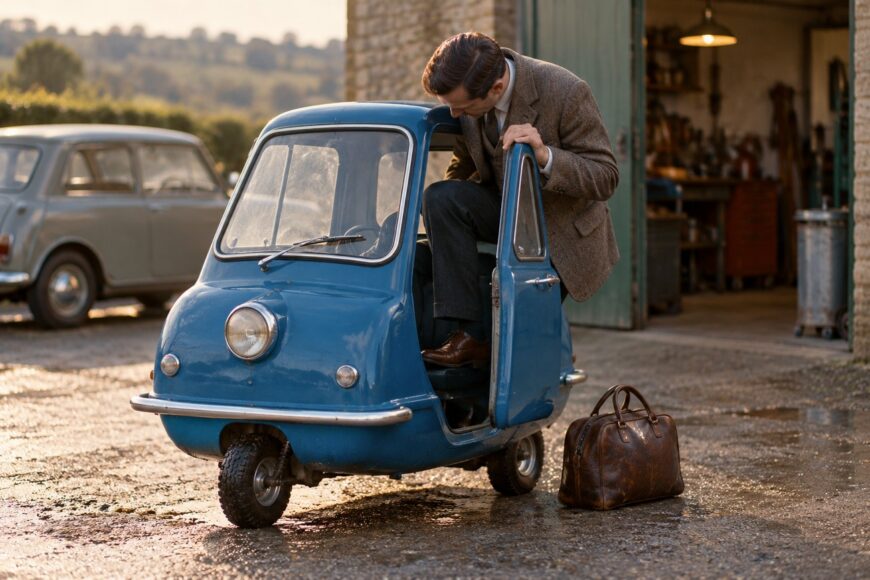
The Peel P50 has a world-record reputation and an awkward physical reality. Its original body is only 54 inches long, its width is 39 inches, and the complete three-wheeler weighs 59 kg. Sitting inside, turning the large controls, and sharing a road with ordinary traffic can feel far less effortless than the famous dimensions suggest.
The central choice is clear: the P50 offers collectible curiosity and low-speed amusement, while comfort, protection, and everyday practicality are severely limited. The original 1960s car also needs to be separated from later replicas and electric versions, which can have different dimensions, weights, drivetrains, and road-use requirements.
What the Peel P50 Really Is
The original Peel P50 was a serially produced three-wheeled microcar built in the United Kingdom from 1962 to 1965. Its compact shape was designed around a single adult and a bag, giving it a purpose closer to an enclosed personal runabout than a conventional small car.
Only 47 original examples were produced. That tiny production run explains much of the P50’s modern status: its value as a collector piece comes from rarity, historical identity, and its extreme design rather than from speed, comfort, or broad transport usefulness.
The “smallest production car” description refers to the original production model commonly associated with that claim. It should not be applied automatically to every modern vehicle sold under the P50 name, because replicas and electric versions may use different bodies, dimensions, and mechanical layouts.
Inside, the one-person arrangement is fundamental to the car’s character. There is no realistic second-seat role, and the available space is quickly consumed by the driver’s legs, shoulders, and one small bag. Treating the P50 like a shrunken family car creates the wrong expectations from the first drive.
Original Peel P50 Specs Versus Modern Replicas
The figures below apply to the original 1962–1965 car. Replica and electric specifications are version-dependent, so they should be checked against the individual vehicle rather than copied from an original P50 data sheet.
| Specification | Original Peel P50 | Replicas and modern electric versions |
|---|---|---|
| Production identity | United Kingdom, 1962–1965 | Later products with separate specifications |
| Length | 54 in (1,372 mm) | May differ by manufacturer and version |
| Width | 39 in (991 mm) | May differ by manufacturer and version |
| Mass | 59 kg (130 lb) | May be substantially different |
| Engine | 49 cc single-cylinder two-stroke DKW engine | May use another engine or an electric motor |
| Power | About 4.2 hp | Version-dependent |
| Transmission | Three-speed manual gearbox | Version-dependent |
| Drive layout | Rear-wheel drive | Version-dependent |
| Top speed | Generally reported as 60–64 km/h; actual speed varies with driver and conditions | Version-dependent |
What Living With a Peel P50 Feels Like
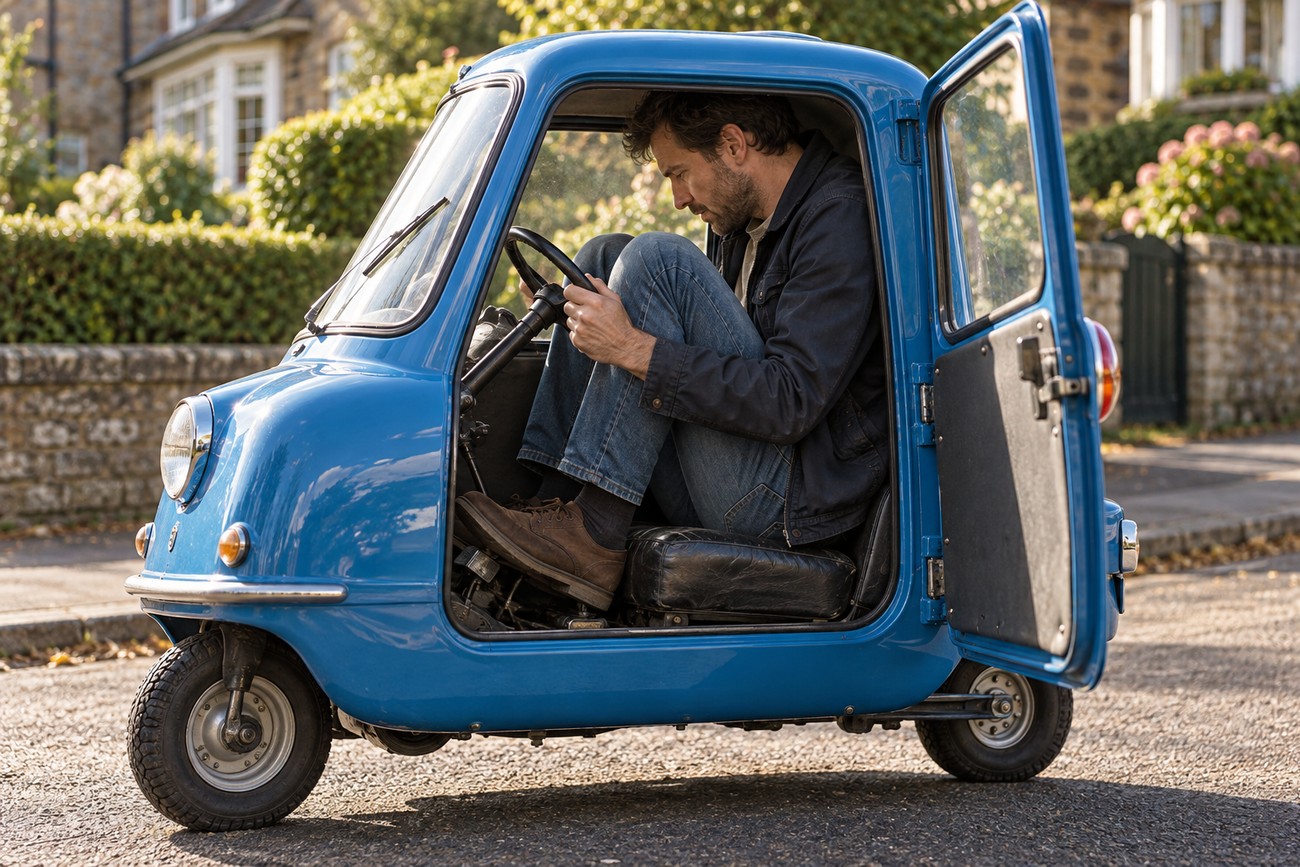
The cabin is extremely tight for an adult, especially for a taller driver. Knees, shoulders, and steering controls compete for the same small space, while entry and exit demand more body movement than the P50’s toy-like appearance suggests. A short demonstration can be amusing; repeated use exposes the ergonomic compromises quickly.
The steering arrangement also changes the experience. Large controls in a narrow cabin can feel awkward to operate, and turning requires confidence in the car’s very small footprint. The three-wheel layout can lean noticeably in corners, so speed that would feel ordinary in a conventional car may feel busy and exposed here.
Low-speed steering, turning clearance, and driver fit deserve testing before performance gets judged. The engine sits offset to the right between the axles, and the driver’s height and weight affect both available space and the way the lightweight car feels balanced.
Performance depends heavily on the person behind the controls. A taller or heavier driver takes up more of the limited cabin and asks more from the small engine, while the short wheelbase and low mass make road surface, cornering, and weight distribution more noticeable than the power figure suggests.
The result is a vehicle that can be entertaining at modest speed in a controlled setting. Its practical question is whether your body fits, your turning space is adequate, and you can read the road confidently from such a small three-wheeler. Engine output alone does not answer that.
Why It Is a Poor Daily Driver
The original P50 has minimal safety protection by modern standards. Its small mass, narrow body, one-door layout, and lack of familiar passive-protection equipment leave little margin compared with an ordinary modern car. That matters most when the vehicle shares roads with much larger traffic.
Routine parking can also be less simple than the dimensions imply. The original configuration is often described as having no reverse gear, although the exact specification should be verified on the individual car. Without reverse, repositioning may involve getting out and moving the vehicle manually, provided the circumstances allow it safely.
Comfort is another limiting factor. The single-person cabin provides room for one adult plus a bag, with little space for belongings, weather equipment, or the small conveniences expected from a commuter vehicle. Visibility and the low seating position can make normal traffic feel more demanding rather than reassuring.
Authentic parts and components can be difficult to source because the original production run consisted of only 47 examples. A complete, correctly identified car therefore deserves more attention than a superficially tidy project. The P50 is generally better understood as a collector or novelty vehicle than as dependable daily transportation.
Buying Mistakes, Myths, and Numbers to Verify
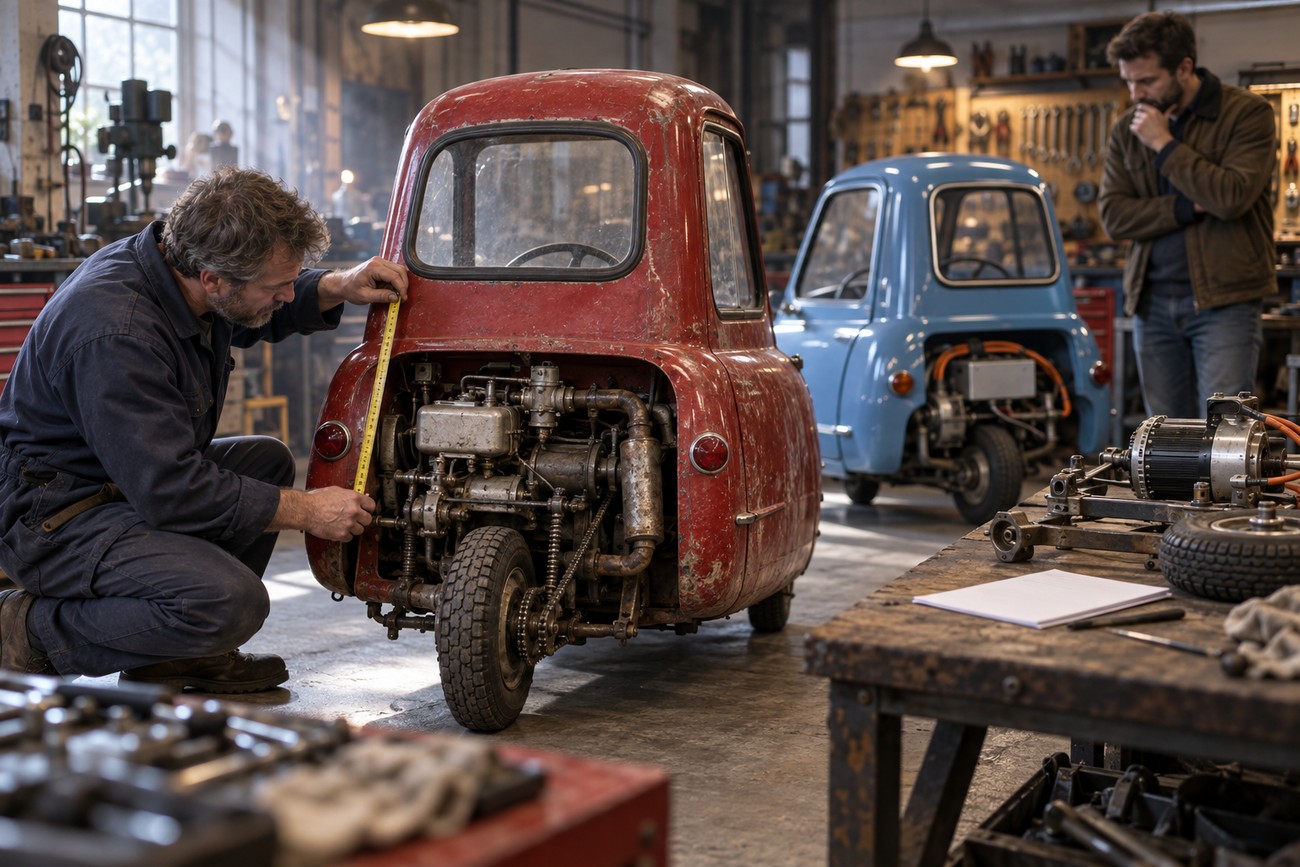
The first buying mistake is accepting the name as a specification. A seller may describe a replica or electric version simply as a “P50,” while the original 1960s car has a 49 cc two-stroke engine, a three-speed manual gearbox, rear-wheel drive, and a mass of 59 kg. Confirm the chassis, body, drivetrain, dimensions, and documentation before comparing prices.
Top speed is commonly reported as 60–64 km/h for the original. That range is more useful than treating 64 km/h as a guaranteed figure, because the actual result varies with driver, condition, and road. A heavier driver or a mechanically tired example may feel quite different from a carefully presented specification.
Fuel-consumption claims also need restraint. The more commonly cited figure is 2.8 L/100 km, while 2.4 L/100 km appears in an isolated account and requires source verification. Such figures should never substitute for checking the engine, fuel system, tires, brakes, and overall mechanical condition of the car being offered.
Descriptions of reverse gear are version-sensitive. Many accounts of the original configuration say there is no reverse, while other summaries omit or blur the point. The original new price is commonly reported as £199, but that historical figure says nothing by itself about the present value of an authentic, complete, documented example.
A sensible inspection separates provenance from presentation. Check whether the car is original, a replica, or an electric conversion; identify missing or substituted components; and assess whether it can actually be used in your intended setting. Paying for the famous silhouette without checking usability is the easiest way to buy an entertaining object that disappoints as transport.
Frequently asked questions
These answers separate historical facts from current-market uncertainty. Registration, road use, and vehicle classification should always be checked with the relevant authority where the car will be operated.
How much does a Peel P50 cost?
There is no single reliable modern price for every Peel P50. The original new price was commonly reported as £199, while present value depends heavily on whether the vehicle is an authentic 1960s example, a replica, or an electric version.
Provenance, originality, completeness, mechanical condition, and documentation can matter more than the badge or body shape. A buyer should establish exactly what is being sold before using an advertised figure as a market reference.
How many Peel P50s are left?
The documented original production total was 47 examples. The available information does not establish a verified exact number surviving today, so claims about how many remain should be treated cautiously unless supported by clear registry or ownership records.







