
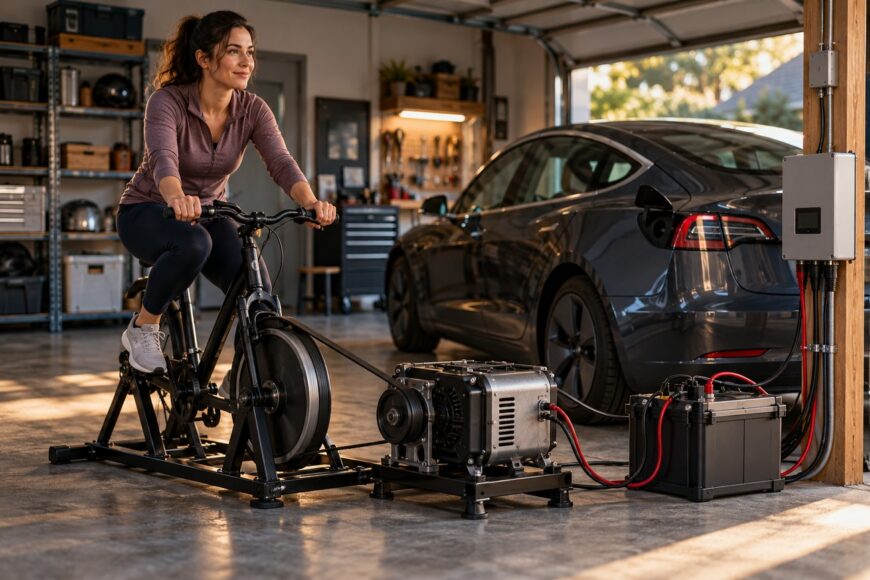
A person can generate electricity for a Tesla, but the charging rate is tiny compared with even household AC charging. A typical rider can sustain about 100–200 watts, while a Tesla commonly accepts approximately 7–11 kW from household AC equipment. The difference is measured in orders of magnitude.
The practical question is whether hours of hard pedaling produce useful driving range. At 150 W, ten kilowatt-hours would require about 66 hours of uninterrupted pedaling in an ideal calculation, before conversion losses. A usable system also needs a generator, controller, battery or inverter, and compatible charging hardware, so the real result depends on efficiency, stable voltage, and safe connection methods.
- How Long Does It Take to Charge a Tesla by Bike?
- From Pedal Power to Tesla Energy: Where the Watts Go
- Pedaling Sessions and Useful Tesla Energy
- DIY Bike-to-Tesla Charging: Compatibility, Safety, and Value
- Frequently asked questions
- How many miles is a 100% charge on a Tesla?
- How long can you leave a Tesla at 100% charge?
- What should you power with a bike generator instead of a Tesla?
How Long Does It Take to Charge a Tesla by Bike?
At 150 W on the pedals, producing 10 kWh takes about 66 hours continuously. That is the ideal mechanical-energy calculation: 10,000 watt-hours divided by 150 watts. It assumes the full pedal output becomes battery energy, which a home-built system cannot achieve.
An average person can usually sustain approximately 100–200 W on a stationary bicycle for a limited session. A trained athlete may briefly reach about 300–400 W, while elite sprint output above 1,000 W lasts only seconds. Those peak figures are useful for sport, yet they do not represent a practical charging rate for an afternoon or a full day.
A Tesla battery is commonly in the broad range of 50–100+ kWh, depending on model and version. Even adding 10 kWh would represent only part of that capacity, and the ideal 66-hour figure becomes longer after losses in the drivetrain, generator, electronics, and charging equipment. A normal one- or two-hour session therefore adds a small amount of energy rather than producing a visibly large battery increase.
Human pedal power is far lower than normal Tesla AC charging power. Household charging works in kilowatts; a person on a bicycle produces a fraction of one kilowatt. The bicycle can contribute energy, but it cannot behave like a conventional wall charger.
From Pedal Power to Tesla Energy: Where the Watts Go
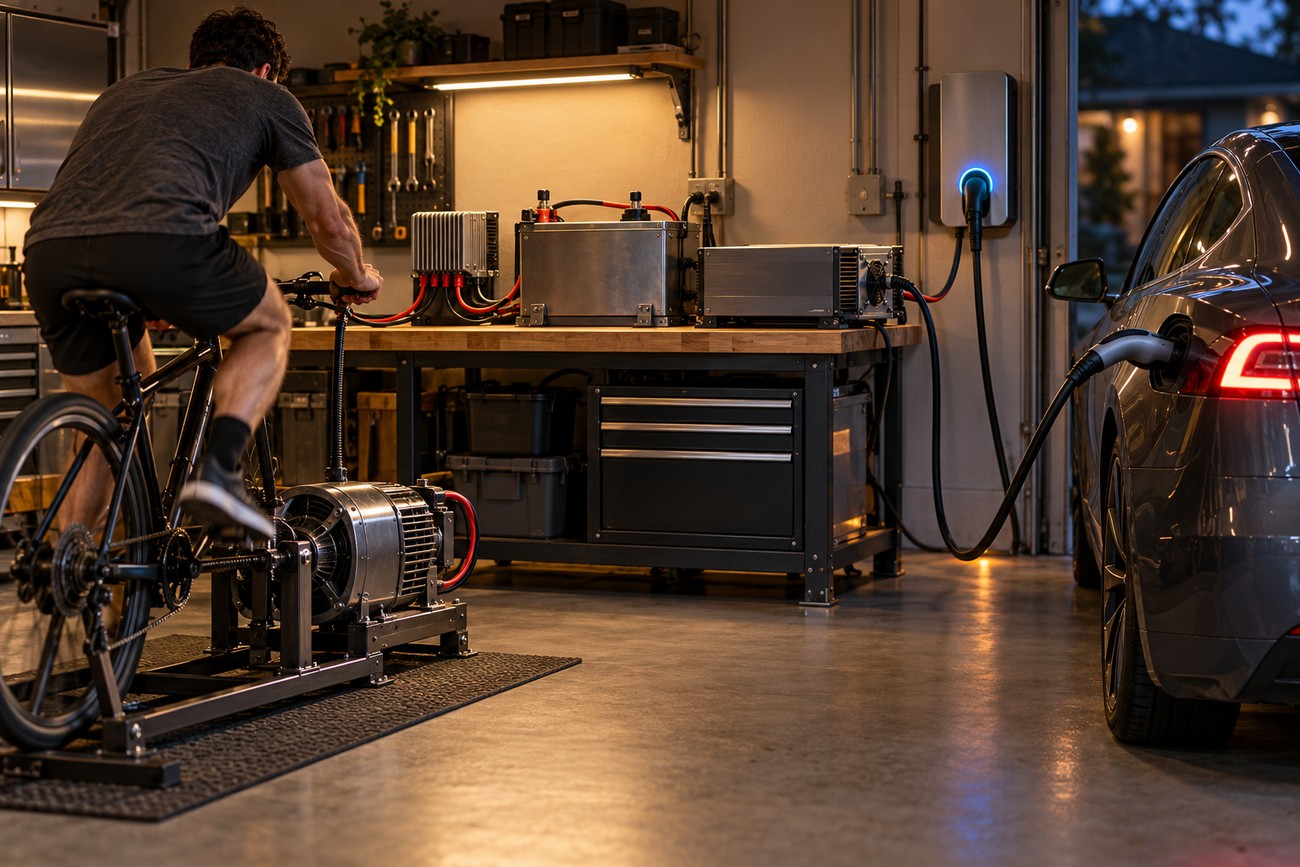
The energy path usually starts at the crank and passes through a mechanical transmission to a generator. Its output then needs regulation, often through a rectifier or controller, before it reaches a battery, inverter, or other buffer. Finally, the vehicle’s charging hardware must accept the electrical supply and convert it into battery energy.
In a DIY installation, the overall efficiency from bicycle generator to usable charging output is typically about 50–70%. At 150 W on the pedals, approximately 75–100 W may reach the charging side. One hour therefore supplies roughly 0.075–0.1 kWh after system losses.
The losses occur in several places: belt or roller friction, the generator, wiring, voltage conversion, battery charging, inverter operation, and the Tesla’s onboard charger. Adding a battery can make the output more stable, yet it also introduces another conversion stage and more losses. A bare generator rating describes potential output at a particular speed; it does not describe energy that safely reaches the car.
Tesla household AC charging is approximately 7–11 kW, while Superchargers deliver tens to hundreds of kilowatts. A bicycle system operating around 75–100 W is therefore far below both charging categories. The car may also require a stable supply and proper charging communication, so a fluctuating generator cannot simply be treated as a low-power wall outlet.
Raw pedal output fluctuates with cadence, fatigue, and gear changes. A battery and controller are placed between the generator and the load because an inverter or vehicle charger expects stable voltage, current, and protection.
This buffering explains why a direct connection often performs badly even when the arithmetic appears adequate. The setup may shut down, restart, or report a charging fault instead of gradually feeding energy into the car.
Pedaling Sessions and Useful Tesla Energy
The table uses 150 W at the pedals and estimates the energy remaining after 50–70% system efficiency. It shows the scale of the result rather than a guaranteed charging outcome.
| Pedaling time | Theoretical output at 150 W | Estimated energy after losses | Practical meaning for Tesla charging |
|---|---|---|---|
| 1 hour | 0.15 kWh | 0.075–0.1 kWh | A small energy contribution; the battery display may barely change. |
| 2 hours | 0.3 kWh | 0.15–0.2 kWh | A long, demanding session for a modest amount of vehicle energy. |
| 4 hours | 0.6 kWh | 0.3–0.4 kWh | Meaningful as a demonstration, yet still a small fraction of a Tesla battery. |
| 8 hours | 1.2 kWh | 0.6–0.8 kWh | Physically difficult and inefficient as a transport-energy strategy. |
Two hours of pedaling may deliver roughly 0.15–0.2 kWh after realistic losses. That can represent only a small amount of driving range, and the result varies with Tesla model, speed, weather, terrain, tires, and driving style. Since the vehicle display rounds and battery capacity is large, the change may appear negligible after a strenuous session.
DIY Bike-to-Tesla Charging: Compatibility, Safety, and Value
A household bike generator is generally designed around approximately 100–300 W for sustained practical operation. The generator, controller, battery, and inverter must be matched for voltage, current, cooling, and protection. A system that works with a lamp may still fail when connected to equipment designed for vehicle charging.
Generator output is unstable by nature. Cadence changes, the rider tires, and the electrical load shifts as the battery state changes. An inverter or charger may respond with shutdowns, error messages, or repeated restarts; inadequate cooling can also cause overheating. Minimum input thresholds create another problem: below a certain voltage or power level, charging may not start or may run unreliably.
Do not connect an improvised generator directly to a Tesla charging port. High-current batteries and inverters can expose you to electric shock, fire, or equipment damage, especially where insulation, grounding, fusing, and isolation are incomplete. Tesla documentation does not describe a standard charging scenario using a low-power hand- or bicycle-powered generator, so a safe project should keep the output on the low-voltage side unless a qualified electrical professional has designed and tested the complete system.
The idea that a bicycle easily produces kilowatts comes from confusing sprint power with sustainable output. A trained athlete may briefly reach 300–400 W, and an elite sprint can exceed 1,000 W for seconds. That does not make a kilowatt a practical household charging rating, since maintaining it would require exceptional athletic performance and suitable machinery.
A collective system with 50–100 riders could add power in theory, but practitioners consider the logistics, cost, stability, and safety impractical. Every bicycle still needs mechanical and electrical integration, and the combined output must pass through equipment that can handle fluctuations and vehicle-charging requirements. Component costs can exceed the value of the electricity produced, even with frequent use.
The sensible applications are education, fitness demonstrations, lighting, small electronics, and charging a properly managed low-voltage intermediate battery. These loads match human-scale power and make the energy output visible without pretending that a bicycle is a substitute for a home charger. For renewable Tesla charging, a properly designed solar or other renewable-energy system is a more realistic investment.
Frequently asked questions
Pedaling can technically add energy to an electric vehicle, yet the useful result depends on the vehicle, the electrical design, and the rider’s sustainable output. These answers cover the ownership decisions that are separate from the basic watt-hour calculation.
How many miles is a 100% charge on a Tesla?
There is no single Tesla-wide mileage figure for a 100% charge. Full-charge range depends on the specific model and battery version, as well as weather, speed, tires, terrain, and driving style.
The displayed estimate is also a prediction based on recent use, rather than a fixed distance guaranteed under every condition. A cold, windy highway trip can produce a different result from gentle urban driving, even with the same indicated battery percentage.
How long can you leave a Tesla at 100% charge?
A Tesla can remain at 100% when that charge is needed, but making 100% the routine storage level may add unnecessary battery stress over time. When battery longevity is a priority, schedule a full charge close to departure and follow the charge-limit guidance for the specific vehicle.
That timing advice concerns battery care, not charging speed. Leaving the car connected briefly after reaching the target is a different situation from routinely storing it fully charged for long periods.
What should you power with a bike generator instead of a Tesla?
Use a bike generator for direct small loads such as LED lighting, displays, sensors, or educational demonstrations. It can also charge a small intermediate battery at a controlled low voltage, provided the battery, controller, fusing, and enclosure are properly matched.
This arrangement makes the fluctuating human input easier to manage and avoids forcing a vehicle charger to operate below its intended power range. It delivers a visible, useful result while keeping the project closer to the generator’s realistic 100–300 W scale.







