
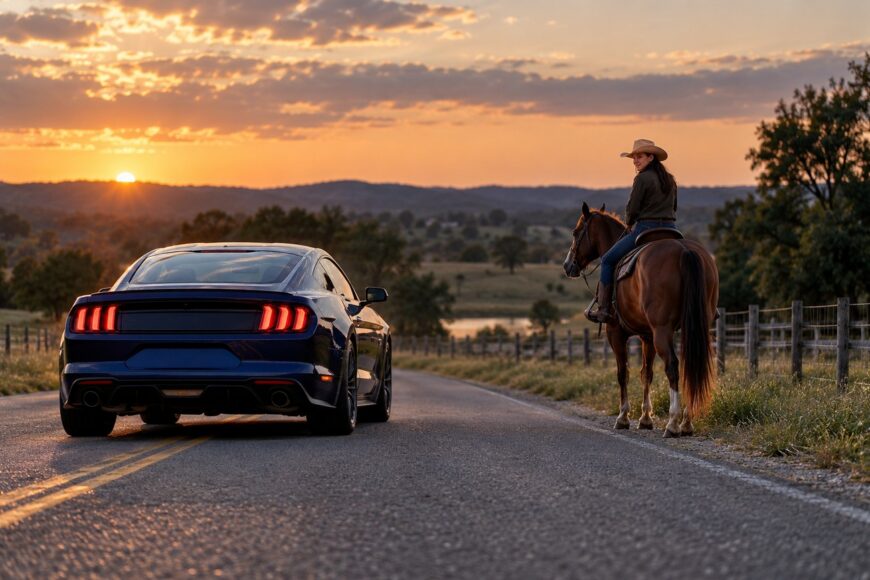
A Mustang GT has abundant power and a noticeable V8 soundtrack, while a horse may react unpredictably to noise, proximity, or sudden movement. That makes passing a horse and rider a communication and timing problem, not an acceleration challenge. The car’s ability to build speed quickly does not make the maneuver safer.
Wait whenever the horse, rider, road, or available clearance is uncertain. A calm horse on a wide, visible, smooth section of road may allow a controlled pass, but a tense animal or restricted roadway changes the decision immediately. In that situation, staying back is the competent choice.
- Why Passing a Horse in a Loud Mustang GT Is Different
- Before Passing: Read the Horse, Rider, and Road
- A Calm Passing Sequence for the Mustang GT
- When You Should Not Pass
- Mustang GT Controls and Driver-Assistance Limits
- Common Mistakes, Myths, and Hidden Trade-Offs
- The Mustang GT Numbers That Matter for This Situation
- Frequently asked questions
- How fast can a horse run, and does that affect whether I can pass it?
- Should I use the horn when approaching a horse and rider?
- What should I do if the horse reacts after I begin passing?
Why Passing a Horse in a Loud Mustang GT Is Different
The modern Mustang GT uses a 5.0-liter V8 and rear-wheel drive. Its exhaust note can be prominent outside the car, especially when the engine is loaded or the driver opens the throttle. A horse may interpret that sound, combined with a low and wide approaching vehicle, as a sudden threat.
The GT also sits low compared with many vehicles, which can make it harder to judge the horse’s movements and the available lateral space from the driver’s seat. The car’s broad coupe doors and rear-quarter blind spots add to the need for deliberate observation. You should establish the situation early rather than appearing beside the rider with little warning.
The engine has enough torque to accelerate quickly without a kickdown. That is useful for ordinary driving, but it removes the margin for casual throttle movements near an animal. A small increase in pedal pressure can produce a larger change in pace than expected.
Rear-wheel drive adds another consideration on uneven or slippery surfaces. A smooth, measured input keeps the car predictable; abrupt power can disturb traction or change the car’s attitude when the road is poor. Horse safety therefore depends more on restraint and consistency than on the GT’s performance reserve.
Before Passing: Read the Horse, Rider, and Road
Start with the road, not the accelerator. A suitable passing section must be wide, visible, and smooth, with enough sight distance to account for oncoming traffic and enough space to leave generous clearance around the horse. Parked vehicles, narrow shoulders, surface damage, or a hidden bend can remove that margin even when the road initially appears open.
Watch the horse’s posture and movement. An animal that is turning, sidestepping, lifting its head, tightening its neck, swishing its tail repeatedly, or reacting to other traffic may be difficult to predict. A nervous horse can make an otherwise clear pass unsafe, so remain behind at a substantial distance and allow the rider time to settle it.
The rider’s signals matter more than the Mustang’s acceleration. Look for an acknowledgment, a clear indication of where the rider wants you to pass, or a deliberate move toward a safer edge of the road. If the rider has not seen you, reduce speed early and give the situation time to develop rather than assuming the rider knows you are there.
Traffic behind you should not determine the decision. If a vehicle is following closely, maintain a safe position and avoid being pressured into passing before the road and horse are suitable. Waiting is especially important at dusk, in darkness, near limited escape space, or whenever another road user could enter the passing area.
A Calm Passing Sequence for the Mustang GT
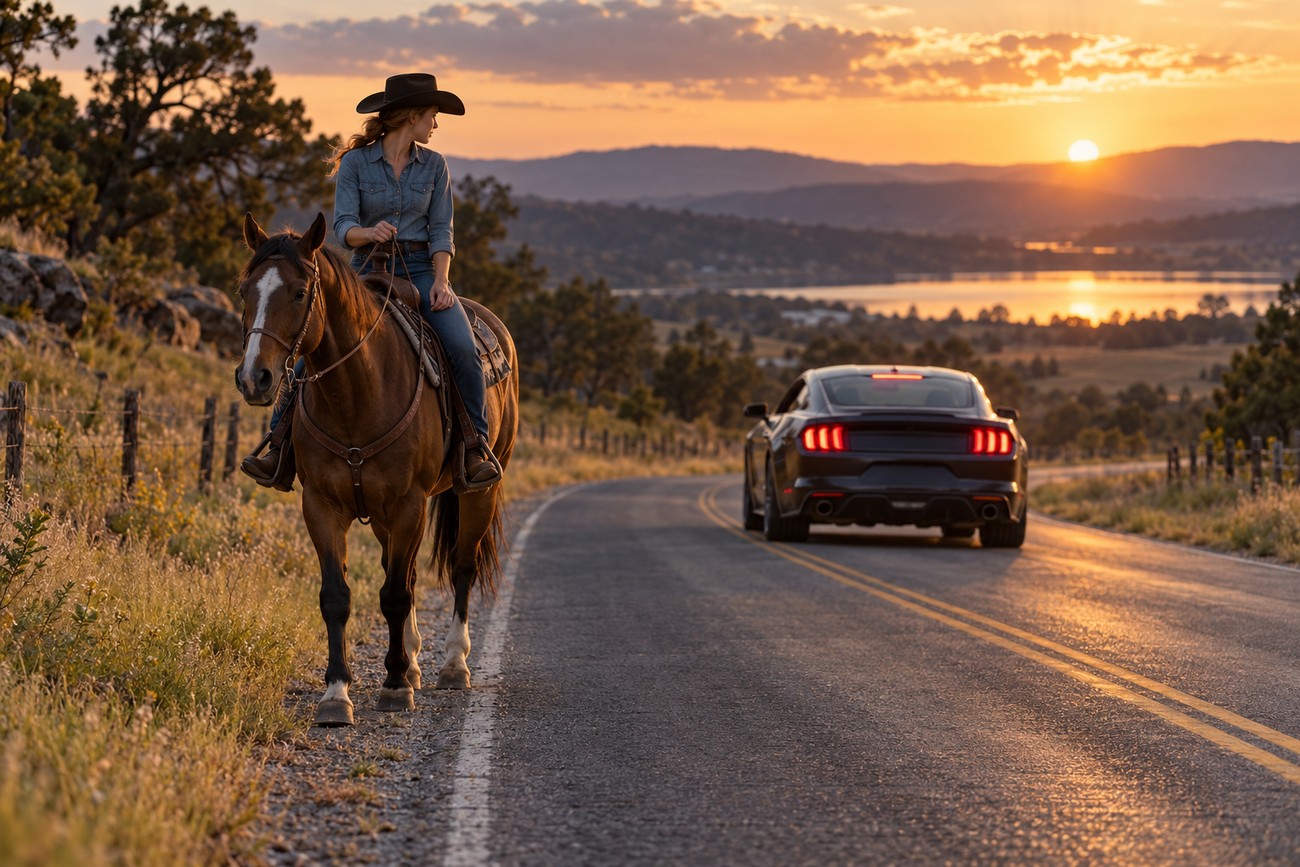
Lift off the accelerator early and create distance before reaching the horse. Approach at a steady, low speed that gives the rider time to hear and identify the car without the V8 suddenly rising in volume. Avoid close following, because the horse may feel pressured even before the actual pass begins.
Confirm that the rider has seen you and that the horse appears settled. Use the widest visible section of road available, check for oncoming traffic and other hazards, and ensure that local traffic laws and road markings permit the maneuver. If any part of that assessment is unclear, continue waiting.
Reduce throttle input early and hold a steady, predictable line instead of accelerating past the horse to minimize the time alongside it.
Pass slowly and smoothly with generous lateral clearance. Keep the steering steady, avoid revving, and do not use hard acceleration to get past. Sudden braking, abrupt steering, or an unnecessary horn signal can increase the horse’s stress and leave less room for the rider to respond.
Once ahead, continue at a steady pace and leave the horse behind without immediately cutting back in. Keep observing until you are well clear. If the rider gives an instruction, follow it when safe and lawful; the rider can often recognize a developing reaction before it is obvious from the car.
When You Should Not Pass
Do not pass on a narrow lane, at a blind bend, near a crest, or where oncoming traffic could remove your clearance. Parked vehicles, barriers, deep drainage edges, limited shoulder space, and poor pavement can make a horse’s available escape route too small. The Mustang’s performance cannot compensate for poor visibility or insufficient space.
Wait when the horse is already unsettled. Repeated sideways movement, sudden stopping, spinning toward the car, or visible tension in the rider are clear reasons to remain behind. Darkness and poor weather also make it harder for the rider to interpret your approach and for you to judge the horse’s position accurately.
If passing is not appropriate, slow progressively while leaving space ahead and behind. Avoid stopping so abruptly that a following vehicle becomes a new hazard. If necessary, pull into a legal, safe position well away from the horse, keeping the car stationary and quiet until the rider has moved on or indicates that a pass is acceptable.
Rear-wheel drive requires extra restraint on uneven, slippery, or poor-quality surfaces. A calm wait avoids turning limited grip, restricted visibility, and an unpredictable animal into one combined emergency. The GT’s ability to pass quickly is irrelevant if the road does not provide a stable, visible path.
Mustang GT Controls and Driver-Assistance Limits
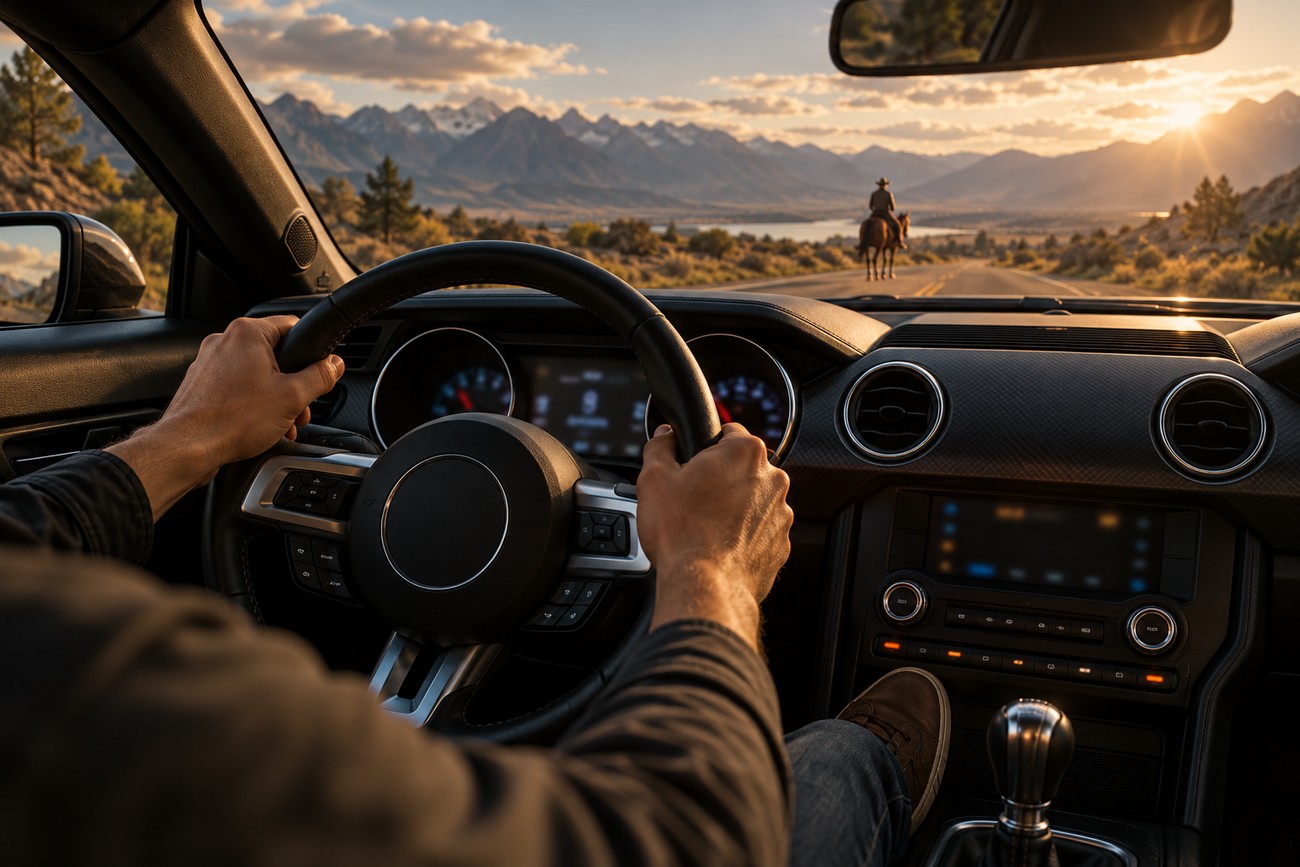
Use a quiet, progressive throttle input and select a driving setting that makes smooth control easy. The V8’s character should not dictate the pace. If the car feels eager to surge, lift earlier and use lighter pedal movements rather than trying to manage the situation with a late correction.
Ford Co-Pilot360-related equipment can include BLIS, rear cross-traffic warning, lane departure warning, lane keeping, automatic emergency braking, pedestrian detection, forward collision warning, adaptive cruise control, automatic emergency steering, traffic-sign recognition, and safe-exit support. Equipment varies by model year, market, and specification, so check the car’s actual configuration.
These systems support observation; they do not identify a horse reliably, interpret a rider’s signal, or grant permission to pass. BLIS can help with vehicles in adjacent areas, while lane keeping and collision systems are designed for broader traffic situations. None replaces a direct view of the horse, the rider, the road surface, and the available clearance.
A low seating position makes careful mirror and shoulder checks important, especially before moving around a horse. Safe-exit support can also be useful in dense traffic, where the Mustang’s wide doors and a nearby cyclist, pedestrian, or animal may create a hazard after you park. Treat every alert as additional information, not as a substitute for judgment.
Common Mistakes, Myths, and Hidden Trade-Offs
The Mustang GT is not only about straight-line power. Its 5.0-liter V8, rear-wheel drive, chassis, and assistance systems create a broader driving package, but none of those features changes the basic requirement for a predictable pass. More speed usually reduces the time available to recognize a horse’s reaction and respond smoothly.
Power figures also need careful identification. The modern GT is commonly listed at 486 hp, while the Dark Horse is commonly listed at 500 hp. Older 4.6-liter GT data, including 215 hp and 380 Nm for one example, must not be applied to the modern 5.0-liter GT.
Official fuel and performance figures do not describe every drive. Reported modern GT figures are approximately 15 city, 23–24 highway, and 18 combined mpg, while another listing cites 13.1 L/100 km combined. Market, fuel, specification, and driving mode can change the result, especially when the engine’s available torque encourages a faster pace.
The GT is also a four-seat coupe, so its practicality is limited despite its ability to cruise calmly. That calm behavior can make the car easy to use in a traffic stream, yet the same broad torque reserve can tempt a driver into unnecessary acceleration. Keeping the pace deliberately modest is part of using the car responsibly around vulnerable road users.
The Mustang GT Numbers That Matter for This Situation
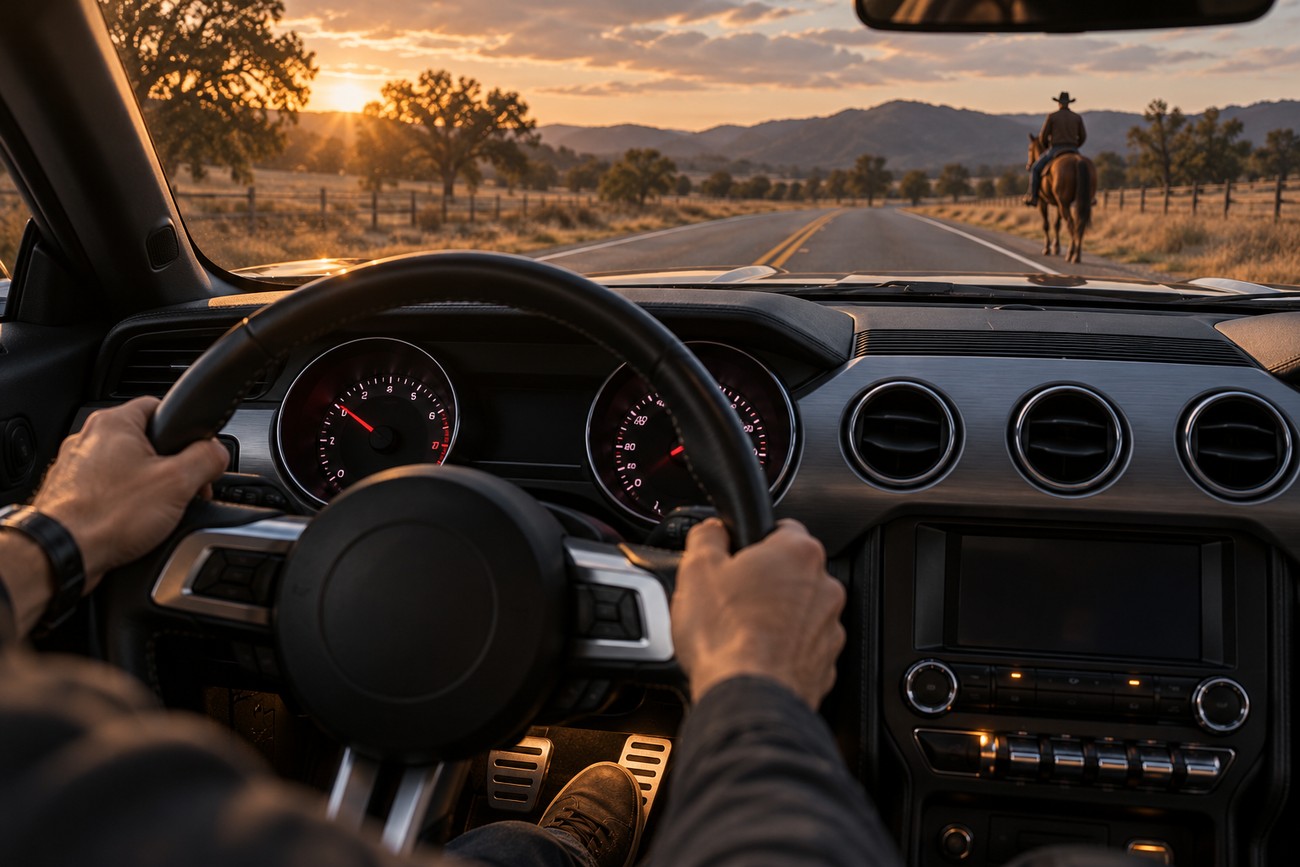
The modern Mustang GT has a 5.0-liter V8, rear-wheel drive, and commonly cited output of 486 hp. A 2024 GT review cites 0–60 mph in under 4 seconds, a 155-mph speed limit, and a 7,500-rpm redline. Those figures describe the car’s capability, not a safe passing speed.
For a horse encounter, the more relevant specification is throttle sensitivity and the driver’s ability to make small, repeatable inputs. A car that can reach high speed quickly needs more discipline near an animal because an unintended surge can increase noise, reduce the rider’s warning time, and narrow the available response window.
Some technical listings cite four seats, a 2,720-mm wheelbase, and a 6.1-m turning radius. These details help explain the practical limits of maneuvering in a narrow lane or beside parked vehicles. A longer, wider coupe may need more room than the driver’s first visual estimate suggests.
Reported fuel figures of approximately 15 city, 23–24 highway, and 18 combined mpg also reinforce the difference between relaxed cruising and active driving. The GT can travel quietly at low engine speed when driven gently, but its performance can quickly change the pace. Visibility, clearance, and a settled horse remain more important than any number on the specification sheet.
Frequently asked questions
The questions below address common decisions when a Mustang GT approaches a horse and rider. The same priorities apply throughout: visibility, clearance, communication, and smooth control. If any of those factors is uncertain, waiting remains the safer choice.
How fast can a horse run, and does that affect whether I can pass it?
A horse’s peak running speed is not a useful road-passing metric. A horse running freely in open space has very different conditions from a horse sharing a road with a rider, traffic, limited escape space, and unfamiliar engine noise. Base the decision on distance, visibility, road width, surface quality, and communication with the rider. The horse may move suddenly in any direction, so its theoretical speed should never encourage a faster pass or closer approach.
Should I use the horn when approaching a horse and rider?
Usually, avoid an unexpected horn because a sharp sound may startle the horse. A gradual reduction in speed and a visible, predictable approach give the rider more opportunity to recognize the car and manage the animal. A brief warning may be appropriate where silence would create greater danger, such as when the rider clearly has not seen the car and local law permits it. Use the least startling signal possible, allow extra distance, and follow the rider’s response rather than assuming the warning means you can pass immediately.
What should I do if the horse reacts after I begin passing?
Slow smoothly, avoid sudden steering or throttle, and increase distance if the road allows. Keep the car’s path predictable rather than trying to accelerate away or making a sharp correction that could frighten the horse further. Follow the rider’s instructions when doing so is safe and lawful. If stopping is necessary, choose a position that does not trap the horse, block traffic, or create a risk for vehicles behind you. The priority is to reduce movement and noise while preserving space for the rider to regain control.







