
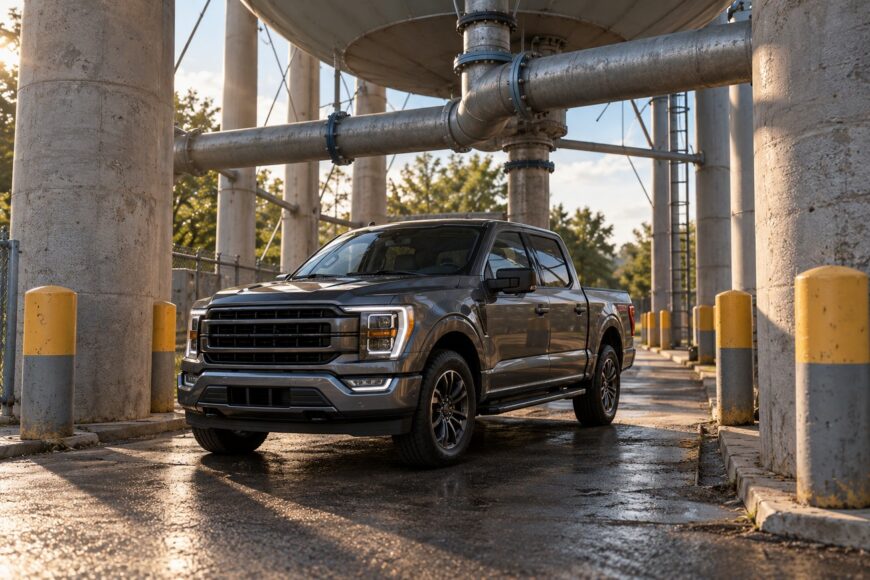
The ground beneath a water tower can look like an easy place to stop, especially when no other vehicles are there. For a Ford F-150 that may be about 6 m long, depending on configuration, the empty space is only part of the picture. Tank supports, fencing, overhead equipment, and a service entrance can turn a simple-looking parking spot into a difficult maneuver or an obstruction.
Before driving in, check whether parking is permitted, whether the truck can clear the entire route, and whether you can get out again without a tight reverse turn. Cameras and parking aids help you observe nearby hazards, but they cannot establish site rules or create space around the pickup. The exact F-150 configuration matters too: a cab-and-bed combination that fits comfortably in one opening may leave little room to correct your position in another.
- Why Parking Under a Water Tower Is Different
- How the F-150’s Size Changes the Parking Problem
- Choose the Position and Approach Before You Move
- A Low-Speed Parking Sequence for the F-150
- What the F-150’s Parking and Trailer Technology Can—and Cannot—Do
- Common Mistakes, Hidden Trade-Offs, and Reasons to Walk Away
- Frequently asked questions
- How can I check the exact dimensions of my F-150 before using a tight site?
- What should I verify before leaving an F-150 unattended near a water tower?
- What is the maximum wading depth of a Ford F-150?
- Why is the F-150 Lightning not selling?
- What are some hidden features of the Ford F-150?
Why Parking Under a Water Tower Is Different
A water tower holds an elevated water tank, and the space around it may serve the structure rather than visiting vehicles. Supports and protective barriers can narrow a route even where the ground looks open. Check above the truck as well as beside it: low-mounted equipment, cables, or other overhead features may make an otherwise usable approach unsuitable.
Access matters after you have parked. A pickup that clears a gate may still block a service vehicle’s turning path, a maintenance entrance, or a route needed in an emergency. Leave space to open your doors without stepping into a restricted area, and consider whether another vehicle could arrive and close off your exit.
Do not assume that apparently unused ground is public parking. Look for signs and fencing, follow property rules, and seek instructions from the site operator or responsible authority if permission is unclear. One available reference mentions a protected area of at least 50 m around a water tower, but it does not establish a universal rule across jurisdictions; check local requirements rather than inferring them from that figure.
How the F-150’s Size Changes the Parking Problem
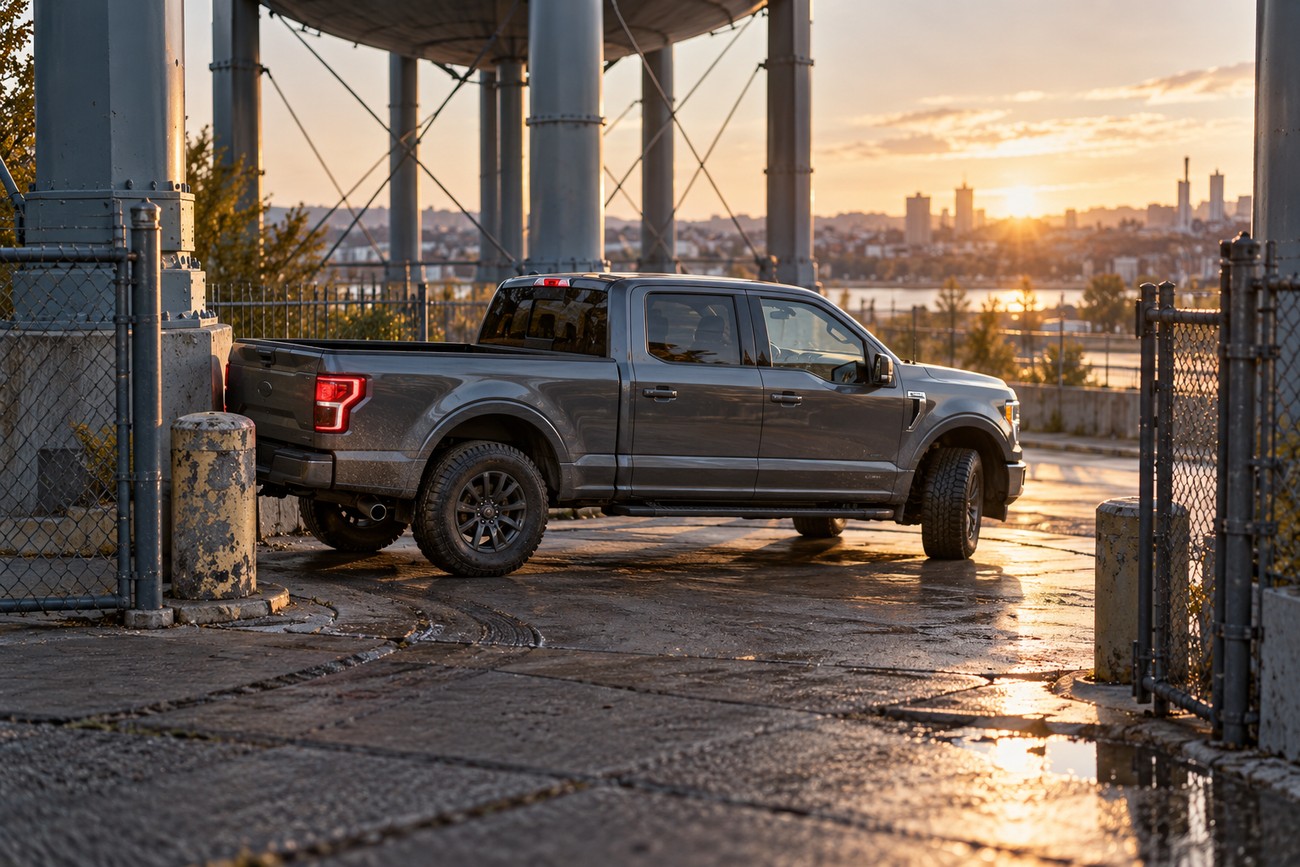
The F-150 is a full-size pickup, with reviews and tests commonly placing its length at about 6 m, depending on configuration. That length affects more than the final footprint. The front end follows a wide path while turning, and the rear can remain close to a post or fence after the hood appears to have cleared it.
Cab, bed, wheelbase, trim, and fitted equipment vary, so the model name alone is a poor measurement tool. Use the dimensions of the truck you are actually driving. A position that leaves enough room for its body may still be awkward if you cannot open a door fully or pull forward to straighten the wheels.
The high hood makes low obstacles near the front harder to judge, while the body’s width demands attention on both sides at once. At low speed, a long wheelbase also limits how quickly the truck changes direction. Give yourself more room for the approach and for corrections than you would in a typical passenger car, especially where supports or curbs sit near the turning path.
Choose the Position and Approach Before You Move
Inspect the whole route while the truck is still in a place where you can leave easily. Identify the entrance, the intended stopping position, and the exit path. If you cannot see the ground near a support or the far side of a fence, stop in a safe place and check on foot rather than guessing from the driver’s seat.
Choose a position that allows doors to open and keeps access clear for other vehicles. Then work backward from the parked position: decide where the truck needs to start and which angle will give its front corners room to swing. Drivers commonly find that an F-150 takes more time and space to park than an ordinary car; an extra setup movement is preferable to discovering the shortfall halfway in.
A controlled parallel-style setup can be more workable than turning nose-first into a tight opening. It lets you establish an angle along the available space and make measured adjustments, provided the route and traffic allow it. Treat this as a maneuvering option, not a rule: if either approach leaves no room to correct or depart, choose another place to park.
Check what will change while the truck is unattended. A currently empty lane may be the only practical approach for a maintenance vehicle. Parking close to the tower for shade or a shorter walk offers little benefit if it leaves the pickup trapped when that lane is in use.
A Low-Speed Parking Sequence for the F-150
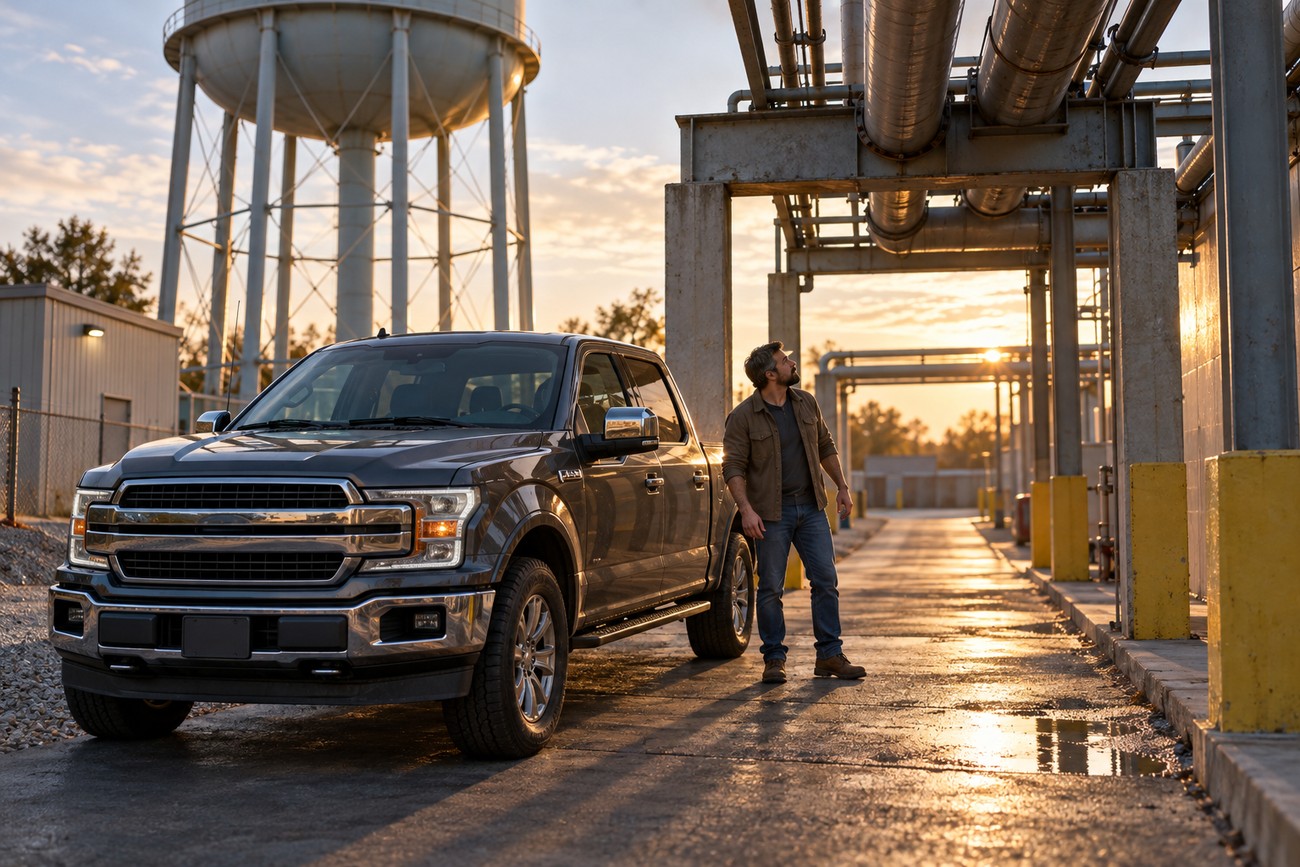
Stop before entering the tight area and inspect the surface, boundaries, and overhead clearance. Set the truck up with enough distance to turn, then move at walking pace while watching the front corners as well as the intended parking space. Small steering inputs make the truck’s path easier to read than a hurried full-lock turn.
Use both mirrors and direct checks around the vehicle. When reversing, look at the rear camera if fitted, then check the sides and front again before continuing; a rear image cannot show every part of the hood or every obstacle beside a door. Pause whenever the clearance becomes uncertain, and use a spotter only if you can agree on clear signals and keep that person safely out of the truck’s path.
When a reverse approach starts to tighten at the front corner, stopping and pulling forward can restore a useful angle. Rapid steering while continuing backward often uses up the remaining clearance before the truck has changed direction enough.
Expect to make more than one correction. Reverse slowly, straighten only after the full truck clears nearby obstacles, and check that the final position preserves room to open the doors and a clear exit route. If the pickup keeps ending up at an awkward angle, pull out and reset from a better starting position. Do not force the last movement merely to get closer to the tower.
What the F-150’s Parking and Trailer Technology Can—and Cannot—Do
Some F-150 configurations offer rear-view cameras, rear sensors, and parking assistance. Their availability and functions depend on the particular truck. Before relying on a display or warning, check what your vehicle has and where its view or detection area ends.
A rear camera can help you judge a fence or post behind the tailgate, while sensors may alert you to nearby objects they detect. Neither provides a complete view around the pickup. Dirt on a camera, an awkward obstacle shape, or a tight front corner can leave a hazard outside the information you are watching, so keep using the mirrors and direct observation.
Pro Trailer Backup Assist is a trailer-reversing aid. It can help control the direction of a compatible trailer while backing, but it is not a universal automatic parking system for the pickup itself. With a trailer attached, the combined vehicle also needs a different, larger route than the truck alone.
A 10-speed automatic transmission is available in modern F-150 configurations and can support controlled low-speed movement. Smooth use of the brake and accelerator still matters more than the number of gears during a close maneuver. No transmission or parking aid removes the truck’s length, width, turning path, clearance needs, or any restriction at the water-tower site.
Common Mistakes, Hidden Trade-Offs, and Reasons to Walk Away
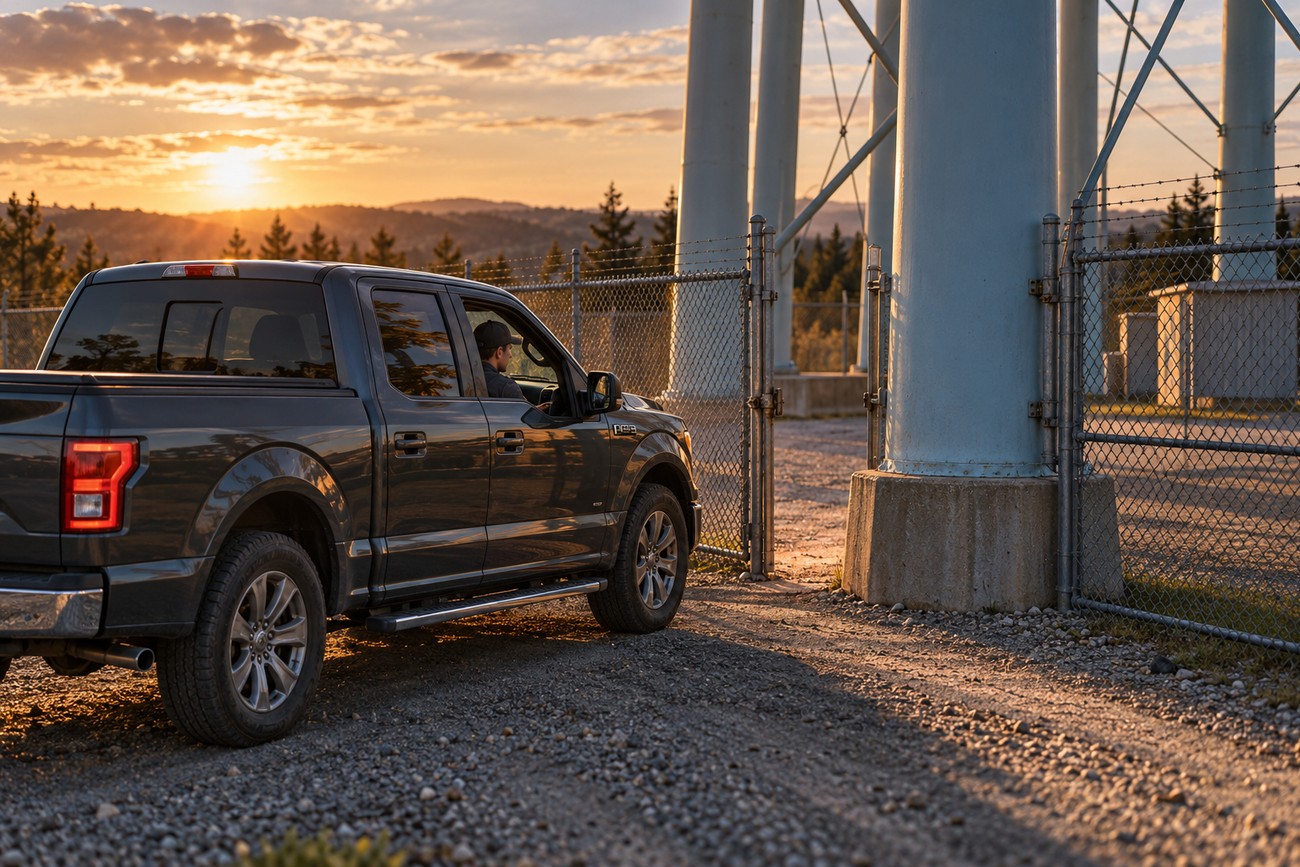
The most basic mistake is treating the F-150 like a sedan: turning in as soon as the front reaches the opening, then finding that the rear has too little room to follow. Another is looking only at the rear camera while a front corner approaches a support. Slow down early enough to assess the whole truck’s path, including the space needed to open a door after stopping.
Equipment can make the maneuver easier to monitor, but a more expensive trim does not become proportionally easier to park. Check the fitted systems rather than assuming a parking-assistance label means the truck will position itself. If visibility is poor or you cannot verify a clearance, get out and inspect from a safe place or leave the site.
Capability figures can also distract from the parking problem. Published F-150 towing capability can reach about 13,500–14,000 lb, and payload can reach about 2,440–3,325 lb in selected configurations; both depend heavily on version and source. Those best-case figures say nothing about whether your truck can turn through a particular gate or sit clear of a service route.
Walk away if the approach is too narrow to make corrections, the truck would obstruct maintenance or emergency access, or the parking rules remain unclear. The same applies if leaving would require reversing blindly into traffic or around a support. An open patch of ground is not a usable parking place unless you can enter, stop, open the doors, and depart without relying on luck.
Frequently asked questions
The answers below address checks that depend on the individual truck or the site. Verify them before committing to a tight space, particularly if you will leave the vehicle unattended.
How can I check the exact dimensions of my F-150 before using a tight site?
Identify your truck’s cab, bed, wheelbase, and fitted equipment, then consult its owner documentation or configuration-specific vehicle information. Generic figures for an F-150, including the commonly cited length of about 6 m, may describe a different version. Measure any added items that could affect clearance, such as accessories projecting from the body.
Compare those dimensions with the narrowest part of the entire route, not only the proposed stopping space. Allow for turning, mirrors, doors, and a forward movement to correct your angle. A static measurement that shows the truck fits between two objects does not prove it can maneuver between them.
What should I verify before leaving an F-150 unattended near a water tower?
Confirm that you are authorized to park and that signs, gates, and instructions from the responsible authority permit it. Check that the truck leaves service entrances, maintenance routes, and any emergency access unobstructed. A reference to a protected area of at least 50 m is source-specific, so ask the relevant authority about the rules at this site rather than treating that distance as universal.
Before walking away, open the door enough to confirm usable clearance and look at the truck from outside. Make sure another vehicle could pass where required, and that you could return and drive out without depending on the space around you staying empty.
What is the maximum wading depth of a Ford F-150?
There is no single maximum wading depth that is safe to apply to every F-150 configuration. Check the guidance for your specific model and equipment, and do not use a figure for another version as permission to enter water. Depth alone is insufficient: moving water, a soft or hidden bottom, and submerged electrical or mechanical components can make a crossing unsafe.
Water pooled near a tower can also hide a curb, drain, or damaged surface precisely where you need room to turn. If you cannot establish the depth and condition of the route from a safe position, avoid it and find another place to park.
Why is the F-150 Lightning not selling?
The F-150 Lightning does sell; the question usually concerns whether demand has met particular expectations, which can vary by market and period. Electric-pickup buyers may weigh purchase cost, charging access, and the effect of heavy loads or towing on range. Without a defined market, date, and sales comparison, a blanket claim that it “is not selling” is misleading.
For parking, do not assume a Lightning shares every dimension, control, or feature with a gasoline-powered F-150. Use documentation for the specific truck and inspect the same access and turning clearances at the water tower.
What are some hidden features of the Ford F-150?
Features that owners overlook often depend on configuration rather than being present on every F-150. Depending on the truck, these may include adjustable camera views, parking-assistance settings, or Pro Trailer Backup Assist for reversing with a trailer. The owner documentation and the vehicle’s menus are the reliable places to confirm what is fitted and how to use it.
Learn those controls in an open area before trying them beside a tower support. Knowing how to change a camera view can improve awareness, but no display setting can tell you whether parking is authorized or whether a service vehicle will have enough room to pass.







