
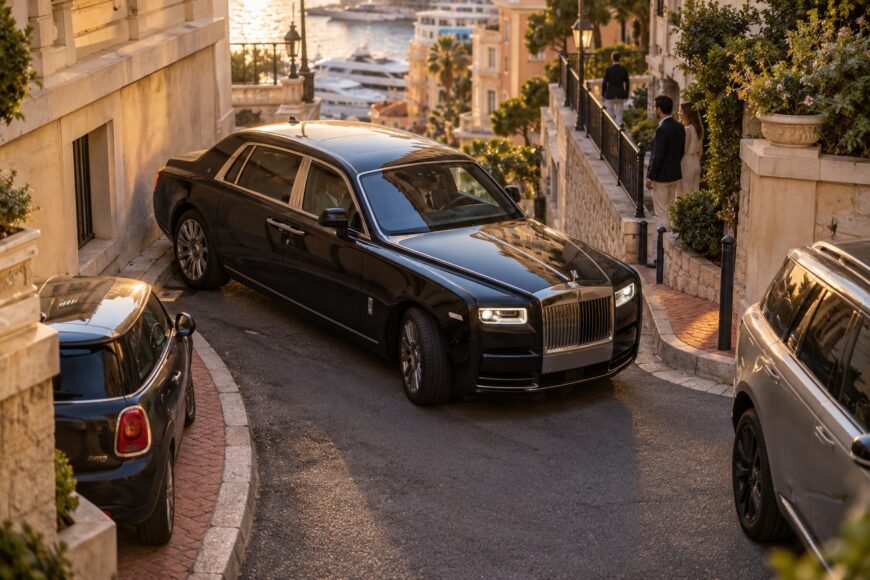
Monaco’s traffic and limited parking matter more than the prestige of the car. The Rolls-Royce Phantom is about 5.77 m long and 2.02 m wide without mirrors, so ordinary turns, ramps, and street spaces can become stressful even for a confident driver.
Central parking usually means choosing between a carefully checked underground public garage and a hotel or restaurant valet service. The right decision depends on the complete approach, including the entrance, turning path, and exit, rather than on the car’s badge or the apparent size of one parking bay.
- Why a Phantom Is Difficult to Park in Monaco
- Choosing a Monaco Car Park: Fit Matters More Than Prestige
- The Low-Stress Arrival Plan: Public Garage or Valet
- Common Mistakes and Myths That Lead to Damage
- Frequently asked questions
- How expensive is parking in Monaco?
- Where do people park their cars in Monaco?
- What car is a poor man’s Rolls-Royce?
- Who owns the $13 million Rolls-Royce?
Why a Phantom Is Difficult to Park in Monaco
Standard road markings and traffic rules apply fully in Monaco. Signs, paid-zone rules, and operating hours determine whether street parking is legal, regardless of the vehicle’s value or marque. A premium car has no exemption from restrictions, loading rules, or time limits.
Street space is scarce, while traffic, pedestrians, and parked vehicles leave little room for correction. The Phantom’s length and width make its rear swing more difficult to judge in tight streets, especially where a turn immediately follows a narrow approach. Some spaces may be usable, but they should never be assumed suitable from appearance alone.
A premium badge does not guarantee a larger or reserved space. Because central parking often depends on an underground public garage or hotel valet service, planning the destination before arrival is more reliable than circling in search of a street bay.
Choosing a Monaco Car Park: Fit Matters More Than Prestige
Underground garages use ordinary European height and width restrictions, with possible local limits for large vehicles. Check the specific facility before setting out, including its published height, width, entrance layout, ramp, turning path, and exit. Navigation may identify the garage without showing how difficult the final approach will be.
Length is only one part of the calculation. The Phantom’s width without mirrors, the position of its wheelbase during a turn, low curbs, ramp angles, and space for opening doors all affect whether a garage is genuinely practical. A bay intended for SUVs or large vehicles may offer more useful clearance, although the complete route still needs checking.
A technically suitable bay can remain risky if the entrance is tight, the ramp is steep, or two cars cannot pass comfortably. Smooth or polished surfaces may also make slow maneuvers more difficult, particularly when the exit requires a sharp turn close to a curb.
The Low-Stress Arrival Plan: Public Garage or Valet
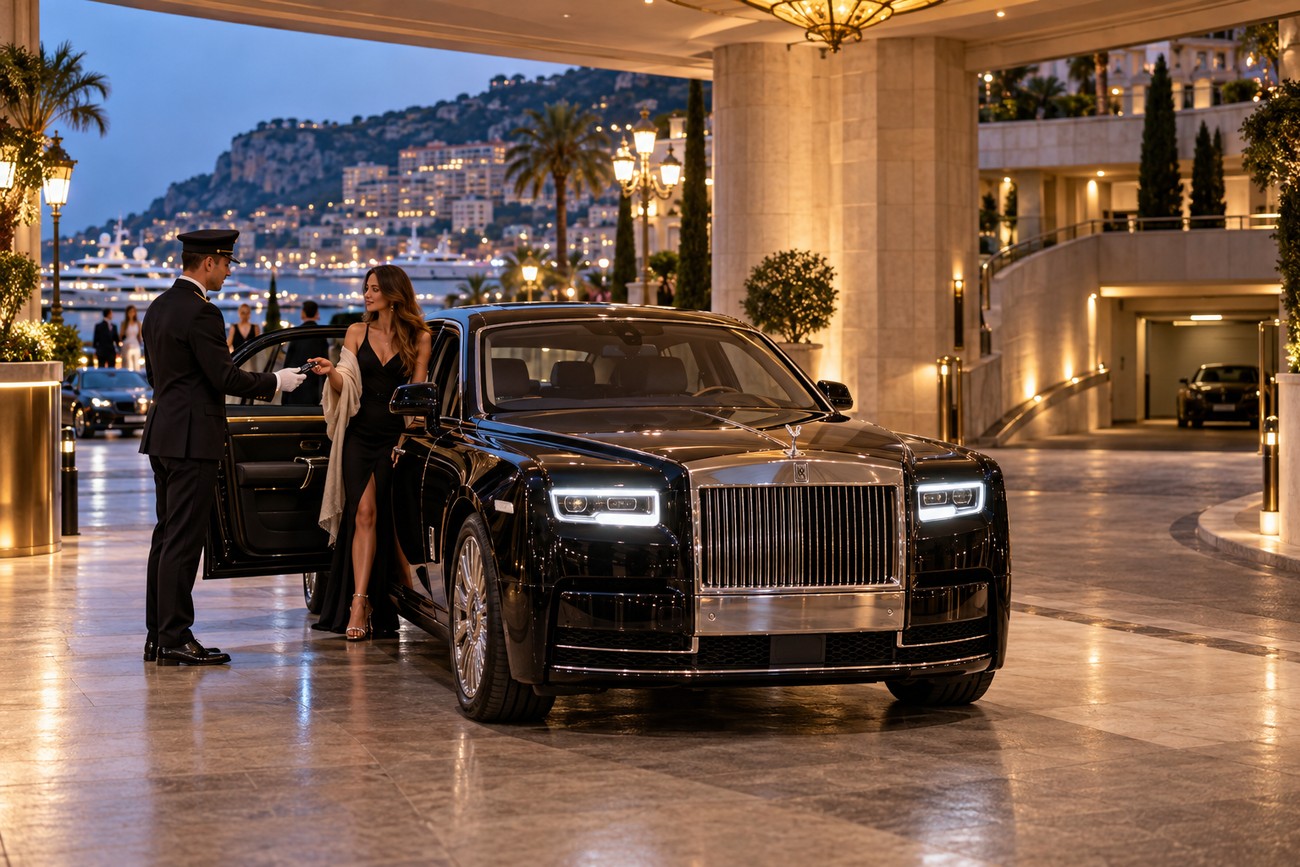
Choose a destination-side public garage when you need predictable access and are prepared to inspect its restrictions in advance. Keep a second option in mind before entering central Monaco. This prevents repeated circuits through dense traffic if the first entrance is unsuitable or full.
Hotel and restaurant valet parking is a common practical option for expensive cars in Monaco. It can reduce exposure to narrow ramps, tight bays, pedestrians, and awkward approaches. Valet is therefore a way to reduce parking risk, rather than a privilege reserved for luxury cars.
A suitable place for a very long sedan is not guaranteed even at a premium location. If you hand over the keys, confirm where the vehicle will be moved, provide clear instructions about clearance concerns, and understand the operator’s insurance arrangements. Trust in the operator remains part of the decision.
Common Mistakes and Myths That Lead to Damage
Relying only on GPS is a common error. Navigation systems may not reflect a garage’s actual height, width, ramp constraints, or turning radius. Entering first and assessing later can leave little room to reverse safely, especially on a steep or spiral descent.
Judging a space by length is equally misleading. Mirrors, width, wheelbase position, turning radius, ramp angle, door clearance, and the spacing of neighboring cars all matter. Low curbs, tight exits, steep gradients, and smooth surfaces can lead to wheel, bumper, or paint damage during a maneuver that looks simple from outside.
Luxury status does not bring special treatment or a reserved bay. Parking can also feel more expensive than in neighboring French Riviera cities, but cost varies by zone, time, and facility; there is no single universal rate. Repeated circling adds stress and increases exposure to traffic, pedestrians, and rushed decisions.
Frequently asked questions
These practical points help set expectations before arriving in central Monaco with a large sedan.
How expensive is parking in Monaco?
There is no single universal Monaco parking price. The charge varies by zone, time, and facility. User discussions sometimes describe Monaco parking as more expensive than in neighboring French Riviera cities, but that is an unverified comparison, not a fixed official rate.
Where do people park their cars in Monaco?
Central visitors commonly use destination-side underground public garages or hotel and restaurant valet services. Street parking remains subject to ordinary signs, paid-zone rules, and operating hours, so it is rarely sensible to treat an available-looking space as automatically legal or suitable for a Phantom.
What car is a poor man’s Rolls-Royce?
The Chrysler 300 is commonly called a “poor man’s Rolls-Royce” because its large body, upright styling, and imposing grille resemble the visual presence of a luxury sedan at a much lower price.
Who owns the $13 million Rolls-Royce?
The reported owner of the approximately $13 million Rolls-Royce Sweptail has not been officially identified. Media reports have described the buyer as a private billionaire, but no confirmed public name is attached to the car.







