
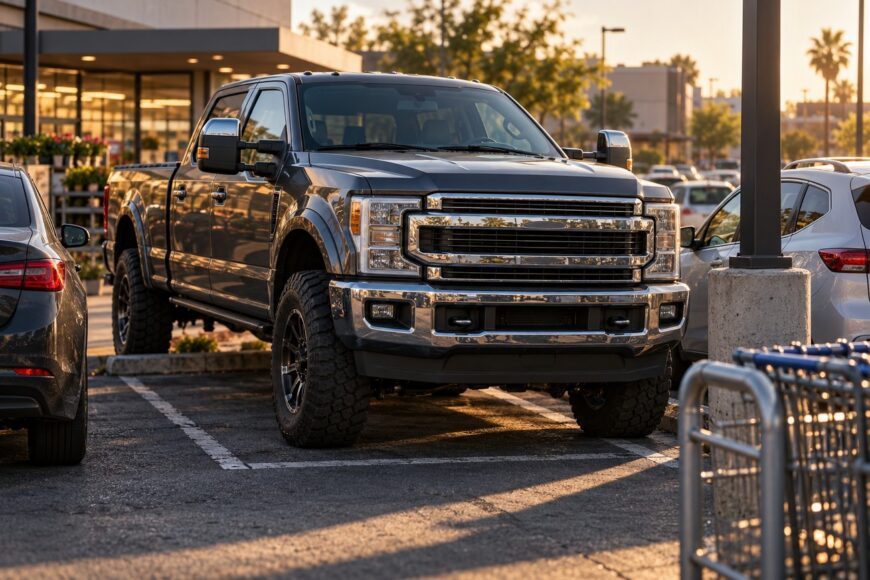
An F-250 can fit within a supermarket space by length and still make the lot unsafe or unusable. Its body is usually about 80 inches wide without mirrors, while extended towing mirrors make the effective width noticeably greater. The truck also needs more turning room than a typical passenger car, and its hood, bed, hitch, and overhangs can reach beyond the tire path.
The workable choice depends on the whole parking envelope: width, door clearance, pedestrian routes, approach angle, and the path you will use to leave. A small city supermarket may simply lack a space that accommodates every F-250 configuration safely. The goal is to choose the least-conflicted position and leave room for people, carts, and neighboring vehicles.
- Why an F-250 Can Fit on Paper but Fail in a Small Lot
- Choose the Space Before You Choose the Maneuver
- A Low-Stress Way to Park and Leave
- Common Mistakes, Conflicts, and Hidden Costs
- Frequently asked questions
- What year of F-250 should you stay away from for tight-city parking?
- What year should you stay away from in an F-250?
- How do you park a Ford truck?
Why an F-250 Can Fit on Paper but Fail in a Small Lot
Length alone gives an incomplete answer. Short-bed F-250 configurations are commonly about 230–250+ inches long, while long-bed versions can reach about 266–267 inches. A typical U. S. parking space is about 8.5–9.0 feet wide, and older or compact spaces may be narrower or shaped awkwardly.
The effective parking envelope includes the mirrors, bed sides, hitch, and the space needed to open doors. A truck may have all four tires inside the lines while a mirror reaches toward a post or a neighboring vehicle. A rear projection can also contact a curb, island, or pedestrian area during a turn.
Cab and bed choices matter because the wheel path and turning circle change how the truck enters and exits. The F-250 has a substantially larger turning circle than a passenger car, so a space that looks long enough may still require several corrections. Treat the approach and exit path as part of the parking space.
Choose the Space Before You Choose the Maneuver
Start with a slow visual inspection before committing to a row. An open edge or far-corner space often gives more maneuvering room and reduces conflicts with adjacent vehicles, provided it has a clean approach and legal markings. Check the likely exit before turning in, especially if reversing would put the truck directly into moving traffic.
Look beyond the painted rectangle. Islands, bollards, curbs, cart corridors, snowbanks, and crooked markings can make a formally adequate space functionally too small. A nominally wide space with a sharp entrance may be harder than a standard space with a straight approach and a clear turning path.
Keep pedestrian movement and accessibility in view. ADA-accessible spaces and access aisles must remain clear, and local signs, fire lanes, painted restrictions, and oversize-vehicle rules still apply. The front or rear overhang can intrude into a pedestrian zone or neighboring space even when the tires remain within the lines.
Leave enough room for carts and doors after you center the truck. If the only available position blocks a cart lane, narrows a walkway, or forces another driver to cross a line, choose another space or use a different store if practical.
A Low-Stress Way to Park and Leave
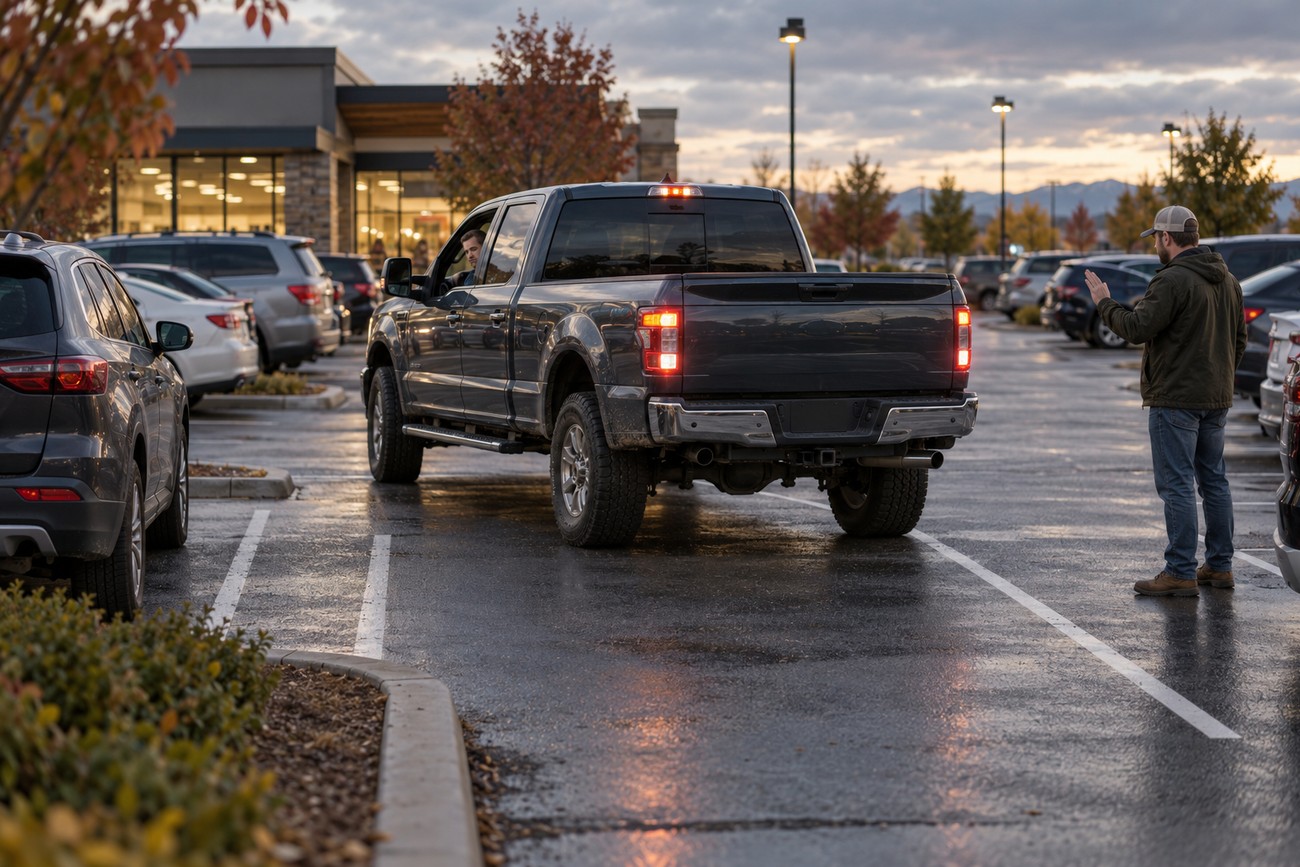
Reduce speed before the turn and set up wide enough for the truck’s wheel path. Use the mirrors, cameras, and a spotter when one is available, then make small, deliberate steering inputs. The F-250 often needs more than one correction in a tight row; stopping to look is safer than guessing from the driver’s seat.
Backing into a suitable space can make the later departure more controlled because the front of the truck is positioned for the exit. That choice depends on traffic, visibility, and the lot’s geometry. Pulling nose-first into a space may be simpler in one location yet create a difficult reverse movement in another.
Plan the exit before committing to the space, especially when the only reverse path leads directly into moving traffic. A parking maneuver is successful only when both arrival and departure can be completed with a clear view.
Check blind areas around the hood, pillars, and rear corners. A high hood line and large pillars can hide pedestrians and low objects, so cameras and mirrors do not replace a visual check. During backing, remember that a tow hitch, bed overhang, or other rear projection can contact a curb or obstruction before the tires do.
Common Mistakes, Conflicts, and Hidden Costs
Drivers sometimes center the truck by its tire tracks and forget door clearance. That can leave too little room for a neighboring driver to open a door or for a shopper to move a cart. Extended mirrors and bed accessories increase the effective width beyond the body measurement, even when the truck appears centered.
A missing prohibition sign does not mean unlimited permission. Painted restrictions, accessible access aisles, fire lanes, local rules, and the physical limits of the lot still govern where the truck can stand. Avoid using a corner that appears empty if it blocks a route or creates a blind exit.
The final difficulty may come from outside the truck. A vehicle parked crookedly, a cart left across the lane, a snow pile, or poor lighting can remove the clearance you expected. Give yourself permission to abandon a maneuver and select a farther space rather than forcing a tight correction.
Owner reports sometimes describe using an F-250 at small supermarkets because work or access needs leave few alternatives. That explains the choice without making the lot convenient for a heavy-duty pickup. Courtesy works both ways: park within the available geometry and avoid turning limited space into a conflict.
Frequently asked questions
Parking suitability depends on the truck’s configuration and the site, so broad rules about every F-250 can be misleading. These answers focus on decisions that remain useful across different lots and model years.
What year of F-250 should you stay away from for tight-city parking?
No single F-250 model year should be rejected solely because of supermarket parking. Cab style, bed length, mirror setup, hitch equipment, visibility, and vehicle condition usually matter more than the year on the title.
For tight parking, compare the actual truck’s overall length, mirror position, camera operation, sensor condition, and turning behavior. A well-maintained shorter configuration may be easier to place than a newer long-bed truck with extended mirrors and a rear hitch.
What year should you stay away from in an F-250?
There is no universal “avoid this year” answer based only on parking. A buyer should inspect the specific truck for damaged mirrors, unreliable cameras or sensors, poor visibility, worn steering components, and equipment that increases rear projection.
Model-year differences can affect features, but they do not remove the basic limits of a full-size heavy-duty pickup. Choose the configuration that gives you the clearest sight lines and the simplest exit path for the places you regularly use.
How do you park a Ford truck?
Inspect the space and exit first, then approach slowly with a wide setup. Use mirrors and cameras, check for pedestrians and low obstacles, and make deliberate corrections rather than relying on one continuous turn.
Folding towing mirrors can reduce mirror-to-obstacle risk when the truck is parked or moving through a narrow aisle, but they do not reduce the body, wheel path, or turning circle. Sensors and cameras assist with detection while leaving you responsible for checking the full surroundings before moving.







