
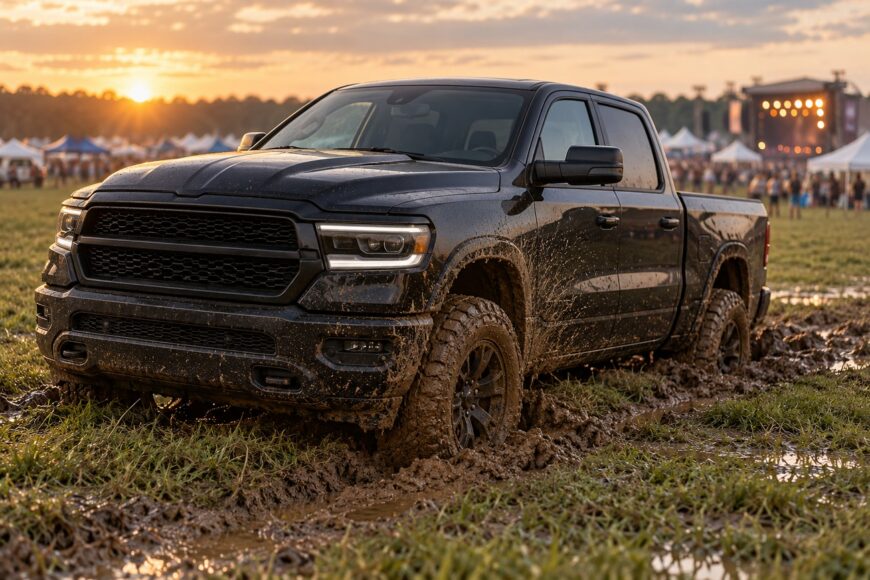
A Ram 1500 can look prepared for rough ground while a rain-saturated festival field quietly removes its margin for error. The truck’s mass, long wheelbase, road-oriented tires, and full passenger load can turn ordinary grass into a recovery problem within a few tire rotations.
The practical decision is choosing a firm parking line and preserving an exit route before you stop. This guide focuses on getting parked, getting out, avoiding hidden underbody and paint damage, and understanding the limits set by festival terms and insurance policies.
- Why a Ram 1500 Can Struggle on a Festival Field
- Before You Enter: Read the Field, Rules, and Weather
- How to Park and Leave Without Digging In
- If the Ram 1500 Gets Stuck
- The Damage You May Not Notice Until You Get Home
- The Capability Myths That Cause Festival-Field Problems
- Frequently asked questions
- How early should you get to a music festival?
- What should you wear to a music festival on a wet field?
- Where can I park at Cavendish Beach Music Festival?
Why a Ram 1500 Can Struggle on a Festival Field
A 2020–2025 Ram 1500 Crew Cab 4×4 with Hemi commonly has an equipped mass of approximately 2,300–2,600 kg. With passengers, fuel, and cargo, the load rises further, and when fully loaded, the load on each rear wheel can readily exceed 800–900 kg. Soft ground has to support that weight through four contact patches, so a heavy pickup can sink quickly where a lighter car leaves only shallow marks.
Firm, well-drained ground usually gives the truck enough support for careful parking. Clayey or loamy soil can lose its ability to support weight after rain, allowing the tires to cut deep ruts before the driver notices the problem. A low area, a shaded section that stays wet, or grass covering saturated soil may look usable from the entrance while offering little support underneath.
Factory ground clearance is approximately 215–220 mm, yet clearance alone does not determine whether the truck will cross a field. The long wheelbase and overhangs increase the chance of high-centering in ruts or loose ground, especially where one axle drops into a depression and the chassis contacts the soil. Once the underbody carries part of the vehicle’s weight, additional engine power rarely solves the problem.
Common 18-inch or 20-inch road-oriented or all-season tires also shed mud less effectively than dedicated AT or MT tires. Their tread can fill with clay, reducing traction even when the truck is in 4×4. The Ram is capable on suitable surfaces, but a wet festival field combines weak ground support, limited tire grip, and difficult recovery conditions in a way that a paved-road capability rating cannot predict.
Before You Enter: Read the Field, Rules, and Weather
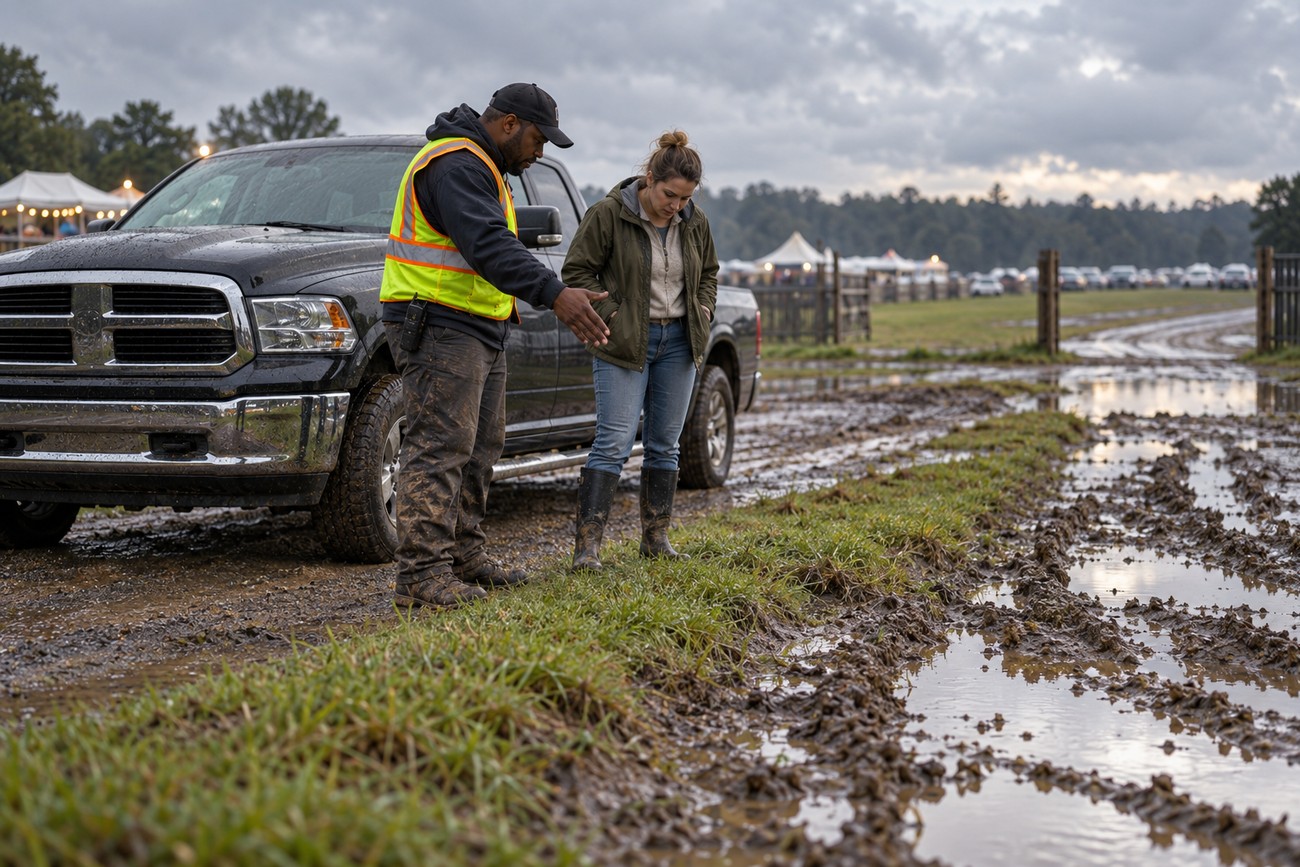
Check recent rainfall, the forecast for the parking period, and the condition of the entrance before committing to the field. Look for standing water, shiny or polished mud, deep existing ruts, sloping ground, and areas where vehicles are already spinning. A higher, firmer section near an exit is generally safer than a low spot or a space close to the stage.
Arriving earlier helps in two ways: daylight gives you time to inspect the surface, and the parking team is more likely to have usable space available. Ask where recovery tractors are stationed and whether they can reach your row. Official parking does not guarantee that the field will remain passable after more rain or that recovery will be free.
Read the current parking terms before entering. Festival conditions often place responsibility for getting stuck and vehicle damage on the driver, with recovery charged separately. Some insurance policies exclude or dispute claims associated with off-road use, including suspension or body damage on a wet grass or dirt parking field, so check the wording that applies to your vehicle before the event.
Reduce unnecessary cargo where practical, and account for passengers before choosing a route. A full bed, heavy equipment, and a full cabin increase ground pressure and make a marginal surface less forgiving. If the entrance already shows deep ruts or a tractor is recovering vehicles, stop to reassess rather than treating the official entrance as proof that every parking row is suitable.
How to Park and Leave Without Digging In
Enter slowly enough to read the surface and keep the truck’s wheels aligned with the direction of travel. Existing tracks can provide a firmer, more predictable route, while crossing deep parallel grooves places one wheel or axle at a difficult angle. Parking along an established rut or track can make the exit easier than turning across it later.
Choose a straight parking position with the front of the truck pointed toward the clearest departure line. Leave room for the vehicle to move forward without a sharp steering angle, and avoid blocking yourself behind another pickup, a trailer, or a deep drainage groove. A short walk to the stage is usually preferable to a difficult turn in the darkest or wettest part of the field.
If equipped, 4×4 Low may support controlled movement on difficult ground, subject to the owner’s manual and conditions. Traction-control intervention can reduce available drive when steady wheel torque is needed on slippery ground, so use the truck’s permitted drive modes carefully and avoid making changes without understanding the system. A modest tire-pressure reduction within the manufacturer’s permitted limits can increase the contact patch, but it does not compensate for a chassis resting on soft ground.
Use gentle, continuous throttle and avoid wheelspin, abrupt steering, or repeated attempts at full power. Uncontrolled wheelspin digs deeper and polishes the hole, while a calm, straight-line approach preserves the limited traction available. Four-wheel drive improves traction, yet it cannot prevent sinking, high-centering, or loss of ground support.
If the Ram 1500 Gets Stuck
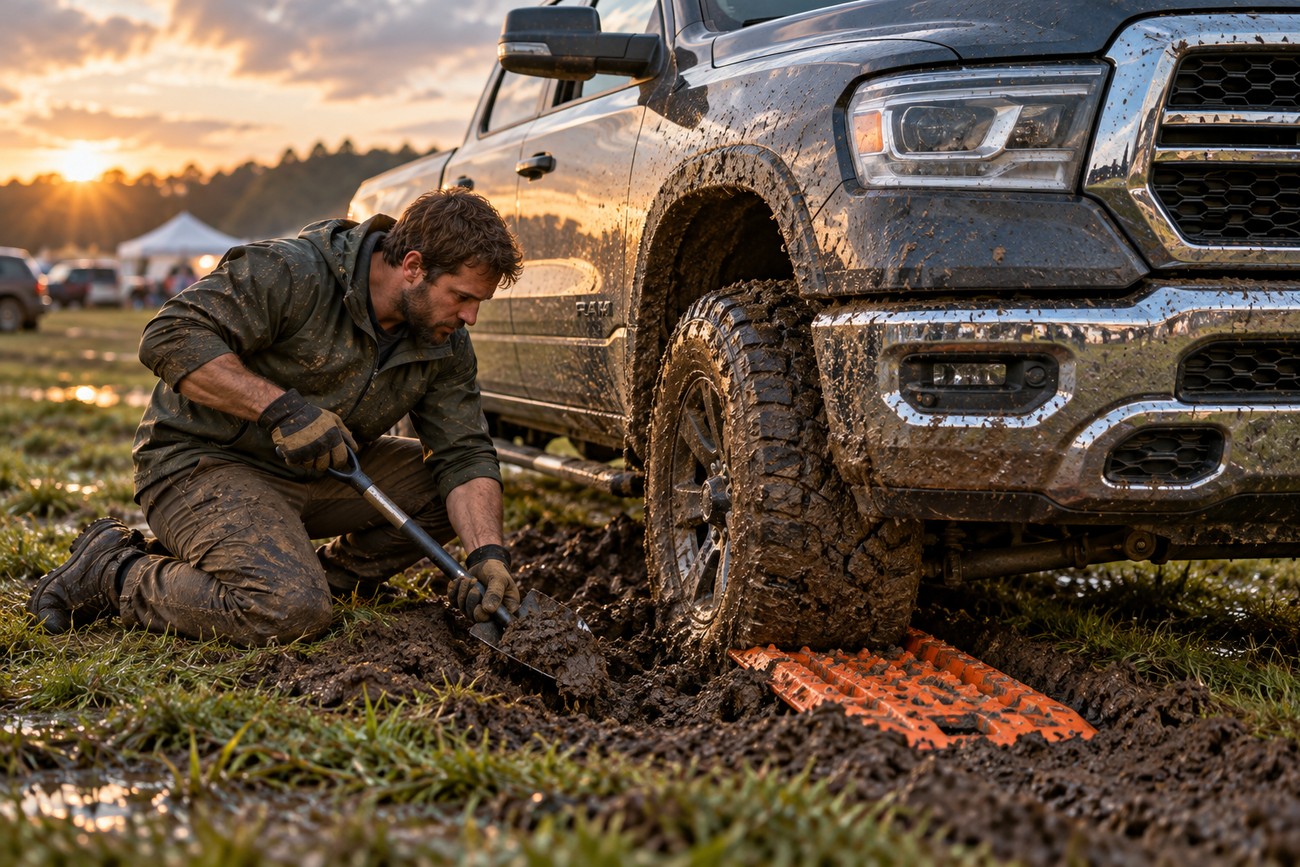
Stop spinning as soon as forward movement ends. Walk around the truck if it is safe, check whether the tires are buried, and determine whether the frame or another underbody component is resting on the ground. Repeated throttle usually increases rut depth and can leave the vehicle supported by its underbody rather than its tires.
Clear mud from in front of the drive tires and beneath any point that is dragging. Reduce passengers or loose cargo where practical, then place traction boards or mats under the tires if you have them. A shovel can create a shallow approach, while gentle rocking may help only when there is enough space and the wheels remain controlled.
A basic field-recovery kit can include a recovery strap, a shovel, traction boards or mats, and suitable rated attachment points. Use the vehicle’s approved recovery points and follow the owner’s instructions. Do not attach recovery equipment to an unapproved bumper or suspension component merely because it is convenient.
If self-recovery is unlikely, stop before the truck sinks farther and contact the event’s recovery team. Festival recovery is often an additional paid service, and drivers report urgent cash payments with inconsistent documentation. Confirm the price, payment method, and expected equipment where possible, keep clear of tensioned straps, and avoid standing between vehicles during a pull.
The Damage You May Not Notice Until You Get Home
After leaving a muddy field, inspect the wheel arches, mudguards, running boards, frame areas, and fasteners. Mud packed into these spaces can retain moisture and increase corrosion risk, especially when it remains trapped after the visible surface dries. A quick rinse of the body does not remove compacted debris behind liners or around mounting points.
Wash the underside and wheel arches thoroughly, then inspect again when the truck is clean. Look for dents, scrapes, loose shields, damaged wiring, leaking fluid, and bent or displaced suspension parts. The Ram 1500’s frame and suspension can be damaged by hidden rocks, stakes, or underbody impacts even when the problem is not immediately obvious.
Examine the lower doors, rocker areas, bumpers, and tow hardware for scratches or impact marks. Tall grass, branches, and gravel can damage paint during ordinary field parking, while a concealed post or stone can affect a bumper or hitch assembly. Photograph anything suspicious before washing if you may need a repair record or insurance discussion.
Cosmetic damage can also affect resale value even when the truck remains mechanically sound. Deal with trapped mud promptly, and arrange a professional inspection if the vehicle struck something, developed a new vibration, pulls to one side, or shows fluid leakage after the event. A muddy parking space does not guarantee damage, but it justifies a careful inspection.
The Capability Myths That Cause Festival-Field Problems
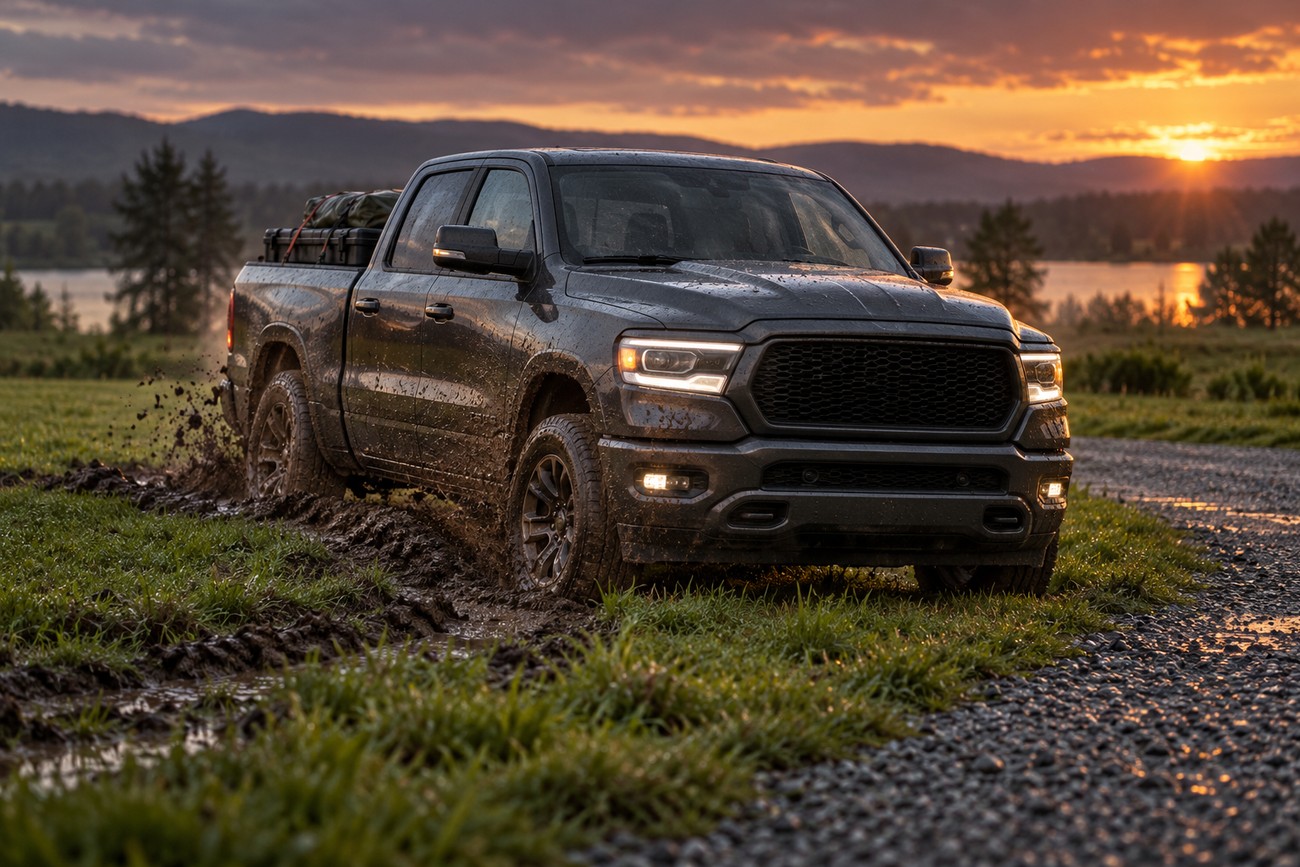
A Ram 1500 is not automatically suited to soft festival fields. Road tires, heavy loading, and weak ground can defeat it, while a tall body can make the driver underestimate how deeply the tires and chassis are sinking. The truck is well suited to many firm surfaces, yet field conditions determine whether that capability is useful.
RWD versions without a locking differential are more likely to struggle on wet grass than suitably equipped 4×4 versions. Four-wheel drive improves traction, but it cannot prevent sinking or high-centering. Tire condition, load, throttle control, and the route across the field remain decisive.
Tow and off-road marketing claims describe vehicle capability rather than a guarantee of safe passage across a wet festival field. Owner reports also describe recoveries and underbody damage in these conditions, illustrating the gap between controlled capability testing and a crowded, rain-soaked parking area with deepening ruts.
Official festival parking does not automatically make the organizer responsible for recovery or vehicle damage. Parking terms often place responsibility for getting stuck and vehicle damage on the driver, with recovery charged separately. Inspect the ground, preserve an exit, and leave early if rain changes the surface.
Frequently asked questions
Arrival time affects how much daylight you have to inspect the field. Wet conditions also affect what you wear and how you move around the truck. Check the event’s current parking instructions before you travel.
How early should you get to a music festival?
Arrive early enough to inspect the parking field in daylight, confirm the current access arrangement, and choose a space before the firm areas fill. The exact timing depends on the event’s gates, traffic plan, and parking pass instructions, so check the organizer’s current information before traveling.
Early arrival also gives you time to ask about recovery tractors and the preferred exit route. If conditions deteriorate later, arriving before the field becomes crowded can prevent a forced choice between a low spot, a deep rut, and a blocked departure lane.
What should you wear to a music festival on a wet field?
Wear waterproof footwear with a secure tread, quick-drying layers, and outer clothing that tolerates mud and standing water. Bring an extra layer because wet grass, wind, and evening temperatures can make a long walk uncomfortable even when the day begins warm.
Choose clothing that allows you to walk safely around the truck without loose straps catching on equipment. Footwear and clothing improve comfort and personal footing; they do not improve vehicle traction or make a soft parking area safer for the Ram.
Where can I park at Cavendish Beach Music Festival?
Use the festival’s current parking map, pass instructions, and organizer updates to identify the permitted area. Parking arrangements can change by edition, weather, traffic controls, and pass type, so generic advice about festival fields cannot establish a specific location.
Confirm whether your pass covers general parking, a designated lot, shuttle access, or an overnight area before entering. Follow staff directions while still assessing the surface and preserving a practical exit line where the rules allow.







