
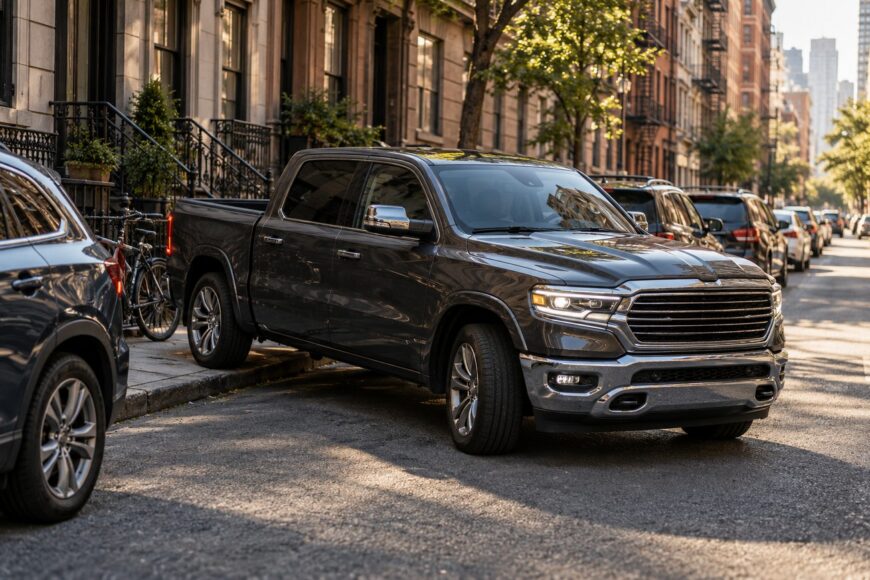
A Ram 1500 occupies a different envelope from the sedan-sized vehicles Manhattan curb spaces were built around. A 2026 Ram 1500 is approximately 228.9–233.7 inches long and 82.1–88.0 inches wide without mirrors, depending on the version. That leaves less room for error beside parked cars, delivery vehicles, construction barriers, and bicycles.
The difficult part is a three-way problem: the truck’s geometry, limited visibility, and New York parking rules. The rear wheels may enter the space cleanly while the front outer corner swings toward traffic or an object across the street. Cameras and sensors help, but Park Assist does not remove responsibility for speed, braking, gear selection, or the space around the truck.
- Why a Ram 1500 Is Harder to Parallel Park in Manhattan
- Check the Space and the Rules Before You Turn In
- A Safer Manual Sequence for Parallel Parking the Ram 1500
- What Park Assist Can—and Cannot—Do
- The Mistakes That Cause Most Manhattan Parking Problems
- Frequently asked questions
- Where can I park a pickup truck in NYC?
- How far from the curb should a Ram 1500 be when parallel parked in New York?
- Why might Ram Park Assist fail to recognize a Manhattan parking space?
Why a Ram 1500 Is Harder to Parallel Park in Manhattan
Length changes the entire shape of the maneuver. A short curbside gap must accommodate the Ram’s rear entry path, the angle needed to bring the body parallel, and the front section that swings outward as you steer. Judging the opening only by whether the truck’s body appears to fit leaves too little room for the turn itself.
Width creates a second problem. The published width of approximately 82.1–88.0 inches excludes the mirrors, so the operating envelope is wider than the body specification. On a narrow Manhattan street, a mirror can be close to a parked vehicle, bicycle, or construction fence even when the body panels appear clear.
Wheelbase and turning radius determine how early you must begin the maneuver. Reference cards show wheelbases of approximately 140.5–145.1 inches, while an official Ram brochure lists 140.6–153.5 inches for different configurations. Identify the specific cab and bed configuration before applying advice from another Ram 1500.
A common version is listed with a curb-to-curb turning diameter of about 46.2 feet, while the RHO is listed at 48.4 feet. That does not mean you need an empty circle around the truck, but it does explain why the front outer corner needs extra swing space. A longer or less maneuverable configuration may require a wider setup and more deliberate corrections in a short parking pocket.
Check the Space and the Rules Before You Turn In
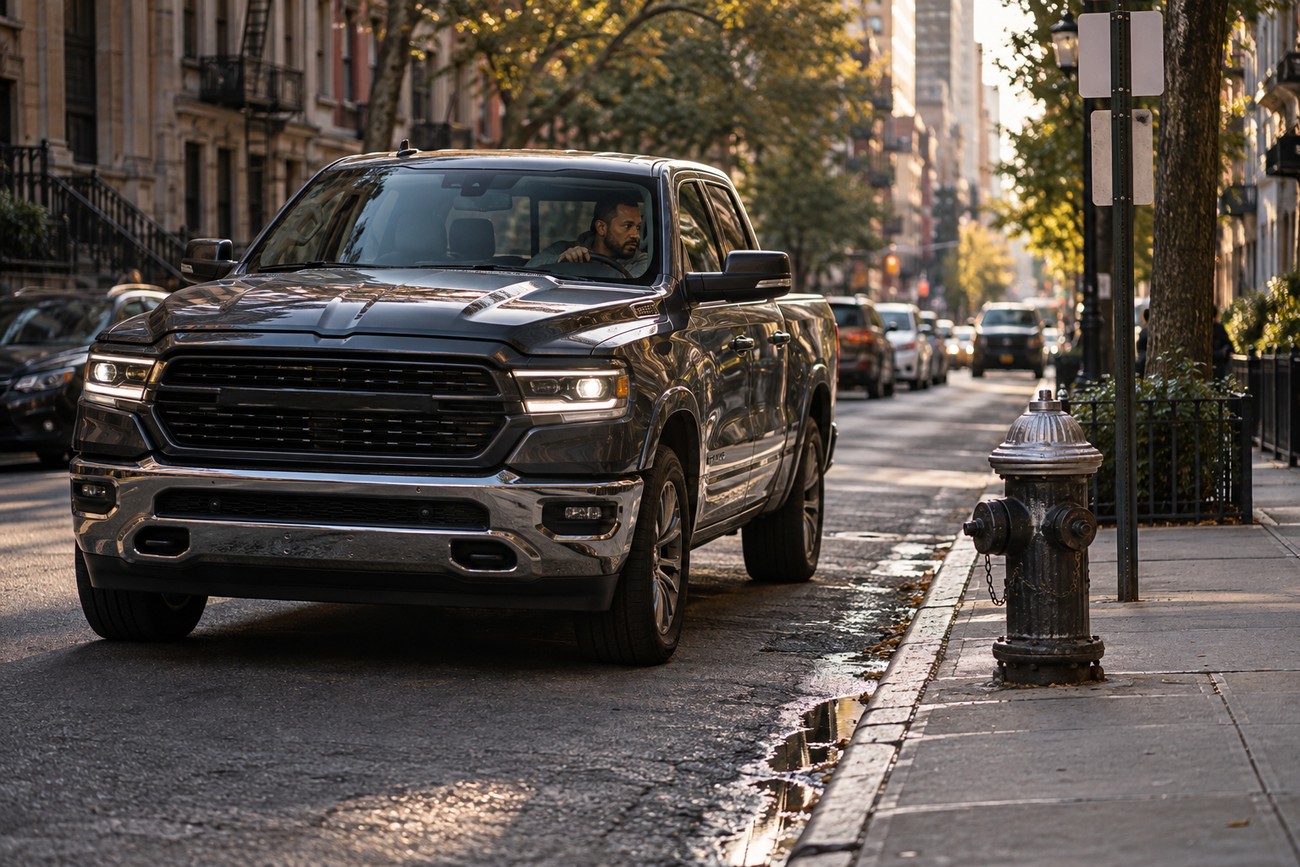
Legal screening belongs at the beginning of the maneuver. Before stopping beside the opening, read the signs, inspect the curb area, and check whether the full truck can remain inside a permitted space without blocking access or extending into a restricted area.
Do not park within 15 feet on either side of a fire hydrant. The stated fine for parking within 15 feet of a hydrant is $115. Painted curb treatment can help you notice the area, but it is not a precise measuring tool for the legal 15-foot distance.
Alternate Side Parking restrictions apply for the entire period shown on the sign, even after the street sweeper has passed. A clear curb immediately after the sweeper is still restricted if the posted period has not ended. Check the sign before committing to the space rather than relying on what traffic or other parked vehicles are doing.
The described daytime exception for a passenger car requires the driver to remain at the wheel and be able to move the vehicle immediately. Do not automatically extend that exception to every Ram 1500. Bus zones, temporary restrictions, driveways, crosswalks, bicycle lanes, and other signs can make an apparently convenient gap unusable.
A Safer Manual Sequence for Parallel Parking the Ram 1500
Start by inspecting the complete path, not only the rear opening. Look at the vehicle ahead, the vehicle behind, the opposite side of the street, bicycle traffic, open doors, hydrants, signs, and any object that may sit below the camera’s useful view. Leave enough room for the truck’s front outer corner to swing while the rear moves into the space.
Align the Ram early and keep the setup predictable. Stop parallel to the vehicle ahead with additional working room rather than squeezing close to its bumper. Straighten the truck before reversing, select Reverse only when the path is clear, and move slowly enough to stop without relying on a warning chime.
The right rear-wheel line and the front outer corner describe two different risks. Track the wheel’s path through the mirror while separately checking where the front corner is swinging; the camera screen cannot provide a complete view of both at once.
During the first reverse movement, use the right mirror to watch the rear-wheel line and the curb relationship. The camera can confirm the general angle, but the mirror often gives a better sense of how the truck is entering the space. Make a controlled correction when the angle is wrong instead of forcing one sharp turn.
As the rear clears the vehicle behind, begin bringing the truck parallel while checking the front outer corner and opposing traffic. A single aggressive maneuver can push that corner toward a neighboring vehicle, a cyclist, or an object across the street. Pause whenever the view changes, and use Drive and Reverse as deliberate positioning tools rather than rapid corrections.
Finish by centering the truck within the legal space and checking the full length of the vehicle. Confirm that the body does not protrude into the travel lane, bicycle lane, crosswalk, hydrant area, or driveway access. If the final position is poor, reset and correct it while there is room instead of accepting a tight angle because the rear bumper appears clear.
What Park Assist Can—and Cannot—Do
On equipped Ram 1500 versions, Park Assist can control steering during the parking maneuver. It does not operate as a fully autonomous parking system. The driver remains responsible for the accelerator, brake, and Drive/Reverse selection throughout the attempt.
Space recognition can also be inconsistent. Owners describe the system as hit-or-miss, and some discussions report roughly 50% successful parallel-parking attempts. Stop-start movement or failure to recognize an opening is a reason to supervise closely, not a reason to continue blindly.
Keep both the surroundings and the controls under active supervision. Watch the mirrors, listen for changes in sensor warnings, check the camera image, and be ready to stop before the system reaches an uncertain point. A sensor alert is useful information, while the absence of an alert is not proof that the path is clear.
Cameras and sensors may miss low posts, thin objects, irregular boundaries, open doors, or protruding bumpers. Construction barriers and other unusual street objects can be especially difficult for a system designed to interpret more conventional vehicle shapes. If the detected path does not match what you see through the windows and mirrors, stop and take over.
The Mistakes That Cause Most Manhattan Parking Problems
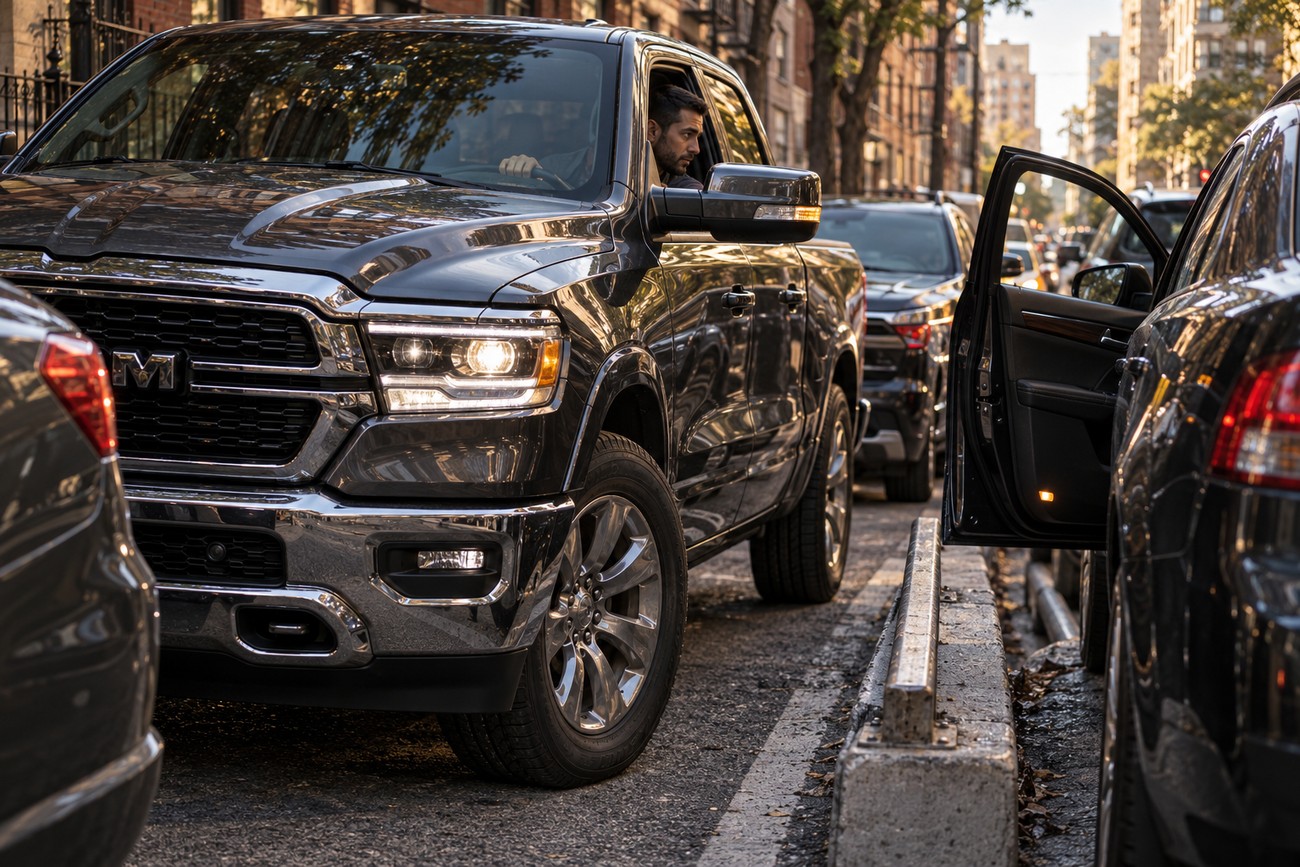
The first mistake is judging a gap by body length alone. The opening must accommodate the entry angle, rear-wheel path, front swing, and mirror-inclusive operating width. A gap that looks long enough while the Ram is straight may become unusable once the front outer corner begins to swing.
The second is trusting sensors as if they guarantee clearance. Low or thin objects, open doors, irregular barriers, and protruding bumpers may be difficult to detect. Keep visual contact with the right mirror and the areas around both front corners, especially when the street is narrow.
A third mistake is treating the sweeper as the end of Alternate Side Parking. The restriction remains active for the entire period shown on the sign. The same kind of shortcut causes trouble at hydrants: compliance is based on 15 feet, not on the apparent end of painted curb treatment.
The final mistake is forgetting that the truck’s published body width excludes the mirrors. A Ram can clear a vehicle with its body while a mirror remains exposed to traffic or a nearby object. The cost of a poor decision can include vehicle damage and tickets for hydrants, Alternate Side Parking, bus zones, signs, or temporary restrictions.
Frequently asked questions
These decisions depend on both the truck’s physical fit and the restrictions controlling that particular block.
Where can I park a pickup truck in NYC?
Use a curb gap only after checking posted restrictions, hydrant clearance, Alternate Side Parking, nearby access points, and the space required for the entire Ram 1500. An opening is suitable only if the full truck can remain within the legal area without blocking a crosswalk, bicycle lane, driveway, bus zone, or travel lane.
Also inspect the approach, not only the final position. A gap beside two ordinary vehicles may offer a clearer path than one beside a construction barrier or an irregular object. If the truck cannot enter, straighten, and finish without the front corner or mirrors entering danger, choose another space.
How far from the curb should a Ram 1500 be when parallel parked in New York?
Finish parallel and close enough that the truck does not protrude into the travel lane, while maintaining clearance from the curb and nearby street features. The supplied facts do not establish one universal numeric curb-to-vehicle distance for every New York parking situation, so do not rely on an invented measurement.
Use the right mirror, the rear-wheel line, and a final walk-around view to confirm the position. Recheck the truck’s front and rear corners, because a vehicle can look parallel from the camera while still sitting at an angle that exposes part of the body to moving traffic.
Why might Ram Park Assist fail to recognize a Manhattan parking space?
Park Assist may fail when the opening is beside an irregular object, a construction barrier, a low post, or another boundary that its sensors cannot interpret clearly. Cameras and sensors can also miss thin objects, open doors, and protruding bumpers.
A conventional gap between two vehicles is generally easier for the system to identify than an isolated opening beside an unusual object. Even when the system recognizes the space, continue supervising speed, braking, gear selection, mirrors, and surrounding traffic.







