
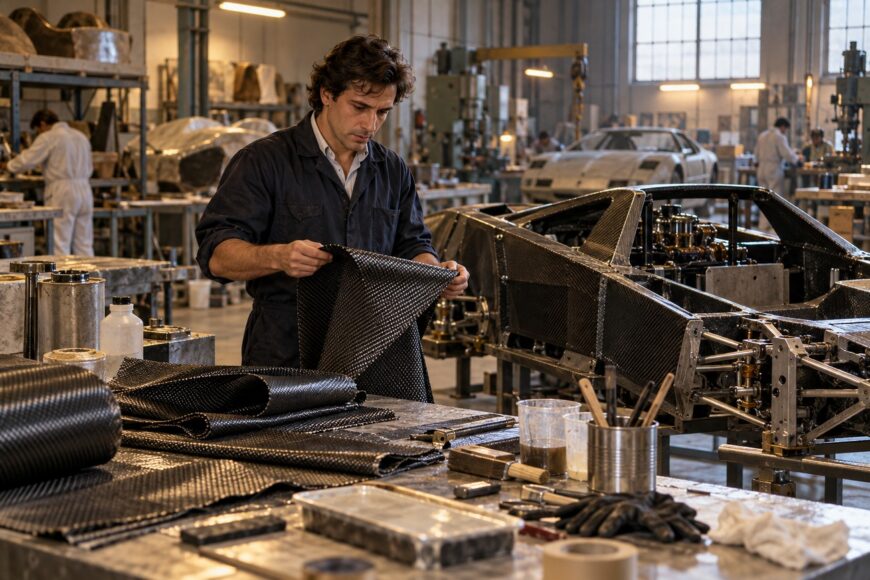
Pagani is widely seen as an Italian hypercar icon, yet its foundation came from an Argentine engineer, a rejected carbon-fiber investment, and a separate composites business. Horacio Pagani’s path ran through Lamborghini, where he worked on carbon components, before he built the industrial base that would become Pagani Automobili near Modena.
The Zonda was therefore both an engineering breakthrough and a demanding low-volume machine. Its carbon monocoque, naturally aspirated Mercedes-AMG V12, and extreme performance explain the fascination; rarity, legality, servicing, repair quality, and changing specifications explain why ownership requires much more scrutiny than a collector-car purchase based on appearance alone.
- How Horacio Pagani Went from Argentina to Lamborghini
- Why Lamborghini Rejected Pagani’s Carbon-Fiber Bet
- How Modena Design Became the Zonda C12
- From C12 to Zonda R: Why the Badge Never Tells the Whole Story
- What Zonda Ownership Really Demands
- The Used-Zonda Trap: Originality, Repairs, and Custom Specifications
- Road-Car Mythology: Is the Zonda R Legal on Public Roads?
- Frequently asked questions
- Was the Zonda connected to Pagani’s first Argentine race car?
- Why can two Zondas with the same model badge have very different values?
- Why might a Zonda’s VIN record not match its current specification?
- Why is a Pagani Zonda difficult to register in the United States?
How Horacio Pagani Went from Argentina to Lamborghini
Horacio Pagani is an Argentine engineer whose interest in vehicles developed before the Pagani name existed as a company. At age 21, he built an early racing project in Argentina. Pagani has regarded that car as his first Pagani in a personal and creative sense, although the brand and its legal identity came much later.
His move to Italy brought him into Lamborghini, where his professional value lay in engineering and materials rather than executive authority or formal design leadership. He specialized in composites at a time when carbon fiber was still an expensive and relatively unfamiliar solution for road-car production. His work included carbon components for the Countach, prototypes, and chassis.
That distinction matters because popular retellings sometimes present Pagani as Lamborghini’s chief designer or head of the company. He held neither role. His influence came from a narrower area with wide technical consequences: understanding how composite structures could reduce mass, improve stiffness, and support more ambitious vehicle architecture.
The experience also exposed him to the limits of established manufacturing culture. Lamborghini gave Pagani a valuable environment in which to develop his expertise, yet the company’s priorities did not automatically favor every material or production method he considered promising. The eventual Zonda grew from that specialist knowledge rather than from a senior corporate position.
Why Lamborghini Rejected Pagani’s Carbon-Fiber Bet
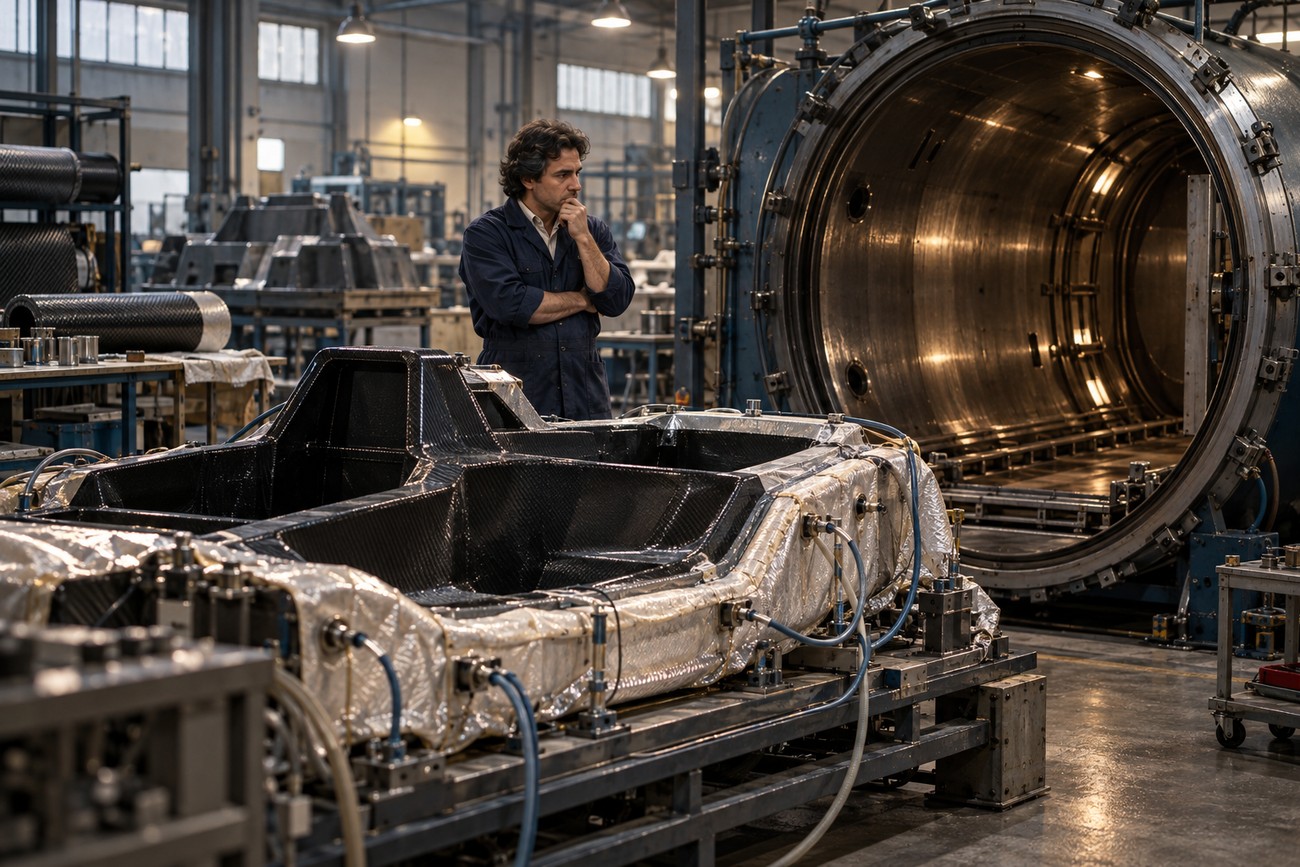
Pagani advocated broader use of carbon-fiber composites at Lamborghini and argued for an in-house autoclave. Such equipment allows composite structures to be consolidated under controlled heat and pressure, which is important when repeatable strength and dimensional accuracy matter. For a small engineering group, owning the process can also reduce dependence on outside suppliers.
Lamborghini management declined the investment, viewing an internal autoclave as too expensive or unnecessary for the company’s needs at that time. The disagreement is often simplified into a personal feud, but the underlying issue was industrial judgment. A manufacturer must balance technical potential against capital cost, production volume, repair systems, and the maturity of the market.
Pagani’s response was to create the capability elsewhere. After leaving Lamborghini, he founded Modena Design, a composites consultancy and manufacturing firm serving motorsport and original-equipment clients. This gave him a practical base for refining materials, tooling, and production methods without waiting for a larger manufacturer to approve the same investment.
Modena Design became the technical foundation for Pagani Automobili. The lesson was broader than “carbon is better.” Pagani’s later philosophy combined specialist equipment, direct control of composite work, low production volumes, and close attention to the individual car. That approach produced unusual technical freedom, while also creating the service complexity that would follow the Zonda throughout its life.
How Modena Design Became the Zonda C12
Pagani Automobili was founded in 1992 near Modena, in an area already dense with Italian motorsport and specialist manufacturing knowledge. The company’s first production car was the Pagani Zonda C12, which entered production in 1999. The gap between founding and production reflected the difficulty of turning a composite engineering concept into a complete, certifiable road car.
The C12 used a carbon-composite monocoque, a structure that integrates much of the passenger cell into one highly stressed shell. This was a direct continuation of Pagani’s Lamborghini and Modena Design experience. The monocoque provided a technical identity for the new company and made the Zonda more than a styling exercise assembled around a powerful engine.
Its layout was mid-engine and rear-wheel drive, with a 6.0-liter Mercedes-Benz V12 producing approximately 394 hp. That engine choice supplied a proven, naturally aspirated power source while leaving Pagani to concentrate on chassis structure, packaging, aerodynamics, and finish. The result combined a major manufacturer’s engine expertise with a small company’s willingness to tailor the surrounding car.
The C12 was therefore a technological statement as much as a brand launch. Its proportions, exposed mechanical details, and carbon structure announced a manufacturer that intended to control the material language of the vehicle. The same decision also made every later repair, modification, and restoration more specialized than work on a conventional steel-bodied sports car.
From C12 to Zonda R: Why the Badge Never Tells the Whole Story
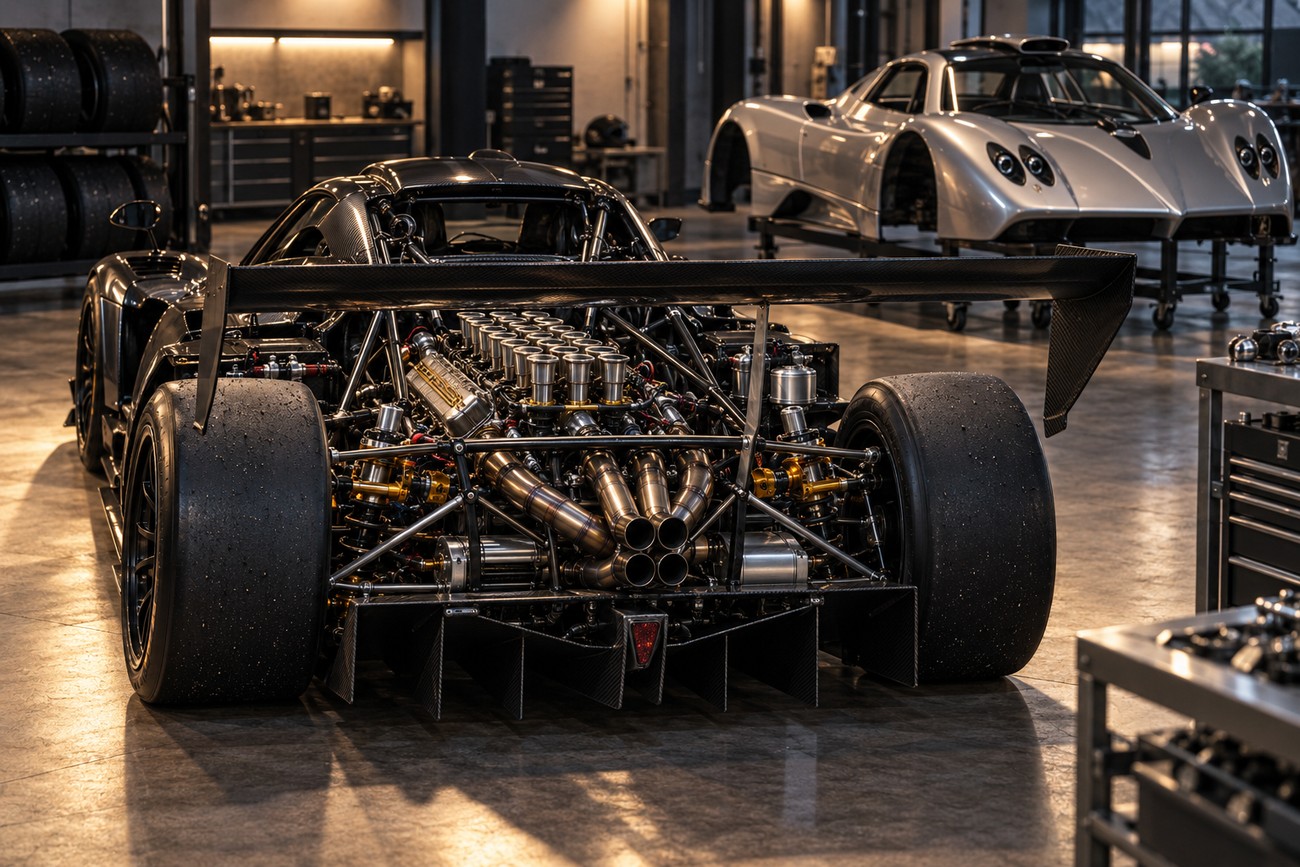
The Zonda was produced from 1999 to 2011, with approximately 209 cars built. Totals vary by source and counting method because special versions, one-off cars, and heavily modified examples are not always classified in the same way. That uncertainty is itself useful context: a Zonda badge identifies a family, not a uniform specification.
Across the range, the car used naturally aspirated Mercedes-AMG M120 V12 engines with displacements from approximately 6.0 to 7.3 liters. Power ranged from approximately 394 to 750 hp, while track versions exceeded 800 hp. Those figures describe a broad technical progression rather than a single engine package, and the difference between an early road car and a track-focused derivative is substantial.
Performance varied accordingly. Depending on version, acceleration from 0–100 km/h ranged from approximately 3.5 to 2.7 seconds, while top speed sat around 340–350 km/h. A typical Zonda was approximately 4.3–4.4 meters long, 2.05 meters wide, and 1.14 meters high, with mass around 1,100–1,200-plus kg depending on specification.
Those dimensions help explain the car’s character. The Zonda is low and wide, with little spare space for soft ride tuning or generous rear visibility. Weight reduction, aerodynamic load, and engine response often took priority over the compromises expected in a long-distance grand tourer.
Special, track-focused, and customer-specific cars cannot be treated as interchangeable. A Zonda R, for example, belongs to a different practical category from a road-going C12 or F. Even within road cars, factory upgrades and individual commissions can change brakes, aerodynamics, interior details, and other components, making the exact car more important than the badge on its engine cover.
What Zonda Ownership Really Demands
Finding a Zonda is difficult because availability is extremely limited. Cars may change hands through private allocations or specialist networks, and very few appear on the secondary market at any given time. A buyer may therefore spend as much effort verifying access, provenance, and support as locating the car itself.
Maintenance requires a specialist approach. Carbon-composite repairs need appropriate equipment and structural knowledge, and many workshops that understand exotic engines do not have the ability to assess or repair a Pagani monocoque correctly. Parts access can be limited, with expensive work and long waits when a component must be sourced or reproduced for a particular car.
Carbon repair must be judged through structural inspection and factory-matching documentation, not merely by checking whether a replacement panel aligns with the surrounding bodywork.
The powertrain adds another layer. A serious fault may involve Pagani-specific systems, composite packaging, or Mercedes-AMG engine support, requiring coordination between two technical worlds. That does not make the M120 V12 unsuitable; it means diagnosis and parts planning should be handled by people familiar with both the engine family and the individual Zonda’s configuration.
Road use can also expose the car’s compromises. Limited sound insulation, firm suspension, restricted rear visibility, and high cabin noise can make long trips tiring, especially in versions configured close to track specification. A collector who leaves the car stationary for long periods still needs regular technical maintenance, because seals, fluids, tires, brakes, and composite structures do not become maintenance-free when mileage is low.
The Used-Zonda Trap: Originality, Repairs, and Custom Specifications
The greatest risk in a used Zonda is often uncertainty rather than age. The cars were built in small numbers and frequently individualized, so two examples carrying a similar model description may differ in hardware, interior finish, aerodynamic parts, and factory history. A seller’s summary is a starting point, not a substitute for a complete technical file.
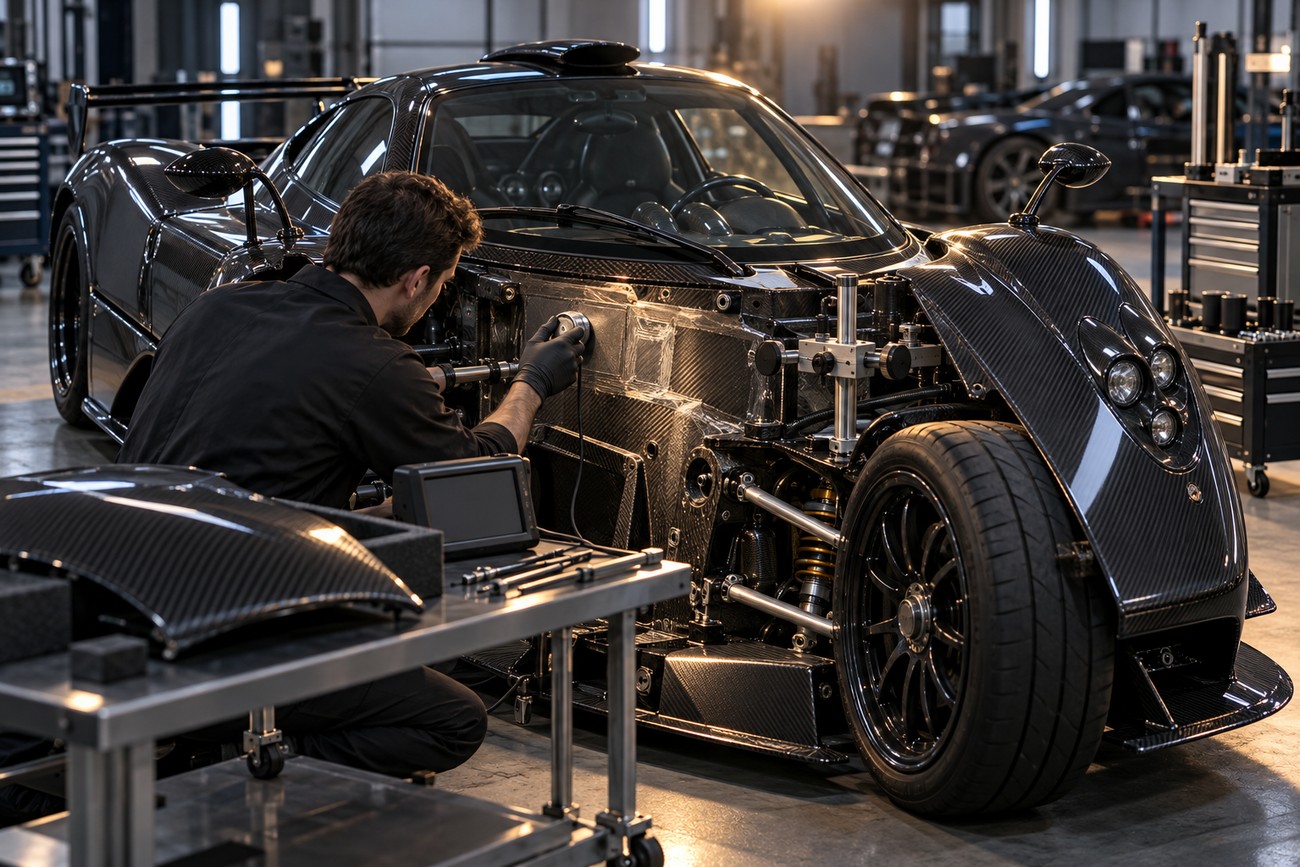
Damage to the carbon-composite monocoque deserves particular caution. A poor repair can affect structural safety, alignment, stiffness, and long-term value even when the exterior looks straight. Inspection should establish what was damaged, which materials and processes were used, who performed the work, and whether the result can be matched to documented factory methods.
Unapproved suspension, exhaust, engine-control, or aerodynamic changes can disturb the balance of the chassis. A component that appears to improve sound or visual presence may alter ride heights, damping behavior, heat management, or aerodynamic stability. Zonda engineering is highly integrated, so ordinary aftermarket logic can produce an expensive mismatch.
Factory modernization complicates the records further. Pagani has sometimes upgraded existing cars, meaning the current configuration may differ from the original VIN description. Value depends heavily on version rarity, factory history, originality, and documented specification; rarity alone does not make every Zonda equally collectible.
Road-Car Mythology: Is the Zonda R Legal on Public Roads?
The Zonda R is generally treated as a track car without full ordinary-road homologation. Its status should not be used to characterize every Zonda, because road-going versions were developed for different certification requirements. Legality depends on the exact version, market, and applicable documentation.
That distinction has practical consequences. A track-focused Zonda may require enclosed transport to a circuit, along with a plan for tires, fluids, setup, and spare parts. Low ground clearance, aggressive geometry, and exposed aerodynamic elements make ordinary roads risky even where limited access is technically possible.
On imperfect pavement, a splitter or diffuser can suffer damage from driveways, ramps, broken surfaces, and abrupt changes in elevation. The problem is therefore partly legal and partly physical: a car designed around smooth circuit asphalt may be difficult to use responsibly on public roads regardless of its headline performance.
A road-going Zonda should not be treated as legally interchangeable with a Zonda R. Registration questions must be answered using the individual vehicle’s certification and local rules, while track use requires accepting that transport and circuit logistics are part of the ownership model.
Frequently asked questions
The Zonda’s history connects personal ambition, composite engineering, and highly individualized production. Those factors also explain why its origin story, specifications, and legal status require careful distinctions. The following questions address the points most likely to cause confusion when researching the model.
Was the Zonda connected to Pagani’s first Argentine race car?
Yes, in personal and creative terms. Pagani considers an early racing project he built in Argentina at age 21 to be his first Pagani, even though Pagani Automobili and the Zonda name did not legally exist at that time.
The connection is therefore one of engineering origin rather than direct corporate continuity. The Argentine project illustrates the early ambition that later developed through Lamborghini, Modena Design, and the Zonda C12.
Why can two Zondas with the same model badge have very different values?
Value depends on more than horsepower or production year. Version rarity, provenance, factory history, originality, one-off specification, and the quality of supporting documentation can separate two cars that appear similar in a listing.
Later factory upgrades and customer modifications also matter. A highly individual car may be prized by one buyer and viewed cautiously by another, especially if its present configuration is difficult to verify or differs substantially from its original recorded specification.
Why might a Zonda’s VIN record not match its current specification?
A Zonda’s current configuration may reflect factory modernization or customer-specific updates carried out after the original build. Changes can involve aerodynamic parts, brakes, interior components, or other systems, so an original VIN description may not show the complete present-day car.
Buyers should compare the physical vehicle with factory correspondence, service invoices, inspection records, and documented upgrade history. The purpose is to establish what the car is now, which parts are original, and whether later changes were approved, correctly installed, and preserved in the provenance file.
Why is a Pagani Zonda difficult to register in the United States?
United States road legality is a certification and version-specific issue. The relevant questions concern the exact Zonda variant, its documentation, its compliance pathway, and the rules applicable to the intended registration, rather than a universal judgment on every car carrying the Pagani badge.
The Zonda R presents a separate problem because it is generally treated as a track car without full ordinary-road homologation. A road-going Zonda and a Zonda R should therefore be evaluated independently, with legal advice and certification records checked for the specific vehicle and jurisdiction.







