
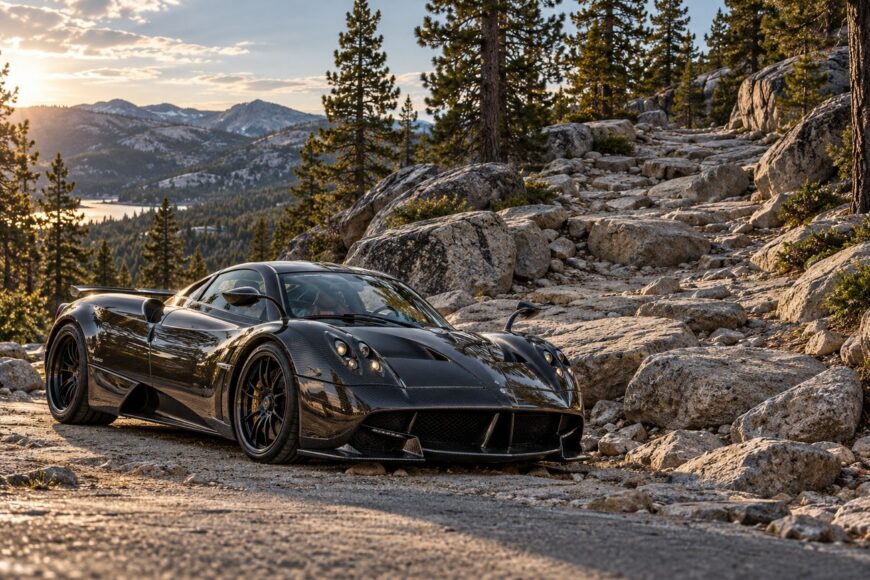
A Pagani Huayra looks like a carbon-fiber sculpture placed beside the Rubicon’s fractured granite. Its flowing bodywork, polished details, and active aero belong to a world of clean pavement and controlled speed; the trail brings ledges, loose rock, mud, water, and abrupt changes in grip.
This is a hypothetical comparison: no verified public test shows a production Huayra completing the Rubicon. Reaching a trail entrance is one thing. The test begins when the route demands clearance, protected sidewalls, four-wheel traction, and controlled crawling.
- A road masterpiece facing a different engineering problem
- Where Rubicon rocks would meet the Huayra first
- Why horsepower and carbon fiber cannot crawl for you
- The credible way to stage the contrast
- Frequently asked questions
- What should be checked before transporting a Huayra to a Rubicon-area photo location?
- What if a Huayra becomes stranded among the rocks?
- How much is a full carbon Pagani Huayra?
- Why is Pagani illegal?
- What is Pagani’s rarest car?
A road masterpiece facing a different engineering problem
The referenced Huayra specification uses a 6.0-liter twin-turbo AMG V12 producing 730 hp and 1,000 Nm. Pagani lists 1,350 kg, although weight varies by version. That combination gives the Huayra formidable acceleration and a high power-to-weight ratio on a paved road.
Its seven-speed automated manual gearbox sends drive to the rear wheels. Four active aerodynamic flaps adjust airflow and balance at speed, while the Carbo-Titanium/Carbo-Triax monocoque, steel front and rear subframes, and independent double-wishbone suspension create a sophisticated road-car platform.
Those features solve problems such as stiffness, response, weight control, and high-speed stability. They do not provide a low-range transfer case, four-wheel drive, rock sliders, or the protected underbody and suspension articulation expected of a technical trail vehicle.
Power and low mass can help a car build momentum, yet momentum is often the wrong tool on a narrow rock ledge. Rubicon obstacles reward measured wheel placement and sustained traction. Any full-trail success story should be treated as speculation.
Where Rubicon rocks would meet the Huayra first
The first problem would appear before the most dramatic obstacle. Rubicon terrain includes rocks, mud, water crossings, and steep climbs, so approach geometry matters as much as the clearance beneath the center of the chassis. A low front end can touch while climbing onto a ledge, and a long rear section can strike as the car leaves it.
Catalogs cite roughly 110 mm of clearance for the Huayra Roadster, but Pagani’s base-Huayra page does not confirm that figure. It should therefore be treated as a catalog reference for one version, not as verified clearance for every Huayra. Exact contact points would depend on the specific car, surface, and line.
As the trail narrows, sills and low aerodynamic pieces become exposed to side contact. A spotter would need to watch the outer edges of the car as carefully as the central underbody. A road car can clear the middle of a rock and still damage a sill, suspension component, or body panel when its wheels drop into different ruts.
Sharp rocks add a separate tire problem. Low-profile road tires are designed for paved surfaces and are vulnerable to sidewall cuts, bead damage, and hard lateral impacts. Rubicon guidance recommends approximately 3 inches of lift, tires of at least 33 inches, sill protection, and a locker or limited-slip differential; even 35–37-inch tires do not eliminate the possibility of hanging up on rocks.
Why horsepower and carbon fiber cannot crawl for you
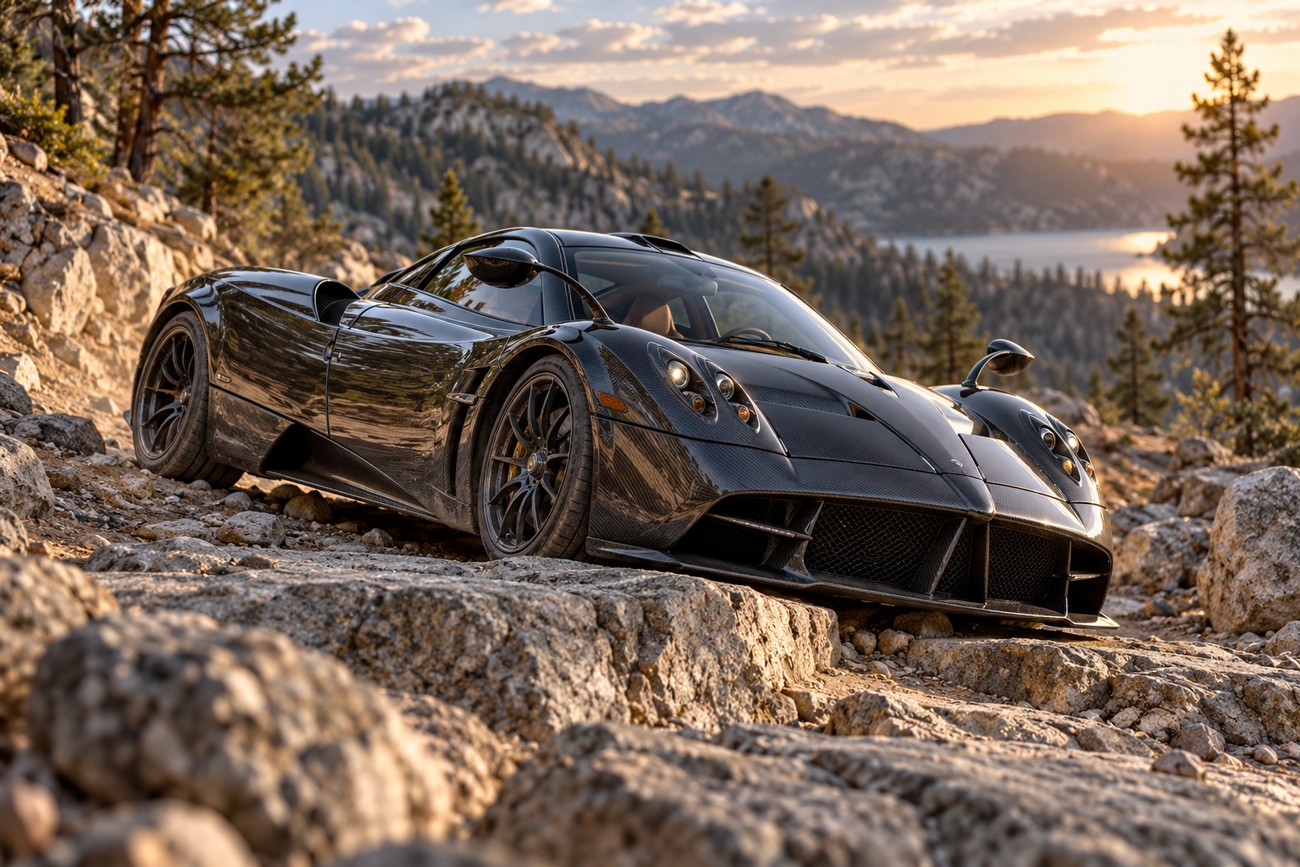
Technical Rubicon sections call for four-wheel drive and low-range gearing. The Huayra has neither an off-road low-range drivetrain nor the extra driven axle that helps distribute torque when one wheel loses grip. Rear-wheel drive can work on firm ground, yet loose rock and steep, uneven climbs make controlled traction much harder.
The automated manual gearbox may deliver rapid shifts during road driving, but slow stop-start crawling is a different workload. Without low-range reduction, the driver has less mechanical leverage at walking pace and may rely more heavily on throttle, clutch management, and braking. That can make precise progress difficult while increasing the chance of wheelspin.
Carbo-Titanium improves structural stiffness and reduces mass; it does not make carbon body panels or aerodynamic parts immune to local rock impacts. A concentrated strike can crack, puncture, or delaminate a composite component, and a damaged active-aero assembly could be costly even if the monocoque remains intact.
Repeated crawling, stopping, and restarting could also create heat in the clutch, brakes, or transmission. That is a plausible mechanical risk, not a documented Huayra failure on the Rubicon. There is no Huayra-specific trail data showing how its systems would behave through a complete technical section.
The credible way to stage the contrast
Legal access to a route does not establish that a road car is technically suited to it. A street-registered vehicle may be allowed to reach a trail, subject to local rules and conditions, while still lacking the geometry, protection, and traction equipment needed to complete the route safely.
The recommended lift, tires, sill protection, and traction aid work as a system. Larger tires affect clearance, gearing, steering, suspension travel, and body clearance, so fitting them alone would not turn the Huayra into a trail vehicle.
Even 35–37-inch tires do not remove the risk of differential or chassis hang-ups on rocks. A cosmetic lift would leave the fundamental rear-wheel-drive layout, road-oriented suspension, exposed carbon components, and absence of low-range control unchanged.
The sensible production is therefore a controlled visual contrast: transport the Huayra to a permitted, suitable viewing or photo location after checking its access conditions, and use a prepared Jeep for the technical trail. Preserving the car is more credible than confusing dramatic scenery with a valid off-road assessment.
Frequently asked questions
Practical questions begin before the Huayra reaches the trail: access conditions and safe transport both matter. If it becomes stranded, recovery must account for its vulnerable components. Questions about value, rarity, and road legality depend on the specific car and jurisdiction.
What should be checked before transporting a Huayra to a Rubicon-area photo location?
Verify permission, current road conditions, surface restrictions, and whether the selected location can accept the transport vehicle. Trailer loading and unloading angles deserve separate attention because a road-accessible viewpoint may still have a sharp transition that risks the Huayra’s front or rear bodywork.
What if a Huayra becomes stranded among the rocks?
Stop repeated wheelspin immediately and keep people clear of the vehicle. Arrange specialist recovery and never assume that a carbon panel, diffuser, suspension part, or aerodynamic component is a tow point. The correct recovery method depends on the specific car and any available manufacturer-approved attachment points.
How much is a full carbon Pagani Huayra?
There is no single universal price for a “full carbon” Huayra. Value depends on the exact version, specification, history, market, and condition, while carbon construction describes the vehicle’s engineering rather than a fixed retail category. A verified valuation requires the individual car’s documentation and current market evidence.
Why is Pagani illegal?
Pagani cars are not inherently illegal. Their road legality depends on the specific model, equipment, certification, and jurisdiction, while trail access is governed by separate route rules and vehicle capability. Legal permission to drive on a road or enter an area does not guarantee that a Huayra is suitable for a technical Rubicon section.
What is Pagani’s rarest car?
There is no single universally accepted answer without defining whether rarity means production quantity, one-off status, or a special factory commission. Pagani has produced limited and individually specified models, so the exact claim should be tied to documented production records rather than a general ranking.







