
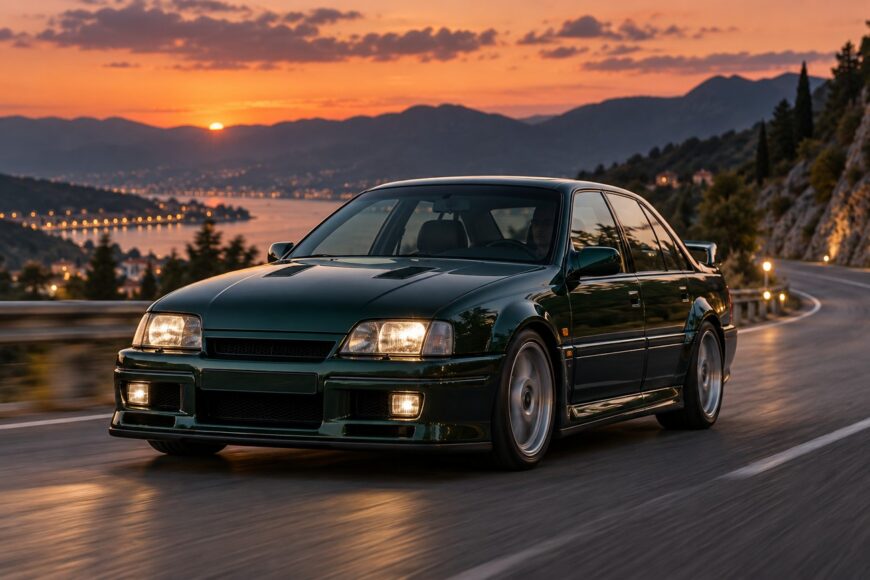
The Opel Lotus Omega is the contradiction at the heart of the 1990s performance car: a discreet family sedan with near-supercar pace, yet one that now demands specialist care and a realistic restoration budget. Its continental European identity, rear-wheel-drive layout, and rare six-speed manual make it more than an old executive car with a large engine.
Only approximately 950 examples were produced, so condition matters more than the badge. A documented, original car can be a compelling analogue performance machine; a modified or poorly maintained example can become an expensive project involving scarce turbocharger, electronic, cooling, and body components. Published performance figures also vary, with approximately 5.0 seconds to 100 km/h and approximately 282 km/h commonly accepted alongside frequently quoted 4.9-second and 280-km/h claims.
- Why the Opel Lotus Omega Was More Than a Fast Opel
- What the Performance Numbers Really Mean
- The Engineering Changes That Made the Power Usable
- Owning One Today: Fast, Rare, and Mechanically Demanding
- How to Inspect a Lotus Omega Before Buying
- Legend Versus Reality: The Myths That Mislead Buyers
- Frequently asked questions
- How much is a Lotus Omega worth?
- Why was the Lotus Carlton banned?
- What is the rarest Lotus car?
Why the Opel Lotus Omega Was More Than a Fast Opel
The Opel Lotus Omega is the continental European road version of the Lotus Carlton. It was based on the Opel Omega A and sold through the Opel dealer network, which explains why its restrained four-door shape could appear relatively ordinary to a casual observer. Underneath, however, the car was developed as a serious high-speed performance project.
The family-sedan disguise was part of its appeal. It offered four doors, a large cabin, and the visual restraint of an executive Opel, while Lotus reworked the mechanical package to deliver performance normally associated with specialist sports cars. That combination also explains why the car became so memorable: it placed extreme pace in a body designed for everyday transport.
Calling it an Omega with a bigger engine misses the engineering scope. The Lotus conversion significantly reworked the engine, transmission, brakes, suspension, and aerodynamics. Those changes were necessary because adding power to a standard executive sedan would not have addressed the demands created by higher speed, greater thermal load, stronger acceleration, and repeated braking.
The result is best understood as a Lotus-engineered performance sedan that retained Opel practicality and dealer support. That distinction matters today because replacement parts, inspection priorities, and restoration decisions cannot be approached as if the car were an ordinary Omega A.
What the Performance Numbers Really Mean
The specification is built around a 3.6-litre twin-turbocharged inline-six, usually quoted as producing 377 hp / 382 PS, approximately 280 kW, and 568 N·m of torque. Power reaches the rear wheels through a six-speed ZF manual. This combination gives the car a distinctly mechanical character, with the driver managing both the engine’s output and the available traction.
| Specification | Published or accepted figure |
|---|---|
| Engine | 3.6-litre twin-turbocharged inline-six |
| Power | 377 hp / 382 PS, approximately 280 kW |
| Torque | 568 N·m |
| Transmission | Six-speed ZF manual |
| Drivetrain | Rear-wheel drive |
| 0–100 km/h | Approximately 5.0 seconds; some sources quote 4.9 seconds |
| Top speed | Approximately 282 km/h; other sources commonly quote 280 km/h |
| Total production | Approximately 950 examples |
In daily driving, the torque figure explains the car’s character better than the horsepower headline. The engine can build speed with relatively little effort in the middle of the rev range, so overtaking and high-speed acceleration arrive with unusual authority for a family sedan. That same delivery can overwhelm the rear tires, especially on cold or wet pavement.
Rear-wheel drive and a manual gearbox make the car engaging, but they also remove the margin that modern all-wheel-drive systems and electronic intervention provide. Smooth throttle application matters, particularly when the road is damp. A driver who treats the car’s shape as evidence of ordinary family-car behavior may find the rear axle moving before the cabin feels dramatic.
Published acceleration and top-speed figures should be treated as approximate rather than universal results. The commonly quoted 4.9 seconds to 100 km/h and 280 km/h sit close to the accepted figures of approximately 5.0 seconds and approximately 282 km/h. Tires, vehicle condition, temperature, fuel, gearing, and measurement method can all change the observed result.
The Engineering Changes That Made the Power Usable
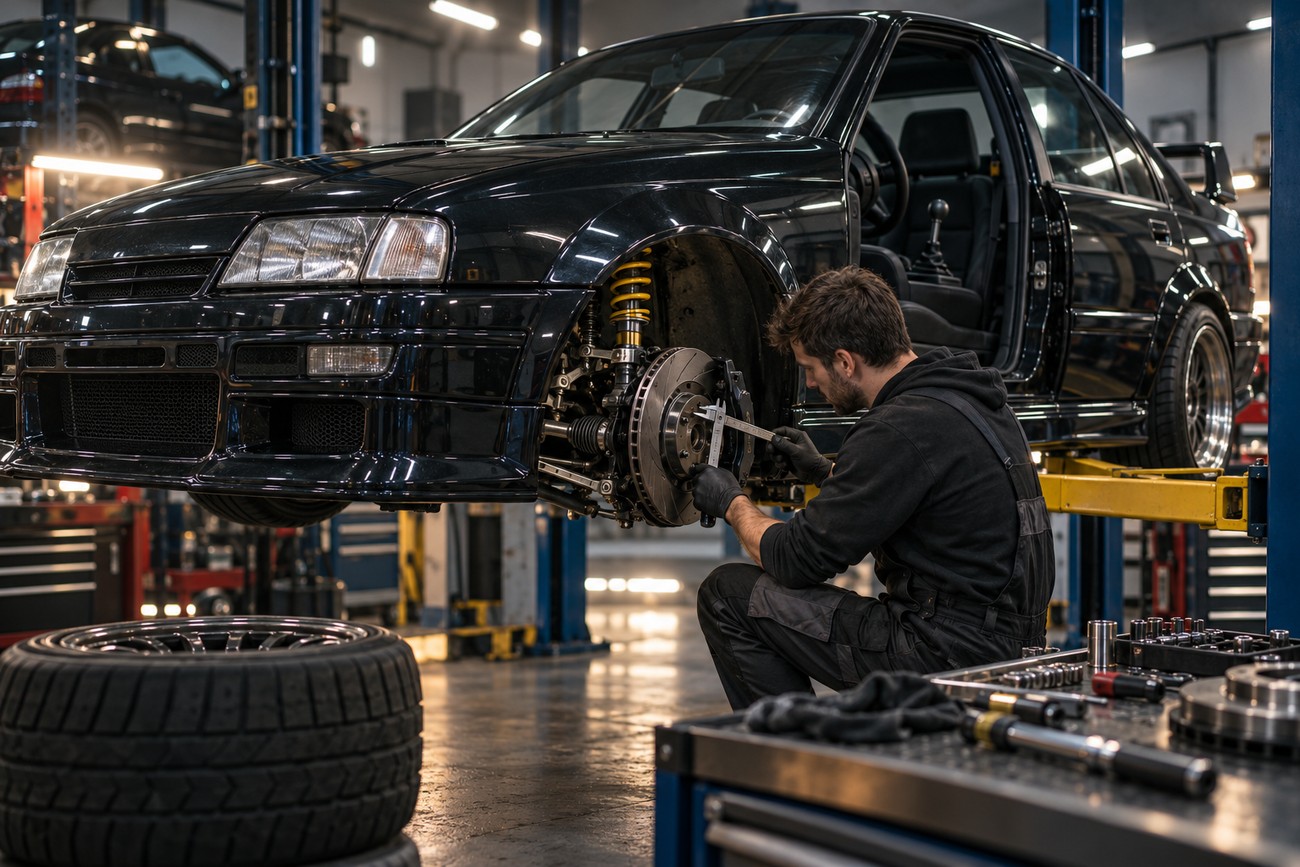
Power alone would not have made the Lotus Omega successful at speed. Compared with an ordinary Omega, it received substantially upgraded brakes and suspension, along with wider wheels and tires intended to manage its power and mass. These systems determine whether the car can remain composed after acceleration, through fast corners, and under repeated braking.
The six-speed manual and rear-drive chassis give the car an analogue quality that many modern performance sedans lack. They also make mechanical condition more important because the driver is directly involved in managing traction and gear selection. A tired clutch, worn suspension, or compromised tire can change the car’s behavior more dramatically than a small difference in engine output.
Cooling is equally central. A twin-turbocharged engine operating in an aging engine bay places substantial importance on radiators, hoses, seals, oil quality, and correct servicing. A car that appears to run strongly during a short drive may still carry evidence of past overheating or inadequate heat management.
Published details about turbocharger sizing, intake tuning, and exhaust configuration vary between sources. Those details should be verified against the specific car and its documentation rather than repeated as fixed specifications. The practical priority is the condition and correctness of the complete system, including cooling, lubrication, boost control, exhaust work, and calibration.
Owning One Today: Fast, Rare, and Mechanically Demanding
Approximately 950 examples were produced in total, and that small production run shapes every ownership decision. Original turbocharger, electronic, and body components can be difficult to source, while suitable specialists are less common than general repair shops familiar with ordinary Omega models. A repair that looks routine on a mass-produced sedan may become a sourcing and engineering exercise here.
Age is often a greater threat than the twin-turbo concept itself. Hoses, wiring, radiators, and seals have had decades to deteriorate, and cooling-system weakness can create consequences far beyond the original failed component. Temperature control, oil quality, correct servicing, and disciplined warm-up and cool-down are essential parts of ownership.
Running costs also extend beyond workshop bills. Insurance, taxation, specialist labor, and the cost of locating suitable parts can exceed what newcomers expect from an Opel-derived sedan. The cheapest car on the market may therefore be the most expensive purchase if it needs extensive mechanical and cosmetic restoration.
The cabin remains recognizably early 1990s. Noise, materials, seating, controls, and urban refinement do not match a modern performance sedan, and heavy traffic can make the car feel less relaxing than its family-car shape suggests. It is more convincing as a carefully used fast-distance machine than as effortless daily transport.
That compromise is part of the appeal for enthusiasts who value a manual gearbox, rear-wheel drive, and minimal electronic interference. A well-maintained example can feel unusually direct and elastic, but originality and documented history matter alongside rarity. Low production numbers alone do not guarantee reliability, comfort, or long-term value.
How to Inspect a Lotus Omega Before Buying
Begin with the engine, and treat a cold start as essential. A pre-purchase inspection should include compression testing, turbocharger condition, oil leaks, cooling-system evidence, and the behavior of the engine as it reaches operating temperature. Look for signs of overheating, poor servicing, or improvised repairs rather than focusing only on whether the car produces strong boost during a test drive.
Inspect the clutch and six-speed gearbox carefully, then assess the brakes, tires, and suspension as safety-critical systems. Wide tires and substantial brakes do not remove the effects of age, storage, incorrect parts, or deterioration. Uneven wear, vibration, poor pedal feel, or vague steering can indicate a larger restoration requirement.
Cooling-system history, turbo health, and non-factory modifications need to be diagnosed together because one problem can conceal or accelerate another. A rebuilt engine paired with improvised cooling or altered boost control is not automatically a reliable car.
Wiring, radiators, hoses, seals, and electronic components deserve the same attention as the major mechanical assemblies. Examine the body for poor repairs, corrosion-related work, mismatched panels, and evidence of accident damage. Originality is especially valuable when the alternative is a collection of undocumented modifications that no future specialist can confidently reverse.
Modified cars require extra skepticism. Tuning, non-standard exhaust work, altered cooling arrangements, or substituted control components may improve one aspect of performance while making factory operation difficult to restore. A lower asking price rarely compensates for missing records, unclear calibration, or a repair history based on trial and error.
The strongest purchase is the example with documented maintenance, coherent specification, and evidence of careful ownership. A specialist inspection before money changes hands is inexpensive compared with rebuilding a rare drivetrain or searching internationally for an original body or electronic component.
Legend Versus Reality: The Myths That Mislead Buyers
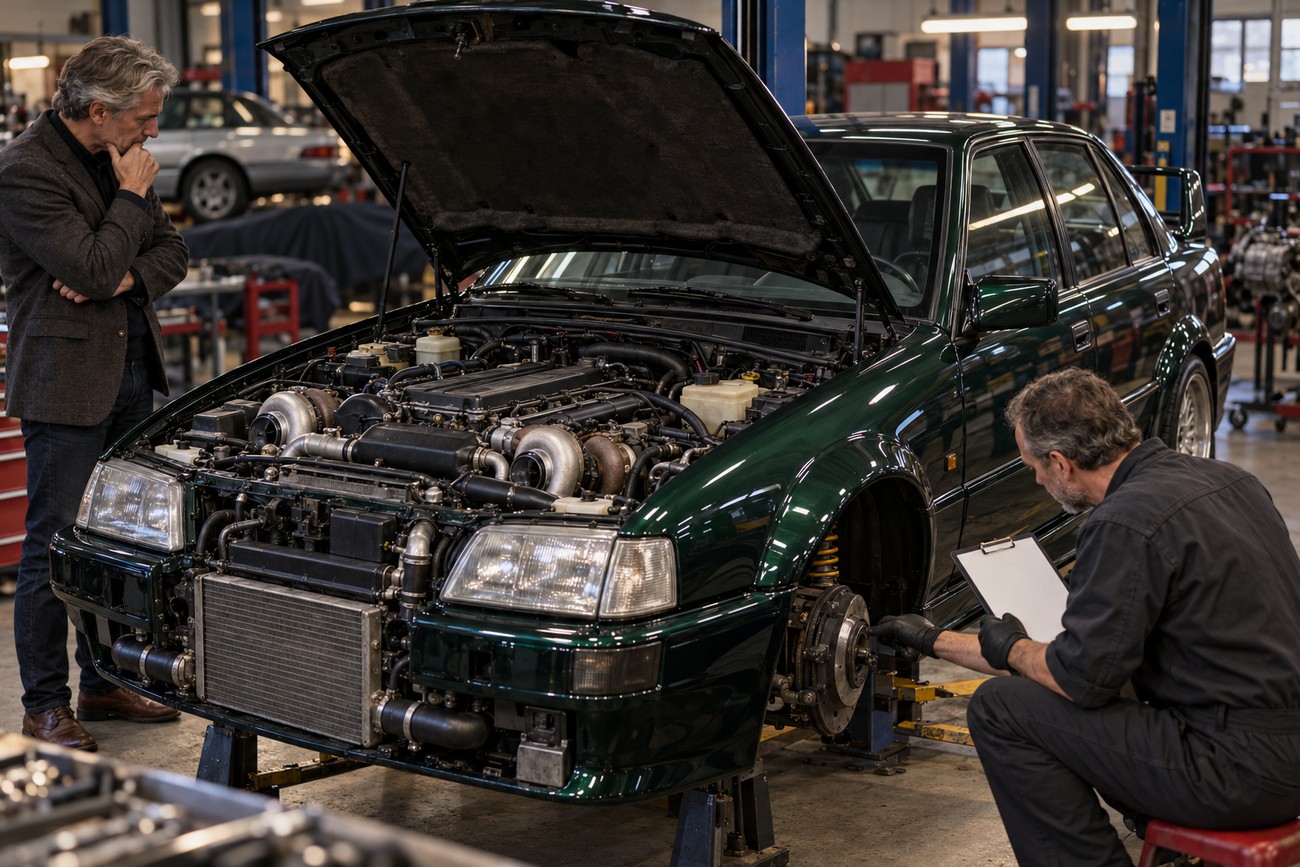
The Opel Lotus Omega was not simply an Opel with a larger engine. The Lotus conversion significantly reworked the engine, transmission, brakes, suspension, and aerodynamics, creating a performance system rather than an isolated power upgrade. Its family-sedan appearance is deliberately misleading when used as a guide to mechanical complexity.
Neither 280 km/h nor the alternative published figures should be treated as guaranteed results in every situation. Tires, temperature, fuel, vehicle condition, gearing, and test method influence acceleration and top speed. A healthy, correctly configured car may perform impressively, while a tired example can fall short despite having the right badge and specification.
Rarity also does not make the car automatically reliable. A small production run increases collector interest, but it can reduce parts availability and limit the number of workshops familiar with the model. Age-related hoses, wiring, radiators, seals, and cooling components remain real mechanical risks.
Twin-turbocharging is not proof that the engine is inherently fragile. Neglected maintenance, overheating, poor oil control, and badly executed modifications are more useful explanations when diagnosing failures. The engine’s complexity demands discipline, yet its ownership risk is determined largely by the history and condition of the individual car.
Frequently asked questions
How much is a Lotus Omega worth?
There is no reliable single price because value depends on originality, documented history, mechanical condition, restoration needs, and parts scarcity. A structurally sound, original example with clear maintenance records will generally be more desirable than a cosmetically attractive car with undocumented tuning or incomplete repairs.
Inspection should therefore come before valuation. A lower-priced car needing turbocharger, cooling, electronic, body, brake, or suspension work can require substantially more expenditure than a properly maintained example. The market rewards provenance and correctness, not rarity in isolation.
Why was the Lotus Carlton banned?
The Lotus Carlton became the subject of public controversy in the United Kingdom because its performance was considered excessive for a family sedan, and its launch prompted a public campaign and parliamentary debate. The simplified claim that the model was universally banned is inaccurate.
The controversy helped create the car’s legend, especially because its restrained appearance contrasted with its speed. The important distinction is between public and legal opposition surrounding the model and a blanket prohibition that applied everywhere.
What is the rarest Lotus car?
There is no single universally accepted answer because Lotus produced limited-run road cars, special editions, prototypes, and competition-related derivatives under different definitions of “rarest.” Production totals also vary depending on whether a model is counted globally, by body style, or by a specific homologation version.
The Lotus Omega is rare at approximately 950 examples, but rarity alone does not make it the rarest Lotus. For buyers, the more useful measure is verifiable originality, documented history, and the availability of the parts needed to preserve the particular car.







