
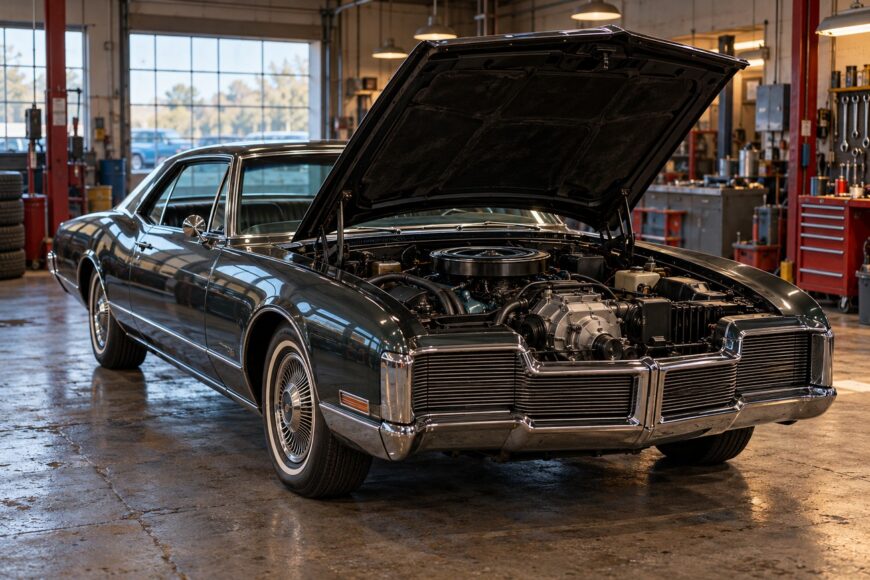
The Oldsmobile Toronado was an unlikely mechanical proposition: a very large American V8 coupe driving its front wheels through a chain-driven transaxle. In an era when American performance usually meant a longitudinal engine, a driveshaft, and rear-wheel drive, the Toronado placed its heavy powertrain at the front and made the front axle handle propulsion as well as steering.
That contradiction defines the car today. The large-displacement V8 delivers effortless torque, and the Toronado remains an important engineering statement, yet its weight, service complexity, fuel consumption, and age-related faults can overwhelm an unprepared owner. The badge may suggest a conventional full-size cruiser; the drivetrain demands a more specialized inspection and maintenance plan.
- Why the Toronado Was More Than a Big American Coupe
- Toronado Specifications: Why the Numbers Do Not Always Match
- How the Front-Wheel-Drive V8 Drivetrain Worked
- What the Toronado Feels Like on the Road
- The Ownership Costs Hidden Behind the V8 Image
- How to Inspect a Toronado Before Buying
- Restoration, Originality, and Collector Value
- Common Toronado Myths and the Sensible Verdict
- Frequently asked questions
- Was the Oldsmobile Toronado a good car when new?
- How much horsepower did a 1969 Oldsmobile Toronado have?
- What should a buyer document before purchasing a modified Toronado?
Why the Toronado Was More Than a Big American Coupe
The first-generation Oldsmobile Toronado launched in 1966 as a front-engine, front-wheel-drive coupe. Its significance came from combining a large American V8 with a driven front axle at a scale that made the packaging problem impossible to ignore. This was not a small economy car using front-wheel drive to save fuel or cabin space. It was a substantial performance-oriented coupe built around a layout then considered highly unusual for American V8 machinery.
Traditional American performance engineering relied on rear-wheel drive because it separated steering from propulsion and allowed the engine, transmission, and rear axle to occupy familiar positions. The Toronado required a different solution. Its engine and transmission had to share the front of the car while sending torque through a compact transaxle arrangement, leaving the passenger compartment free of a conventional driveshaft tunnel.
The choice created a useful packaging advantage. A long hood could still accommodate the V8, while the floor and cabin avoided the full-length propeller shaft normally associated with a rear-drive American coupe. That benefit came with concentrated mechanical loads at the front axle, where steering, braking, suspension, and drive torque all had to coexist.
Its historical importance therefore rests on engineering, rather than on a claim that front-wheel drive made the car light, economical, or inherently nimble. The Toronado demonstrated that a large V8 and front-wheel drive could function together in a full-size American coupe. The solution was clever enough to become the car’s defining identity and complicated enough to remain a major ownership consideration.
Toronado Specifications: Why the Numbers Do Not Always Match
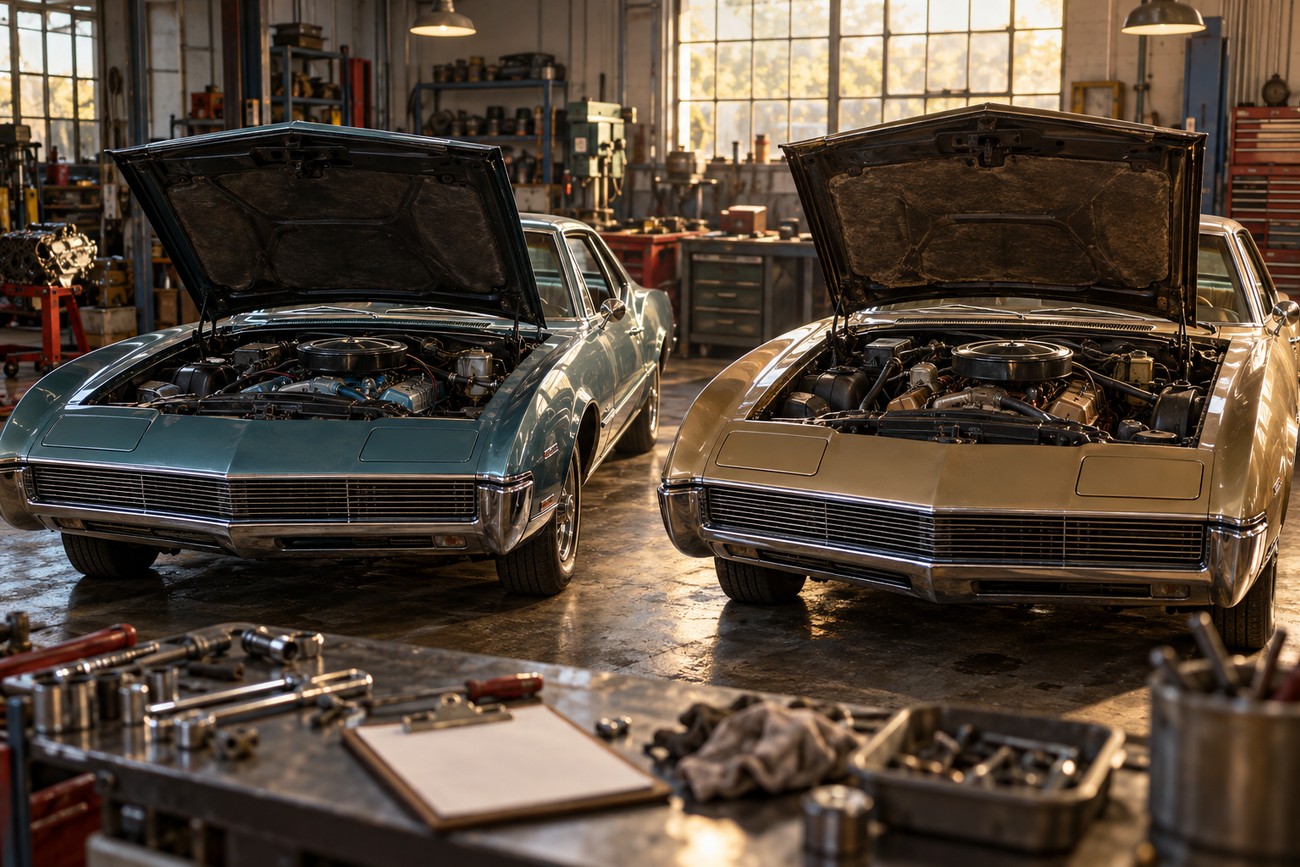
Toronado specifications should be read by model year and source. Early specifications commonly cite a 7.0-liter V8 rated at 385 hp, while a 1968 road-test reference cites a 455 cu in engine, approximately 7.45 liters, and 400 hp. Those figures describe different year and source contexts, so neither should be applied as the universal rating for every first-generation Toronado.
The distinction between a factory-style specification and a road-test result matters. A published rating may reflect the manufacturer’s stated configuration and measurement practice, while a magazine test identifies the particular engine, calibration, and test car being evaluated. The 385-hp and 400-hp figures are therefore year- and source-dependent figures, rather than interchangeable labels for the model.
Displacement also deserves careful checking. A buyer examining a 1968 car should establish whether the engine corresponds to the 455 cu in, approximately 7.45-liter reference, instead of assuming that every early Toronado carried the commonly cited 7.0-liter engine. Casting information, service records, and the actual engine installation provide more useful evidence than a generic online specification sheet.
Even basic dimensions vary across secondary sources. Reported overall length falls approximately between 5.36 and 5.59 meters, depending on the source and version. That spread is large enough to affect garage planning, transport, storage, and the driver’s sense of the car on tight streets. A prospective owner should verify the exact year and body configuration before ordering covers, arranging shipping, or relying on catalog measurements.
How the Front-Wheel-Drive V8 Drivetrain Worked
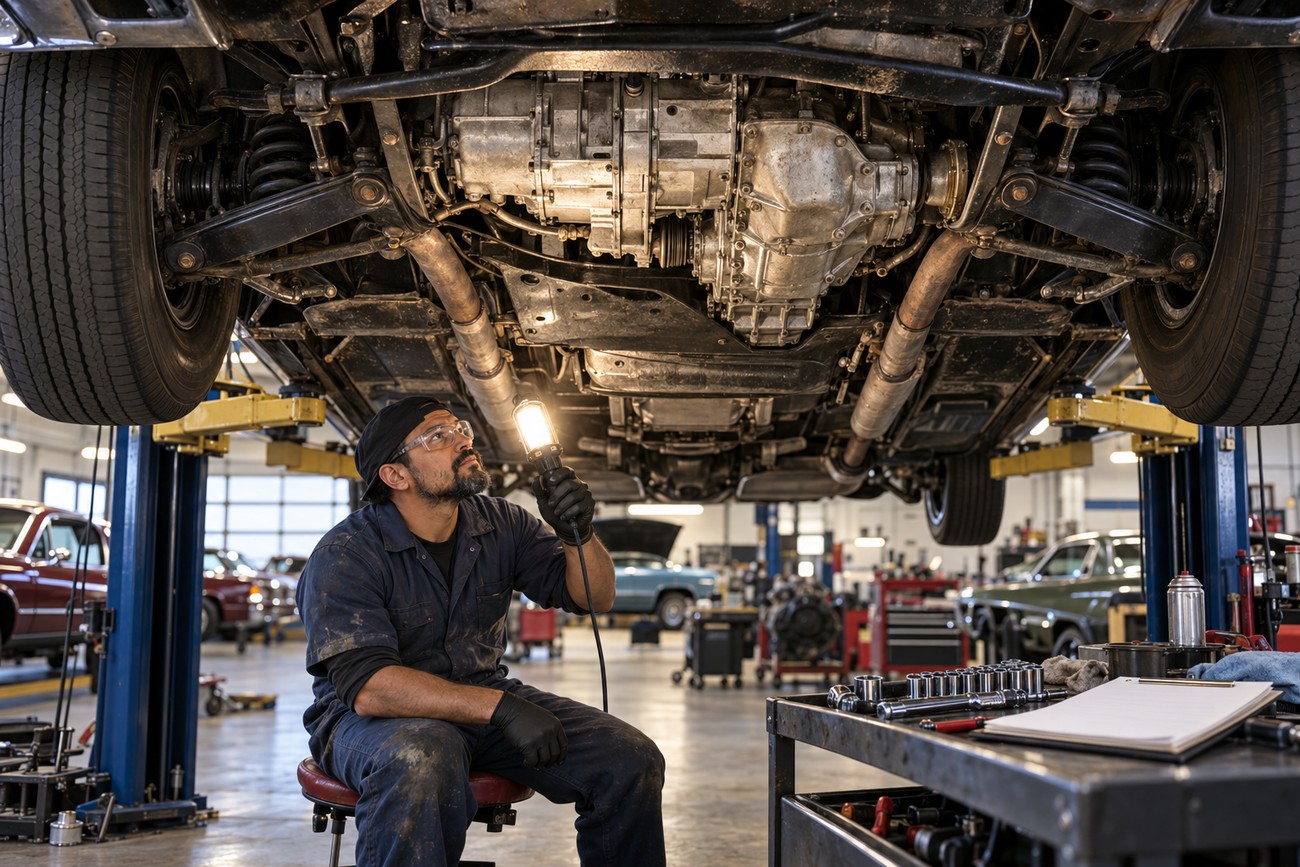
The Toronado used a 3-speed THM-425 automatic transmission adapted to the front-wheel-drive layout. Instead of sending torque through a conventional driveshaft to a rear axle, the powertrain transferred torque through a chain drive to the final drive. The final drive was integrated into the transaxle case, allowing the engine and transmission to remain together at the front of the car.
In simple terms, the chain allowed the transmission and final-drive components to occupy a workable relationship within the front transaxle package. That arrangement solved a major packaging problem created by the offset relationship between the engine’s output and the front axle. It also concentrated the drivetrain in a space where access was limited by the V8, body structure, suspension, and steering hardware.
The layout explains why the Toronado cannot be approached exactly like a conventional rear-drive Chevrolet or Oldsmobile. A mechanic may understand the engine perfectly and still need additional knowledge of the THM-425, chain drive, integrated final drive, and front-drive service procedures. The mechanical concept is understandable; practical access and parts availability are less forgiving.
This architecture also matters when evaluating replacement parts or previous repairs. A transmission issue, a chain-drive concern, and a final-drive problem may present as related driveline symptoms, while the correct repair depends on identifying the actual source. Generic assumptions about rear-drive automatic transmissions can lead to incorrect diagnosis, unnecessary disassembly, or a search for parts that do not fit the Toronado’s specific arrangement.
What the Toronado Feels Like on the Road
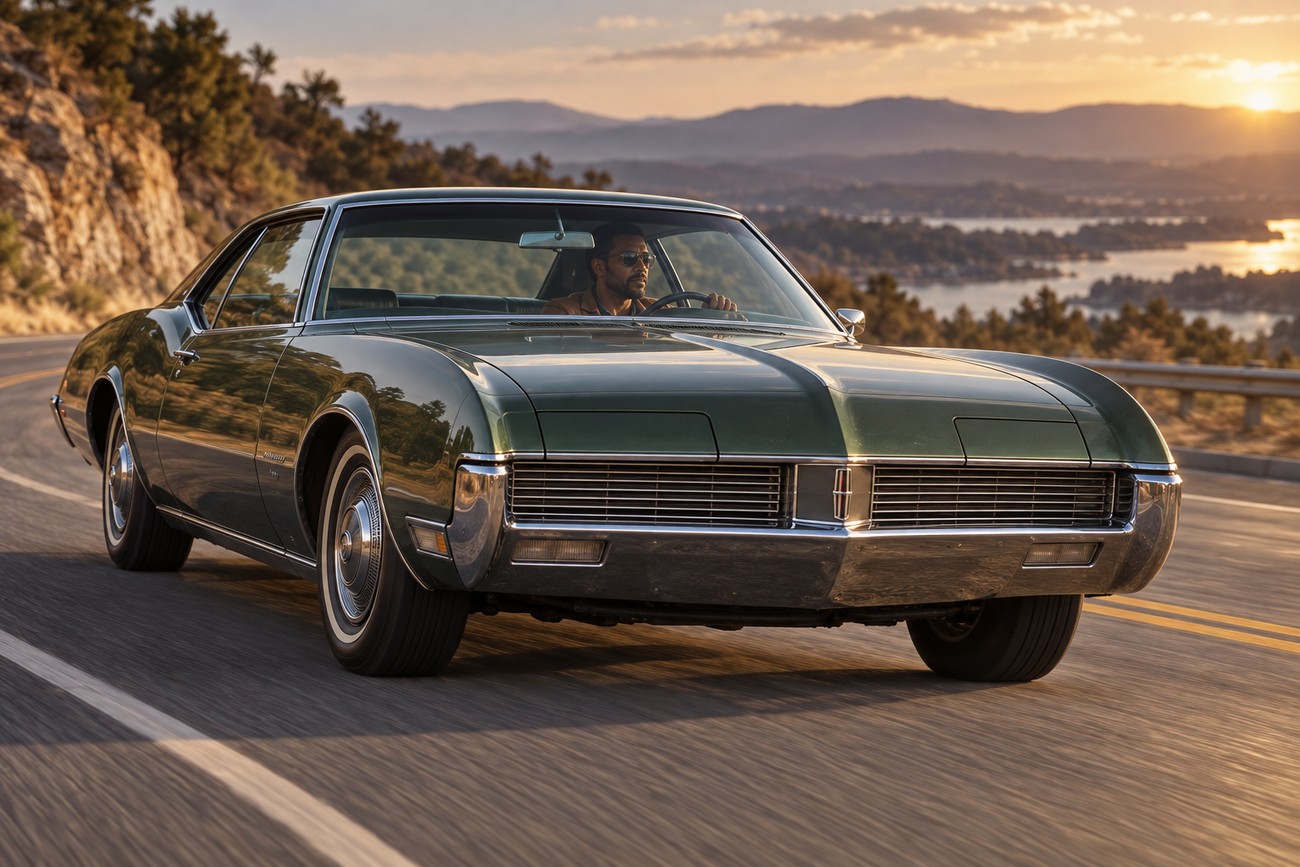
The Toronado’s road character starts with torque. A Car and Driver test reported 500 lb-ft at 3,200 rpm for the 1968 Toronado, enough to give the car strong straight-line authority without requiring constant high-rpm operation. Published 0–100 km/h figures vary approximately from 7.5 to 9.5 seconds, depending on the year and test method, so acceleration claims should be treated as period-specific measurements rather than a single definitive result.
That performance arrives through a very large and heavy car. Early Toronados have a pronounced front-end weight bias, and the driver feels the mass most clearly during low-speed maneuvering, braking, and rapid changes of direction. The steering and suspension are managing a substantial front assembly that also delivers engine torque, so a worn example can feel reluctant or imprecise even when the engine remains strong.
Owner discussions commonly mention a heavy nose and a dislike of abrupt low-speed maneuvers. Such comments are useful clues, though they are not factory test data. Tire condition, alignment, spring and bushing wear, brake condition, and drivetrain modifications can change the behavior substantially. A sound Toronado and a tired Toronado may share the same specifications while giving very different impressions.
One source observes that the front end did not rise during acceleration or on climbs. That is an isolated driving observation, not a universal specification for every Toronado. The more dependable conclusion is that the front-drive layout changes the way the car transfers power compared with a rear-drive V8, while the car’s mass and front-heavy balance remain central to its character.
The Ownership Costs Hidden Behind the V8 Image
Fuel consumption is an obvious weakness. Front-wheel drive did nothing to turn a heavy coupe with a large-displacement V8 into an economical car, and the drivetrain’s historical interest should not be confused with low running costs. Anyone using a Toronado regularly needs to budget for fuel in addition to the ordinary expenses of an old, heavy vehicle.
Service access creates a second cost. The V8, front-drive hardware, steering components, and transaxle occupy the same crowded end of the car, making some operations substantially less convenient than comparable work on a conventional rear-drive coupe. Labor time can rise when a component is sound in principle yet difficult to reach, remove, or reinstall.
The THM-425, chain drive, and front-drive-specific parts also deserve advance planning. Owners and specialists report that some components can be costly or difficult to source, especially when a car has been neglected or modified. Availability varies by market and by the condition of the particular part, so a buyer should identify competent supply and repair options before committing to a project.
Age adds risks independent of the unusual drivetrain. Wiring can deteriorate, fluid leaks can develop in multiple systems, and suspension and brake components can lose effectiveness under the load of a large car. A powerful engine may make a worn Toronado feel lively during a short drive while the braking, steering, and suspension systems remain unsafe or expensive to recommission.
Thermal load is another restoration concern. The engine bay contains a large V8 and a tightly packaged front-drive system, while decades of degraded hoses, wiring, seals, cooling components, and previous repairs can complicate diagnosis. These are commonly reported owner concerns and restoration priorities, rather than claims that every Toronado has the same fault. The sensible approach is to inspect each system and document its condition.
How to Inspect a Toronado Before Buying
Start with identity and documentation. Confirm the model year, engine configuration, transmission identity, and any evidence that the major aggregates are original or consistent with the car. This step prevents the common mistake of buying a car advertised with a broad Toronado description and discovering that its engine, transmission, or drivetrain has been changed without a clear record.
The first mechanical inspection should cover the THM-425, chain drive, and integrated final drive. Listen for abnormal noises during engagement, acceleration, deceleration, and steady cruising, and look for leaks around the transmission and final-drive areas. A clean underside is useful evidence, but fresh cleaning can conceal seepage, so the car should be inspected again after a proper road test.
A drivetrain can sound acceptable when cold and reveal chain-drive, final-drive, or THM-425 problems only after the fluid and components are fully warm. Inspect it cold, drive it under load, allow it to reach operating temperature, and then repeat the noise and shift checks before drawing a conclusion.
Cold-start behavior should be recorded rather than judged by a few seconds of engine noise. Check how the engine starts, how it holds temperature, and whether leaks or electrical faults appear as the car warms. Cooling performance, charging behavior, wiring condition, and signs of excessive heat in the engine compartment deserve attention because a short static demonstration cannot reproduce the load of driving.
Brakes and suspension should receive the same scrutiny as the engine. The car’s mass increases the consequences of worn brakes, loose steering components, tired springs, and degraded bushings. Uneven braking, wandering, harsh impacts, or excessive body movement may indicate work that costs more than the cosmetic issues visible in the advertisement.
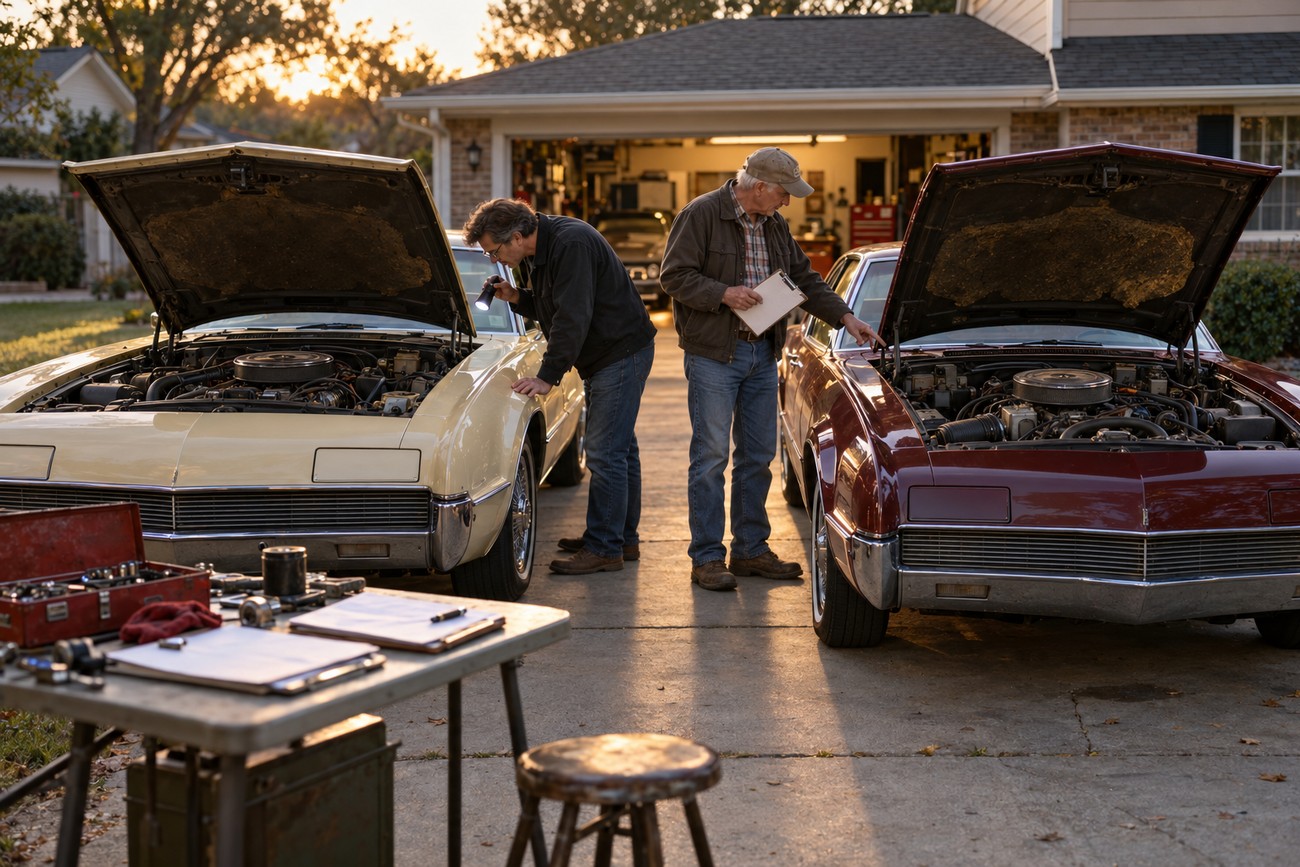
Finally, look for drivetrain modifications and undocumented repairs. A non-original transmission, altered mounts, substituted controls, or improvised wiring can change both serviceability and driving behavior. Ordinary Chevrolet-style service knowledge is useful for general mechanical principles, yet it is insufficient by itself for a front-wheel-drive V8 with Toronado-specific hardware. Treat the car as a rare large classic, and have a specialist review the drivetrain before purchase.
Restoration, Originality, and Collector Value
Cosmetic quality does not establish mechanical authenticity. A freshly painted Toronado may conceal a substituted engine, an incorrect transmission, incomplete cooling work, or a modified front-drive system. Conversely, a preserved car with honest age and a documented drivetrain can provide stronger evidence of what the car actually is and how it was maintained.
Confirmed history and original major aggregates can increase collector confidence because they reduce uncertainty. This does not make every original car mechanically superior to a restored one. It does mean that the buyer can distinguish an authentic configuration from a visually convincing reconstruction and can make restoration decisions with better information.
Modified examples require a separate judgment. An engine or transmission change may improve service access or suit a particular owner’s needs, while altered mounts, controls, gearing, or suspension can affect how the Toronado behaves on the road. Such modifications may also reduce collector appeal when they cannot be reversed or documented.
Restoration work should respect the unusual front-wheel-drive hardware. Replacing visible trim while postponing the THM-425, chain drive, cooling system, brakes, or wiring produces an attractive car with unresolved risk. A careful project establishes the mechanical baseline first, records what is original, and then decides whether preservation, sympathetic repair, or modification best suits the intended use.
Common Toronado Myths and the Sensible Verdict
The claim that every Toronado was a 7.0-liter, 385-hp car is too broad. Early specifications commonly cite a 7.0-liter V8 rated at 385 hp, while a 1968 road-test reference cites a 455 cu in engine, approximately 7.45 liters, and 400 hp. The correct figure depends on the year, engine version, and source, so a responsible description keeps that context attached.
Front-wheel drive also did not make the Toronado economical. It solved a packaging and drivetrain-layout problem within a large V8 coupe, while the vehicle retained substantial mass and a large-displacement engine. Buyers attracted by the drivetrain should expect engineering distinctiveness and strong torque, rather than the fuel costs associated with a smaller or lighter car.
Calling the Toronado an ordinary American coupe misses its main achievement. Its body, V8, automatic transmission, and broad road presence belong to the American grand-touring tradition, yet the chain-driven transaxle and front-drive power path distinguish it mechanically. That distinction is why parts sourcing, specialist knowledge, and careful inspection matter more than a generic classic-car checklist.
The sensible verdict is conditional. The Toronado suits an enthusiast who values unusual engineering, period performance, and the experience of operating a large front-drive V8. It is a poor choice for someone seeking inexpensive ownership, simple repairs, or modern maneuverability. Buy the documented, mechanically understood example you can support, and the car’s contradictions become part of its appeal rather than an unpleasant surprise.
Frequently asked questions
Was the Oldsmobile Toronado a good car when new?
Yes, it was a significant and capable car by period standards, especially for buyers who valued its engineering, torque, and high-speed American coupe character. The first-generation Toronado’s front-engine, front-wheel-drive layout and 3-speed THM-425 made it technically distinctive, while its large V8 gave it strong performance for a car of its size.
“Good” needs a period reference point. Its weight, fuel consumption, and unusual service requirements were part of the ownership proposition from the beginning, and modern expectations make those traits more conspicuous. The Toronado was a successful engineering statement and an appealing grand-touring machine for the right buyer; it was never a sensible substitute for a small, economical, easy-to-service car.
How much horsepower did a 1969 Oldsmobile Toronado have?
The answer should be taken from a 1969-specific factory reference or authoritative technical record for the exact engine version. Published Toronado figures vary by year, engine configuration, rating method, and source, so applying the commonly cited early 385-hp figure or the 1968 road-test reference of 400 hp to every nearby model year can produce a misleading answer.
A buyer or writer should identify the engine first, then state whether the number is a manufacturer-style rating or a road-test result. The 1968 reference concerns a 455 cu in, approximately 7.45-liter engine and reports 400 hp; it should remain tied to that test context. The early 7.0-liter, 385-hp figure likewise belongs to its own year and specification context.
What should a buyer document before purchasing a modified Toronado?
Document the engine identity, transmission identity, and the history of every drivetrain change. The file should record whether the THM-425 remains installed, what happened to the chain-drive and final-drive arrangement, whether mounts or controls were altered, and which major parts were replaced. Clear photographs, invoices, serial or casting information where available, and dated service records are more useful than a seller’s general statement that the car has been “upgraded.”
Also establish what remains original: the engine, transmission, front-drive hardware, wiring, cooling system, suspension, and brakes. A modified car can be usable and well engineered, yet undocumented changes complicate future repairs and make collector evaluation harder. Proof of originality is especially valuable where it exists, because confirmed history and original major aggregates can matter more than cosmetic presentation alone.







