
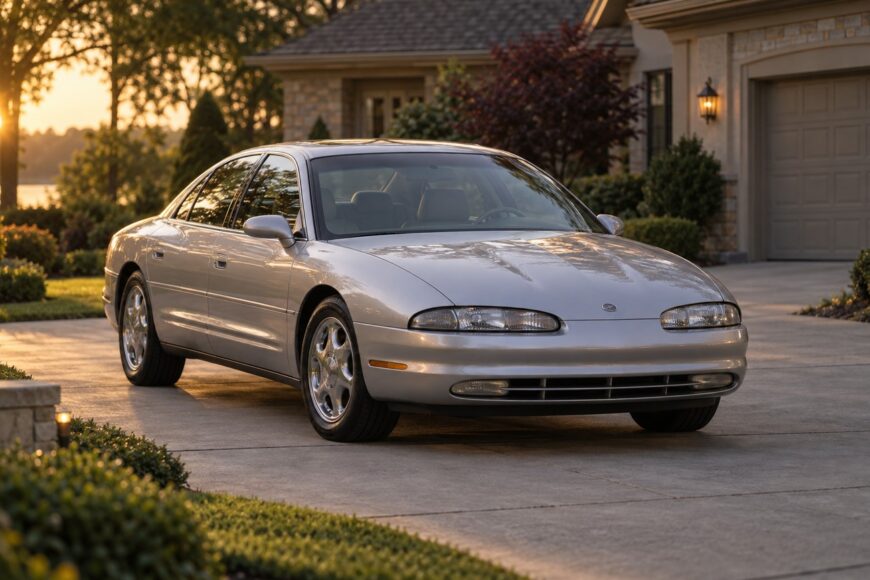
The Oldsmobile Aurora was a technically ambitious near-luxury sedan wearing a badge whose influence was already fading. Its V8, quiet ride, and distinctive design gave it more substance than a conventional family Oldsmobile, yet the brand itself could not provide the prestige or market confidence that the car was meant to challenge.
That contradiction explains the Aurora’s appeal today. Enthusiasts still value the first generation’s smooth 4.0-liter V8 and substantial comfort, while the car’s rarity gives it an identity missing from more common sedans. Ownership, however, depends on whether that character outweighs the practical risks: fuel consumption, aging electronics, scarce parts, transmission repairs, and difficult resale.
- Why Oldsmobile Needed the Aurora
- First- and Second-Generation Aurora: What Changed
- The Engineering That Made Aurora Special—and Complicated
- The Ownership Costs Hidden Behind the Bargain Price
- How to Inspect a Used Oldsmobile Aurora
- Why Aurora Failed—and What It Is Worth Today
- Frequently Asked Questions
- Why did the Oldsmobile Aurora fail despite its strong engineering?
- How much is a 1995 Oldsmobile Aurora worth today?
- What did the Oldsmobile logo look like on Aurora models?
Why Oldsmobile Needed the Aurora
Oldsmobile introduced the Aurora in 1994 to give the division a modern flagship and a credible entry into the near-luxury market. The strategy relied on engineering and presentation rather than badge prestige. A long, clean body, a carefully finished cabin, a powerful V8, and a quieter driving experience were intended to move Oldsmobile closer to Cadillac, Acura, and other established premium competitors.
The first-generation car used the 4.0-liter L47 V8, an engine related to Cadillac Northstar technology. That relationship mattered because it gave Oldsmobile access to advanced aluminum-engine engineering and strong performance without making the Aurora a simple Cadillac clone. The model had its own styling, interior treatment, and front-wheel-drive layout.
Oldsmobile’s problem was larger than the quality of one sedan. The division’s identity had become unclear, and many buyers no longer saw the badge as a meaningful premium signal. Aurora could demonstrate that Oldsmobile was capable of building a refined and sophisticated car, but it could not quickly rebuild the brand’s reputation across the market.
Production continued from 1994 to 2003, ending in March 2003 after Oldsmobile’s closure. The result was an accomplished car with a short commercial future. Its engineering merits survived the brand, while its badge became part of the reason the model was overlooked.
First- and Second-Generation Aurora: What Changed
Aurora specifications vary by model year and source, so the engine and VIN should always be checked before using performance, fuel, or parts information.
| Generation | Engine and approximate output | Transmission | Drivetrain | Character and ownership implication |
|---|---|---|---|---|
| First generation | 4.0-liter L47 V8, approximately 250–253 hp and 352–353 Nm | Usually four-speed 4T80-E automatic | Front-wheel drive | Strong V8 identity, smooth performance, and more complex age-related repairs |
| Second generation | 3.5-liter LX5 V6, approximately 215–218 hp and 312–317 Nm; later 4.0-liter V8 | Usually four-speed 4T80-E automatic | Front-wheel drive | More accessible V6 entry point, with specifications and parts varying by year |
The first-generation Aurora is the version most associated with the model’s original mission. Its L47 V8 produced approximately 250–253 hp and 352–353 Nm, giving the large sedan effortless highway pace. The body was substantial: published dimensions differ, but sources generally place the first generation at roughly 5.06–5.22 meters long and 1.85–1.89 meters wide.
The second generation broadened the model’s range. Its 3.5-liter LX5 V6 produced approximately 215–218 hp and 312–317 Nm, making it a more accessible choice for buyers who wanted Aurora comfort without the full V8 specification. Later cars also received a 4.0-liter V8, which means a second-generation badge alone does not identify the engine.
All Aurora versions used front-wheel drive, and the usual automatic transmission was the four-speed 4T80-E. That combination delivered stable, relaxed cruising, but it also placed a heavy powertrain and a large body on the front tires. The V6 can reduce fuel and repair exposure, yet it does not transform the Aurora into a cheap compact sedan.
The Engineering That Made Aurora Special—and Complicated
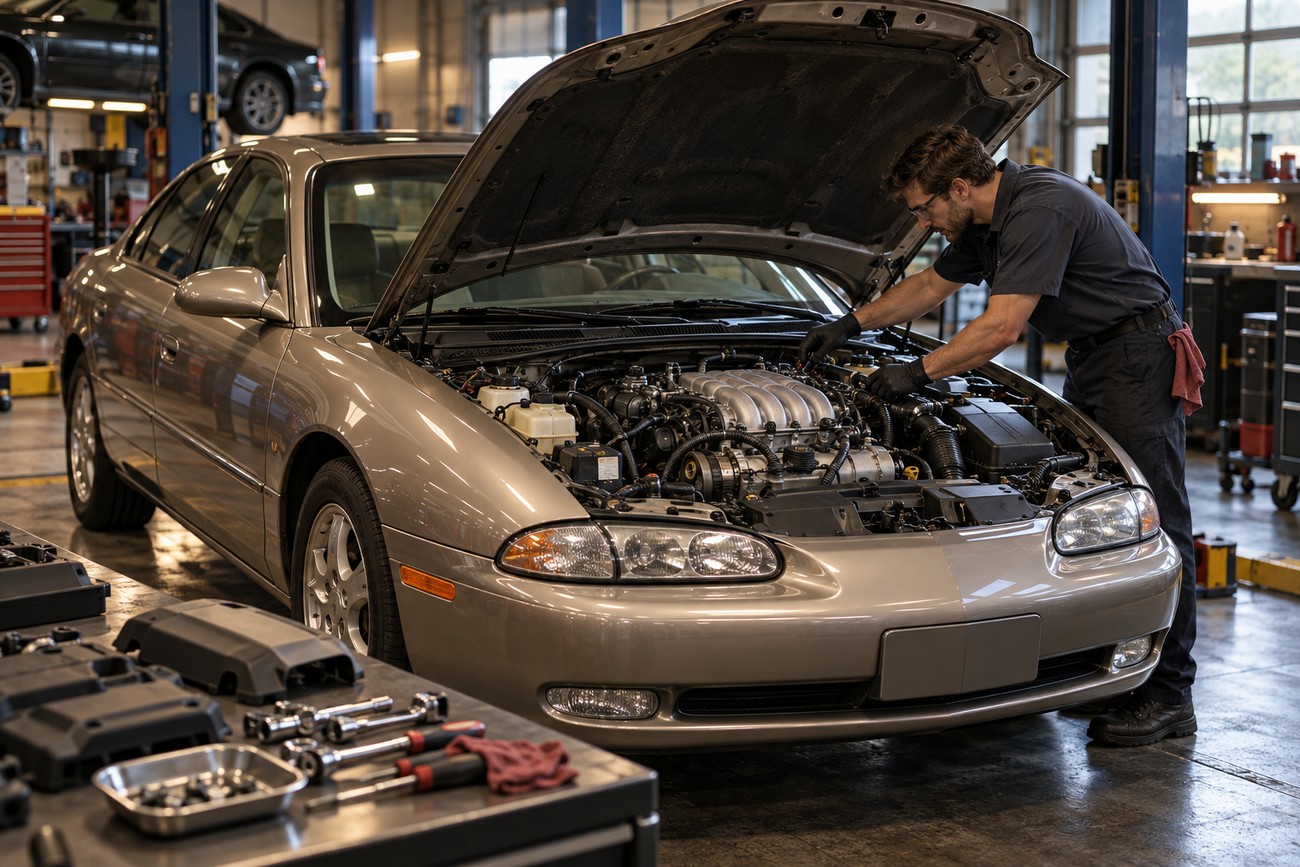
The Aurora’s appeal comes from the way its parts work together. The L47 V8 was related to Cadillac Northstar technology, but it should not be described as a literal Northstar transplant. It was a distinct Oldsmobile application of related engineering, installed in a sedan designed to emphasize quietness, stability, and long-distance comfort.
With the 4.0-liter V8, published performance figures commonly place 0–100 km/h acceleration at approximately 8.5–8.6 seconds, with a top speed of about 217 km/h. Those numbers are respectable rather than exotic. The more important impression is the delivery: the V8 moves the heavy car with little strain, while the suspension and cabin suppress much of the effort.
Contemporary evaluations often rated the Aurora’s ride and refinement above many comparable GM sedans of the period. That quality remains noticeable in a well-preserved example. The long body, sound insulation, and smooth automatic make the car especially suitable for steady highway travel, although the front-drive layout and weight limit its agility.
Technological sophistication becomes a liability as maintenance history disappears. The V8 is more demanding than a basic period American V6, and the 4T80-E is a large, complex transmission whose repair can be costly. A neglected Aurora may therefore feel inexpensive to buy while carrying the mechanical exposure of a much more expensive car.
The Ownership Costs Hidden Behind the Bargain Price
Fuel is the first cost that surprises new owners. A heavy, front-wheel-drive sedan with a V8 can use substantial fuel, particularly in city driving. The purchase price may resemble that of an ordinary used sedan, but consumption reflects the car’s mass and performance rather than its discounted market value.
The 4T80-E deserves special attention. Repairs can be more complex and expensive than those for more common automatic transmissions, and a test drive must cover cold operation, warm operation, gentle acceleration, firm acceleration, reverse engagement, and highway cruising. Delayed shifts, slipping, harsh engagement, or unexplained noise should be treated as financial warnings rather than minor character traits.
Age affects the electrical side as well. Owners report sensor faults, warning lights, and failures of smaller convenience functions on older cars. One failed feature may be inexpensive; several unrelated faults can consume time because diagnosis, wiring access, and model-specific knowledge are harder to obtain than on a high-volume GM sedan.
Parts availability is another practical limit. V8-specific components, body panels, trim, and interior pieces may require used parts or searches through dismantlers. Some routine service items remain manageable, but a missing switch, damaged interior panel, or unusual engine component may take longer to locate than the buyer expects.
Service knowledge is uneven because Aurora numbers are low and the model is easy to overlook. A competent general repair shop can handle many basic jobs, but unusual systems and transmission problems benefit from a technician willing to verify the correct year, engine, and component rather than relying on a generic parts lookup.
How to Inspect a Used Oldsmobile Aurora
Start with the VIN and model year before discussing price. Listings can mix engines, equipment, and photographs, so establish whether the car has the 4.0-liter V8 or the 3.5-liter V6. That distinction affects expected performance, fuel use, maintenance planning, and parts compatibility.
Service records should then be organized around the transmission and cooling system. Look for evidence of transmission servicing, previous symptoms, fluid leaks, overheating, cooling-system repairs, and unresolved warning lights. A clean engine bay does not prove good mechanical health, and a recently washed underside can conceal leaks.
Transmission scanning, cooling-system review, and a complete electrical-function check should come before cosmetic evaluation. On a rare Aurora, hidden diagnostic faults can matter more than visible wear.
Drive the car long enough to reach operating temperature. Check shift quality in every range, steering feel, braking stability, temperature behavior, climate control, gauges, power seats, windows, locks, lighting, and warning messages. A diagnostic scan is particularly valuable because a quiet dashboard during a short test drive does not eliminate stored faults.
Inspect the body for corrosion, previous repairs, uneven panel gaps, damaged trim, and glass or lighting issues. Body and interior parts may be harder to replace than mechanical consumables. A visually attractive car with an unhealthy transmission or failing electronics is usually a worse purchase than a less polished example with documented maintenance.
The common mistake is buying emotionally and budgeting only for the acquisition. Aurora ownership requires money for diagnosis, rare parts, and specialist repairs even when the initial price is low. The right sequence is VIN verification, records, mechanical inspection, electrical testing, and then negotiation.
Why Aurora Failed—and What It Is Worth Today
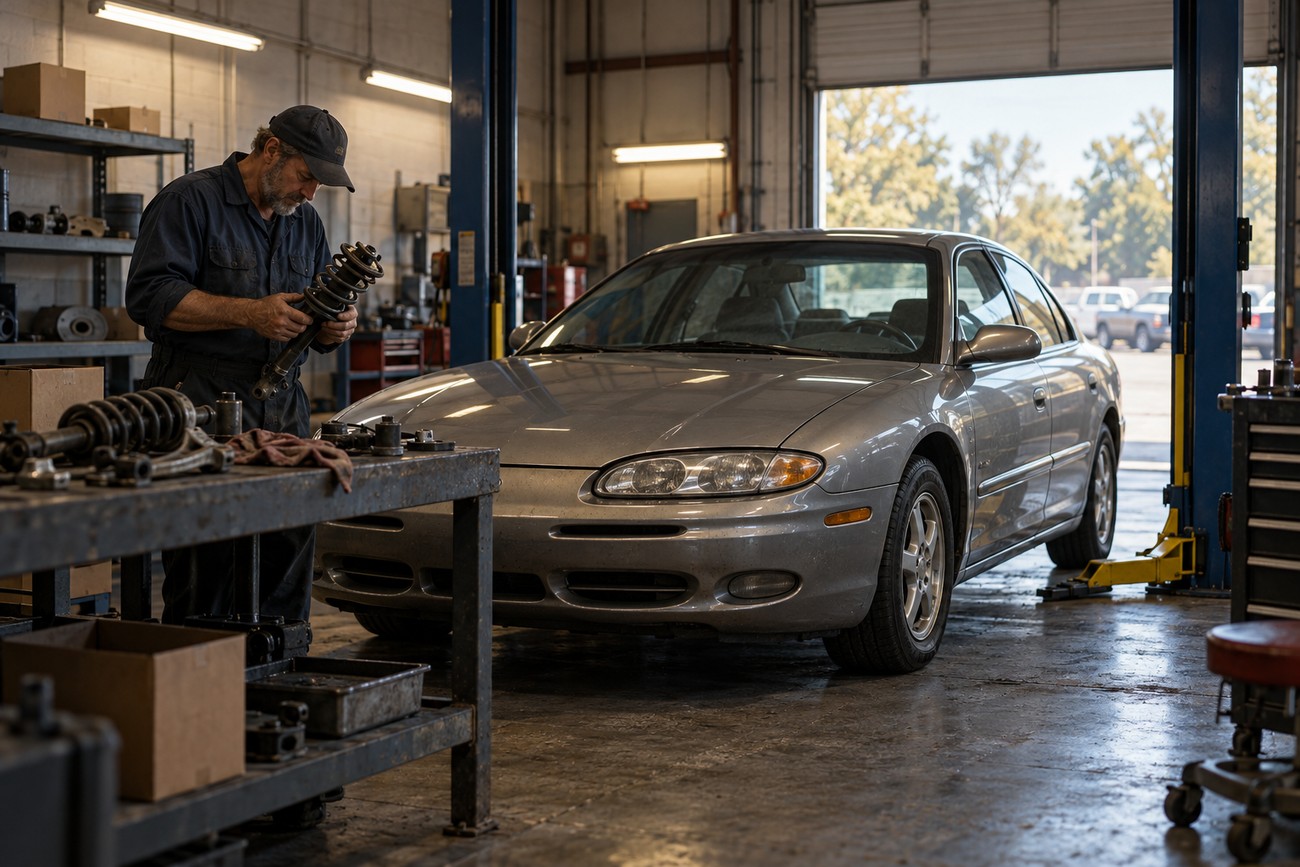
Aurora failed because product quality and brand strength are different things. The car offered a credible near-luxury experience, but Oldsmobile’s remaining market recognition was too weak to support sustained demand. Buyers who wanted a premium sedan often chose a badge with clearer status, while traditional Oldsmobile customers did not necessarily want the added complexity or price position.
The model also arrived during a period when brand identity mattered greatly to buyers of expensive sedans. Aurora’s premium character was stronger than Oldsmobile’s public image, creating a mismatch between what the car delivered and what the badge communicated. Production ended in March 2003 after Oldsmobile’s closure, leaving no long-term product family to reinforce its position.
Today, rarity creates niche interest rather than guaranteed collectibility. A clean first-generation car may attract buyers seeking V8 character and distinctive design, while a second-generation V6 can provide a more accessible entry into the model. Neither version is automatically easy to sell, because the pool of informed buyers is limited and parts concerns narrow the market.
Aurora suits an owner who enjoys research, diagnosis, and the process of keeping an unusual car alive. It is a poor choice for someone seeking inexpensive transportation, predictable parts availability, or quick resale. The best example is the one with transparent history and healthy major systems, even if its appearance is less perfect.
Frequently Asked Questions
Why did the Oldsmobile Aurora fail despite its strong engineering?
The Aurora failed because strong engineering could not compensate for weak brand strength. Its platform, powertrain, comfort, and finish gave it genuine near-luxury credibility, but Oldsmobile no longer had enough identity or buyer confidence to sustain broad demand. The car proved that the division could build a sophisticated sedan; it could not make the Oldsmobile badge carry the same meaning as a dedicated luxury brand.
How much is a 1995 Oldsmobile Aurora worth today?
There is no reliable universal value without examining the individual car and its local market. Assess a running example by separating engine and transmission health, corrosion, originality, maintenance records, interior condition, and diagnostic faults. A documented 4.0-liter V8 with a healthy 4T80-E can be more useful to an informed buyer than a cheaper car with attractive paint and unknown mechanical history, while local demand and parts access strongly affect resale.
What did the Oldsmobile logo look like on Aurora models?
Aurora carried Oldsmobile branding, while Aurora identified the model itself. That distinction reflects the car’s confused market position: the body and engineering aimed upward, but the familiar Oldsmobile badge did not have the same premium authority as Cadillac or other luxury marques. The logo connected the sedan to its parent division, even as the car tried to establish a more independent identity through styling and technology.







