

After several hot laps, the oil-pressure light may flicker in a long corner even though the dipstick reads normal when you return to the paddock. That pattern points to a possible loss of oil pressure under load, and the correct decision is to end the session rather than complete another lap.
A stationary oil-level check cannot prove that the pickup remains covered during braking or sustained cornering. Treat any flicker while the engine is running as a possible pressure loss: reduce load, leave the track safely, stop the engine in a safe location, and diagnose the cause before another session.
- What to do the moment the oil light flickers
- Why a full dipstick cannot protect an EJ engine in a long corner
- How to verify the cause before another track session
- After the warning: decide whether the engine needs inspection
- Match track-day fixes to the pressure problem
- Frequently asked questions
- Why is the AT OIL TEMP light flashing in my Subaru?
- What details should I record for a shop after a track-only oil-light flicker?
- Why did my oil light flicker on then off?
- My Subaru oil light is on and off. What could be causing this?
What to do the moment the oil light flickers
Lift off the throttle and reduce engine speed without making a sudden move across other cars. Leave the racing line when it is safe, signal as required by the track, and exit the circuit. Do not shut the engine off in a live lane unless the situation leaves no safer alternative.
Once the car is stopped in a safe location, switch off the engine and allow the car to settle according to the owner’s manual before checking the oil. Park on suitable level ground where possible, use the specified dipstick procedure, and look for fresh oil around the engine, filter, drain plug, and undertray.
A normal reading does not clear the car for another run. The dipstick shows oil quantity with the vehicle stationary; it does not establish adequate oil pressure under track load. A persistent warning, abnormal mechanical noise, or a warning that returns after restarting warrants recovery and diagnosis rather than another lap.
If the light flickers again, the engine develops knocking, tapping, or a new rumble, or the oil level is low and the cause is unclear, arrange recovery. A brief warning can indicate a pressure event that has already exposed bearings and other engine components to damage.
Why a full dipstick cannot protect an EJ engine in a long corner
Oil in the sump must remain available at the pickup while the engine is braking, accelerating, or cornering. A full dipstick reading confirms the approximate static quantity, while the oil pump needs a continuous supply at its pickup. Under sustained lateral load, oil can move away from that pickup even though the total amount in the sump appears correct.
On EJ-series WRXs, sustained track loads can expose pickup starvation or aeration. The factory sump and pickup arrangement may struggle with long corners, depending on the exact engine, model year, tires, suspension, braking setup, and circuit. This discussion should not be applied automatically to every WRX, because Subaru has used different engines and oil systems across the range.
Hot oil adds another variable. As oil gets hotter, its viscosity generally falls and pressure may decrease. That can help explain why a car completes an initial run without a warning, then begins flickering after several faster laps when oil temperature has risen.
Aerated oil can also reduce the pump’s ability to provide a stable supply. Air mixed into the oil changes what reaches the pump and bearings, so adding oil based only on a static dipstick reading may fail to address the underlying problem. Overfilling can introduce its own aeration and drag concerns.
Duration matters as much as peak lateral load. A short transition may produce a high instantaneous load without sustaining pickup exposure long enough to cause a warning, while a long corner gives the oil more time to migrate. This is why a problem can appear in one specific bend and disappear when the car straightens.
How to verify the cause before another track session
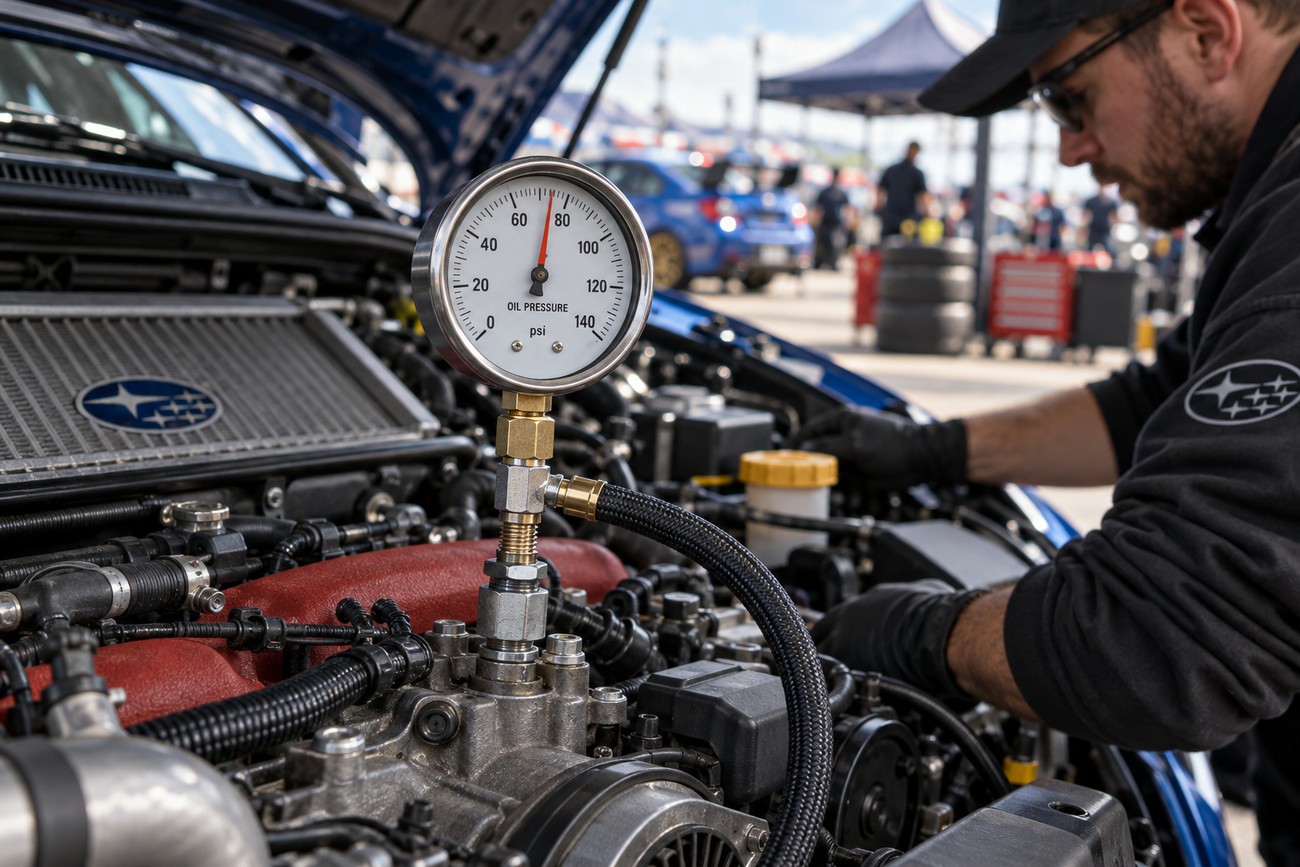
Begin by confirming which warning illuminated. The engine oil-pressure warning, the AT OIL TEMP warning, and other dashboard indicators point to different systems. Then verify the oil level using the exact procedure in the owner’s manual, inspect for leaks, and check the filter, drain plug, wiring, and visible connectors for obvious faults.
The next step is measuring actual oil pressure with a reliable mechanical gauge or an appropriately installed pressure sensor. A switch or dashboard lamp alone cannot distinguish low pressure from a failed switch or circuit. An EJ oil-pressure warning may illuminate only after pressure is already dangerously low, and it may miss shorter dips altogether.
Compare the results only with the factory specifications for the exact model year and engine. There is no universal WRX pressure threshold that applies to every generation. Testing should cover cold and fully warmed conditions where appropriate, while avoiding unnecessary running if the engine has already shown warning symptoms.
For a car used regularly on track, logging oil temperature, engine speed, pressure, and the location of each warning can reveal a repeatable hot-corner dip that a hot-idle reading alone would miss. A suspect switch should be replaced or tested when indicated, but an electrical fault must not be assumed to be the cause until actual pressure has been confirmed.
After the warning: decide whether the engine needs inspection
A warning that disappears when the car straightens out is not a clean bill of health. As cornering load falls, oil may return to the pickup, but the engine may still have experienced a brief pressure loss. A normal static dipstick reading does not establish adequate oil pressure under load.
Oil starvation under track load, especially with high oil temperature, raises the risk of bearing damage on EJ engines. New knocking, rumbling, tapping, unusual vibration, metallic debris in the oil or filter, or a warning that remains illuminated should be treated as reasons not to restart the engine and to arrange qualified inspection.
A single flicker with no new noise still requires pressure testing before further track use. The inspection may find a switch or wiring fault, but that conclusion should follow a pressure check rather than replace it. If pressure is low, the cause may involve oil supply, temperature, internal clearance, or another mechanical fault.
After a severe event or track use, change the oil and filter according to the engine’s condition and service plan, especially where high temperatures were involved. Inspecting the used oil and filter can provide useful evidence, although clean-looking oil does not rule out a short pressure event or bearing damage.
Match track-day fixes to the pressure problem
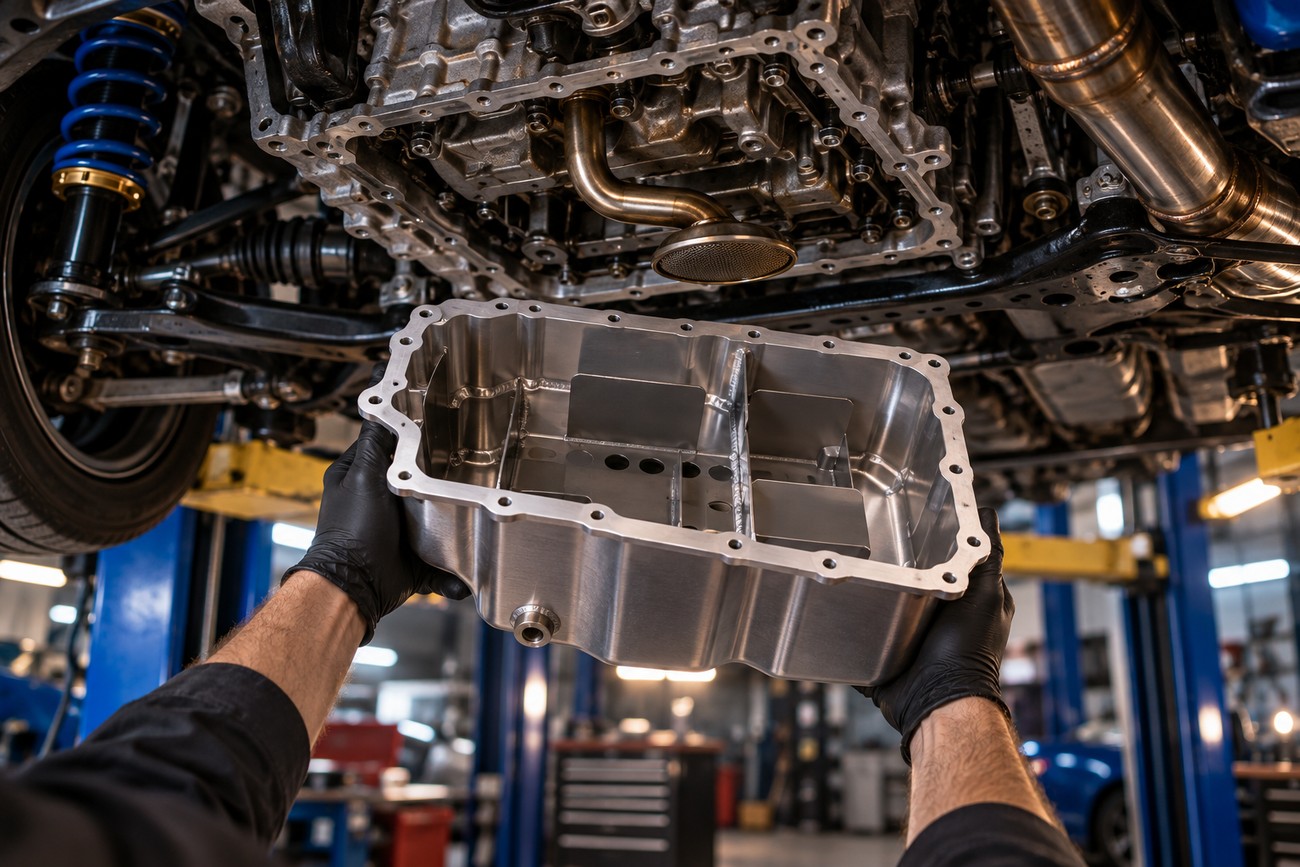
Correct a low oil level or an external leak before considering track upgrades. If testing shows a pressure warning linked to sustained cornering, investigate oil movement, pickup exposure, and aeration. If pressure falls mainly as oil temperature rises, cooling and monitoring may be relevant, while a pressure loss unrelated to track load may require mechanical repair.
Baffled oil pans, pickup-related upgrades, and oil accumulators are commonly discussed measures for track-driven WRXs. Their fitment, installation requirements, and likely benefit depend on the specific chassis, engine, sump, circuit, and failure mode. None should be treated as a guaranteed solution for every WRX.
An accumulator can provide an additional oil reserve during a pressure event, while baffling can help control oil movement around the pickup. These systems still require correct sizing, placement, plumbing, and maintenance. Monitoring oil pressure and temperature can show whether the chosen changes address the actual event rather than merely adding parts.
Higher viscosity may alter hot pressure, yet it does not eliminate pickup starvation or aeration. Overfilling is not a dependable remedy and can contribute to aeration. Oil selection should follow the exact engine, clearances, temperature range, and manufacturer guidance, with the lubrication system addressed as a complete system.
Power increases raise the consequences of an oil-supply weakness. Before adding engine output for regular track use, establish stable pressure at operating temperature and under the car’s actual cornering loads. A configuration that works on a short street drive may still need sump, pickup, cooling, and monitoring changes for repeated track sessions.
Frequently asked questions
Before diagnosing a warning, identify which dashboard light appeared. The AT OIL TEMP light and the engine oil-pressure warning concern different systems. If the oil-pressure light flickered on track, record the conditions and confirm actual pressure before another session.
Why is the AT OIL TEMP light flashing in my Subaru?
The AT OIL TEMP light relates to automatic or continuously variable transmission temperature, while the engine oil-pressure warning concerns engine lubrication. A flashing AT OIL TEMP light requires the transmission system and the vehicle’s model-specific diagnostic procedure to be checked; it should not be diagnosed as an engine oil-pressure fault from the symbol alone.
Stop applying track load safely and consult the owner’s manual for the exact warning behavior. Record the conditions that triggered it, because transmission temperature, fluid condition, sensor faults, and cooling performance can require different tests.
What details should I record for a shop after a track-only oil-light flicker?
Record the corner or braking zone, lap timing, warning duration, engine speed, oil temperature if available, and any pressure data. Note whether the light appeared only when hot, whether it cleared as the car straightened, and whether the engine produced a new sound or vibration.
Also document the oil level and grade, recent service work, track conditions, tire and suspension changes, and any modifications to the sump or pickup. This information helps a technician reproduce the operating conditions instead of judging the car from a cold, stationary inspection.
Why did my oil light flicker on then off?
The warning may have responded to a brief pressure drop caused by pickup starvation, aeration, hot oil, a faulty switch, or an electrical fault. Straightening the car can restore oil flow to the pickup and make the light go out, but that does not prove the engine remained protected.
End the session and confirm actual pressure before driving on track again. The model year and engine determine the applicable pressure specifications, so a universal threshold cannot be used.
My Subaru oil light is on and off. What could be causing this?
Intermittent illumination can result from low oil level, an external leak, oil movement under cornering or braking, aeration, high oil temperature, a failing pressure switch, wiring problems, or an internal mechanical issue. A normal dipstick reading narrows the possibilities only slightly because it does not confirm continuous oil supply at the pickup or adequate pressure under load.
Check the vehicle safely, avoid another session, and have pressure measured with suitable equipment. Persistent illumination or new engine noise calls for recovery and inspection rather than repeated starts.







