
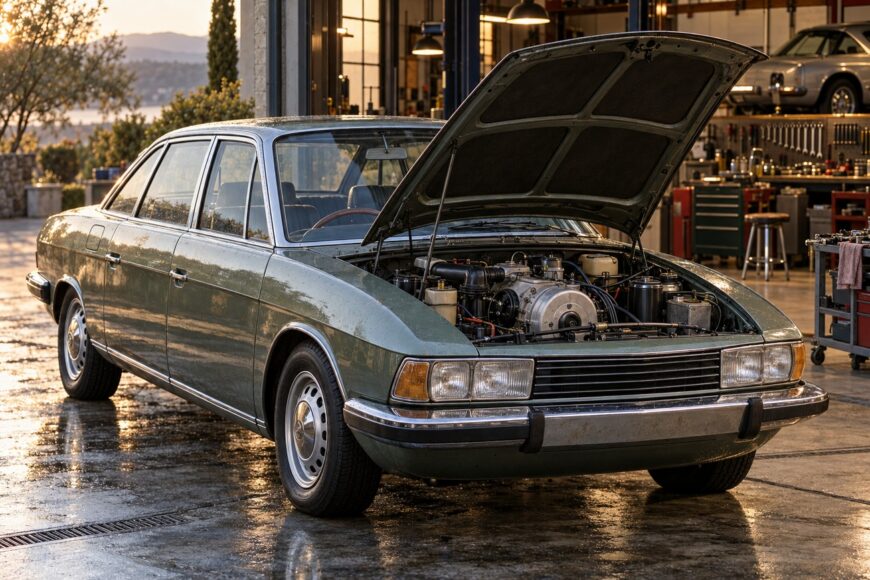
The NSU Ro 80 was an advanced sedan whose defining feature became a financial liability. Its rotary engine promised smooth power from a compact unit, while its front-wheel-drive chassis, suspension, and brakes gave it abilities that many larger sedans lacked. Early engine failures, however, brought expensive warranty work and damaged confidence in the car.
That history gives the Ro 80 its familiar reputation as the car that broke NSU. The phrase captures a real commercial strain, though it gives one model and one defect too much explanatory weight. The car remained in production for a decade, and its engineering deserves to be understood alongside the costs that NSU struggled to contain.
- A sedan that looked and drove ahead of its time
- The rotary promise—and the unfamiliar transmission
- How seal wear turned early promise into repair bills
- How the Ro 80 strained NSU without telling the whole story
- Why the reliability legend misses the whole car
- Buying one today: price the engine before the dream
- Frequently asked questions
- What was the last production car with a rotary engine?
- What should you ask before commissioning a Ro 80 engine rebuild?
- What killed the rotary engine?
- What was the last car to have a rotary engine?
A sedan that looked and drove ahead of its time
The NSU Ro 80 was a four-door, front-wheel-drive sedan produced from 1967 to 1977. Its low, clean-lined body gave it a distinctive shape, but the layout mattered beyond appearance. Front-wheel drive was unusual in a substantial late-1960s sedan and helped NSU make effective use of the space available for passengers.
Independent suspension at all four wheels, with front MacPherson struts, was another meaningful choice. It helped the car maintain its composure on uneven roads, where a large sedan’s size could otherwise make it feel cumbersome. The Ro 80’s appeal was therefore apparent even to someone with no interest in the engine under its hood.
Disc brakes at all four wheels reinforced that sense of a carefully specified chassis. Such equipment was associated with more expensive or sporting cars, and it suited a sedan with a claimed top speed of 180 km/h. Braking hardware cannot compensate for poor maintenance, but it shows that NSU considered how the whole car would perform at speed.
These strengths also explain why the Ro 80 cannot be dismissed as an eccentric engine installed in an ordinary body. Its steering, road holding, and brakes formed a coherent package around the rotary’s smooth delivery. For an owner today, that distinction matters: a healthy engine is essential, yet the chassis is a substantial part of what makes the car worth preserving.
The rotary promise—and the unfamiliar transmission
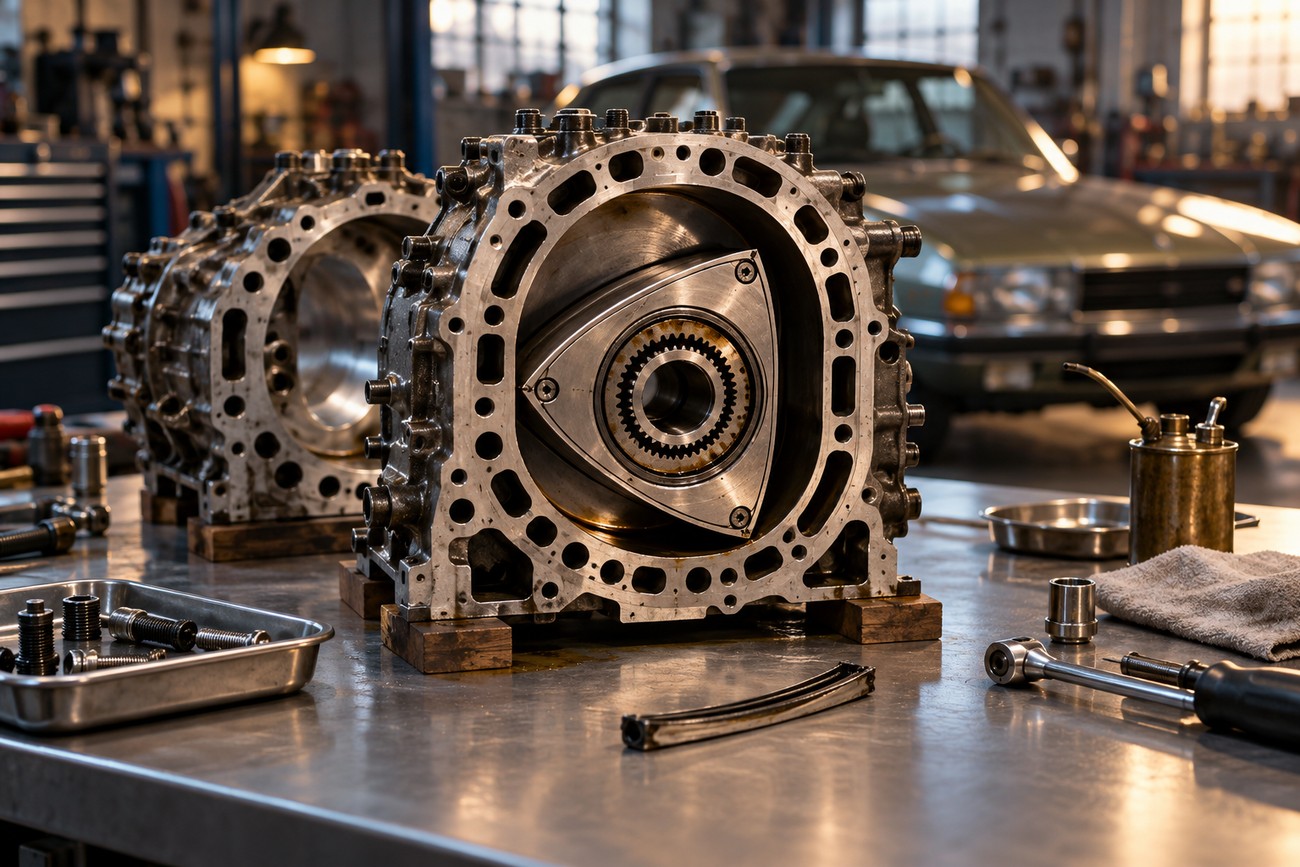
The Ro 80’s Wankel rotary engine offered an appealing alternative to a conventional piston engine. It was compact and smooth-running, qualities that suited a refined sedan with an unusually low front end. Its quoted displacement was 995 cm³, and output is generally given as approximately 113–115 hp, depending on the source.
That displacement figure needs care. Rotary and piston engines describe swept volume differently, so reading 995 cm³ as though it represented a similarly sized piston engine gives a misleading impression of the Ro 80’s performance. Period figures put acceleration from 0 to 100 km/h at approximately 12.5–14 seconds, with a claimed top speed of 180 km/h.
The transmission added another unfamiliar element. Drivers selected the gears themselves, while an automatic clutch handled engagement; it was a manually shifted gearbox with an automatic clutch, not a conventional automatic transmission. A buyer expecting to select a drive range and leave every shift to the car will misunderstand how an Ro 80 is operated.
Neither the engine nor the gearbox was an incidental novelty. Together they gave the car much of its character, while making informed maintenance more important than it would be on a familiar piston-engine sedan. The rotary in particular depended on suitable attention to its condition and oil needs. The qualities that impressed a new-car driver could become liabilities when servicing was poor or specialist knowledge was scarce.
How seal wear turned early promise into repair bills
Early rotor-seal durability was the Ro 80’s central reliability problem. The seals help the engine maintain the compression it needs to start and deliver power; as their effectiveness declines, the consequences can emerge gradually. An engine may still sound smooth while its performance is deteriorating, which makes a brief, pleasant drive a weak test of its remaining life.
Warning signs for owners include weakening power, rising fuel or oil consumption, and increasingly difficult starting. Cold and warm starts both matter because an engine that fires readily in one condition may behave differently in the other. None of these symptoms proves a particular fault on its own, but together they call for investigation rather than reassurance based on the car’s appearance.
The frequently cited 50,000 km engine-life figure is a reference from the Ro 80’s troubled history, not a fixed failure point. Some engines developed problems sooner, while condition, maintenance, and the quality of any rebuild can produce substantially different outcomes. Treating that figure as either a guaranteed minimum or an inevitable deadline obscures the condition of the engine in front of you.
Repair was consequential because the rotary was unfamiliar to many workshops and its critical components demanded appropriate work. A rebuilt engine could restore the car’s appeal, but a rebuild label alone says little about what was inspected, replaced, or measured. For a present-day owner, records and a knowledgeable assessment carry more weight than an odometer reading or a confident claim that the car has always run well.
How the Ro 80 strained NSU without telling the whole story
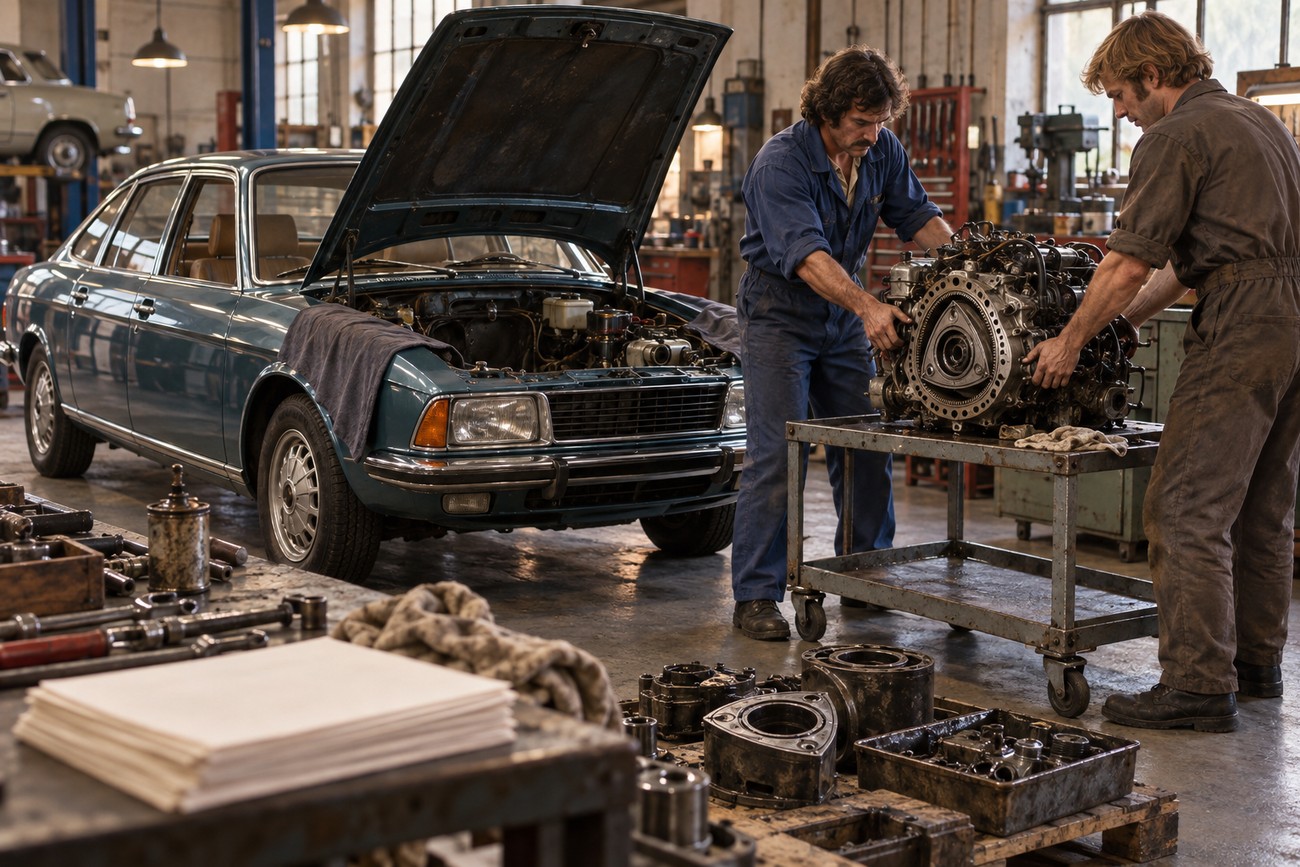
The Ro 80’s commercial problem went beyond the cost of an individual failed engine. Its complex construction made the car expensive to produce, while early rotary failures generated warranty work and repairs after sale. Each failure also challenged the premise on which the car was sold: advanced engineering was supposed to make this sedan desirable to live with.
That combination helps explain the force of the Ro 80’s reputation. An owner facing repeated engine attention lost time and confidence as well as money, even when a repair was covered. For NSU, fixing cars already sold consumed resources that could not be recovered by praising the model’s ride, brakes, or design.
NSU became part of the Volkswagen group through its 1969 merger with Auto Union. The Ro 80 continued in production until 1977, but continued production does not erase the financial strain caused by its early years. Equally, it does not establish that the model alone determined the company’s fate; corporate decisions and the wider business context belong in that history too.
“The rotary sedan that broke the company” works as a warning about the cost of putting ambitious technology into customers’ hands before its weaknesses are resolved. Taken literally, it reduces a complicated outcome to one mechanical flaw. The mechanism is narrower and clearer: expensive production, engine-related warranty and repair costs, and a loss of confidence placed serious pressure on NSU.
Why the reliability legend misses the whole car
One version of the Ro 80 story treats every surviving example as equally hopeless. That shortcut overlooks differences in engine condition, maintenance, rebuild quality, and whether a car has early or later components. None of those factors makes a later car automatically dependable, but they make an individual inspection more useful than a verdict based solely on the badge.
The opposite shortcut blames poor publicity for a sound car’s decline. Public confidence certainly suffered, yet the underlying engine faults and their costs were real. A reputation can outlast a repair, but it did not arise independently of owners’ experiences with starting, consumption, and loss of power.
Judging the Ro 80 solely by its engine also hides the reasons people kept driving and preserving it. Front-wheel drive, independent suspension, and four-wheel disc brakes gave this large sedan a combination of space, road manners, and stopping ability that was notable for its period. Those qualities remain relevant once the condition of the rotary has been honestly assessed.
This is the tension at the heart of the car’s history. The chassis shows how thoroughly NSU considered the driving experience; the engine shows the cost of failing to deliver comparable durability. Appreciating one does not require excusing the other, and a careful owner has to hold both assessments at once.
Buying one today: price the engine before the dream
Begin with the engine’s history, rather than its shine or a short demonstration drive. Ask for records of rebuilds and subsequent maintenance, including what work was done and who did it. A claimed rebuild without supporting detail offers little basis for judging its quality, while a low recorded mileage cannot establish the state of the rotor seals.
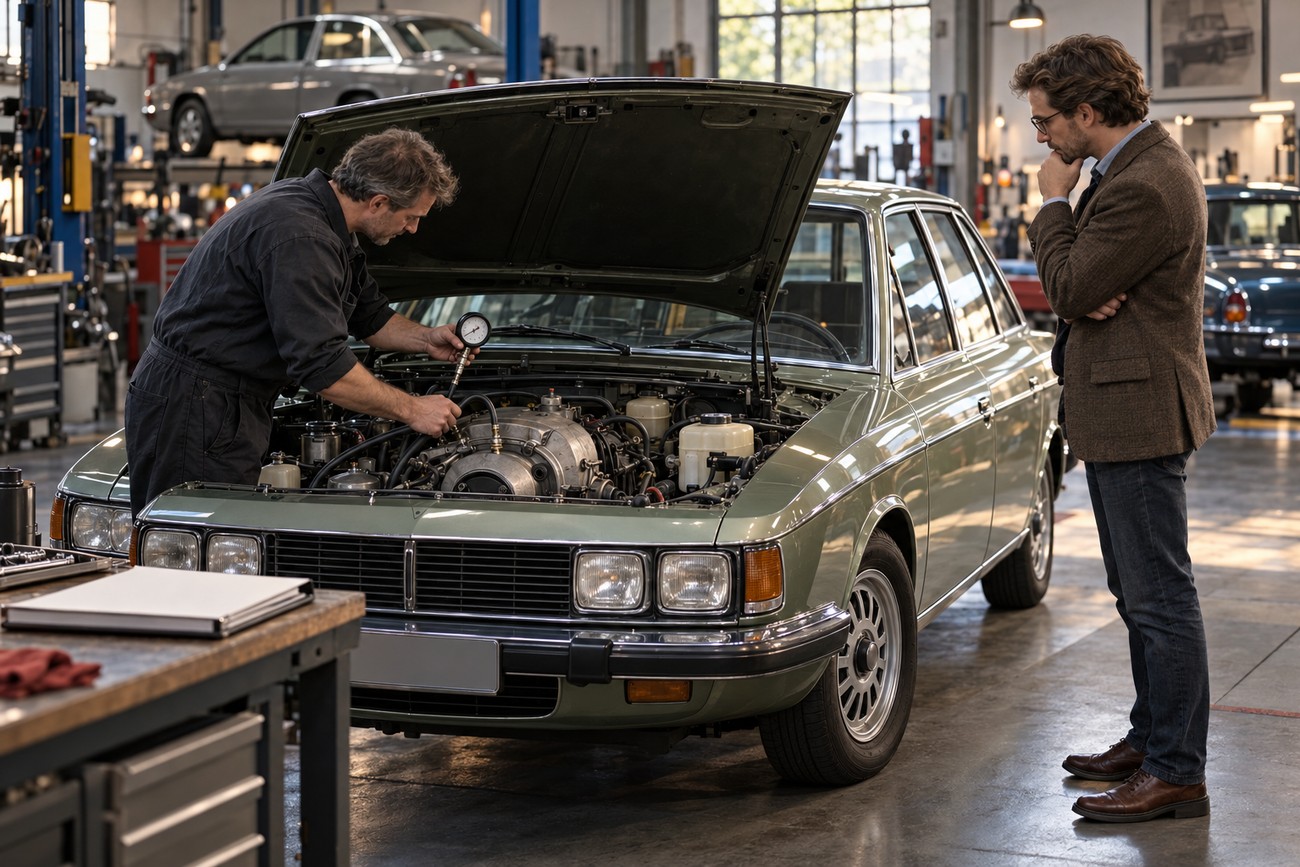
Arrange an assessment by someone familiar with Wankel engines before committing to the car. Observe cold and warm starting, then pay attention to power delivery and any evidence of rising fuel or oil consumption. These checks are most useful together: a car that feels smooth over a short route may still have a developing compression problem.
A compression check needs a rotary-appropriate procedure and specialist interpretation. A pleasant test drive, or a test assessed as though this were an ordinary piston engine, cannot establish the health of its seals.
Budget on the assumption that proper diagnosis and rotary work may require specialist help. Treating the Ro 80 as a conventional classic sedan with an unusual badge can leave too little room for an engine repair. If the records are incomplete, allow for that uncertainty before deciding what the car is worth to you.
Learn the transmission’s behavior during the inspection as well. You still select gears in its manually shifted gearbox; the automatic clutch does not turn it into a conventional automatic. A sound purchase is one whose engine condition, maintenance history, and driving controls you understand, rather than one whose remarkable design has made those questions easy to overlook.
Frequently asked questions
Rotary cars are easy to group together even when their engines perform different jobs. The distinctions below matter when comparing the Ro 80 with later models or planning work on one.
What was the last production car with a rotary engine?
The Mazda RX-8, which ended production in 2012, is a clear reference point for a production car whose rotary engine drove the wheels. The Mazda MX-30 R-EV uses a rotary engine as a generator for its electric drive instead. Because production and availability can change by market, calling either model definitively “the last” requires a current, specific definition.
What should you ask before commissioning a Ro 80 engine rebuild?
Ask what inspection found, which components need replacement, and how the rebuilder will assess sealing and compression afterward. Request evidence of their rotary-engine experience, written documentation of the work, and a clear explanation of any warranty’s scope. No rebuild should be sold on a guaranteed service life alone.
What killed the rotary engine?
The rotary engine has not disappeared entirely. Its limited use in cars reflects a difficult combination of sealing durability, fuel and oil consumption, emissions requirements, and the cost of developing and supporting a specialized design. Those pressures affect different applications differently, which is why a rotary generator is a separate proposition from the Ro 80’s engine driving the car.
What was the last car to have a rotary engine?
If “have” includes a rotary engine used to generate electricity, the Mazda MX-30 R-EV is a more recent example than the RX-8. If it means a rotary engine mechanically driving the wheels, the RX-8 is the relevant modern production example. An unqualified “last car” answer risks mixing those two roles and overlooking changes in current production status.







