
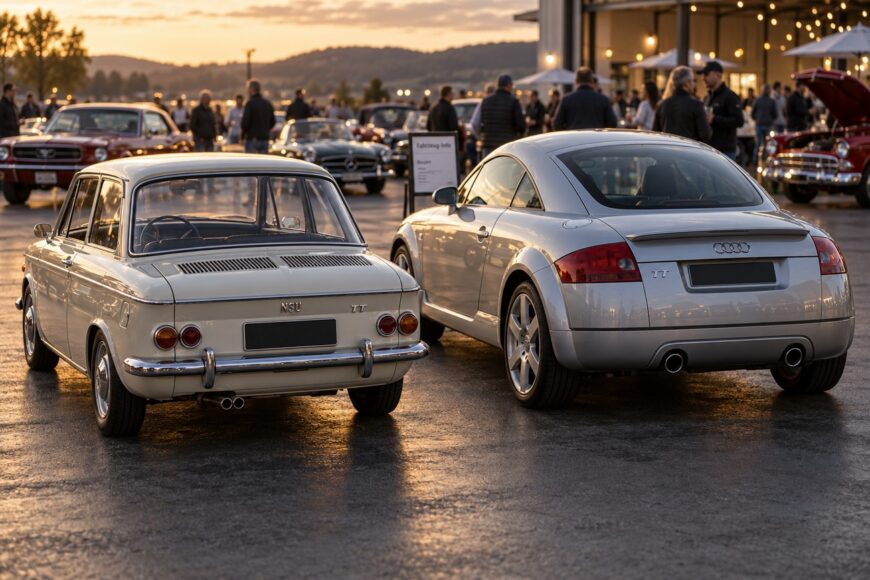
A tiny, rear-engine NSU from the 1960s seems an unlikely relative of the Audi TT that arrived decades later. The connection lies in sporting heritage and a shared badge, not in a platform, drivetrain, or line of mechanical development. That distinction matters because the little car has acquired a larger legend than its production specifications alone can explain.
Period road cars, homologation records, and modified racers are often grouped together under “NSU TT.” Their engines, power figures, and performance need to be read separately. Start with the Prinz 1000, and the history of the TT name becomes much clearer.
- Before the badge became famous: the Prinz and its TT
- Prinz 1000, Prinz 1000 TT, NSU TT, and TTS at a glance
- Why the little TT felt faster than its figures
- Racing reputation, homologation, and the TTS distinction
- What the NSU TT gave Audi—and what it did not
- The ownership reality behind a surviving TT
- Frequently asked questions
- What was the top speed of the standard NSU Prinz 1000?
- What does TT stand for in the NSU and Audi names?
- How can you tell a genuine NSU TT from a converted Prinz?
Before the badge became famous: the Prinz and its TT
The standard NSU Prinz 1000 was a small rear-engined, rear-wheel-drive car. Its air-cooled 996 cc inline-four produced 43 hp, with a stated top speed of approximately 135 km/h. Those figures describe the ordinary Prinz, rather than the sporting version whose initials later became familiar.
NSU introduced the Prinz 1000 TT in 1965. Built through 1967, it applied the TT designation to a more powerful member of the same small-car family. The name then changed to NSU TT; that later version continued from 1967 through 1972.
This sequence explains why a listing for a “Prinz TT” may refer to an early car, while another simply says “NSU TT.” It also explains conflicting specifications in casual accounts: a change of name separates two production periods that should not automatically be assigned the same power figure.
The Prinz deserves attention on its own terms. Its rear-mounted engine, compact body, and sporting derivatives gave NSU a distinctive performance identity. The later Audi TT could draw on that history without inheriting the NSU’s engineering.
Prinz 1000, Prinz 1000 TT, NSU TT, and TTS at a glance
These figures identify the variants; FIA homologation capacities should be checked separately from a particular road car’s specification.
| Variant | Period | Engine capacity | Stated power | Stated top speed |
|---|---|---|---|---|
| Prinz 1000 | Standard model | 996 cc | 43 hp | Approximately 135 km/h |
| Prinz 1000 TT | 1965–1967 | Verify by vehicle; FIA entries include 1085 cc and 1177 cc | Approximately 54–55 hp in commonly cited accounts | Approximately 148 km/h for a cited 55 hp version |
| NSU TT | 1967–1972 | Verify by vehicle | 65 hp, Audi’s production figure | Up to 155 km/h |
| NSU TTS | Competition-oriented variant | Verify by vehicle | 70 hp | No reliable figure supplied here |
Why the little TT felt faster than its figures
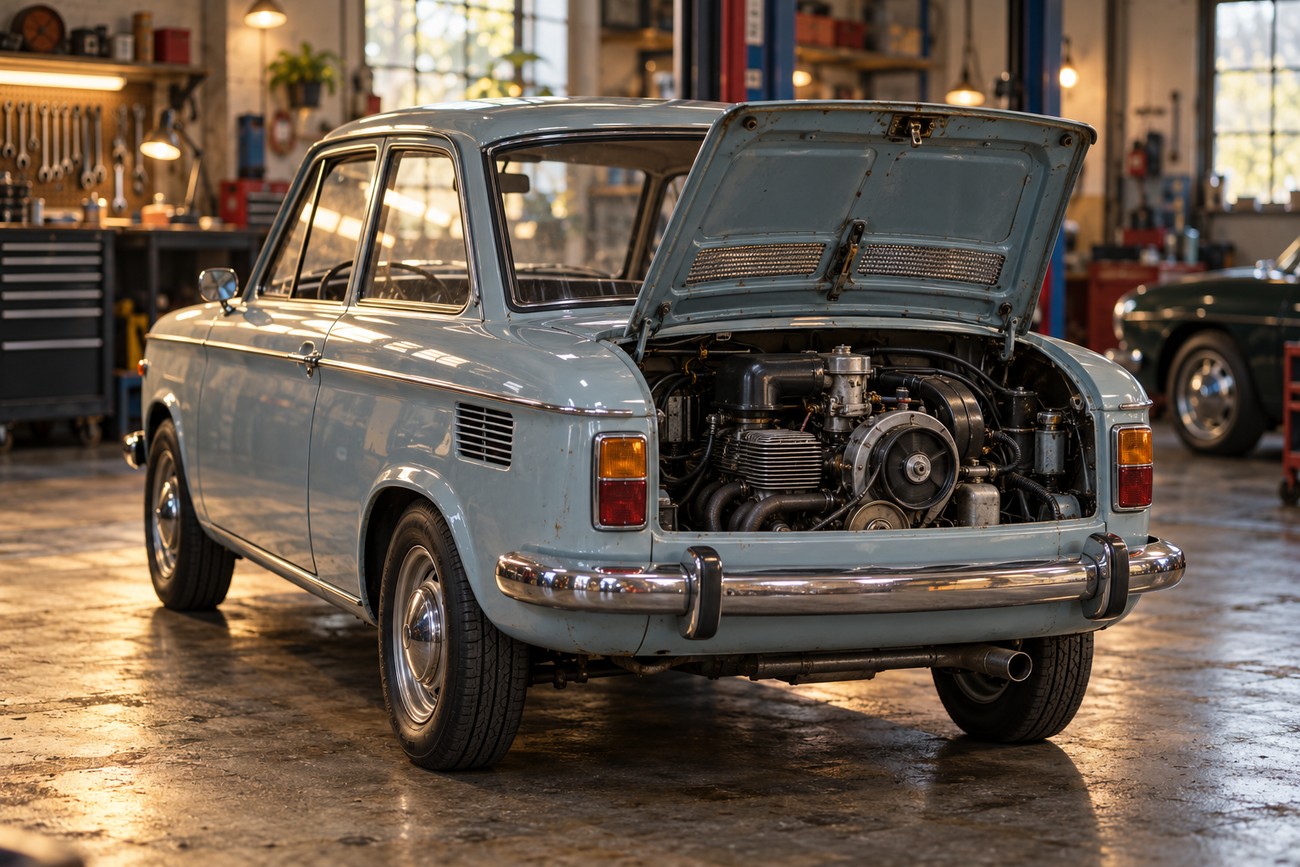
The TT’s engine sat transversely behind the occupants and drove the rear wheels. It was an air-cooled overhead-cam inline-four fed by a Solex carburetor, paired with a four-speed, fully synchronized manual gearbox. In practical terms, the driver had a compact car with its engine and much of its mechanical weight concentrated at the back.
Weight helps explain the appeal more clearly than horsepower alone. Figures across the TT versions described here run approximately 620–700 kg, rather than to one guaranteed curb weight. An engine rated at 55 or 65 hp has less mass to move in such a car, which contributes to the eager response remembered by enthusiasts.
That layout also asks for judgment. With a short wheelbase and rear-biased weight distribution, abrupt steering or a sudden lift of the accelerator in a bend can unsettle the rear. Loading and crosswinds may change how the car feels on a longer road; its small size does not make it automatically forgiving.
Surviving examples can add another complication. Engines, suspension, and wheels were sometimes altered for competition, so a lively test drive cannot establish how a production TT originally behaved. Its specification and condition deserve as much attention as the sensation from behind the wheel.
Racing reputation, homologation, and the TTS distinction
Hill climbs and historic racing are central to the TT’s reputation. A light, rear-engine car made a compelling competition machine, and continued use in these disciplines has kept the NSU visible long after road production ended. It has also made race-prepared survivors prominent among the cars enthusiasts encounter.
The NSU TTS occupies its own place in that story. It was a competition-oriented homologation variant rated at 70 hp, distinct from the later production NSU TT rated at 65 hp. A road TT modified by an individual racer is a third category, even if it now looks or performs much like a competition car.
FIA Historic Database entries classify the Prinz 1000 TT in Group 2 and record rear-wheel drive, four cylinders, and separate 1085 cc and 1177 cc homologations. Those entries document differing eligible specifications. They do not establish that every road-going TT had both capacities, or that a surviving car retains the engine with which it left the factory.
This is why competition history is most useful when it is documented. Period entries, photographs, and a consistent record of changes can give a modified car a legible past. Without them, an impressive engine or racing livery tells you little about its original specification.
What the NSU TT gave Audi—and what it did not
Audi acknowledges the NSU TT within the sporting heritage associated with the later Audi TT. The initials carry a Tourist Trophy association, giving Audi a name with an established motorsport resonance. That historical connection makes the title of this story meaningful, provided “named” is understood as a link of heritage rather than shared hardware.
The late-1990s Audi TT was a different kind of car, built around a front-engine platform with front-wheel-drive and all-wheel-drive versions. It did not use the NSU’s rear-mounted engine, rear-wheel-drive layout, or small-car architecture. Calling the NSU a technical ancestor would obscure both vehicles.
There is also a limit to what the naming evidence establishes. Enthusiast accounts sometimes say that the Prinz 1000 TT alone directly determined Audi’s choice of badge. The available support for that narrower claim is limited; Audi’s recognition of NSU sporting heritage does not, by itself, document a single decisive naming step.
The stronger conclusion is simpler. NSU had already made “TT” part of a memorable German sporting-car history, and Audi later placed those initials on a very different coupe. The badge connects their stories; the engineering shows how far apart the cars are.
The ownership reality behind a surviving TT
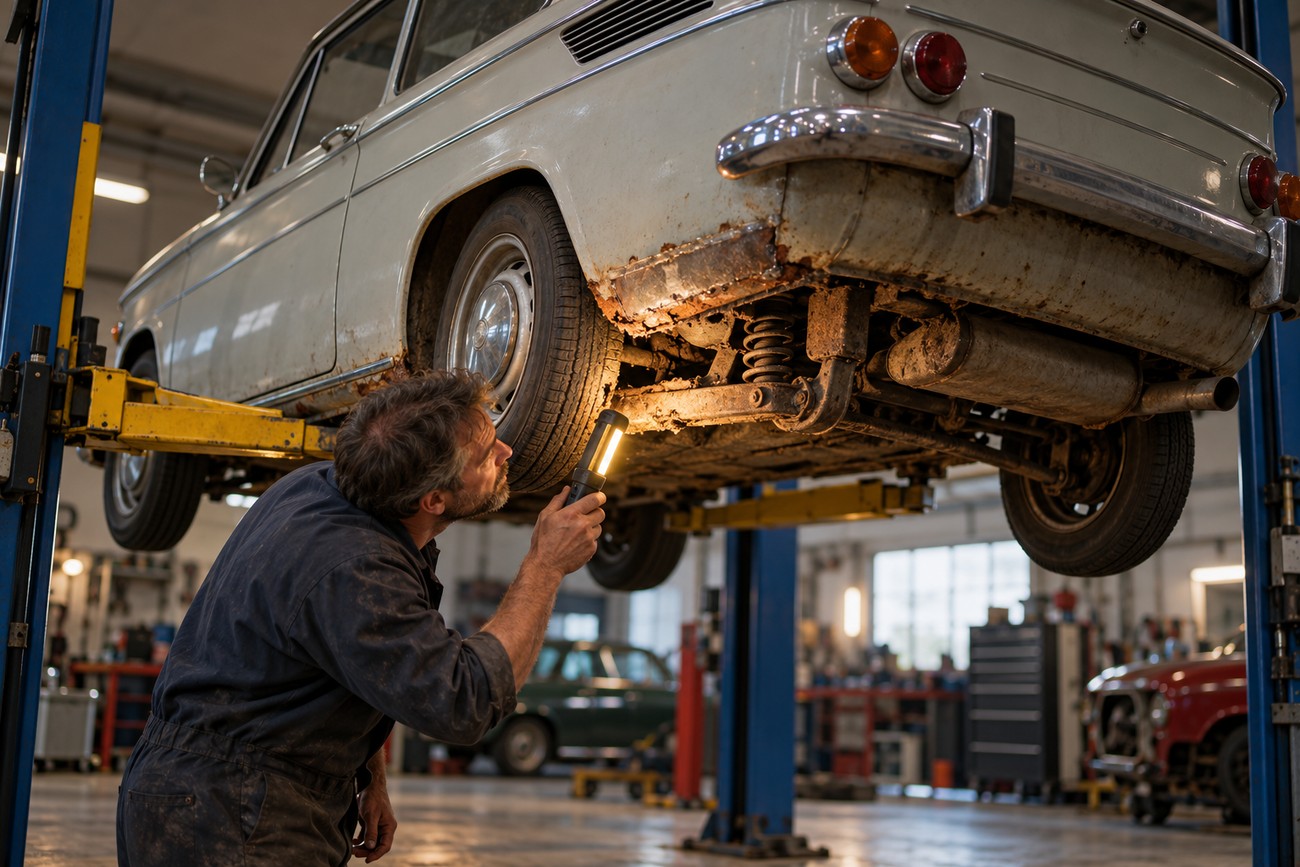
For a prospective buyer, body condition comes first. Corrosion can hide in sills, structural members, and suspension mounting areas beneath tidy paint or a fresh interior. Inspect those points and the surrounding metal before judging an engine’s tune or accepting a car’s claimed performance.
TT-specific panels, lighting parts, and mechanical components can be difficult to find. A car missing the right pieces may require more research and fabrication than its outward appearance suggests. Photographs and records of earlier repairs help establish what metal remains and what has already been replaced.
Next, establish the engine’s identity and examine its cooling, carburetor, and ignition setup together. Blocked airflow or poorly matched adjustments can cause running problems; air cooling alone is not evidence that every TT overheats. Aging wiring and oxidized connections also merit inspection, particularly on a car that has stood unused.
Finally, work out what the car was built to do. A former racer may have altered suspension, wheels, bodywork, and engine parts, making a standard specification sheet a poor guide to repairs or road manners. An accompanied drive and access to someone familiar with NSU-specific components are more useful than assuming another rear-engine car follows the same service practices.
Frequently asked questions
The answers below separate the standard Prinz from the TT variants and focus on checks that a badge or a specification sheet cannot settle alone.
What was the top speed of the standard NSU Prinz 1000?
The standard 996 cc, 43 hp Prinz 1000 had a stated top speed of approximately 135 km/h. A generic search for “Prinz top speed” can produce higher figures because it mixes this car with sporting TT versions. Check the exact model before using a quoted speed to identify a vehicle.
What does TT stand for in the NSU and Audi names?
TT refers to Tourist Trophy, a name with a motorsport association. That meaning is separate from the more specific question of precisely how Audi selected its model badge. Audi acknowledges NSU’s TT sporting heritage, but that does not establish that the Prinz 1000 TT alone dictated the later naming decision.
How can you tell a genuine NSU TT from a converted Prinz?
Start with the vehicle’s identity and period documents, then check whether its equipment and recorded history are consistent with the TT variant claimed. A TT badge, twin headlights, or a modified engine is not conclusive on its own: such parts can be fitted to another Prinz. For a car presented as having raced, seek period evidence and a record of subsequent changes as well as its present specification.







