
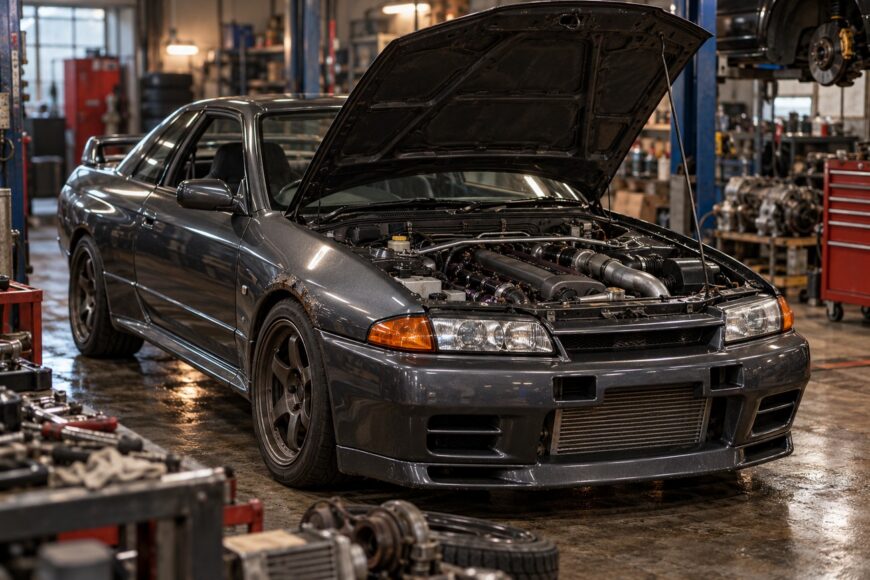
The Nissan Skyline R32 GT-R earned the name Godzilla by humiliating established touring-car opposition. Ownership is a quieter test. A 30-year-old performance car brings brittle wiring, corrosion risk, specialist labor, and parts scarcity alongside the RB26DETT’s famous response. The badge promises a monster; the shell, service history, and previous modifications determine whether you get one.
The BNR32 was built from 1989 to 1994, mainly for Japan, with limited official export availability and much wider gray-import circulation later. Its 2.6-liter twin-turbo inline-six, rear-wheel-drive-by-default ATTESA E-TS system, and electronically controlled HICAS rear steering made it unusually sophisticated for its era. The central ownership decision remains simple: preserve a sound chassis, or spend the budget chasing headline horsepower on an aging platform.
- How the R32 GT-R Became Godzilla
- The Engineering Behind the First Bite
- A Legend with Old-Car Weaknesses
- Buying an R32 GT-R: Inspect the Shell Before the Horsepower
- Tuning the RB26 Without Breaking the Car
- Living with the R32: Value, Variants, and Ownership Risk
- Frequently asked questions
- How much does the Godzilla R32 Skyline GT-R cost?
- Can an R32 GT-R be legally registered where it was not officially sold?
- What is the difference between a standard R32 GT-R and a V-Spec?
- Why can two R32 GT-Rs with similar mileage have very different values?
How the R32 GT-R Became Godzilla
The R32 GT-R arrived in 1989 as the performance flagship of the BNR32 chassis family. Production continued through 1994, with approximately 43,934 examples produced. That number sounds substantial until you account for the car’s strong demand, limited original market, and the attrition caused by racing, tuning, accidents, and corrosion.
Japan was the primary market. Official export availability was limited, while Australia, New Zealand, and some other markets gained access through restricted channels or gray imports. This distribution helped create the car’s mystique: many enthusiasts knew the Skyline through magazine reports and racing coverage long before they could see one on local roads.
The Godzilla nickname was not a factory marketing term. Australian press coverage popularized it after the R32’s dominance in touring-car competition, particularly in the ATCC. English-language magazines then adopted the name, linking the car’s boxy silhouette and relentless circuit pace with a creature from Japanese popular culture.
That racing reputation still shapes buying decisions. It explains why an unmodified example attracts attention, yet it also creates a trap: many cars have been treated as inexpensive track weapons rather than collectible machinery. The result is a wide gap between a carefully preserved BNR32 and a tired shell wearing expensive wheels and a fresh engine.
The Engineering Behind the First Bite
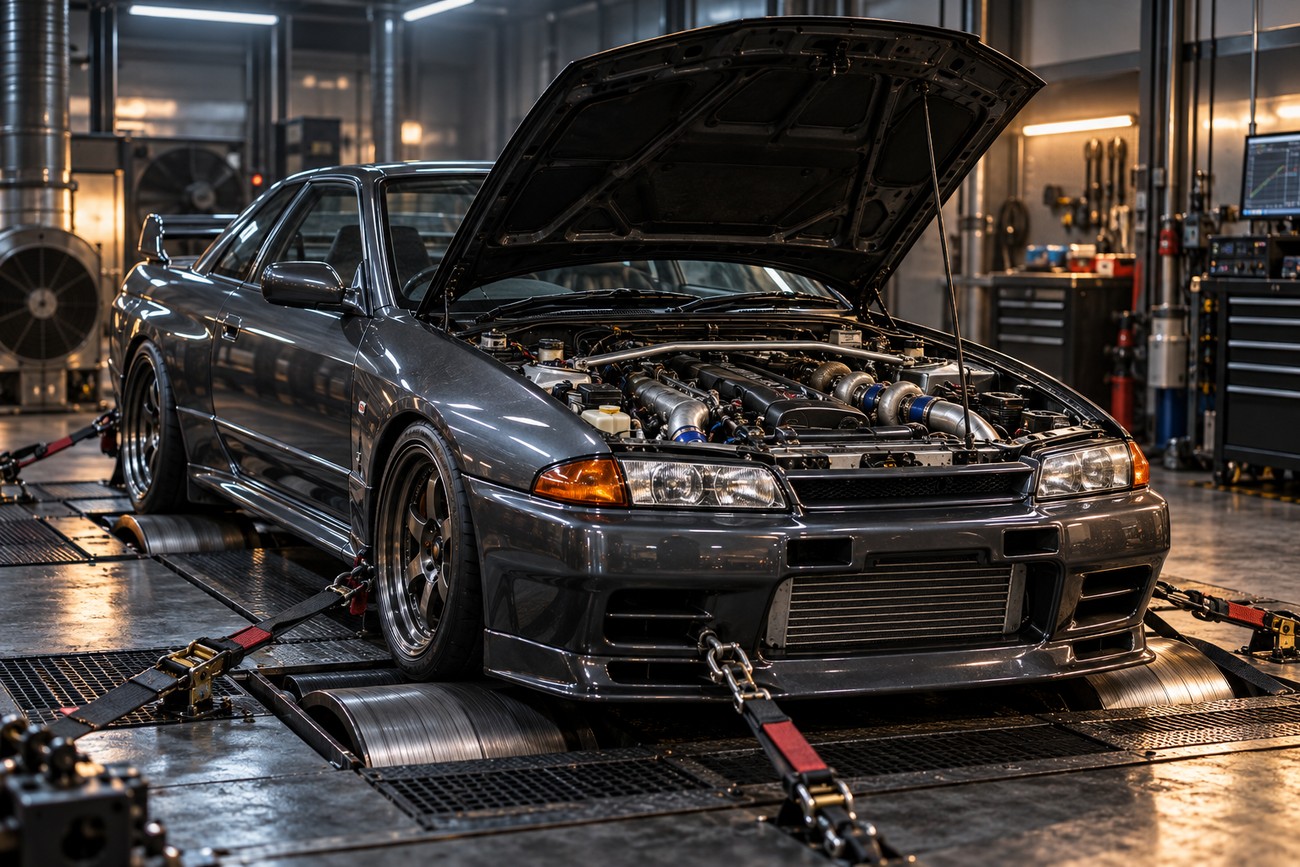
The RB26DETT is a 2.6-liter twin-turbo inline-six with a strong mechanical character. Its official output was 280 hp at approximately 6,800 rpm and approximately 360 Nm, a figure shaped by Japan’s gentleman’s-agreement-era rating. Enthusiast dyno results commonly describe approximately 300–320 hp at the crank on otherwise stock examples, depending on measurement and condition.
Power alone does not explain the R32’s reputation. ATTESA E-TS is rear-wheel drive by default, then can send up to approximately 50% of torque to the front axle when required. An electronic control unit uses sensor inputs to manage that transfer, so the system can preserve a rear-driven feel while adding traction under acceleration.
HICAS adds electronically controlled rear-wheel steering. Its purpose is to improve turn-in and stability by changing the rear wheels’ steering angle through the corner. A functioning system can help on a fast circuit, especially through linked bends, although worn actuators, sensors, or hydraulic components can make the car feel inconsistent.
The coupe weighs approximately 1,480–1,530 kg, depending on specification and market, with approximately 59/41 front/rear weight distribution. Those figures are hardly modern lightweight territory, yet the chassis, drivetrain control, and turbocharged engine worked together effectively. The car could feel agile because its systems managed the mass rather than pretending it did not exist.
That integration is why modifications need restraint. A large turbocharger or aggressive suspension setup can improve one metric while damaging the balance that made the original car effective. V-Spec models also deserve careful identification: their differences include brakes and wheels, along with changes to ATTESA and suspension settings.
A Legend with Old-Car Weaknesses
The R32 can be used in city traffic, though its daily-driver suitability depends heavily on your tolerance for old-car compromises. Active driving can produce approximately 15–20 L/100 km, and the cabin lacks the isolation expected from a modern performance car. Engine and transmission mounts that have softened with age add vibration, drivetrain movement, and interior rattles.
The engine bay is tightly packaged. Access to the turbochargers, hoses, wiring, and surrounding hardware often requires more labor than a casual inspection suggests. A small leak or sensor fault may therefore carry a disproportionate repair bill because the diagnostic part is quick while reaching the component is not.
Suspension condition changes the car’s personality. Original dampers may be tired, while old coilovers are often set too stiff for public roads. Excessive spring rates and poor damping reduce ride quality, increase fatigue on rough streets, and can accelerate stress on an already elderly chassis. Wheel alignment and tire choice matter just as much as the damper brand.
ATTESA and HICAS are active vehicle systems, not decorative badges. They depend on working sensors, valves, actuators, connectors, and control electronics. Intermittent ABS, MAF, or HICAS faults can produce behavior that feels like a mechanical handling problem, leading owners toward expensive parts-swapping before the electrical fault is found.
The platform remains inherently capable. A neglected example is a different proposition. The same drivetrain that feels remarkably composed when its fluids, sensors, mounts, and geometry are healthy becomes expensive and unpredictable when several small maintenance failures overlap.
Buying an R32 GT-R: Inspect the Shell Before the Horsepower
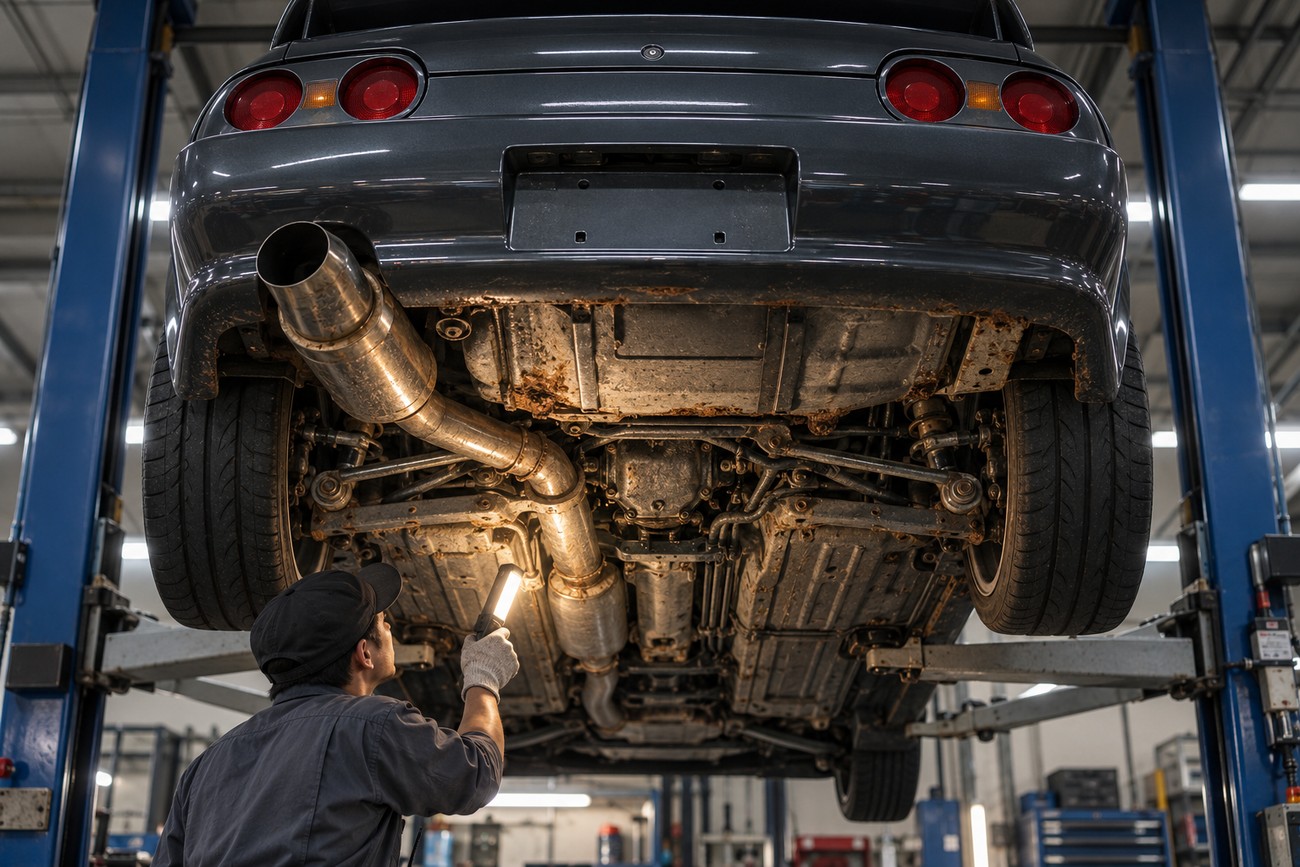
Start underneath the car, preferably on a lift, before discussing compression figures or turbo upgrades. Serious corrosion commonly affects the sills, wheel arches, chassis rails, and rear suspension mounting points. A clean exterior can conceal repaired or advancing rust, particularly on an imported car that has spent time in wet climates or received cosmetic preparation for sale.
The shell deserves priority because structural corrosion can erase the value of every mechanical upgrade. Inspect seams, drain areas, jacking points, floor sections, and the metal surrounding suspension loads. Check whether repairs are properly formed and protected rather than covered by fresh underseal. Original panels and correct factory structure are valuable evidence, while thick new coating can hide the evidence you need.
Lift inspection and corrosion probing come before compression numbers. A structurally compromised shell can consume the budget that was supposed to improve the engine, drivetrain, and brakes.
Once the body passes inspection, assess the RB26DETT without being distracted by polished pipework. Neglected engines may show oil consumption, poor compression, or signs of damage after track use and poorly managed tuning. Look for cooling-system condition, oil leaks, uneven running, smoke, and maintenance evidence. An engine rebuild is expensive; rebuilding it inside a rusty shell is worse value.
Electrical diagnosis deserves the same attention. Aging wiring and oxidized connectors can trigger intermittent faults involving the MAF, ABS, and HICAS systems. Verify that warning lights behave correctly, then scan and test the systems rather than accepting a seller’s explanation that a light is merely an old-car quirk.
Treat auction mileage as one clue, not a verdict. Compare the claimed distance with the steering wheel, pedals, seat bolsters, cabin wear, gearbox feel, and suspension condition. Original body panels, lighting, interior parts, and electronic modules are increasingly scarce and expensive, so a complete, documented car can be worth more than a lower-mileage example assembled from uncertain parts.
Tuning the RB26 Without Breaking the Car
A health check should precede any boost increase. It should include sensor logging, fuel-system inspection, compression testing, cooling-system verification, and a general mechanical inspection. This sequence identifies a lean condition, weak cooling, or an aging sensor before extra cylinder pressure turns a manageable fault into engine damage.
The original ceramic turbocharger wheels are vulnerable when boost is raised to approximately 1 bar and above. Raising pressure without understanding turbo speed, exhaust temperature, fueling, and the condition of the compressor and turbine hardware can destroy a wheel. Debris from a failed turbocharger then creates additional damage through the intake or exhaust system.
A healthy stock-internal RB26 is commonly regarded as operating in a safer range of approximately 450–500 hp, provided the engine, fuel, and cooling systems are healthy. A blanket claim that every stock engine safely supports 600-plus hp ignores age, detonation history, oil control, machining quality, and the condition of the supporting hardware. Higher outputs require serious internal engine, fuel-system, and cooling upgrades.
Nistune or PowerFC can be sensible control strategies because they may preserve more factory-system compatibility than a complete standalone ECU. That does not make them automatic solutions. The calibration still needs accurate sensor data, stable fuel pressure, suitable injectors, and a tuner who understands the interaction between engine management, ATTESA, and the car’s original electrical architecture.
Drivetrain strength is another common blind spot. Putting 500-plus-hp tuning on an unreconditioned gearbox and differentials can cause rapid failure, especially when sticky tires and repeated launches increase shock loads. Keep a correctly functioning HICAS when the car is used for circuit driving unless there is a specific diagnostic reason to remove it; an indiscriminate delete can discard useful chassis behavior while hiding the real fault.
Living with the R32: Value, Variants, and Ownership Risk
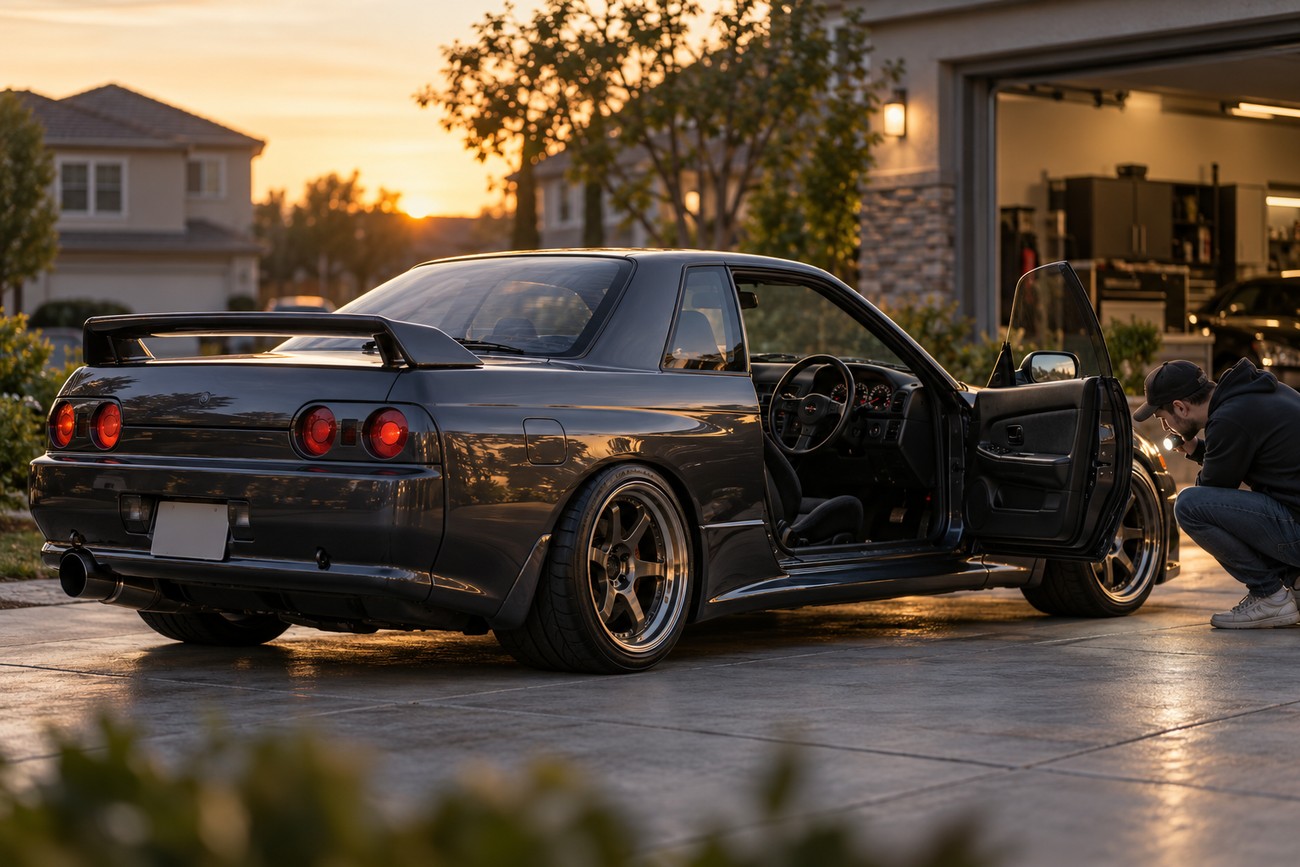
The R32 is usable as a daily for owners who accept its fuel consumption, noise, ride harshness, and maintenance costs. Others find those same traits tiring after a short commute. Registration and insurance can also complicate ownership in countries where the car was not officially sold, particularly when right-hand-drive rules, emissions requirements, or specialist underwriting apply.
Wheel and tire selection needs care. Incorrect sizing or mismatched rolling diameters can compromise geometry, handling, and ATTESA behavior. The cheapest set of wide wheels may create clearance, alignment, and drivetrain problems that take more money to correct than a properly selected original-style setup would have cost.
Specialist knowledge is often necessary. A shop familiar with ordinary turbocharged Japanese cars may still lack the diagnostic equipment or practical understanding required for RB26DETT, ATTESA, and HICAS work. Budget for inspection, fluids, hoses, electrical repairs, and recommissioning before treating the purchase price as the full cost of ownership.
V-Spec identification matters because the package is functional as well as cosmetic. Brakes and wheels are visible, while the ATTESA and suspension-setting differences are easier to miss and more relevant to a track-focused buyer. Regardless of variant, structural condition, originality, and documented maintenance determine value more reliably than the badge alone.
Frequently asked questions
The R32 GT-R market rewards evidence. A low odometer reading or famous variant can support a valuation, yet neither replaces a sound shell, documented maintenance, and a clear record of modifications.
How much does the Godzilla R32 Skyline GT-R cost?
There is no single universal price. Value depends on corrosion, originality, import status, documentation, mechanical condition, and the recommissioning budget required after purchase.
A tidy car with a sound shell and correct parts can cost more than a modified example with impressive dyno figures. Include inspection, transport, legal compliance, specialist labor, and likely electrical or rubber-component replacement in the budget. A low asking price can represent deferred repairs rather than a bargain.
Can an R32 GT-R be legally registered where it was not officially sold?
It can be legal in some jurisdictions, but the answer depends on local age rules, emissions requirements, right-hand-drive policy, inspection paperwork, and insurance availability. The fact that the car was accepted in another country does not guarantee approval in yours.
Confirm the rules before shipping the car. Ask the registration authority and an insurer which documents, chassis identification records, emissions evidence, and inspection standards apply. Solving those issues after import can leave the car stored and unusable while costs continue to accumulate.
What is the difference between a standard R32 GT-R and a V-Spec?
The V-Spec includes functional changes rather than a cosmetic trim package alone. Its differences include brakes and wheels, plus changes to ATTESA and suspension settings that matter during hard driving.
Verify the specification through documentation, equipment, and chassis records. Rebuilt cars may carry V-Spec parts, standard cars may have been modified with similar hardware, and imported listings can use variant names loosely.
Why can two R32 GT-Rs with similar mileage have very different values?
Odometer mileage says little about shell condition, storage, track use, or the quality of previous repairs. Compare the chassis rails, sills, arches, rear suspension mounts, cabin wear, electrical systems, and service evidence before comparing mileage.
Originality also matters. High-quality, documented modifications can be useful, while rushed wiring, unknown engine work, missing original parts, and unresolved drivetrain faults reduce value. The stronger car is usually the one with a sound structure and traceable maintenance, regardless of which odometer shows the smaller number.







