
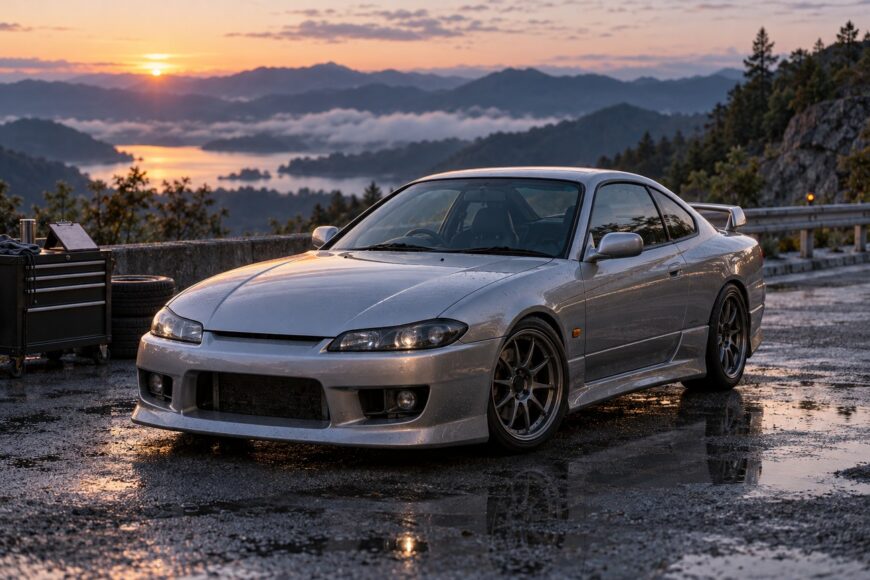
The Nissan Silvia S15 carries a reputation as the ultimate drift-era Silvia, yet buying one today means dealing with a two-decade-old, Japan-only performance coupe. Its compact dimensions, rear-wheel drive, and SR20 engine still create a compelling package, but rising prices have made poor examples harder to dismiss as cheap projects.
Behind a clean exterior may be repaired chassis rails, hidden welds, distorted suspension geometry, or wiring changed around an undocumented ECU tune. Original panels and headlights are becoming difficult to source, while the gap between the Spec-S and Spec-R affects the engine, brakes, transmission, reinforcement, and cooling equipment. The S15 remains desirable because of its engineering, though its ownership risks deserve more attention than its reputation usually receives.
- Why the S15 became the last Silvia
- Spec-S vs. Spec-R: the differences buyers underestimate
- What makes the S15 work on the road, drift course, and track
- Why owning one now is harder than owning one in its heyday
- The inspection mistakes that turn a dream S15 into a project
- Myths about the S15 that cost owners money
- Frequently asked questions
- When was the last S15 Silvia made?
- How much is a Nissan Silvia S15 worth today?
Why the S15 became the last Silvia
Nissan produced the Silvia S15 from 1999 to 2002. It was officially sold only in Japan, with no factory export program for Europe or the United States. That Japan-only status now shapes almost every purchase decision, from registration and parts sourcing to the documentation needed to establish what a car originally was.
The S15 was the final Nissan Silvia. The S-chassis platform was not continued with a direct coupe successor, leaving the S15 as the last version of a layout that had evolved through the S13 and S14. Its appeal comes from a relatively light, compact body, a front-engine, rear-wheel-drive chassis, and mechanical controls that feel direct by modern standards.
Production ended amid stricter safety requirements and economic pressure. A small sports coupe with limited international sales became harder to justify as compliance costs increased. Modern cars also gained more airbags, stronger crash structures, electronic assistance, and comfort equipment that the S15 does not provide.
That makes the S15 a poor fit for buyers expecting the safety and refinement of a recent performance car. It can be an engaging second car or a carefully selected project, but its analog character comes with old-car compromises. The right example rewards careful ownership; the wrong one turns nostalgia into structural, mechanical, and regulatory expense.
Spec-S vs. Spec-R: the differences buyers underestimate
Spec-S and Spec-R share the S15 identity, yet they are not equivalent starting points. The naturally aspirated car uses the SR20DE, while the turbocharged Spec-R uses the SR20DET and a broader set of chassis and drivetrain equipment.
| Area | Spec-S | Spec-R |
|---|---|---|
| Engine | Naturally aspirated SR20DE | Turbocharged SR20DET |
| Factory power claim | Approximately 165 hp | Approximately 250 hp in Japanese factory catalog data |
| Real-world stock output | No comparable turbo output dispute applies | Some tuners report approximately 230–240 hp for a stock engine on a dynamometer |
| Manual transmissions | 5-speed manual was available in the S15 range | Associated with the 6-speed manual; the range also included a 5-speed manual |
| Automatic transmission | 4-speed automatic was available in the range | Availability depends on the exact specification and must be verified from records |
| Differential | Open or viscous limited-slip equipment may apply depending on specification | Optional LSD, with the exact equipment requiring verification |
| Brakes | Different brake equipment from Spec-R | Upgraded brake-related equipment compared with Spec-S |
| Chassis reinforcement | Different reinforcement package | Additional chassis reinforcement compared with Spec-S |
| Cooling-related equipment | Different cooling provision from Spec-R | Cooling-related equipment suited to the turbocharged specification |
The factory catalog figure for the Spec-R SR20DET is approximately 250 hp, while some tuners report approximately 230–240 hp for a stock engine on a dynamometer. Those figures are measured and specified in different contexts, so they should not be treated as a simple argument that one side is correct. For a buyer, engine condition matters more than winning a power-output debate.
A Spec-S conversion can require brakes, transmission, reinforcement, cooling equipment, and related supporting work. The result may still have the history and limitations of the original naturally aspirated shell. Buyers who want Spec-R capability often spend less overall by locating a correctly specified, documented Spec-R in sound condition.
What makes the S15 work on the road, drift course, and track
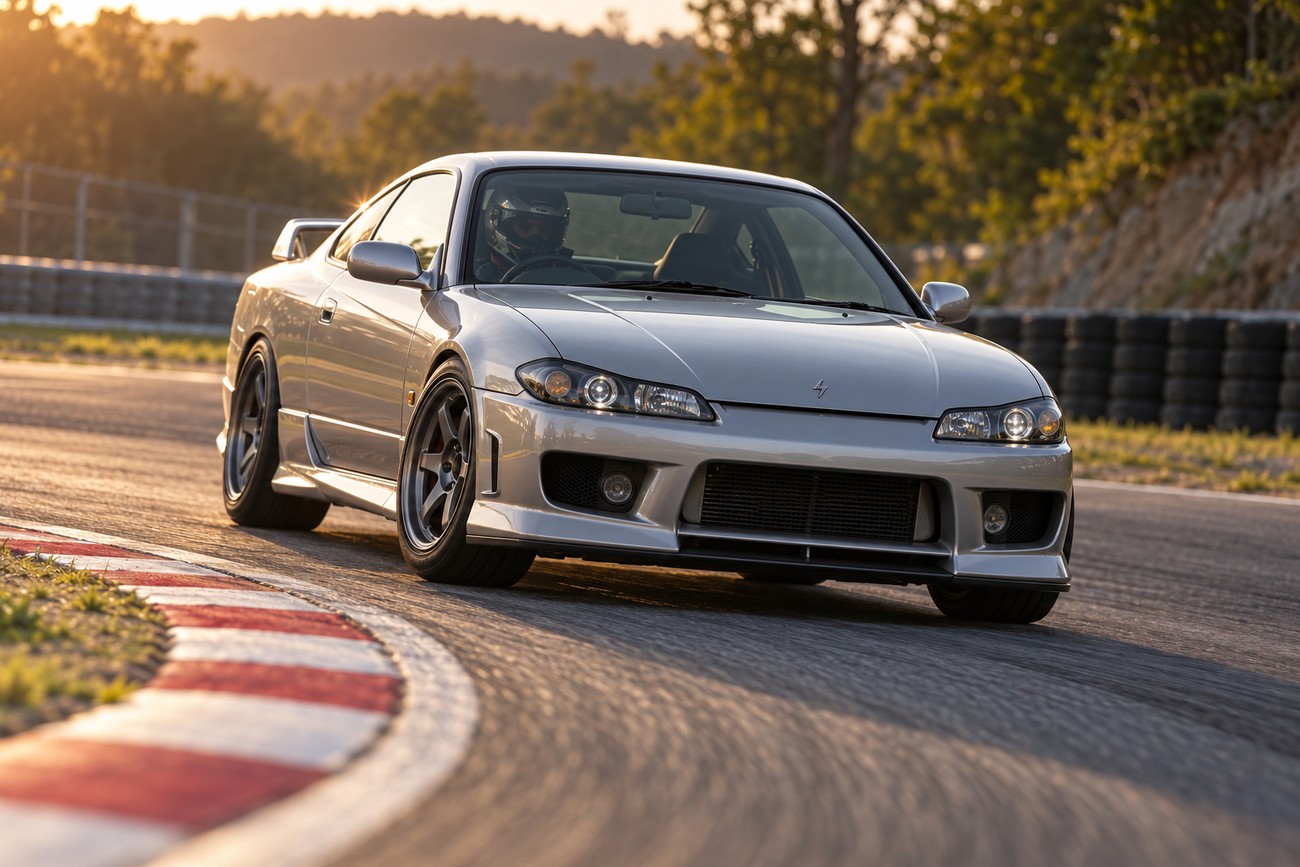
Depending on specification, a stock S15 weighs approximately 1250–1350 kg. That mass gives the chassis enough stability for fast driving while keeping the car responsive to throttle and steering inputs. The compact body also makes it easier to place on a narrow road or a technical circuit than a larger modern performance coupe.
The front suspension uses MacPherson struts, while the rear uses a multi-link layout related to the S14 design. Revised rear kinematics help explain why the S15 has a reputation for predictable balance when its bushes, alignment, and dampers are in good condition. A worn or modified example can lose that clarity quickly.
Owners, drivers, and tuning shops commonly report greater body rigidity than in the S13 and S14, with less twisting under drift use. That rigidity gives suspension changes a more consistent effect and helps the car maintain its geometry under load. It does not make an old shell immune to fatigue, accident repair, or poorly executed reinforcement.
The platform also works for time attack and track use. Cooling, steering components, suspension bushings, and subframes usually deserve attention before power increases, especially on a car that will see repeated hard laps. A carefully sorted S15 can be effective outside drifting, while an extreme drift build may be tiring and unstable on public roads.
Why owning one now is harder than owning one in its heyday
Prices for sound S15 examples in Japan and at auction have risen substantially. That increase affects both genuinely original cars and cars advertised mainly through appearance. A high asking price does not prove that the shell is straight, the specification is correct, or the modifications were carried out well.
Original body panels and headlights are increasingly difficult to source. Replica fenders, bumpers, and lighting can vary widely in fit, finish, and durability, and some sellers present them as original or nearly equivalent. A buyer who values originality should inspect mounting points, part markings, panel gaps, and the quality of the finish instead of relying on the listing description.
Importing and registering a right-hand-drive S15 can involve substantial complications in Europe and the United States. Age rules, local safety requirements, emissions requirements, tax treatment, and registration procedures differ by jurisdiction. A car that is legally usable in one country may require significant work or may be difficult to register in another.
The cabin also shows its age. The S15 lacks many modern passive-safety systems and current comfort features, and its ergonomics reflect late-1990s Japanese design rather than present-day expectations. Insurance and replacement-part costs have increased while many cars continue to be damaged in drifting and track use.
Original condition, rare factory colors, correct specification, and documented history can support value. An expensive car with repaired rails, replica panels, and undocumented modifications is simply an expensive damaged car. Preservation can matter more than a long list of aftermarket parts.
The inspection mistakes that turn a dream S15 into a project
Exterior presentation is a poor proxy for S15 condition. Fresh paint can hide repaired chassis rails, welds, distorted floor sections, and accident damage, while an aggressive body kit can conceal poor panel alignment. A proper inspection should establish whether the shell is straight before attention turns to wheels, power figures, or interior trim.
Inspect the chassis rails, strut towers, and suspension mounting areas for rust and repairs. These locations carry structural and suspension loads, so corrosion or heat-affected welding can create problems that are expensive to correct. The car should also be checked for bent geometry and uneven wheel positions rather than judged only by visible panel gaps.
Returning a modified S15 to a known stock baseline often makes diagnosis easier than adding more parts. Boost, fueling, wiring, and handling faults can overlap, so a stable baseline helps separate an old problem from a new modification.
Modified cars may contain an undocumented ECU tune, altered sensors, spliced wiring, or removed factory safeguards. An engine that starts and idles during a short viewing can still have unstable fueling or temperature control under load. Wiring quality, ECU hardware, boost control, and service records deserve the same scrutiny as the engine itself.
The SR20DET depends heavily on oil quality and cooling condition. Neglect can contribute to coking, oil-passage problems, and turbocharger failure, particularly when a car has been driven hard or modified without matching fuel and cooling support. Check oil pressure and temperature behavior where possible, inspect the turbocharger and cooling system, and treat unexplained smoke, noise, or heat as a reason to pause the purchase.
The safest order is shell, geometry, and mechanical baseline first, followed by modifications. A car that needs structural repair and engine work cannot be rescued by an attractive wheel package or a claimed dyno number. Documentation of previous repairs and maintenance is worth more than vague assurances that the car was built for drifting or track use.
Myths about the S15 that cost owners money
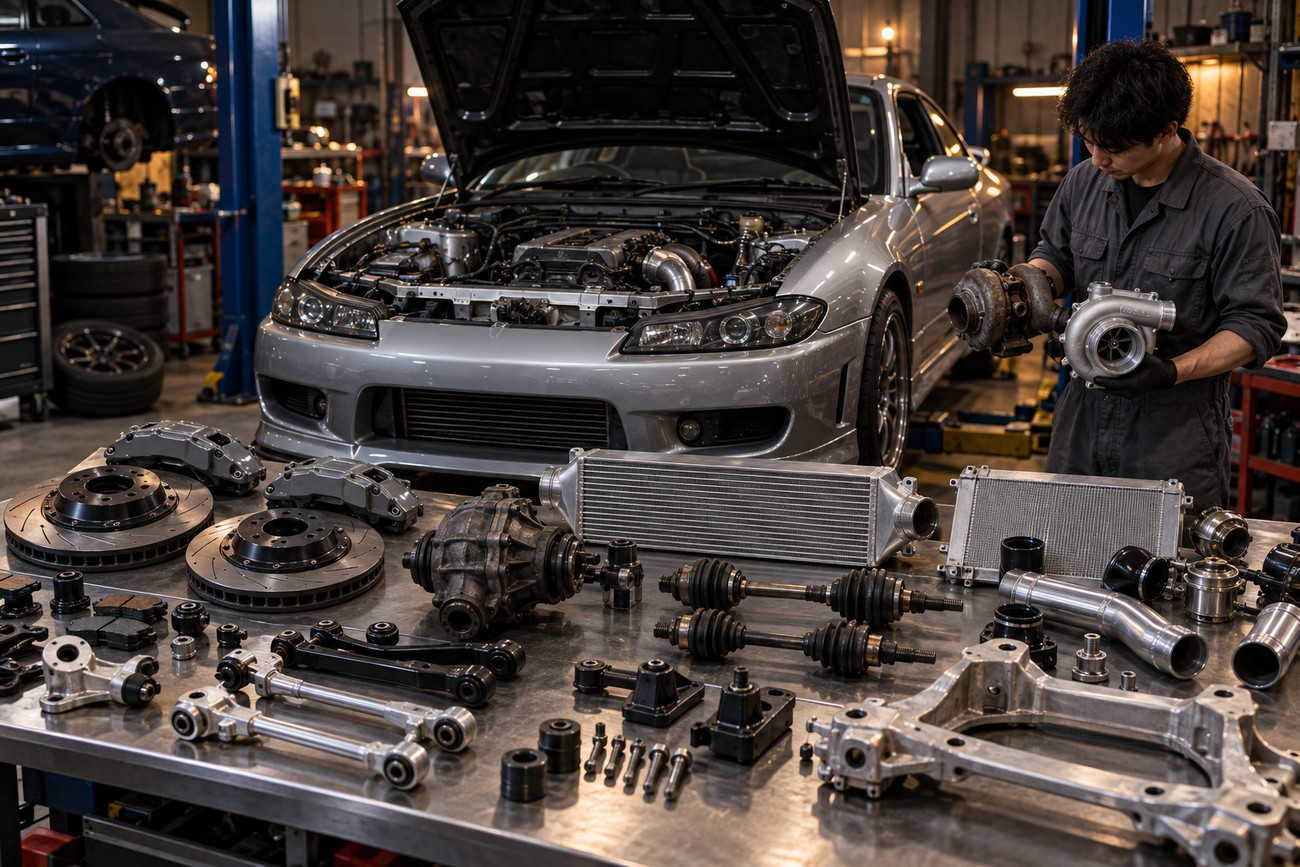
The S15 is not limited to drifting. Its suspension layout, mass, and body rigidity can support time attack and track use when cooling, steering, bushings, and subframes are properly addressed. A track-oriented car still needs careful preparation, and power alone will not compensate for tired chassis components.
Another costly assumption is that every Spec-S can easily become a Spec-R. The conversion requires more than installing a turbo engine. Brakes, transmission, chassis reinforcement, cooling, differential equipment, and supporting systems all affect the result, which is why a correctly specified Spec-R can make better financial sense.
The SR20DET also deserves monitoring even when it remains stock. Oil condition, engine temperature, and fuel-system condition influence its survival, and an unmodified engine may still be suffering from years of neglected servicing. Factory specification reduces variables; it does not remove the need for maintenance.
Extreme steering-angle kits and aggressive alignment settings can look impressive while reducing road stability. Less aggressive angles and alignment can preserve more predictable behavior for a car that sees public roads. The S15 is also a demanding first sports car because insurance, maintenance, and limit handling all carry real costs; its reputation should not be confused with beginner-friendly ownership.
Frequently asked questions
When was the last S15 Silvia made?
The Nissan Silvia S15 was produced from 1999 to 2002. It was the final Silvia generation and was sold officially only in Japan.
The S15 ended the S-chassis Silvia line. Nissan did not continue the platform with a direct coupe successor, so later cars cannot be treated as a new generation of the same chassis.
How much is a Nissan Silvia S15 worth today?
There is no single reliable price for an S15. Value depends heavily on shell condition, originality, specification, repair history, documentation, and the quality of any modifications.
A documented, structurally sound car in correct original specification can command a premium, especially with a desirable factory color or limited-series equipment. A damaged drift car with fresh paint may look expensive while carrying substantial repair and parts costs, so auction price and advertised price should never replace an independent inspection.







