
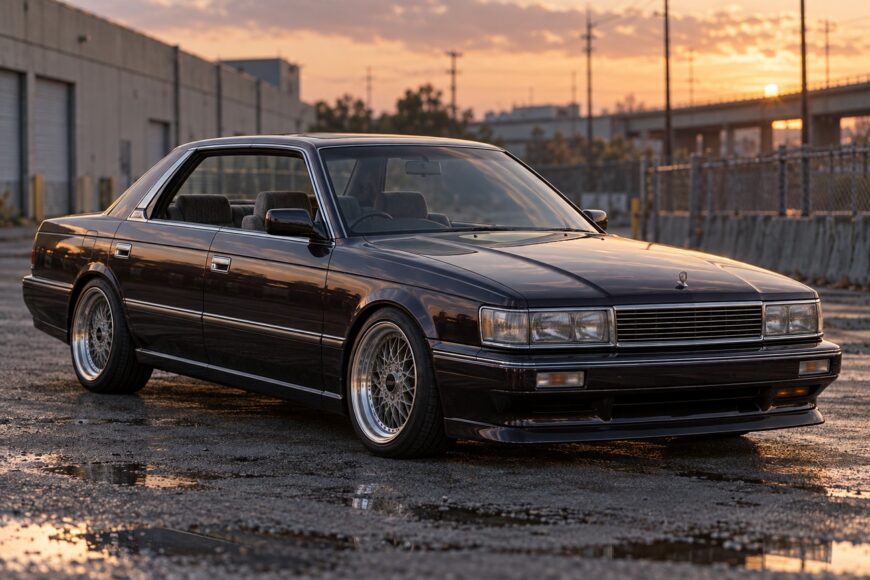
The Nissan Laurel C33 is admired for a combination that has become rare: a pillarless hardtop body, rear-wheel drive, and a family of smooth RB inline-six engines. That same combination creates an ownership problem. Age, torsional flex, corrosion, tired seals, and years of drift use can turn an attractive Japanese classic into a shell that needs more money and fabrication than its appearance suggests.
The sensible choice depends on the example in front of you. A clean, original Laurel can deserve preservation as a rare retro hardtop; a straight shell with proven mechanical upgrades can become a capable drift car; and a cosmetically tidy project with hidden repairs may be better left alone. The C33 rewards careful inspection and punishes impulse buying.
- What the Nissan Laurel C33 Actually Is
- Engines, Drivetrain, and Chassis Basics
- Why Drifters Love the C33—and Why It Is Not a Skyline
- The C33 Buying Inspection: Rust, Geometry, and Hardtop Wear
- Building a Drift Laurel Without Breaking the Shell
- Living With a C33: Safety, Comfort, Cost, and the Myths
- Frequently asked questions
- How many Nissan Laurel C33s are left?
- What is the average price of a Nissan Laurel C33?
- Which C33 Laurel engine is the best starting point for a road-and-drift build?
What the Nissan Laurel C33 Actually Is
The C33 was produced for the 1989–1993 model years as a Japanese executive sedan with a strong comfort bias and rear-wheel-drive engineering. Some versions used a pillarless hardtop body, where the center door pillar is absent and the window glass drops into a clean side opening. That feature is central to the car’s appeal, although not every C33 is pillarless. The actual doors, roof opening, and window arrangement should be checked in photographs or in person rather than accepted from an advertisement.
Every factory C33 used rear-wheel drive; there was no factory all-wheel-drive version. Its front-mounted, longitudinal powertrain, independent suspension, and substantial cabin gave it a stable grand-touring character before enthusiasts began turning it into a drift platform. Depending on specification, automatic or manual transmission, turbo hardware, and equipment level, curb weight typically falls between approximately 1,300 and 1,450 kg.
The Laurel shares chassis and component lineage with the R32 Skyline and Cefiro A31, which explains much of its popularity among Japanese-car builders. Suspension, steering, and engine-related parts can often be sourced through that wider ecosystem, though fitment differences in brackets, lengths, and mounting details still matter. Compatibility should be confirmed against the exact part and version rather than assumed from a catalog heading.
Calling the C33 a four-door Skyline misses its purpose and behavior. The Laurel has a different body structure, cabin emphasis, weight distribution, and factory calibration. It feels more relaxed and substantial, with a long body and a cabin designed for distance. That is useful for stability and comfort, yet it also makes the car more demanding to rotate, stop, and reinforce than a lighter, simpler drift chassis.
Engines, Drivetrain, and Chassis Basics
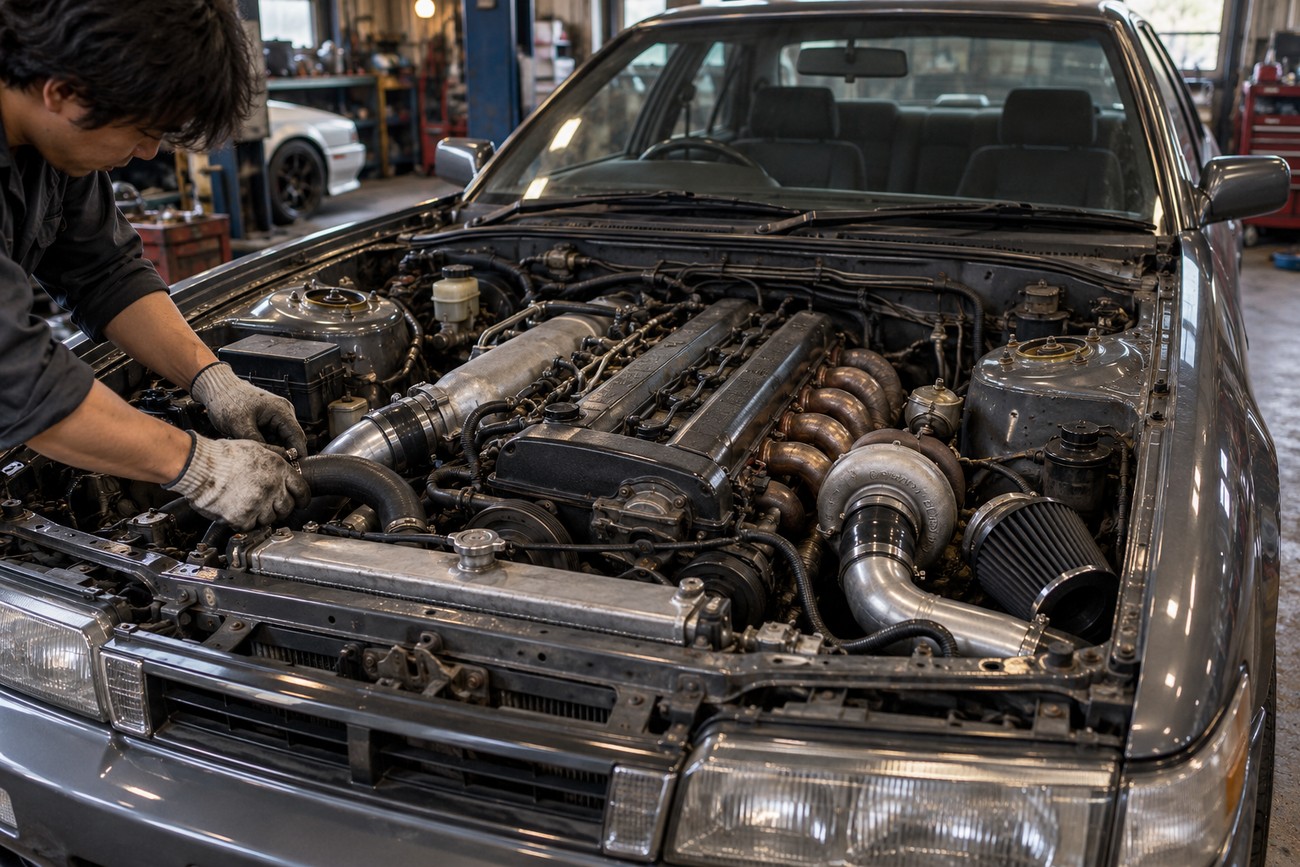
The C33 engine range included the RB20E, RB20DE, RB20DET, and later RB25DE. All belong to the 2.0–2.5-liter longitudinal RB inline-six family. The RB20E is the simplest naturally aspirated choice, while the RB20DE adds a more responsive and stronger naturally aspirated character. The RB20DET brings factory turbocharging and is the version most associated with performance builds.
Japanese-spec RB20DET output was about 210 hp, delivered with a smooth response that suits the Laurel’s long-wheelbase behavior. A naturally aspirated car can be easier to assess and may have suffered less turbo-related abuse, but it requires a realistic plan if turbo power is the goal. Later RB25DE cars offer more displacement without factory turbo hardware, so engine condition and conversion quality remain more important than the badge alone.
Independent suspension is used at both ends, with a multilink rear layout that gives the car useful control during transitions. Some limited C33 versions are reported to have HICAS rear steering, although its prevalence is disputed. A car with that equipment needs careful identification and inspection because rear-steering hardware can change alignment work, parts selection, and the way the chassis responds after modifications.
The RB engines are compact enough to support a large aftermarket around the platform, but age changes the calculation. A healthy RB20DET can potentially reach approximately 250,000–300,000+ km with careful maintenance, while a neglected engine can fail quickly under boost. Compression, leak-down results where available, oil pressure, cooling performance, turbo condition, and service history tell you more than a clean idle or an attractive engine bay.
Why Drifters Love the C33—and Why It Is Not a Skyline
The C33 offers the basic ingredients that make a rear-drive drift car satisfying: a front-engine, longitudinal layout, predictable rear-wheel drive, a long wheelbase, and an RB engine with smooth power delivery. The body’s length helps settle the car during a slide, giving the driver time to work with steering and throttle. Its broad aftermarket support also makes repairs less obscure than the car’s age might suggest.
Shared component lineage with the R32 Skyline and Cefiro A31 is a major advantage. Builders can draw on suspension, steering, engine, and differential knowledge developed around those platforms. The detail that matters is fitment. A part that appears interchangeable may need a different bracket, spacer, bushing, or alignment setting, and a drift car exposes those small errors quickly.
The Laurel’s comfort-oriented structure changes the experience. Its greater mass gives it composure, yet it demands more braking capacity, tire management, and engine effort than many smaller beginner platforms. Weight also increases the load transmitted into the shell when the car lands from a transition or contacts a curb. A well-set-up C33 can feel smooth and stable; a poorly prepared one feels slow to change direction and expensive every time it does.
Platform kinship therefore should not be treated as identical handling. The C33 is related to the Skyline and Cefiro, while its body structure and equipment give it a different balance. That difference is part of the appeal for drivers who want a more unusual car, though it removes some of the simplicity that makes lighter drift platforms attractive to newcomers.
The C33 Buying Inspection: Rust, Geometry, and Hardtop Wear
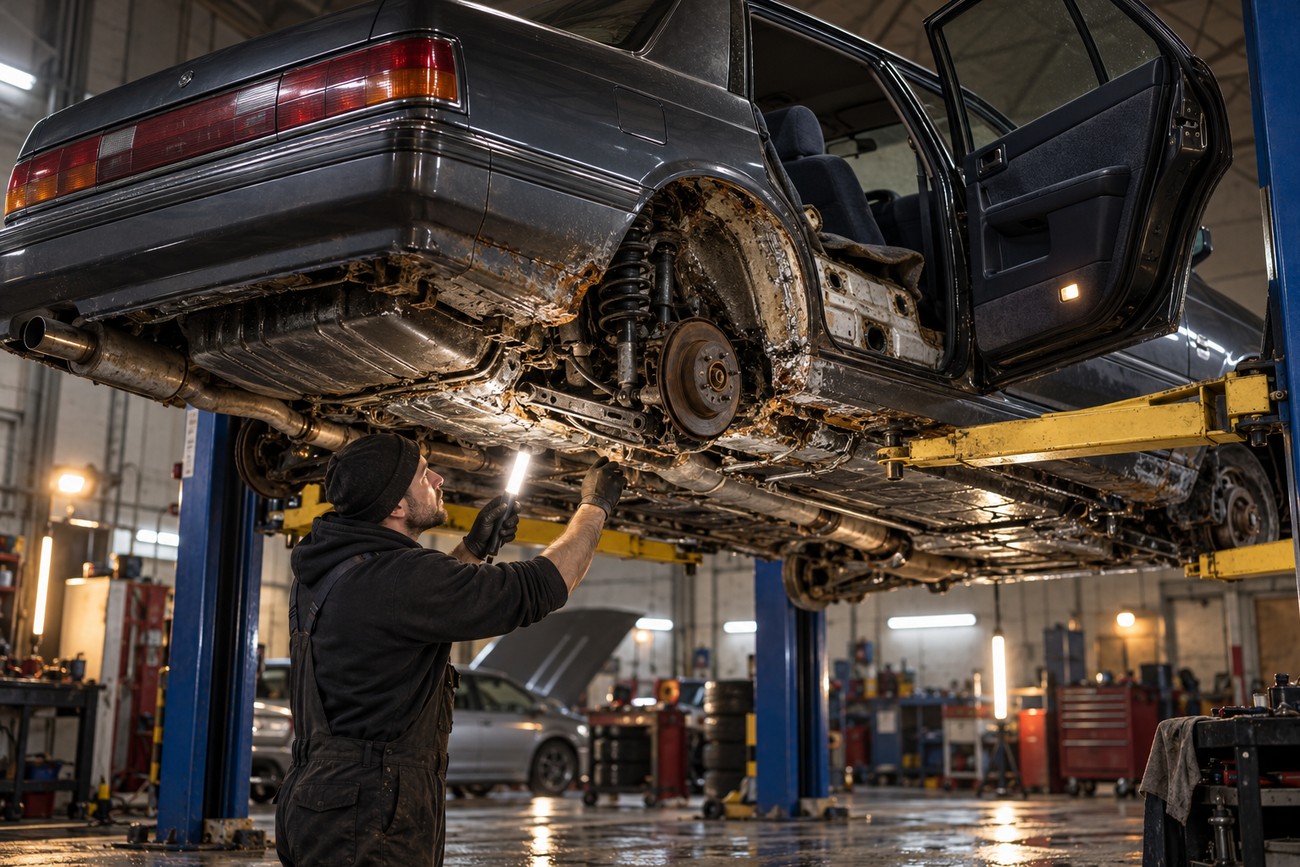
Chassis geometry comes before engine sound. Inspect the chassis rails, suspension pickup points, strut towers, floor, sills, arches, and visible welds from previous repairs. A car that tracks straight on a short drive can still have a bent shell, uneven pickup points, or poorly repaired collision damage that makes correct camber and toe difficult to achieve.
Rust commonly appears in the arches, chassis rails, strut towers, sills, lower door edges, and concealed areas beneath body kits or insulation. Lift the carpets and inspect drain areas where possible. Remove or look behind loose trim and examine repairs from both sides; thick underseal can hide an old patch until the car is placed under sustained suspension load.
A drift history is not automatically a reason to reject a Laurel, but it changes the inspection standard. Look for welded differentials, bent suspension arms, elongated mounting holes, repeated weld repairs, cut dashboard sections, and wiring routed without proper protection. Taxi use can also leave a car with heavy interior wear and a long record of repairs. Cosmetic paint, fresh wheels, or a polished engine cover can conceal an exhausted shell.
The pillarless body needs a separate check. Old door and glass seals can produce wind noise, water leaks, squeaks, and changing gaps. Open and close each door carefully, check whether the glass meets the seal evenly, and inspect for water after a wash or rain. A door that needs to be lifted, slammed, or pushed inward to seal is evidence of wear or alignment trouble, not a charming old-car quirk.
Electrical faults are common on cars of this age, especially where aftermarket gauges, alarms, turbo controllers, or audio equipment have been installed badly. Expect intermittent contacts, failing climate-control modules, and damaged wiring to require patient diagnosis. C33-specific doors, glass, moldings, and interior parts are increasingly difficult and expensive to source, so a missing trim piece can be a larger ownership issue than it appears in a listing.
Building a Drift Laurel Without Breaking the Shell
A sensible build starts with the shell. Measure the car, verify that the suspension pickup points are square, repair corrosion properly, and establish a baseline alignment before increasing power. Refresh worn bushings, ball joints, wheel bearings, brakes, cooling components, and seals before fitting aggressive spring rates or steering modifications. This sequence prevents new parts from masking an old structural problem.
The pillarless body has less torsional stiffness than a comparable sedan with a center pillar, and repeated drift loads expose that weakness. Serious builds may require a welded cage or bracing work together with floor and sill reinforcement. Bolt-on braces can help in selected areas, but the available solutions are limited, and a safe, effective structure often involves welding, careful measurement, and consequences for registration and insurance.
Measure the shell before fitting stiff suspension. Alignment drift, glass stress, and new seal gaps often reveal flex long before a dramatic structural failure becomes obvious.
Very stiff suspension on an unreinforced shell can amplify creaks, glass stress, and changing door gaps. It may also make the car feel worse by transferring impact loads directly into weak mounting areas. A balanced setup with usable wheel travel and verified alignment usually teaches more than maximum spring rate, especially on a heavy car used on imperfect surfaces.
Factory turbo automatics are often criticized for slow response and for becoming tired under hard use. If the transmission is retained, test its engagement, shift behavior, fluid condition, and cooling system before relying on it for drift work. A manual conversion can improve control, but the quality of the conversion matters: clutch hydraulics, tunnel work, wiring, driveshaft length, and mounting must be finished to a road-car standard.
Power increases should follow fuel and temperature control. A Japanese-spec RB20DET starts at about 210 hp, and builders commonly treat approximately 260–280 hp as a reliable-use range without serious internal work. Claims that a stock engine easily supports 350-plus hp are disputed; above the conservative range, service life can fall sharply without major preparation. Mixture control, detonation protection, oil temperature, coolant temperature, and turbo condition deserve attention before chasing a dyno figure.
Living With a C33: Safety, Comfort, Cost, and the Myths
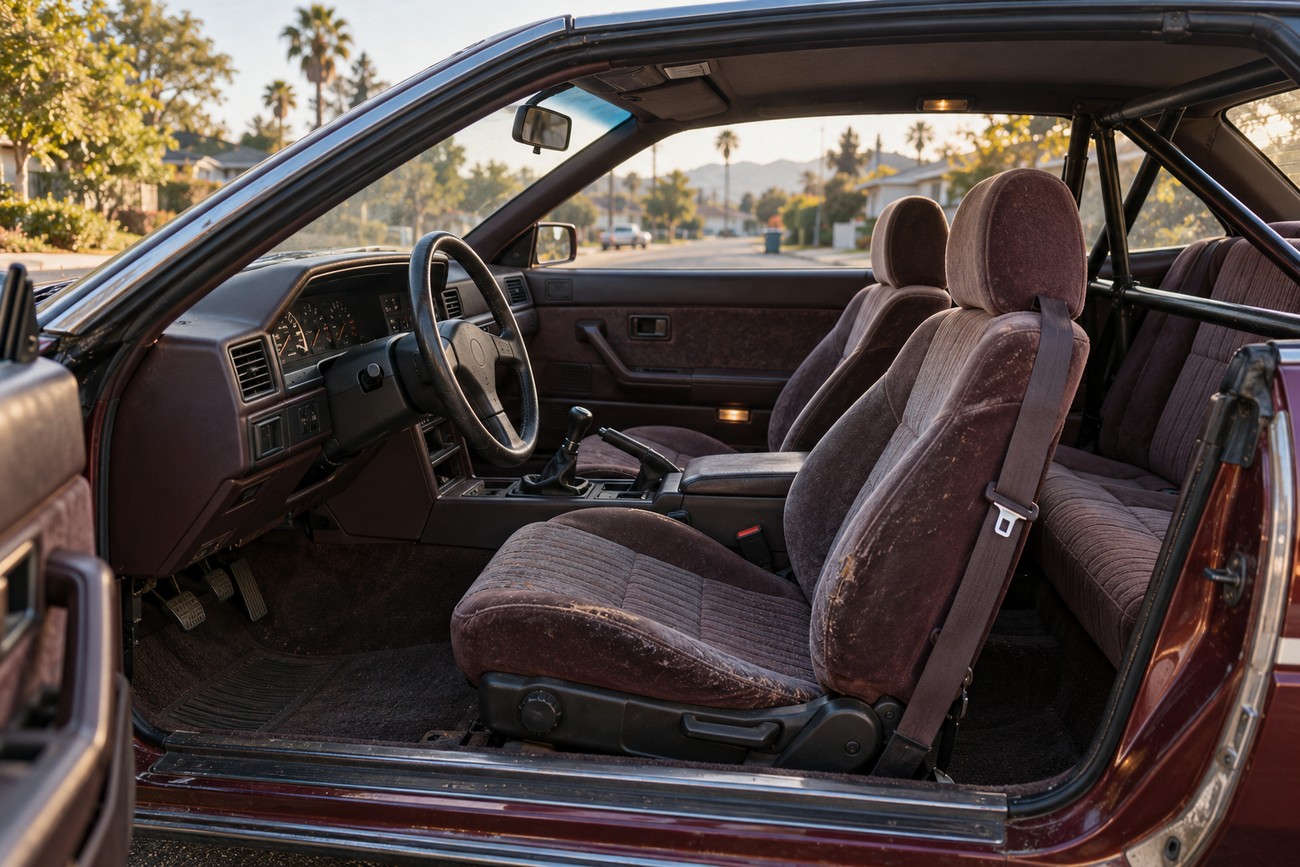
The C33’s period safety equipment requires honest expectations. Early versions may lack airbags, while restraint equipment varied and could include one or two belts with pretensioners. A pillarless body generally provides weaker side-impact and rollover protection than a sedan with a center pillar, so a roll cage intended for motorsport should never be treated as a substitute for modern crash protection on public roads.
Comfort also depends heavily on condition. The missing center pillar and aged seals allow more wind noise and vibration than a modern sedan, while body flex can create squeaks that become worse after stiff suspension or repeated drift use. Replacing worn door and glass seals can substantially improve the cabin and reduce water intrusion, but it cannot turn a 1990s hardtop into a contemporary quiet car.
Owner reports commonly place mixed fuel use for RB20DET cars at approximately 12–15 L/100 km, with higher consumption under aggressive driving or tuning. Tires, brakes, fluids, cooling parts, and old electrical repairs add to the budget. The absence of a dependable worldwide survivor registry and the lack of a single stable market average make condition more important than a headline asking price.
Major RB swaps, turbo changes, and roll cages may require declaration or affect road legality and insurance, depending on the country. Check those rules before cutting the shell or buying a modified car. A road-registered drift build can become difficult to insure when its paperwork does not match its engine, restraint system, or structural changes.
Several popular assumptions deserve correction. The Laurel is not simply a budget Skyline; the shared engineering creates useful parts knowledge while the car retains its own weight and body behavior. Pillarless construction does affect stiffness, particularly in an old or previously damaged shell. The C33 is also a demanding first drift car because it is heavier, more complex, and more expensive to maintain than many simpler platforms. Increasing interest in untouched examples adds another consideration: a clean original hardtop may have greater value as a classic than as a donor for an irreversible project.
Frequently asked questions
These questions cover the parts of C33 ownership that listings and enthusiast shorthand often leave unclear.
How many Nissan Laurel C33s are left?
No dependable worldwide registry records the surviving C33 population. Import records cover only selected countries and time periods, while regional clubs, auction listings, and visible street cars represent narrow and overlapping groups. Many cars also move between countries, disappear from road registration, or remain in storage, so those sources cannot be combined into a trustworthy global total.
The practical measure is the condition and provenance of the individual car. A documented, structurally sound example is more meaningful to a buyer than an uncertain estimate of how many C33s remain worldwide.
What is the average price of a Nissan Laurel C33?
There is no single dependable average because prices vary sharply by market, shell condition, originality, engine, and drift history. A clean stock hardtop, a running project, and a drift-built car may appear in the same search results while representing completely different ownership costs.
Judge an asking price by separating the shell from the modifications. Verify rust repair, geometry, seals, glass, engine health, transmission condition, and the availability of missing C33-specific parts. A cheaper car with concealed structural work or hacked wiring can cost more to recover than a sound, original example with fewer performance parts.
Which C33 Laurel engine is the best starting point for a road-and-drift build?
RB20DET is the most direct starting point when factory turbo hardware and a familiar performance ecosystem are priorities. RB20E and RB20DE cars can make sensible road-focused bases when the shell is substantially better, although a turbo conversion adds fuel, cooling, wiring, transmission, and legal complications. Later RB25DE cars offer more displacement, but they still need a careful plan if turbocharging is intended.
Condition should decide between comparable cars. A straight, rust-free naturally aspirated Laurel with documented maintenance is usually a stronger foundation than a neglected RB20DET car with a tired automatic and years of drift abuse. The engine badge matters less than the shell, cooling system, wiring quality, and the legality of the finished build.







